
If an 8 percent decrease in the price of lobster leads to a 15 percent decrease in the
quantity supplied of lobster, then the supply of lobster is
A) unit-elastic.
B) unitarily elastic.
C) elastic.
D) perfectly inelastic.
Fiscal policy is determined by
A) the Federal Reserve.
B) the president and the Federal Reserve.
C) Congress and the Federal Reserve.
D) Congress and the president.
If GDP is currently $13 trillion and is growing at a rate of 2.3% per year, how long will
it take GDP to reach $26 trillion?
A) about 15 years
B) about 17 years
C) about 25 years
D) about 30 years
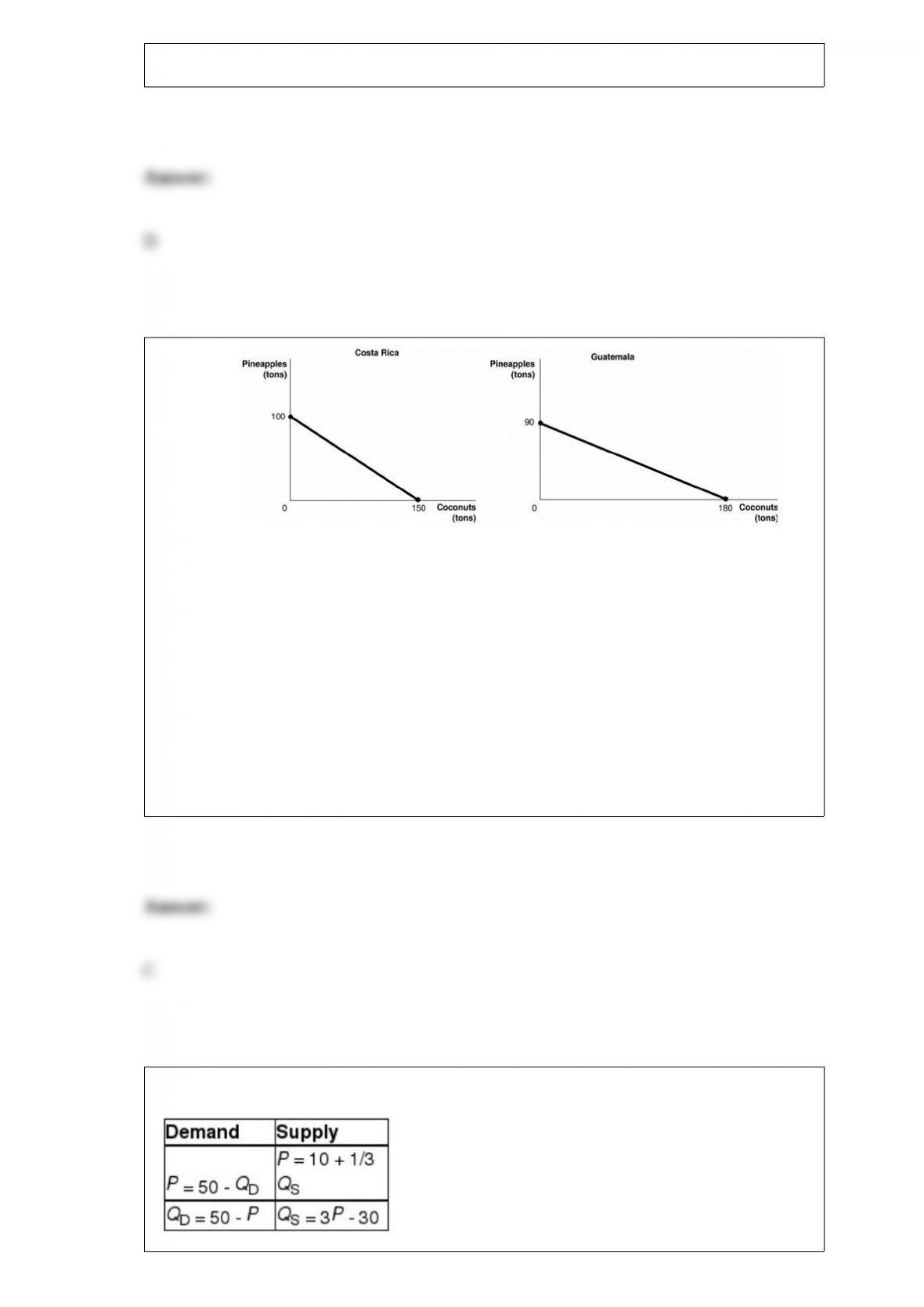
Figure 2-8
Figure 2-8 shows the production possibilities frontiers for Costa Rica and Guatemala.
Each country produces two goods, pineapples and coconuts.
What is the opportunity cost of producing 1 ton of pineapples in Guatemala?
A) 1/2 of a ton of coconuts
B) 1 1/3 tons of coconuts
C) 2 tons of coconuts
D) 180 tons of coconuts
Table 4-13

The equations above describe the demand and supply for Aunt Maud’s Premium Hand
Lotion. The equilibrium price and quantity for Aunt Maud’s lotion are $20 and 30
thousand units. What is the value of economic surplus in this market?
A) $600 thousand
B) $1,050 thousand
C) $1,500 thousand
D) $2,100 thousand
A copyright grants the creator of a book, film, or piece of software exclusive legal
rights to use the creation for how long?
A) 10 years
B) 20 years
C) 50 years
D) the creator’s lifetime plus 70 years for the creator’s heirs
If total revenue exceeds fixed cost, a firm
A) should produce in the short run.

B) has covered its variable cost.
C) is making short-run profits.
D) may or may not produce in the short run, depending on whether total revenue covers
variable cost.
How does an increase in a country’s exchange rate affect its balance of trade?
A) An increase in the exchange rate raises imports, reduces exports, and reduces the
balance of trade.
B) An increase in the exchange rate reduces imports, raises exports, and reduces the
balance of trade.
C) An increase in the exchange rate reduces imports, raises exports, and increases the
balance of trade.
D) An increase in the exchange rate raises imports, reduces exports, and increases the
balance of trade.
Short-run macroeconomic equilibrium occurs when
A) aggregate demand and short-run aggregate supply intersect.
B) the equilibrium lies on the long-run aggregate supply curve.
C) structural and frictional unemployment equal zero.

D) A and B
The Clayton Act prohibited
A) all vertical mergers.
B) all horizontal mergers.
C) any merger if its effect was to substantially lessen competition or create a monopoly.
D) all conglomerate mergers.
If a stock’s dividend is expected to grow at a constant rate of 6 percent in the future and
it has just paid a dividend of $3.00 per share, and you have an alternative investment of
equal risk that will earn a 9 percent rate of return, what would you be willing to pay per
share for this stock?
A) $9
B) $20
C) $45
D) $106
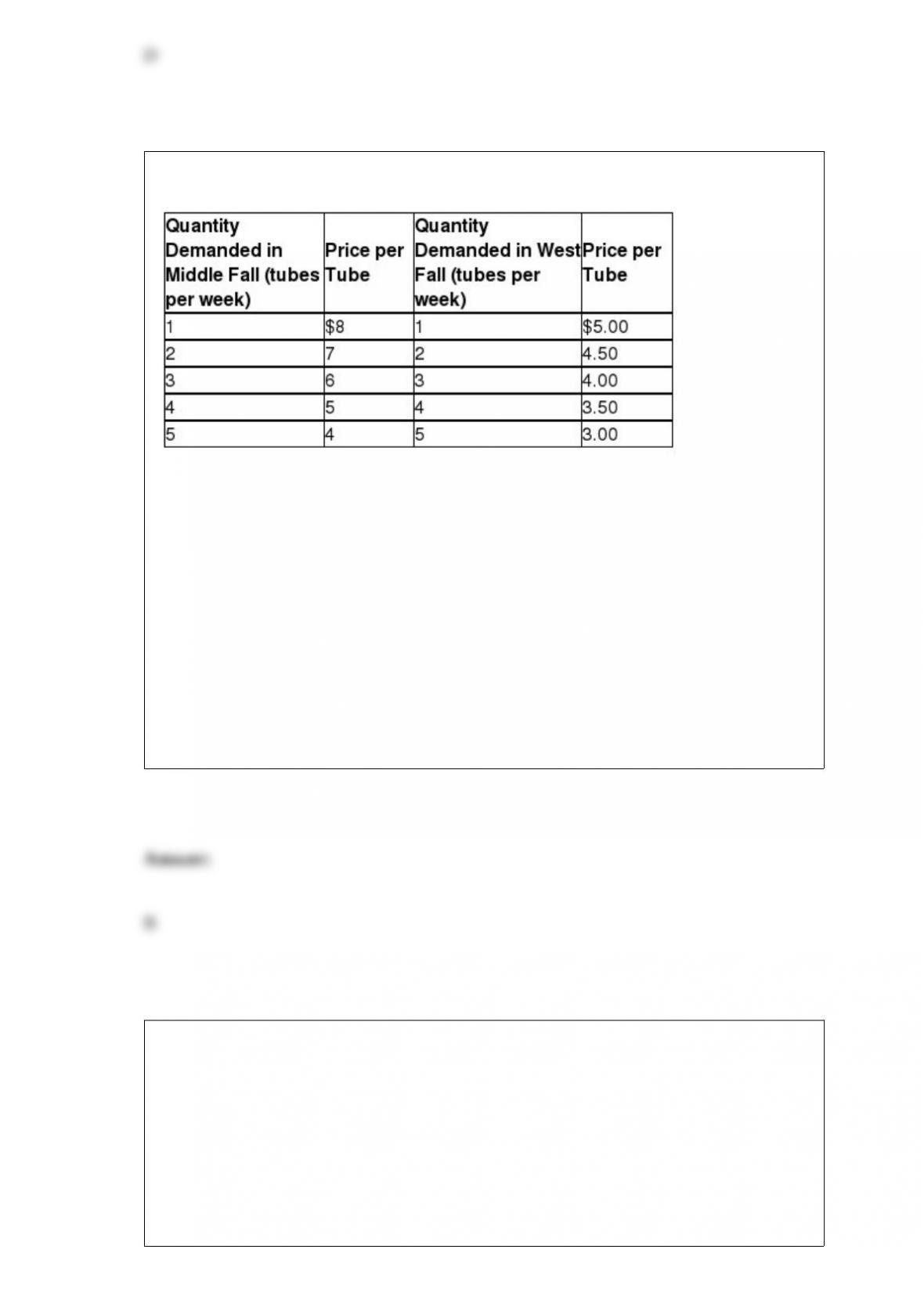
Table 16-2
Neem Products sells its Ayurvedic Neem toothpaste in two completely isolated markets
with demand schedules as shown in Table 16-2. The average cost of production is
constant at $2 per tube.
What is the total revenue received from both markets combined?
A) $30
B) $34
C) $68
D) $70
Joan Jillson owns a coffee shop. Assume that the marginal product of the labor Joan
employs (MPL)equals 500 cups per week and the marginal product of her shop’s capital
(MPK) equals 1,000. Assume also that the wage (w) Joan pays her workers equals $250
per week and the rental price () of her capital – her coffee machines – equals $500 per
week. Which of the following correctly analyzes whether Joan is minimizing her costs?
A) No, Joan is not minimizing her costs because MPK is greater than MPL and is
greater than w.

B) Yes, Joan is minimizing her costs because MPK/ equals MPL/w.
C) No, Joan is not minimizing her costs because MPLw is less than MPK .
D) Yes, Joan is minimizing her costs because the she is a price-taker in the markets for
labor and capital.