
Increases in the price level accompanied by reductions in total real output mean that the
economy is experiencing
a. leftward shifts in the aggregate demand curve.
b. full employment.
c. technological advances leading to increased productivity.
d. leftward shifts in the Phillips curve.
e. supply-side inflation.
Economic growth is generally measured by the rate of increase in
a. population.
b. the price level.
c. output per hour of labor.
d. technological change.
e. per capita output.
To produce a rightward shift in the aggregate supply curve, supply-siders argue for

a. a large surplus of unemployed workers to hold down wage rates.
b. large government deficits to hold down aggregate demand.
c. higher taxes on personal and corporate incomes.
d. financial incentives to encourage additional saving.
e. a money supply that is absolutely fixed over time.
In general, what percentage of their income do U.S. households spend on goods and
services?
a. 27 percent
b. 32 percent
c. 64 percent
d. 81 percent
e. 96 percent
In a perfectly competitive market, it pays the profit-maximizing firm to employ another
unit of an input as long as the
a. price of the input is less than the price of the product produced.

b. price of the input exceeds the price of the product produced.
c. marginal product of the input exceeds the price of the product.
d. value of the marginal product of the input exceeds the product’s price.
e. increase in the firm’s costs are less than the price of the output times the increase in
total product.
In the United States, the quantity of money is determined
a. entirely by commercial banks through their lending procedures.
b. entirely by the public through their willingness to hold currency.
c. primarily by the amount of gold flowing into or out of the country.
d. primarily by Congress, which legislates the amount of money to be printed by the
Treasury.
e. primarily by the Federal Reserve but to some degree by the private sector.
The Club of Rome study was concerned primarily with the ________ growth.
a. benefits of
b. costs of
c. sources of
d. limits to
e. rates of
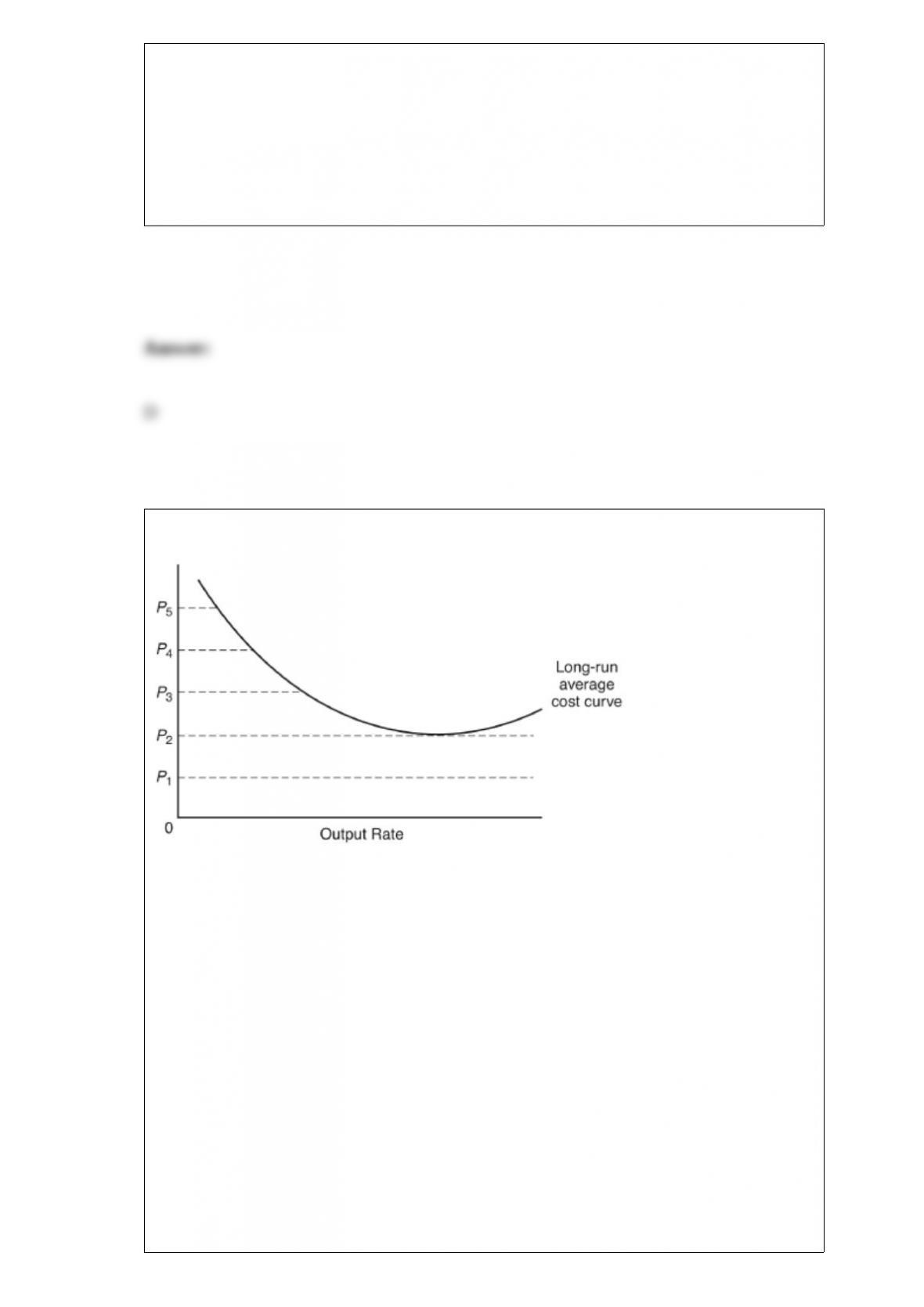
Suppose all firms in an
industry in long-run equilibrium have U-shaped average cost curves. If the market
demand increases, the resulting increase in price in the short run
a. rations out the current production.
b. rations out the current production and results in higher profits to producers.
c. rations out the current production, results in higher profits to producers, and prompts
existing firms to increase output by hiring more variable input.
d. rations out the current production, results in higher profits to producers, prompts
existing firms to increase output by hiring more variable input, and causes a short-run
increase in industry capacity by drawing new producers into the market.
e. rations out the current production, results in higher profits to producers, prompts
existing firms to increase output by hiring more variable input, and causes a short-run
increase in industry capacity by drawing new producers into the market, all while

existing firms increase capacity by expanding plant size.
When inflation constitutes a major economic problem, government policy may attempt
to
a. shift the aggregate demand curve to the left.
b. shift the aggregate supply curve to the left.
c. encourage and augment spending.
d. raise the equilibrium price level.
e. raise the minimum wage to reduce the effective price level.
Which of the following is a limitation of real GDP as a measure of economic
well-being?
a. Little is revealed about the distribution or composition of output.
b. Output is overstated because intermediate production is included.
c. It fails to account for the consumption of a country’s productive capacity.
d. It measures only a country’s expenditures, not its income.
e. It fails to account for expenditures by the public sector.

Currently, the largest share of the annual federal budget goes toward
a. interest on the national debt.
b. energy programs.
c. education and health.
d. national defense and other items connected with international relations and national
security.
e. Social Security programs, welfare and other income-security programs, health, and
education.
The following questions are based on the following diagram:
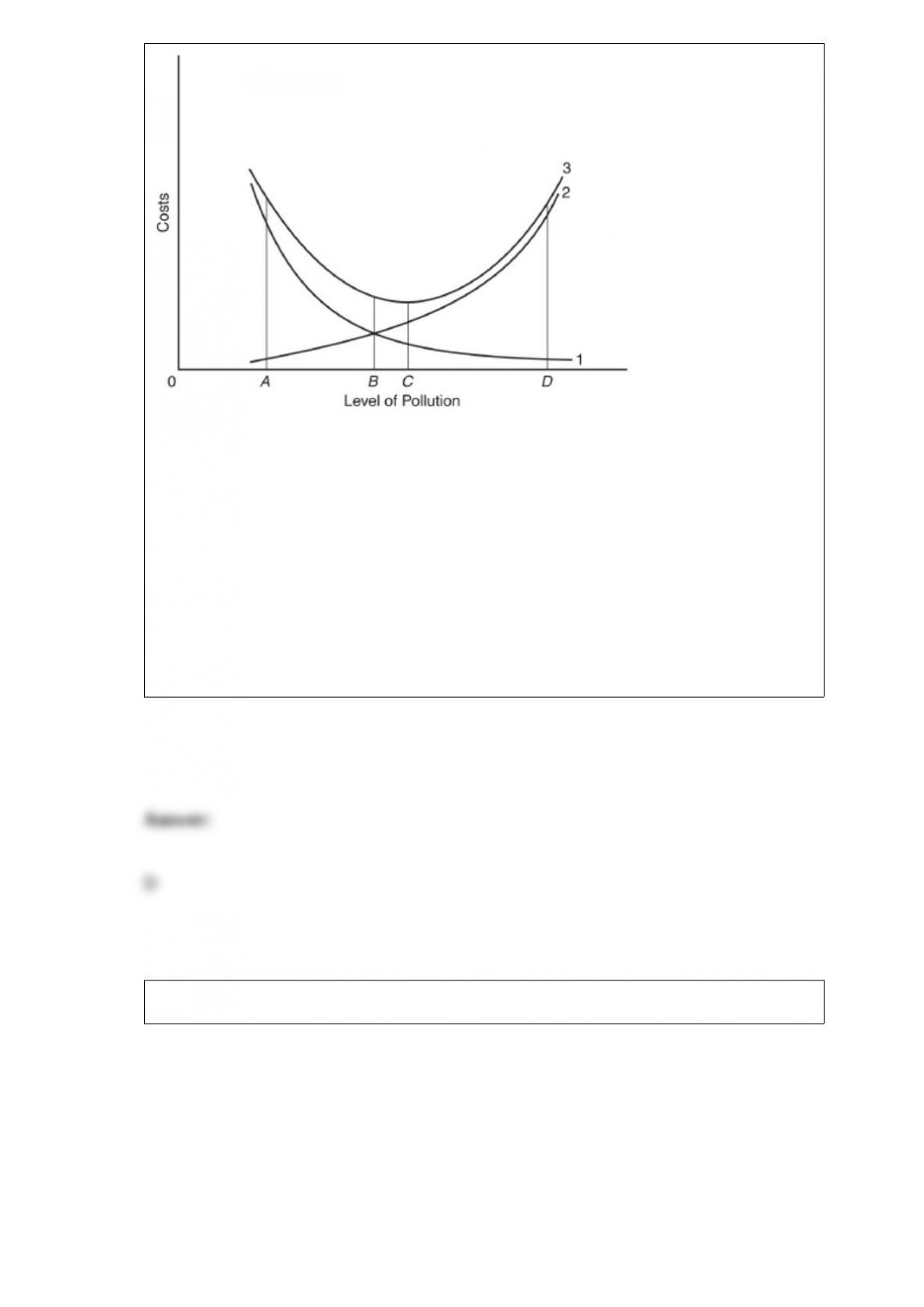
Curve 3 represents the
a. cost of pollution to society.
b. cost of pollution control to society.
c. difference between the cost of pollution and the cost of pollution control.
d. sum of the costs of pollution and of pollution control.
e. cost of pollution divided by the cost of pollution control.
The following questions are based on the following diagram:
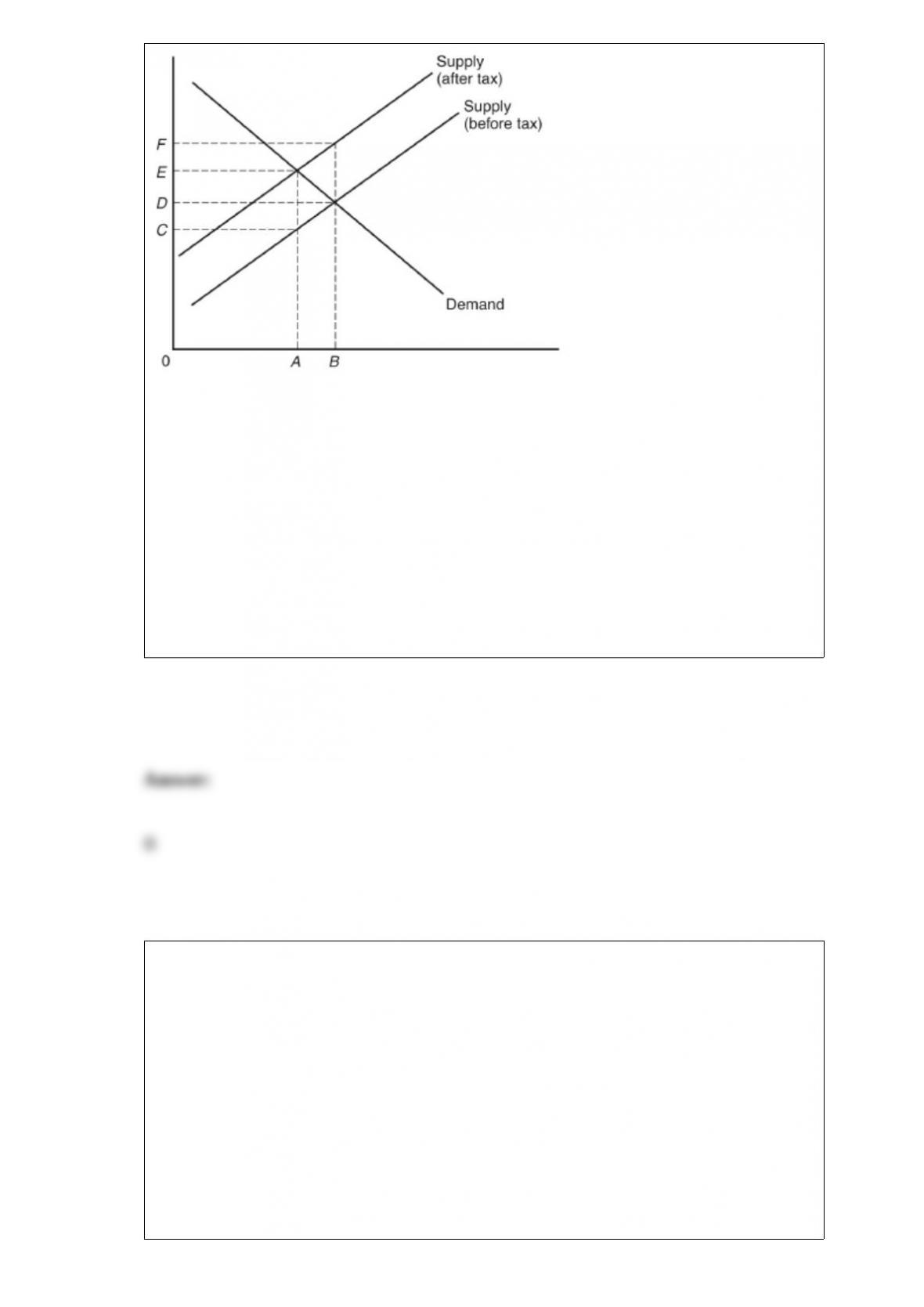
The amount of tax shifted forward onto the consumer is best illustrated by
a. AB.
b. DE.
c. CE.
d. DC.
e. CF.
The social cost of pollution equals 4P, where P is the level of pollution, and the cost of
pollution control equals 10 – 1P. What is the optimal level of pollution?
a. 0
b. 1
c. 2
d. 4
e. 10

A process by which oligopolists coordinate their behavior without resorting to outright
collusion is called price
a. discrimination.
b. escalation.
c. stabilization.
d. reform.
e. leadership.
The current value of U.S. currency depends on
a. the price level.
b. interest rates.
c. the velocity of circulation rate.
d. the value assigned to it by the Fed.
e. its gold content.
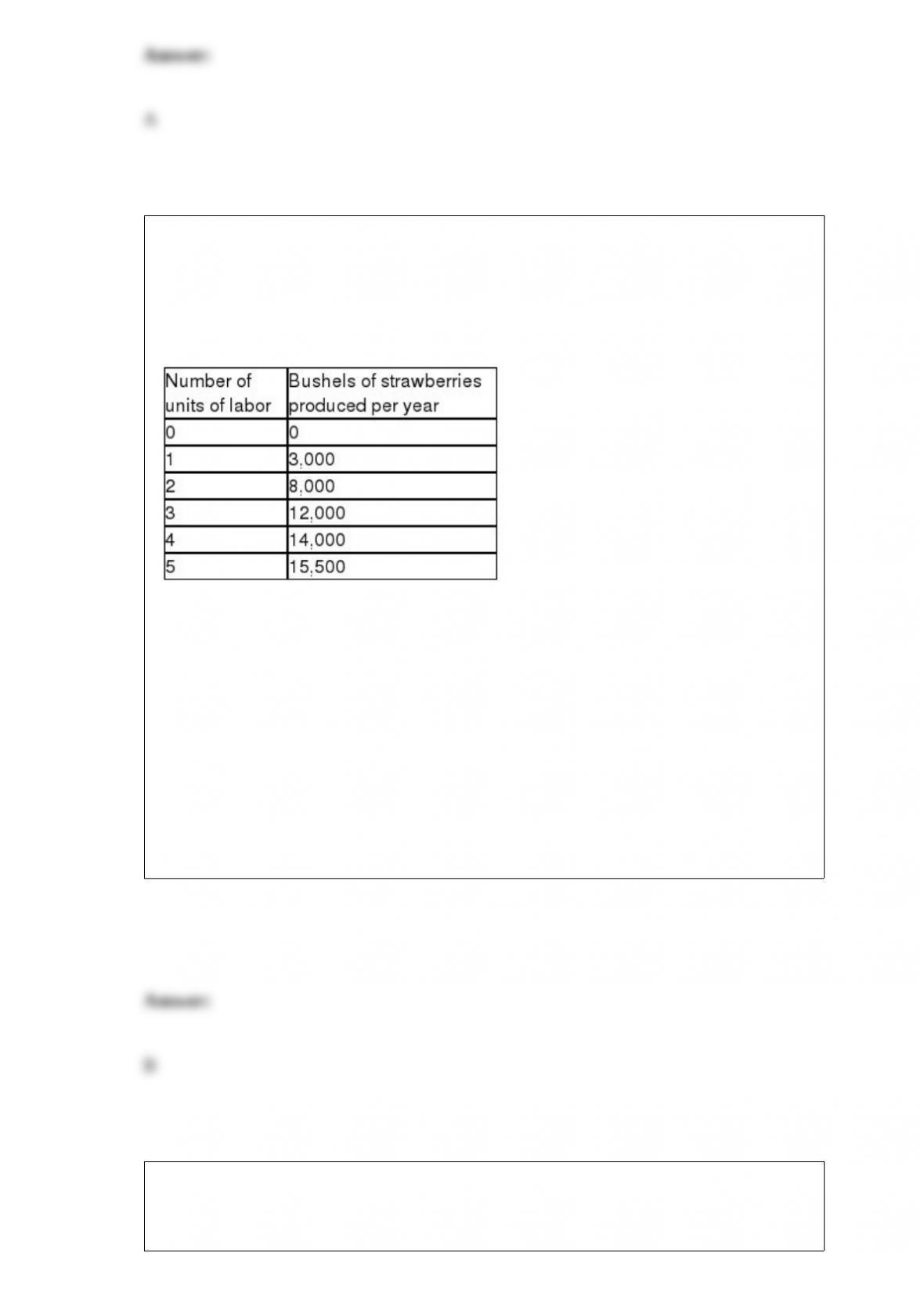
The following questions are based on the following information:
A firm uses inputs of labor, fertilizer, and land to produce strawberries (which are sold
to wholesalers and processors). The quantity of land used is fixed at eight acres per
season and the production function implies the relationships in the following table:
The marginal product of the fourth unit of labor is ________ bushels.
a. 1,000 d.
b. 2,000 e.
c. 3,100
3,500
4,000
Any definition of the money supply must be
a. legally established by the Federal Reserve System in conjunction with Congress.

b. arbitrary because many assets exhibit the properties of money.
c. agreed on by a majority vote of economists.
d. determined by the price level.
e. determined by the bullion content of an asset.
As a result of this government action, we would expect that the price of glass produced
by Crystal would
a. fall steeply.
b. fall slightly.
c. stay about the same.
d. rise.
e. do any of the above, since government action may either raise or lower costs.
Since 1945, the average annual unemployment rate in the United States has
a. varied from 10 to 20 percent.
b. increased steadily from 2 to 12 percent.
c. varied from slightly under 3 to over 9 percent.

d. decreased steadily from 10 to slightly under 7 percent.
e. not varied by more than 3 percentage points over the entire period.
After-tax income inequality tends to be reduced under a tax structure that is
a. progressive.
b. productive.
c. propulsive.
d. prohibitive.
e. protective.
Public choice theorists argue that the provision of public goods tends to be
economically inefficient because
a. the private sector will always provide those goods even if the government does not.
b. government officials are generally more stupid, lazy, or corrupt than their
private-sector counterparts.
c. it leads the economy to operate outside the production possibilities curve.
d. to stay elected, politicians frequently adopt programs that benefit a great number of
people who each gain very little at the expense of a small group of people who each

lose very much.
e. all a voter is able to do is vote for a candidate who favors that group of programs
closest to those favored by the voter.
The tradeoff between unemployment and inflation occurs primarily when the
economy’s aggregate demand curve intersects the aggregate supply curve in
a. the horizontal range.
b. the upward-sloping range.
c. the vertical range.
d. all three ranges.
e. a manner impossible to determine from the diagram.
An important disadvantage of incremental tax credits to encourage industrial research
and development is that they
a. are difficult to administer, requiring more government control and intervention.
b. disproportionately penalize those firms that do little research and development.
c. apply only to defense-related research and development.

d. reward firms for doing research and development they would have done anyway.
e. raise the after-tax cost of applied research and development, discouraging new
technology.
Which of the following best describes the overall economic impact of the food and
energy supply shocks in the 1970s?
a. Many Americans began spending more in an effort to acquire needed goods before
the shortages grew worse.
b. The economy experienced both rising price levels and increased unemployment.
c. The prices of food and oil products increased, but there was little impact on other
sectors of the economy.
d. Because the U.S. economy is self-sufficient, these international supply shocks had
little impact.
e. Many consumers responded by boycotting oil-related and food products, driving
down the prices of these goods.
A budget policy in which the government is expected to run a big enough surplus
during periods of high employment to offset deficits during an ensuing period of
excessive unemployment is called a(n)
a. annually balanced budget.

b. structural budget.
c. full-employment budget.
d. conflict-resolution budget.
e. budget balanced over the course of the business cycle.
Opponents of zero economic growth as a means to reduce pollution argue that growth in
productive capacity would
a. help produce the equipment required to reduce pollution.
b. encourage a more rapid growth in population.
c. shift resources from consumers to businesses, reducing the consumption of polluting
goods.
d. redistribute income to more affluent people, who pollute less than poor people.
e. be the most effective way to slow the rate of technological change.
A business firm that is regarded as a fictitious legal person is called a
a. front.

b. corporation.
c. silent partnership.
d. limited proprietorship.
e. special interest.
Discrimination in labor markets arises because
a. race or gender characteristics present barriers to mobility and create noncompeting
groups.
b. women and minorities are inherently less productive.
c. the supply curve of women and minorities is smaller than the total labor supply
curve.
d. women and minorities typically have more education and experience.
e. of various laws such as the Civil Rights Act of 1964.
In his testimony to Congress in 1975, Fed chair Arthur Burns argued that the high
dynamic variable in the business cycle is NOT the stock of money but
a. the price level.

b. real output.
c. interest rates.
d. personal consumption expenditures.
e. the velocity of the circulation of money.
When the government establishes programs to aid the poor by taxing the more affluent,
it
engages in
a. income redistribution.
b. economic stabilization.
c. providing a competitive framework.
d. establishing the rules of the game.
e. free market capitalism.
GDP overestimates our true economic welfare because
a. goods are not valued at their market prices.
b. costs associated with environmental damage are not deducted.
c. it includes consumer expenditures on nondurables.
d. government economists are responsible for its computation.
e. intermediate goods are excluded.
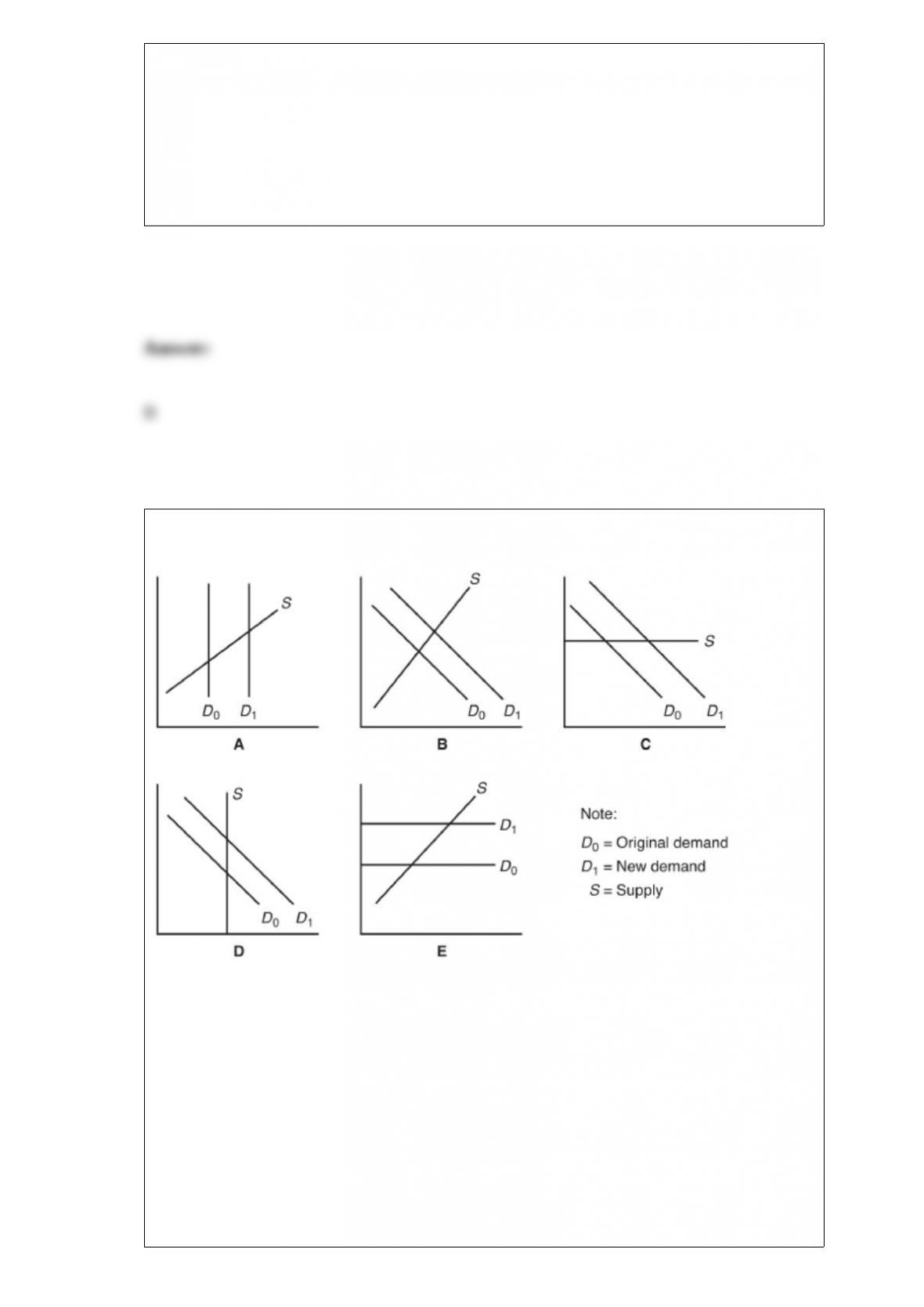
Which of the above diagrams, illustrating changes in demand, best demonstrates the
concept of economic rent?
a. A
b. B
c. C
d. D

e. E
Under normal conditions the president may appoint a member to the Federal Reserve
Board every
a. year.
b. two years.
c. four years.
d. seven years.
e. 14 years.
What is the profit-maximizing level of output for a perfectly competitive firm with the
following cost and revenue information?

a. 20 units
b. 21 units
c. 22 units
d. 23 units
e. 24 units