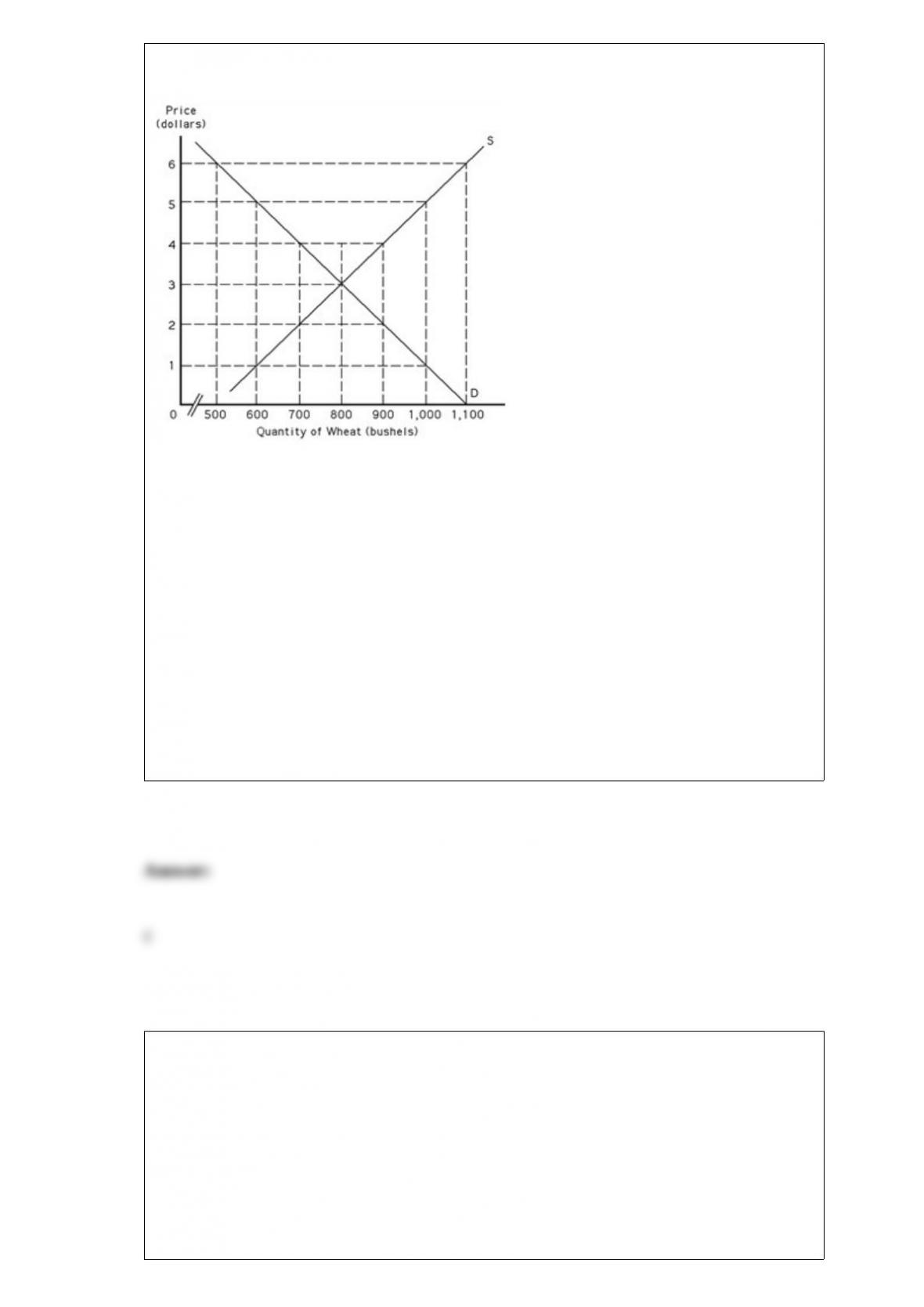
Exhibit 39-4
The government feels that the present level of farmers’ total revenues is insufficient to
support a reasonable standard of living and wants to raise it to exactly $3,000. This can
be achieved by
a. restricting supply so that price increases to $4.
b. a price support of $5.
c. restricting supply so that price increases to $5.
d. any of the above
e. none of the above
Which of the following statements uses the term ceteris paribus correctly?
a. In economics, there are numerous theories, ceteris paribus.
b. New York City is a major American city, ceteris paribus.
c. The price of pineapples is low in Hawaii, ceteris paribus.
d. The more ice cream you eat, the more weight you will gain, ceteris paribus.

e. none of the above
Demand for a given good is elastic, which means that the percentage change in
__________ is greater than the percentage change in __________.
a. quantity demanded; income
b. quantity demanded; price
c. price; quantity demanded
d. income; price
e. none of the above
In the long run, the purchasing power parity theory predicts exchange rates accurately,
particularly when there is a large difference in inflation rates across countries.
a. True
b. False

The U.S. dollar has depreciated relative to the Japanese yen if it takes
a. fewer yen to buy a dollar.
b. more yen to buy a dollar.
c. more dollars to buy a yen.
d. fewer dollars to buy a yen.
e. a and c
When an investor buys shares of stock, those stocks must be held for a specified period
of time before they can be sold.
a. True
b. False
Which of the following is an example of a legal barrier to entry?
a. a public franchise
b. a patent
c. exclusive ownership of a scarce resource
d. a and b
e. a, b, and c
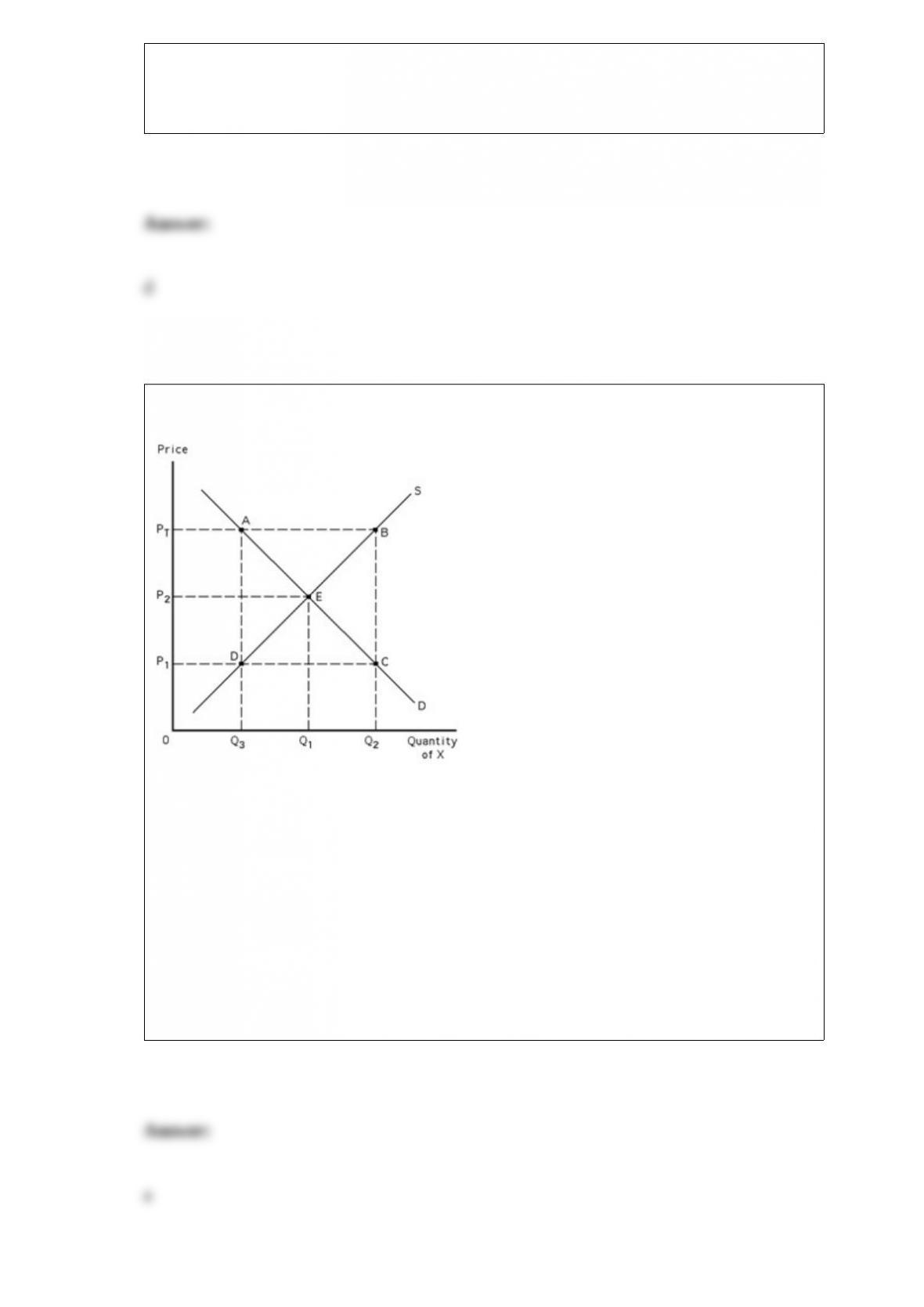
Exhibit 39-1
At a support price of PT, private sector spending on this good equals
a. PT x Q3.
b. PT x Q2.
c. P1 x Q3.
d. P1 x Q2.
Elasticity of demand for labor is affected by the
a. price elasticity of demand for the product that labor produces.
b. availability of substitute (nonlabor) factors.
c. ratio of labor cost to total cost.
d. all of the above
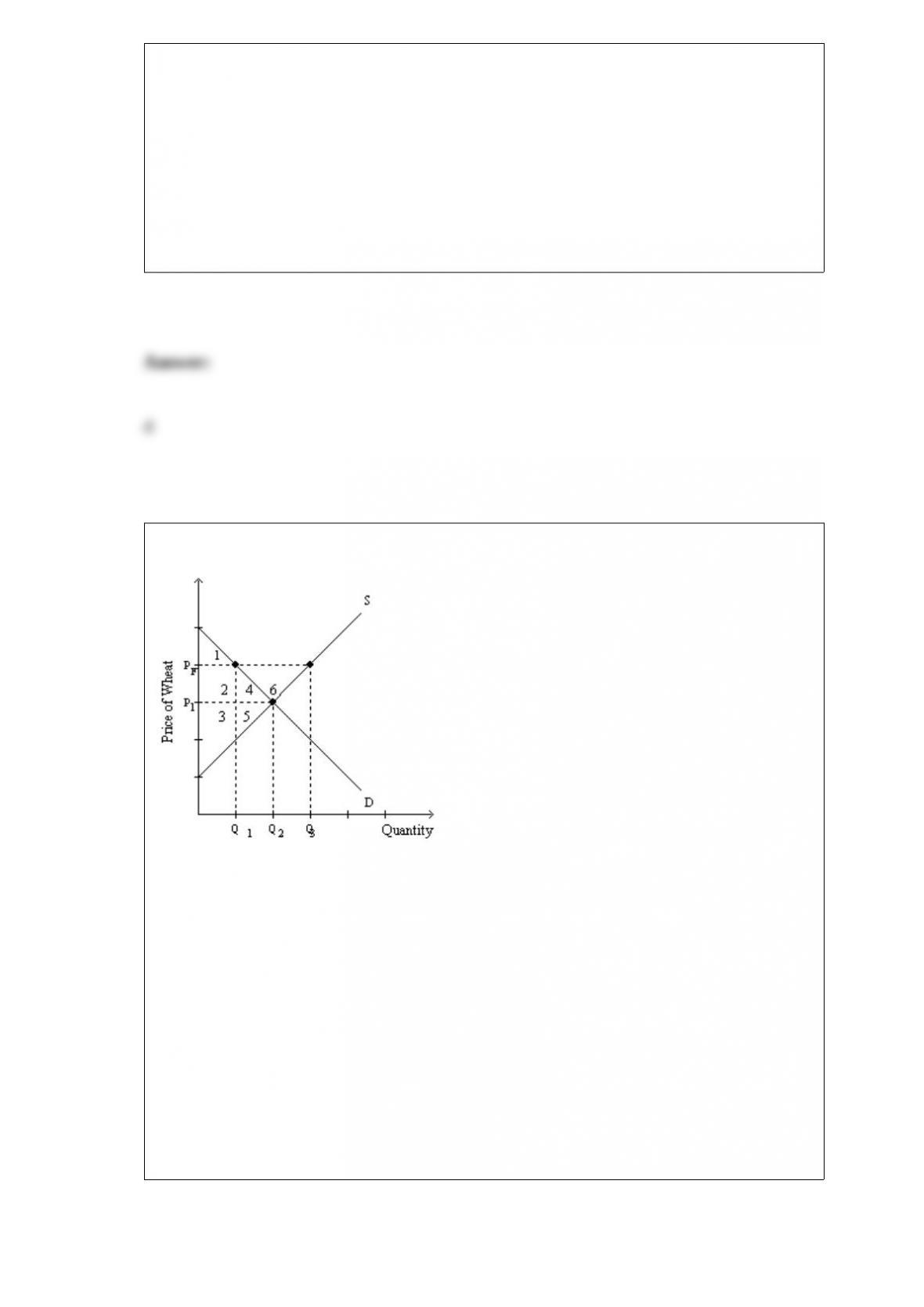
Exhibit 4-8
Suppose that wheat producerslobby the government for a price floor and receive
one.This price floor is set at PF.How many fewer units of wheat will be sold at the price
floor than at the equilibrium price?
a. Q2 – Q1
b. Q3 – Q2
c. Q3 – Q1
d. Q2
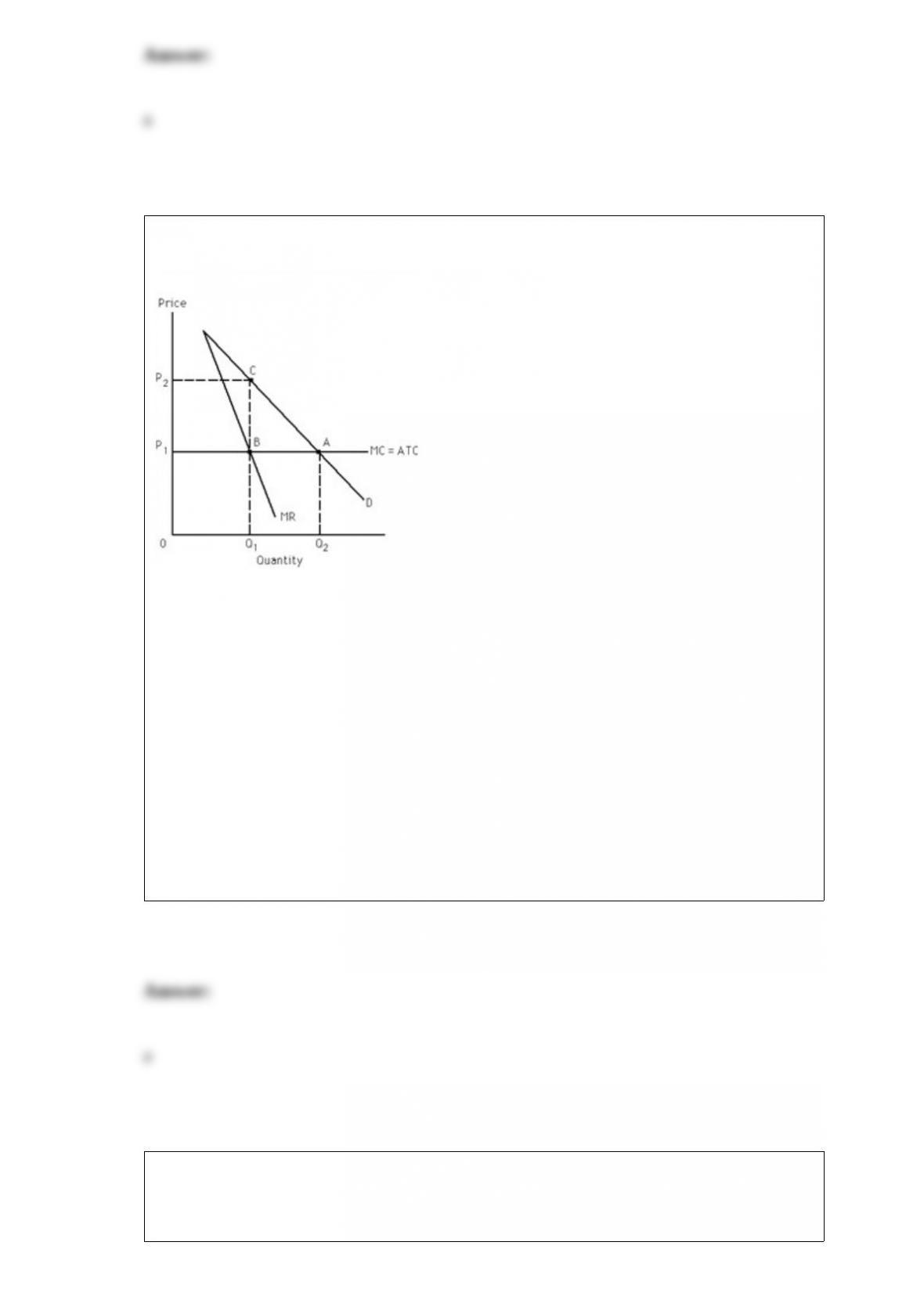
Exhibit 24-1
If the product is produced under single-price monopoly, what do total costs equal at the
profit maximizing level of output?
a. area 0P1BQ1
b. area BCA
c. area P1P2CB
d. area P2CAP1
e. none of the above
If for a given individual, between a wage rate of $30 and $35 the
____________________ effect outweighs the ________________ effect, the
individual’s supply curve of labor curve between those two wages will be

_________________.
a. substitution; income; vertical
b. substitution; income; downward sloping
c. income; substitution; downward sloping
d. income; substitution; vertical
e. income; substitution; upward sloping
Which of the following is not a necessary condition for price discrimination to hold?
a. The seller must be a price searcher.
b. The seller must be able to distinguish between customers willing to pay different
prices.
c. It must cost the seller more to service some customers than others.
d. Reselling the product must be extremely costly or must not be possible
A monopsonist’s wage rate is
a. the same as marginal factor cost.
b. greater than marginal factor cost.
c. less than marginal factor cost.

d. the same as marginal revenue product.
e. a and d
In 2014, the federal government disbanded the practices of fixed direct payments and
countercyclical payments to farmers.
a. True
b. False
It is possible for total utility to rise as marginal utility falls.
a. True
b. False

When negative externalities are involved, the market is said to
a. fail, because it underproduces the good connected with the negative externality.
b. fail, because it overproduces the good connected with the negative externality.
c. succeed, because it produces the socially optimal quantity of the good connected with
the negative externality.
d. be “in optimum,” because the equilibrium fully adjusts for the negative externality.
The following statement, “Every contract, combination in the form of trust or
otherwise, or conspiracy, in restraint of trade or commerce among the several states, or
with foreign nations, is hereby declared illegal,” is part of the
a. Clayton Act.
b. Sherman Act.
c. Federal Trade Commission Act.
d. Wheeler-Lea Act.
e. Celler-Kefauver Antimerger Act.