
Compensating differentials are associated most closely with which of the following?
A) hazardous jobs
B) comparable worth
C) economic discrimination
D) differences in education
Assume that Bulgaria has a comparative advantage in producing sandals and Finland
imports sandals from Bulgaria. We can conclude that
A) Bulgaria also has an absolute advantage in producing sandals relative to Finland.
B) Bulgaria has a lower opportunity cost of producing sandals relative to Finland.
C) Finland has an absolute disadvantage in producing sandals relative to Bulgaria.
D) Labor costs are higher for sandal producers in Finland than in Bulgaria.
Table 16-1
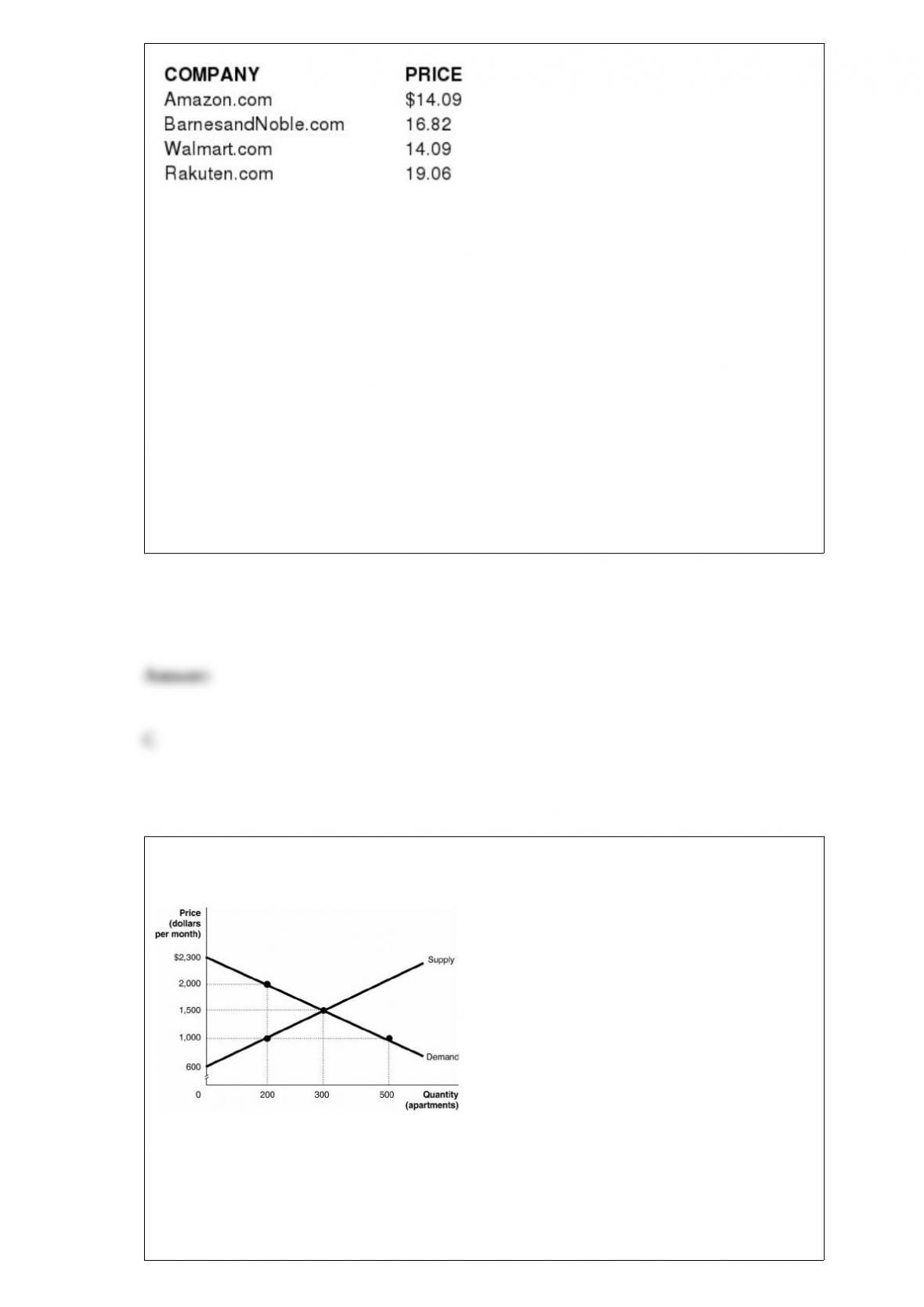
Table 16-1 shows the price for the hardcover version of the novel Inferno by Dan
Brown at four online bookstores.
Refer to Table 16-1. Which of the following can one conclude from the data above?
A) The data provides clear evidence of price discrimination in online bookstore market.
B) Amazon.com and Walmart.com are able to charge a lower price for the item because
they are more cost efficient than the other two companies.
C) The item offered for sale is similar but not identical; the quality of service and
delivery time might vary from store to store, which justifies the price differences.
D) Walmart.com and Amazon.com have deliberately under-priced their product to force
the other two companies out of business.
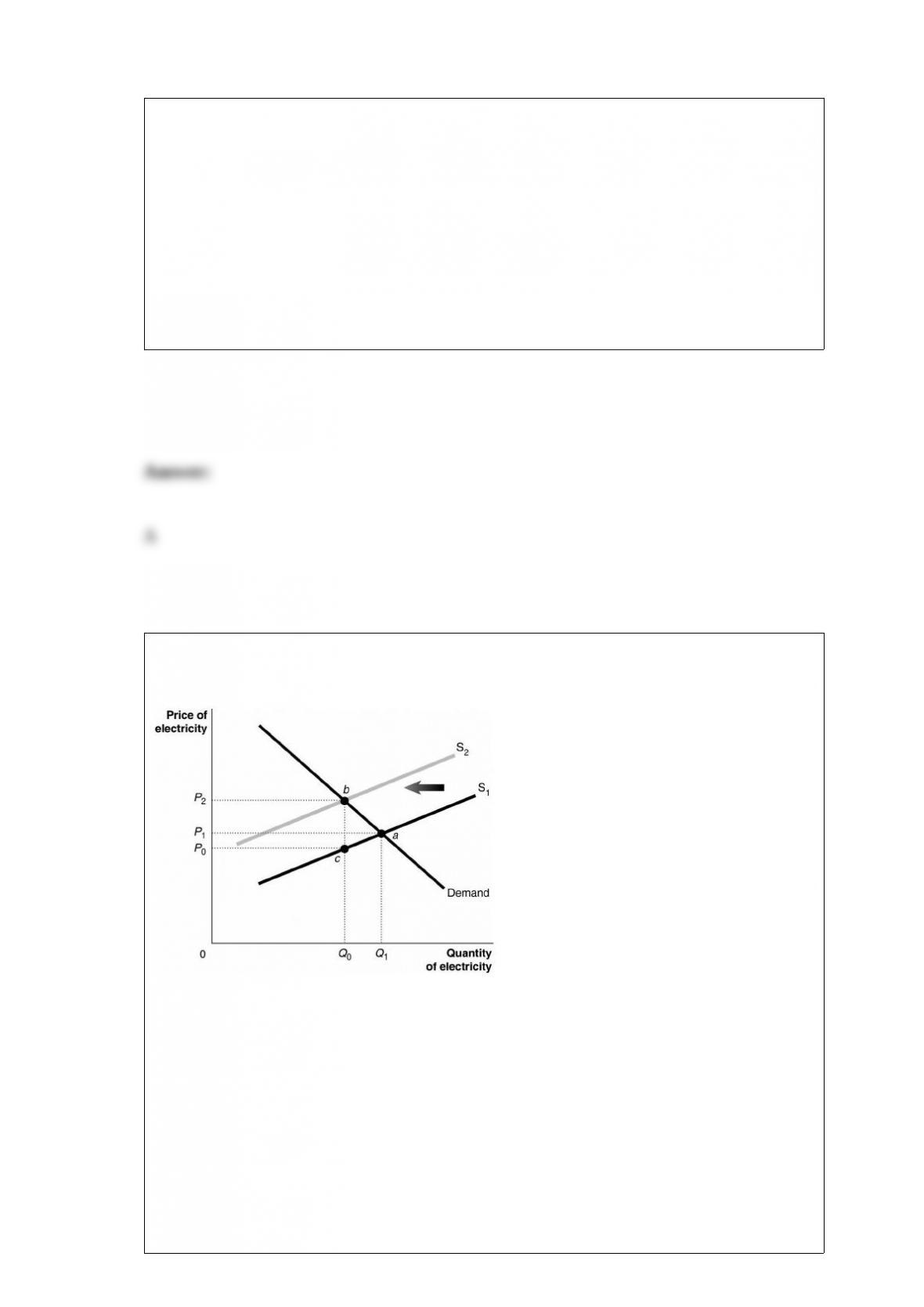
Figure 4-5
Figure 4-5 shows the market for apartments in Springfield. Recently, the government
imposed a rent ceiling of $1,000 per month.
Refer to Figure 4-5. What is the value of producer surplus after the imposition of the
ceiling?

A) $40,000
B) $100,000
C) $300,000
D) $430,000
Consider the market for blackjack dealers in Las Vegas. In each of the following cases,
explain what happens to the equilibrium wage rate and the quantity of blackjack dealers
hired.
a. Three new large resort casinos open in Las Vegas.
b. Fewer students are attending classes to learn to become blackjack dealers.
c. Traditionally, blackjack dealing is a field that attracts foreign workers. However,
changes in immigration laws have made it more difficult for foreign workers to come to
Las Vegas to obtain jobs. The demand for blackjack dealers, however, does not change.
d. Advances in technology have increased the popularity of electronic blackjack
machines and decreased the popularity of live table games which require the use of a
dealer.

There are two conditions necessary for a consumer to maximize her utility. One is that
the marginal utilities per dollar spent on each good and service consumed are equal.
What is the other condition?
A) Total spending on all goods and services must equal the amount available to be
spent.
B) The consumer must be satisfied with the choices she makes.
C) The total spent on each good and service is the same.
D) The prices of each good and service consumed must not be too high.
Imposing tariffs in cases of dumping
A) is allowed under the WTO agreement.
B) is not allowed under the WTO agreement.
C) is not addressed by the WTO agreement.
D) has never occurred, even though it is allowed under the WTO agreement.
When consumers pay only a fraction of the true cost of medical services, their demand
increases. The marginal cost of producing these extra services
A) is greater than the marginal benefit consumers receive from them.
B) is less than the marginal benefit consumers receive from them.
C) is equal to the marginal benefit consumers receive from them.
D) is zero due to the insurance payments.
Figure 5-11
Coal burning utilities release sulfur dioxide and nitric acid which react with water to
produce acid rain. Acid rain damages trees and crops and kills fish. Because the utilities
do not bear the cost of the acid rain they overproduce the quantity of electricity. This is
illustrated in Figure
5-11.
Refer to Figure 5-11. S1 represents the supply curve that reflects the private cost of
production and S2 represents the supply curve that reflects the social cost of production.
One way to internalize the external cost generated by utilities is to impose a Pigovian
tax on the production of electricity. What is the size of the Pigovian tax that will

internalize the cost of the externality?
A) P0
B) P2–P0
C) P1–P0
D) P2–P1
Comparative advantage means the ability to produce a good or service
A) at a lower selling price than any other producer.
B) at a lower opportunity cost than any other producer.
C) of a higher quality than any other producer.
D) at a higher profit level than any other producer.
For consumers who opt to pay a $10 monthly fee to have unlimited texting on their cell
phones, but choose not to pay a $5 monthly fee to have unlimited call minutes, the
unlimited texting option has a ________ than the unlimited minutes option.
A) higher price elasticity of demand
B) higher cross-price elasticity of demand
C) lower price elasticity of demand
D) lower cross-price elasticity of demand
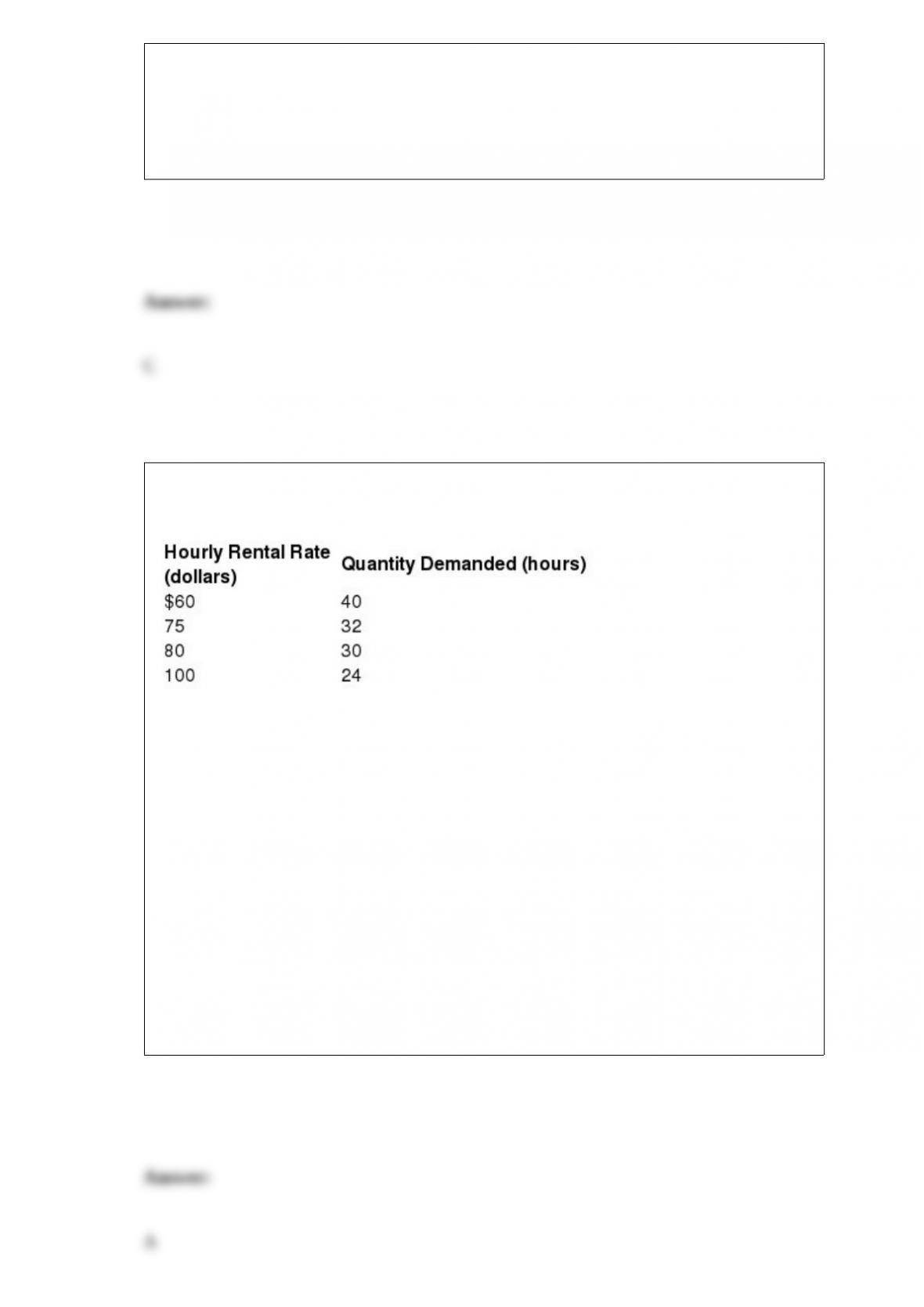
Table 6-5
Refer to Table 6-5. Katie Graham owns a kayak rental service in Santa Barbara. Table
6.3 below shows her estimated demand schedule for kayak rentals per week. She would
like to increase her sales revenue by changing the price she charges for rentals. At
present she charges $75. Based on the information in the table, Katie
A) is not able to increase her revenue by changing her price because the demand for
kayak rentals is unit-elastic.
B) should lower her price to $60 to increase her revenue because the demand for kayak
rentals is price elastic.
C) should raise her price to $80 to increase her revenue because the demand for kayak
rentals is price inelastic.
D) should raise her price to earn the most revenue.

Vipsana’s Gyros House sells gyros. The cost of ingredients (pita, meat, spices, etc.) to
make a gyro is $2.00. Vipsana pays her employees $60 per day. She also incurs a fixed
cost of $120 per day. Calculate Vipsana’s total cost per day when she produces 50 gyros
using two workers?
A) $100
B) $124.40
C) $220
D) $340
Along an upward sloping labor supply curve, as the wage rate increases, the opportunity
cost of leisure ________, causing individuals to supply a ________ quantity of labor.
A) increases; greater
B) increases; lower
C) decreases; greater
D) remains constant, constant
The supply curve of a perfectly competitive firm in the short run is
A) the firm’s average variable cost curve.
B) the portion of the firm’s marginal cost curve below the minimum point of the
average variable cost curve.
C) the portion of the firm’s marginal cost curve above the minimum point of the average
variable cost curve.
D) the portion of the firm’s marginal cost curve above the minimum point of the
average total cost curve.
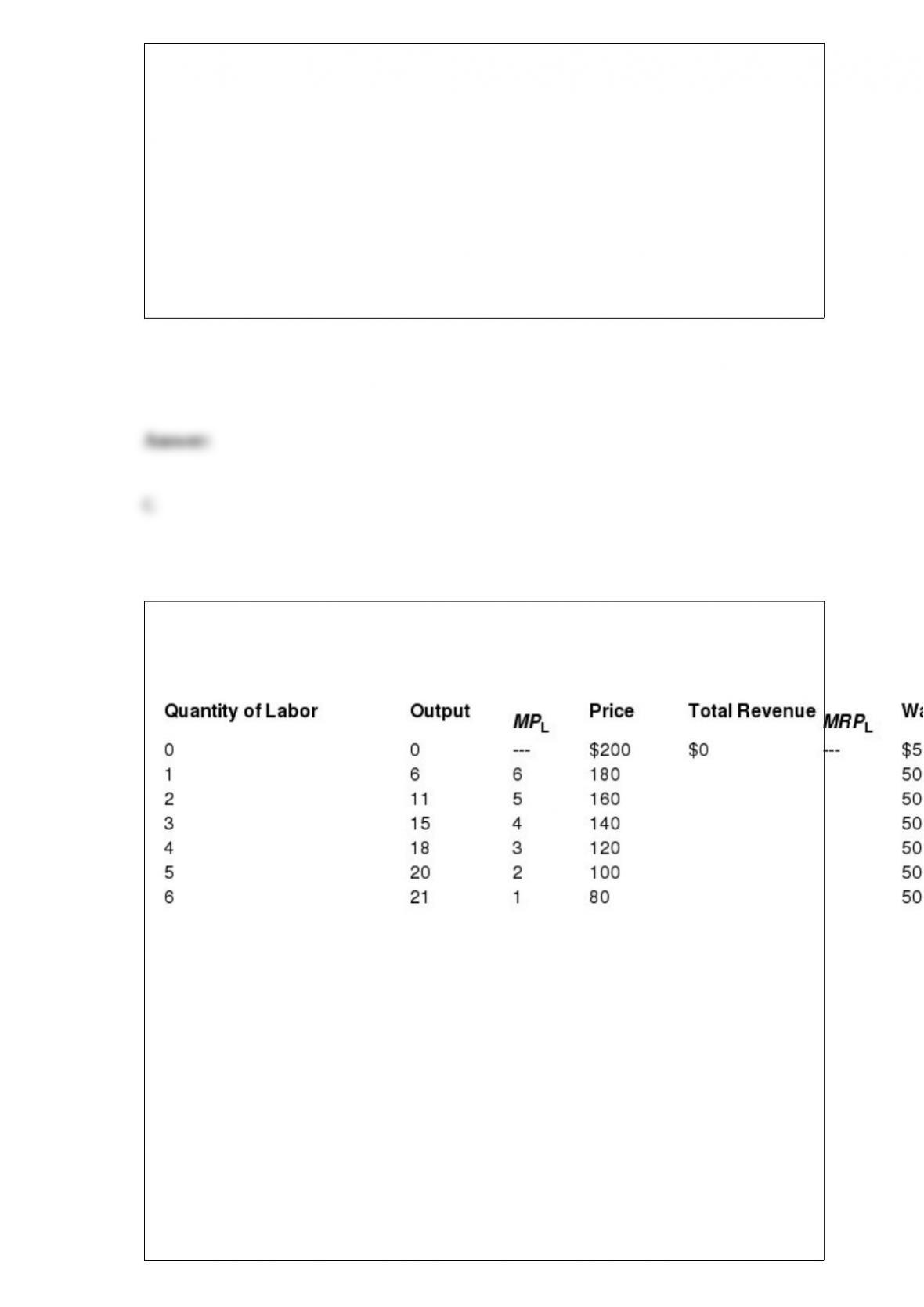
Table 17-4
Table 17-4 lists data for the production of Apple iPods. Apple is assumed to be a price
maker, so to increase its sales of iPods the firm must lower its price. MPL and MRPL
refer to the marginal product of labor and the marginal revenue product of labor,
respectively.
Refer to Table 17-4. What are the quantity of labor and marginal revenue product of
labor that will maximize the profit Apple would earn from selling iPods?
A) 2; $160
B) 3; $340
C) 2; $680

D) 3; $140
What is shown on a firm’s income statement?
A) costs
B) profits
C) revenues
D) All of these are shown on a firm’s income statement.
Government intervention in agricultural markets in the U.S. began in the
A) 1920s.
B) 1930s.
C) 1950s.
D) 1970s.
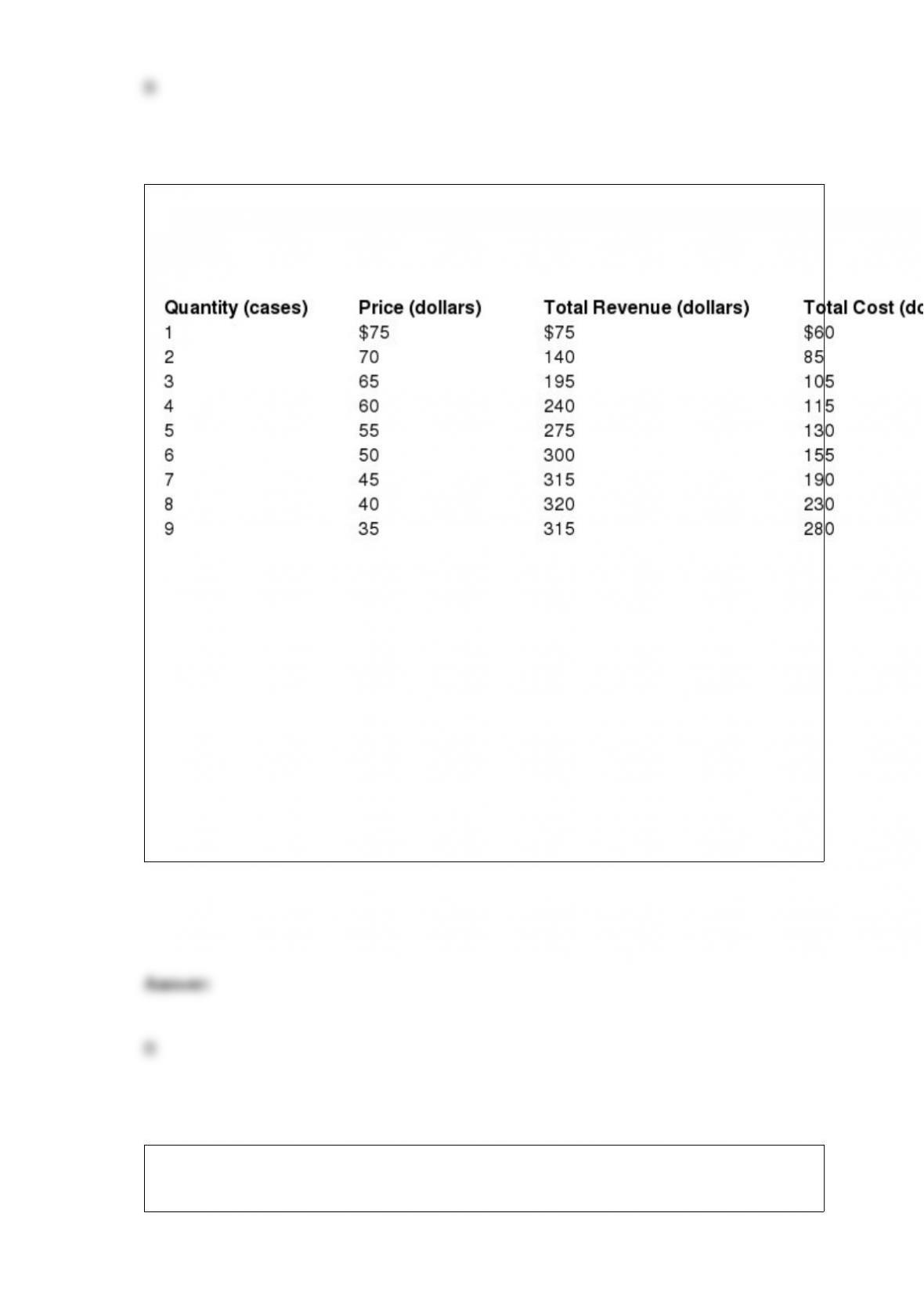
Table 13-2
Eco Energy is a monopolistically competitive producer of a sports beverage called
Power On. Table 13-2 shows the firm’s demand and cost schedules.
Refer to Table 13-2. What is the output (Q) that maximizes profit and what is the price
(P) charged?
A) P=$55; Q=5 cases
B) P=$50; Q=6 cases
C) P=$45; Q=7 cases
D) P=$40; Q=8 cases
Table 18-1

Suppose $1 billion is available in the budget and Congress is considering allocating the
funds to one of the following three alternatives: 1. Subsidies for education, 2. Research
on Alzheimer’s or 3. Increased border security. Table 18-1 shows three voters’ rankings
of the alternatives.
Refer to Table 18-1.Suppose a series of votes are taken in which each pair of
alternatives is considered in turn. If the vote is between allocating funds to education
subsidies and increased border security
A) Ivy and Jasmine vote for education subsidies, Rose votes for increased border
security, and education subsidies wins.
B) Ivy and Rose vote for increased border security, Jasmine votes for education
subsidies, and increased border security wins.
C) Jasmine and Rose vote for education subsidies, Rose votes for increased border
security, and education subsidies wins.
D) Jasmine and Ivy vote for increased border security, Rose votes for education
subsidies, and increased border security wins.
One argument advanced in favorof not increasing the income tax on individuals with
high income is that
A) increasing income tax increases wealth which contributes to increases in GDP.
B) increasing the income tax on these individuals will reduce economic efficiency.
C) increasing the income tax affects mostly middle-income and low-income individuals
who are already paying heavy income taxes.
D) not increasing income taxes will discourage corporations from increasing
investment.
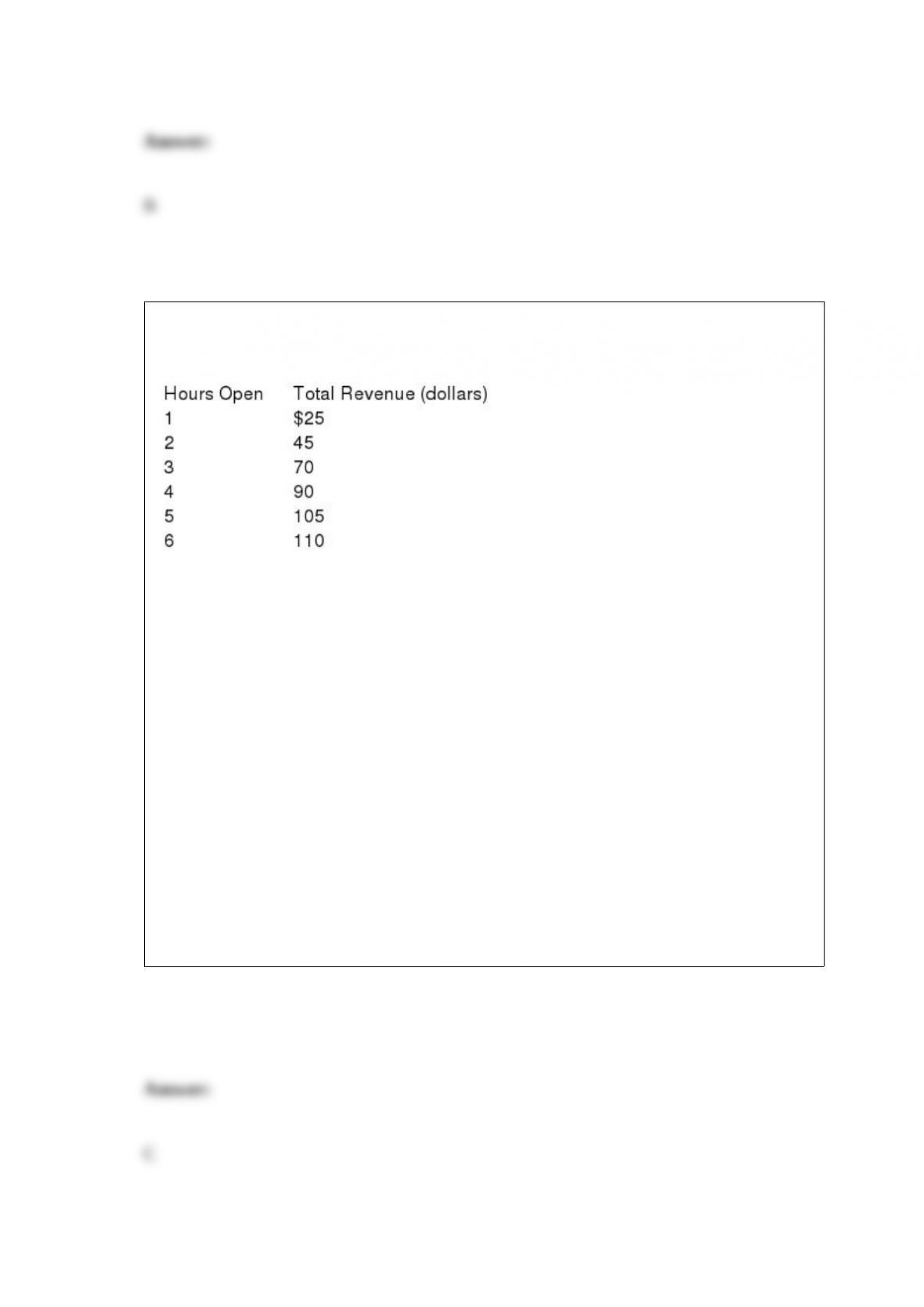
Table 1-2
Thuy Anh runs a small flower shop in the town of Florabunda. She is debating whether
she should extend her hours of operation. Thuy Anh figures that her sales revenue will
depend on the number of hours the flower shop is open as shown in the table above.
She would have to hire a worker for those hours at a wage rate of $16 per hour.
Refer to Table 1-2. What is Thuy Anh’s marginal benefit if she decides to stay open for
three hours instead of two hours?
A) $0
B) $20
C) $25
D) $45
E) $70
The combined effect (both income and substitution) of a wage increase is that
A) the substitution effect always dominates, leading to more work at a higher wage.
B) the income effect always dominates, leading to less work at a higher wage.
C) if the substitution effect outweighs the income effect, the labor supply curve slopes
upward, but if the income effect outweighs the substitution effect, the labor supply
curve is backward bending.
D) if the substitution effect outweighs the income effect, the labor supply curve is
backward bending, but if the income effect outweighs the substitution effect, the labor
supply curve slopes upward.
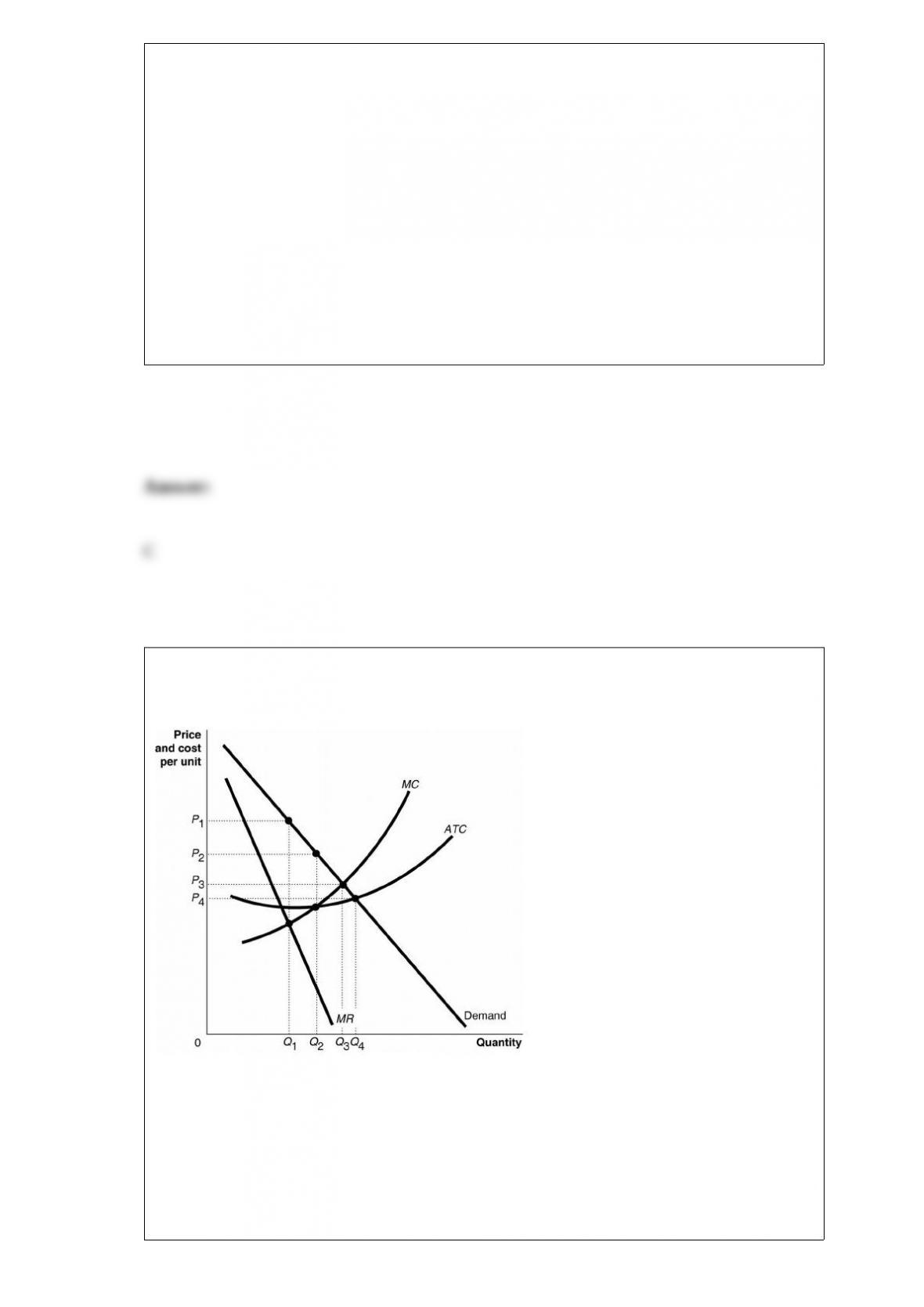
Figure 16-1
Refer to Figure 16-1. What is the consumer surplus received under perfect price
discrimination?
A) the area under the demand curve above P1
B) the area under the demand curve above P3
C) the area under the demand curve above P4
D) zero
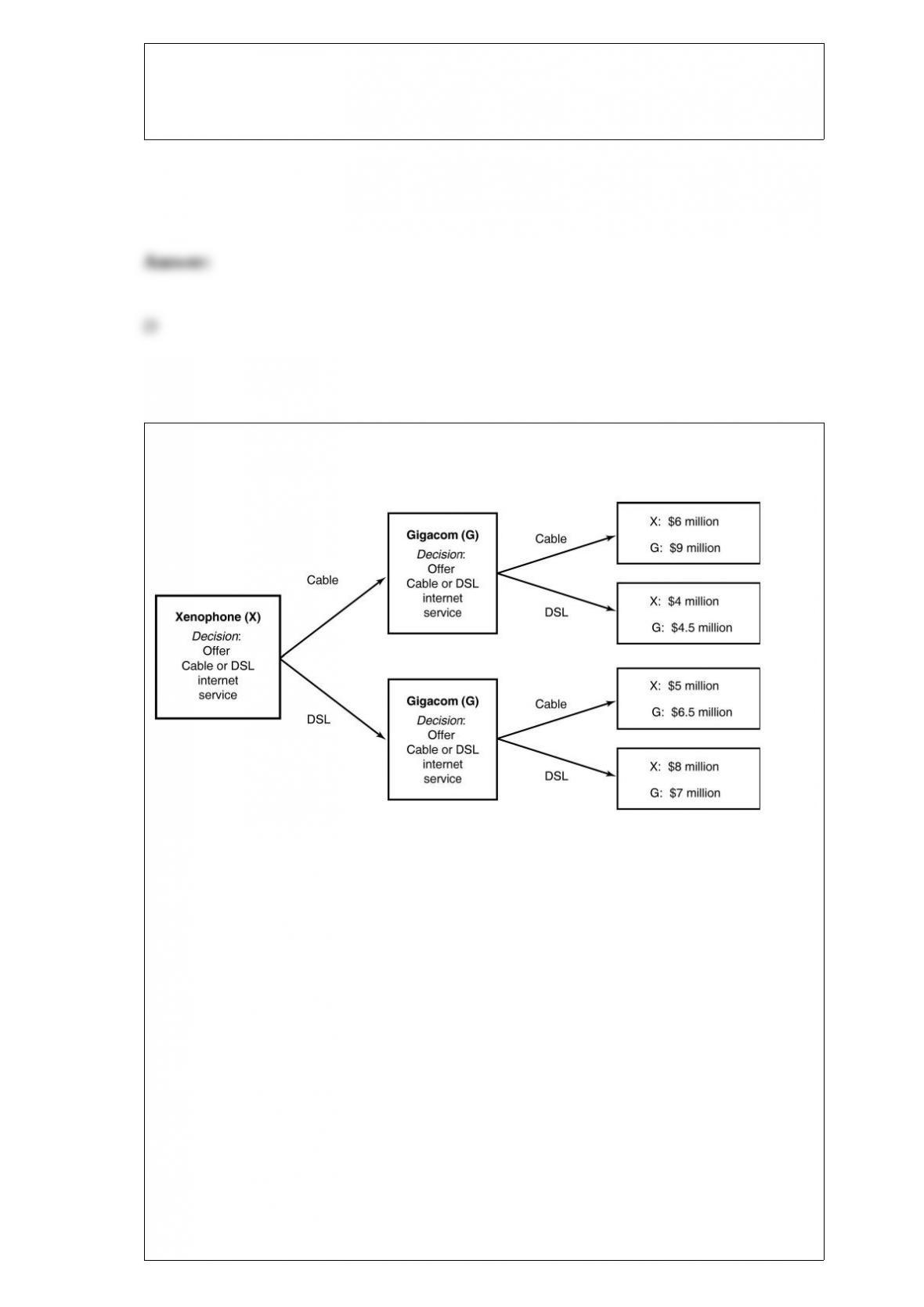
Figure 14-2
The government of a developing country plans to award two firms, Gigacom and
Xenophone, the exclusive rights to share the market for high speed internet service.
Gigacom and Xenophone can both provide the service either via television cable lines
or via direct subscriber line (DSL). Suppose the government is considering a proposal
to delay one firm’s entry into the market on the grounds that it wants to prevent
“harmful” competition. Figure 14-2 shows the decision tree for this game.
Refer to Figure 14-2. Now suppose that the government delays Xenophone’s entry and
Gigacom moves first, what is the likely outcome in the market?
A) Both offer internet service via cable line; Xenophone earns a profit of $6 million and
Gigacom earns a profit of $9 million.
B) Both offer DSL internet service; Xenophone earns a profit of $8 million and
Gigacom earns a profit of $7 million.
C) Xenophone offers DSL internet service and earns a profit of $5 million while
Gigacom offer internet service via cable line and earns a profit of $6.5 million.

D) Xenophone offers internet service via cable line and earns a profit of $4 million
while Gigacom offers DSL internet service and earns a profit of $4.5 million.
Which of the following statements is trueabout scarcity?
A) Scarcity refers to the situation in which unlimited wants exceed limited resources.
B) Scarcity is not a problem for the wealthy.
C) Scarcity is only a problem when a country has too large a population.
D) Scarcity arises when there is a wide disparity in income distribution.
Macroeconomics is the study of
A) how households make choices.
B) how firms make choices.
C) how households and firms make choices.
D) the economy as a whole.

Which of following is the best example of a monopoly if we use a broader definition of
monopoly?
A) Spuds McKenzie, a wealthy potato farmer in Idaho
B) Cheap Gas, one of two gasoline stations in a large rural community
C) Santos Tacos, the only taqueria in the small town of Santosville
D) Zippie Rentals, a sports car rental service in the downtown Boston area
With a monopolist engages in perfect price discrimination, the quantity produced and
sold
A) is lower than the quantity produced and sold if it adopted a single price.
B) is larger than the quantity produced and sold if it adopted a single price.
C) is the same level as that produced and sold if it adopted a single price.
D) could be lower, higher or the same as that produced and sold if it adopted a single
price.

In the long run, if price is less than average cost
A) there is an incentive for firms to exit the market.
B) there is profit incentive for firms to enter the market.
C) the market must be in long-run equilibrium.
D) there is no incentive for the number of firms in the market to change.
________ have a horizontal and a vertical axis and are used in economics to illustrate
relationships between two economic variables.
A) Two-dimensional graphs
B) One-dimensional graphs
C) Pie Charts
D) Bar graphs
When Roxanne, a U.S. citizen, purchases a designer dress from Barneys of New York
that was made in Milan, the purchase is
A) both a U.S. and an Italian import.

B) a U.S. import and an Italian export.
C) a U.S. export and an Italian import.
D) neither an export nor an import for either country.
The Coase theorem states that
A) government intervention is always needed if externalities are present.
B) assigning property rights is the only thing the government should do in a market
economy.
C) if transactions costs are low, private bargaining will result in an efficient solution to
the problem of externalities.
D) a free market equilibrium is the best solution to address externalities.
A supply curve that is vertical
A) is perfectly elastic.
B) is perfectly inelastic.
C) is impossible.

D) has an elasticity equal to 1.
A carbon tax which is designed to reduce pollution is an example of a
A) command-and-control policy.
B) government administrative rule.
C) noneffective incentive.
D) market-based policy.