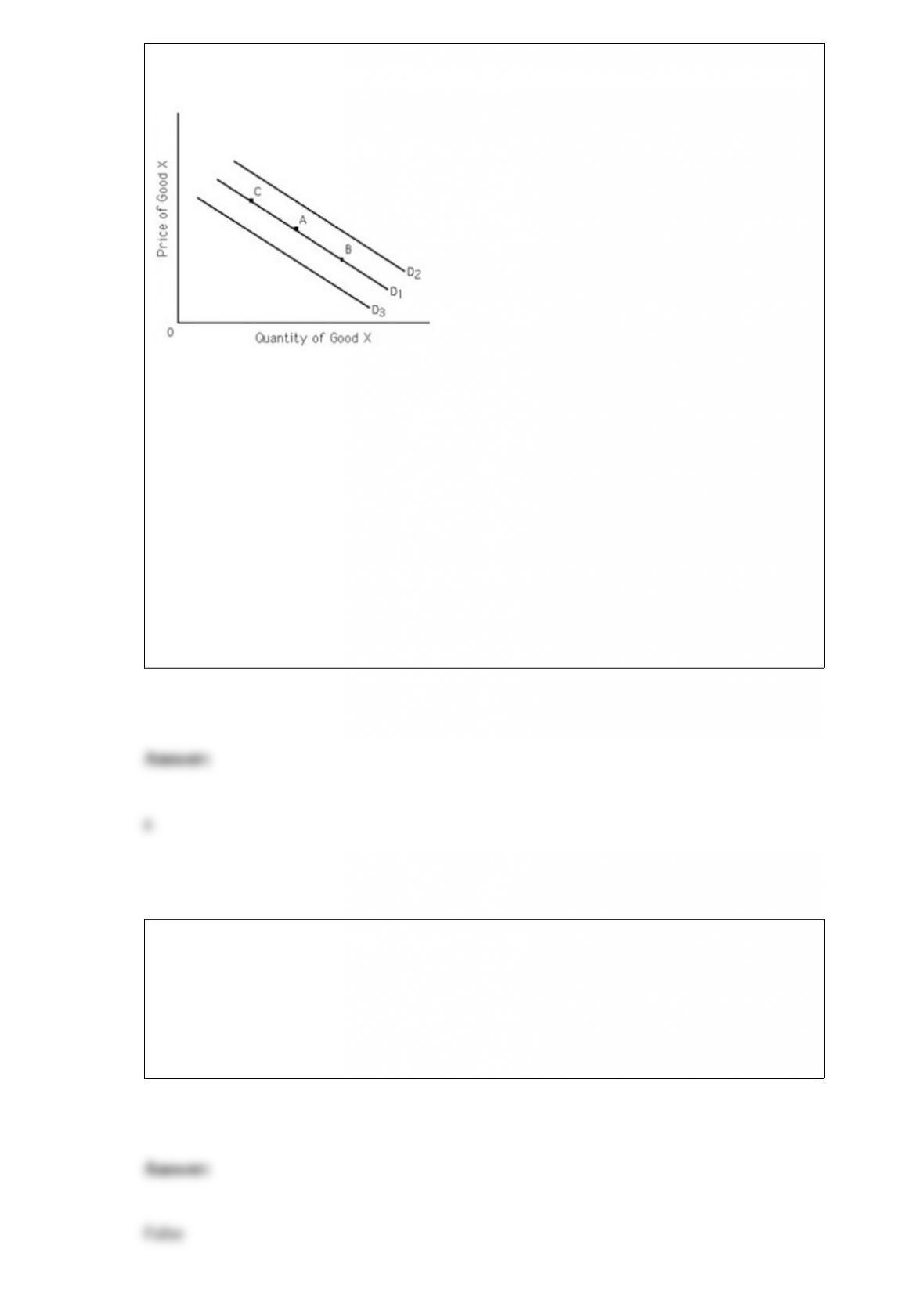
Exhibit 3-6
If an increase in income causes the demand for good X to shift from D1 to D2,then good
X is
a. a normal good.
b. an inferior good.
c. a substitute good.
d. a complementary good.
e. a neutral good.
Consumers receive more consumers’ surplus when tariffs exist than when they do not
exist.
a. True
b. False

Suppose that for Jim the marginal benefit (MB) of producing is $60 and that the
marginal cost (MC) of producing is $10.Suppose also that his marginal benefit of
stealing is $50 and the marginal cost of stealing is $10.Is Jim currently maximizing
utility in terms of producing and stealing?If not, should he produce more and steal less,
or produce less and steal more to move toward utility maximization?
a. Yes, Jim is maximizing utility.
b. No, Jim is not maximizing utility.Since the MB/MC ratio for producing is less than
the MB/MC ratio for stealing, Jim should produce more and steal less.
c. No,Jim is not maximizing utility.Since the MB/MC ratio for producing is greater than
the MB/MC ratio for stealing, Jim should produce more and steal less.
d. No,Jim is not maximizing utility.Since the MB/MC ratio for producing is greater than
the MB/MC ratio for stealing, Jim should steal more and produce less.
If the demand for a product is perfectly elastic, a tax of $1 per unit imposed on sellers
will
a. increase the market price by $1 per unit.
b. increase the market price by less than $1 per unit.
c. decrease the market price by $1 per unit.
d. decrease the market price by less than $1 per unit.
e. not affect the market price.
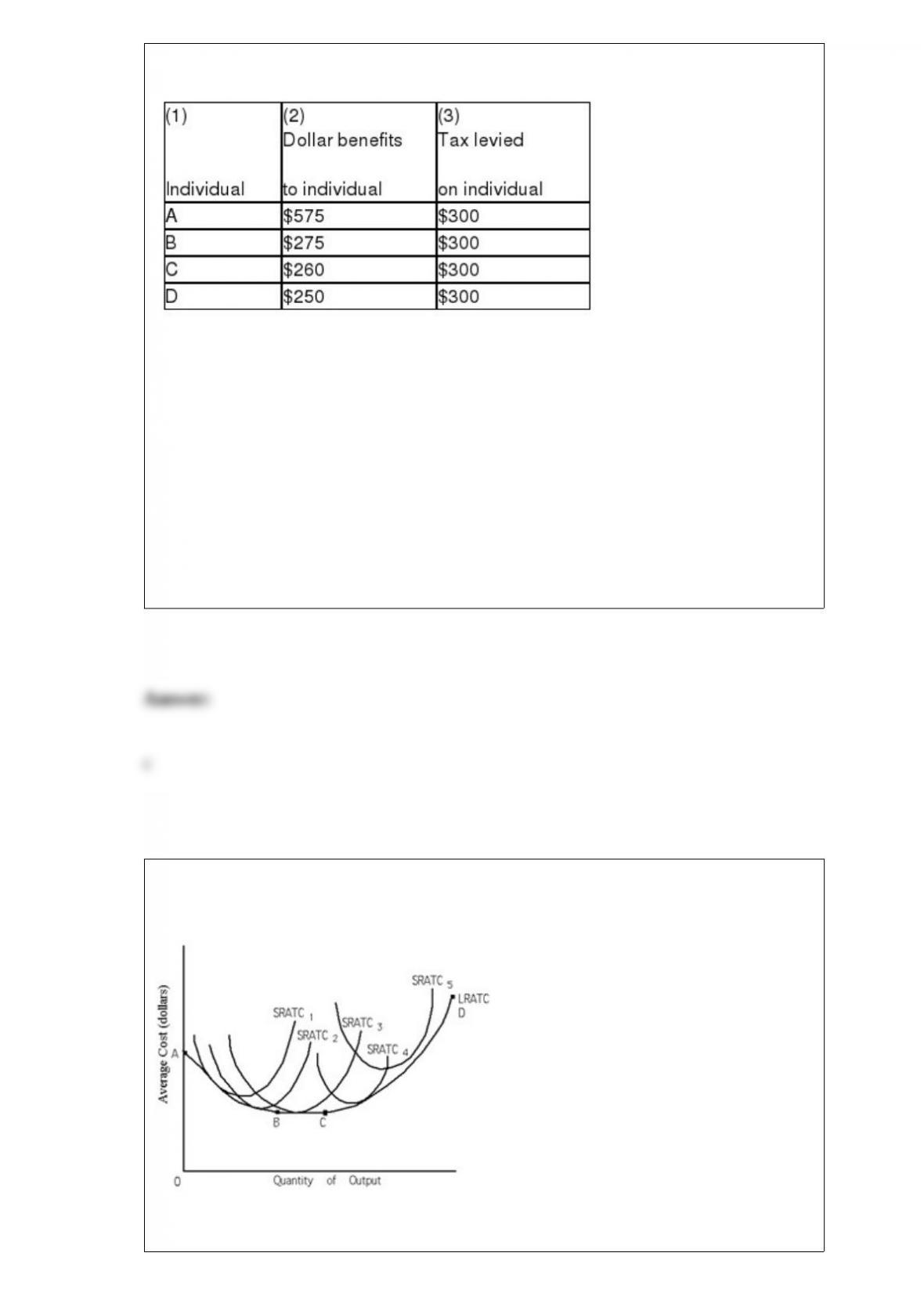
Exhibit 32-1
The exhibit shows the breakdown of benefits and costs for a four-person town
considering the purchase of an additional $1,200 worth of books for the public library.If
simple majority voting determines the outcome, the books will
a. be purchased because more persons are for it than against it.
b. be purchased because the total benefits are greater than the total costs.
c. not be purchased even though total benefits exceed total costs.
d. not be purchased because the total costs are greater than the total benefits.
Exhibit 22-5
The minimum efficient scale is at
a. point A.

b. point B.
c. point C.
d. point D.
e. points B and C.
The right-to-work law specifies that
a. everyone in the country has a right to work at a decent wage.
b. every worker has a right to a two-week paid vacation.
c. everyone in the country has a right to work, although it does not specify at any
particular wage.
d. every worker has a right to require his employer to give him 30 days notice before
terminating employment.
e. it is illegal to require union membership for purposes of employment.
Minerals, animals, water and forests are all considered to be part of the resource
category known as
a. capital
b. entrepreneurship

c. labor
d. land
e. none of the above
Which of the following is one of the assumptions upon which the theory of
monopolistic competition is built?
a. There are many sellers.
b. There are few buyers.
c. It is difficult to enter the industry.
d. Each firm in the industry produces a homogeneous product.
What is the difference between an inflation-indexed Treasury bond, and a Treasury
bond that is not indexed?
a. An inflation-indexed Treasury bond guarantees a certain real rate of return, while a
nonindexed Treasury bond does not.
b. A nonindexed Treasury bond guarantees a certain real rate of return, while a
nonindexed Treasury bond does not.
c. An inflation-indexed Treasury bond can only be purchased directly from the Federal
Reserve, while a nonindexed Treasury can be purchased through a broker.
d. An inflation-indexed Treasury bond always guarantees the purchaser a 5 percent rate
of return, while a nonindexed Treasury bond does not.
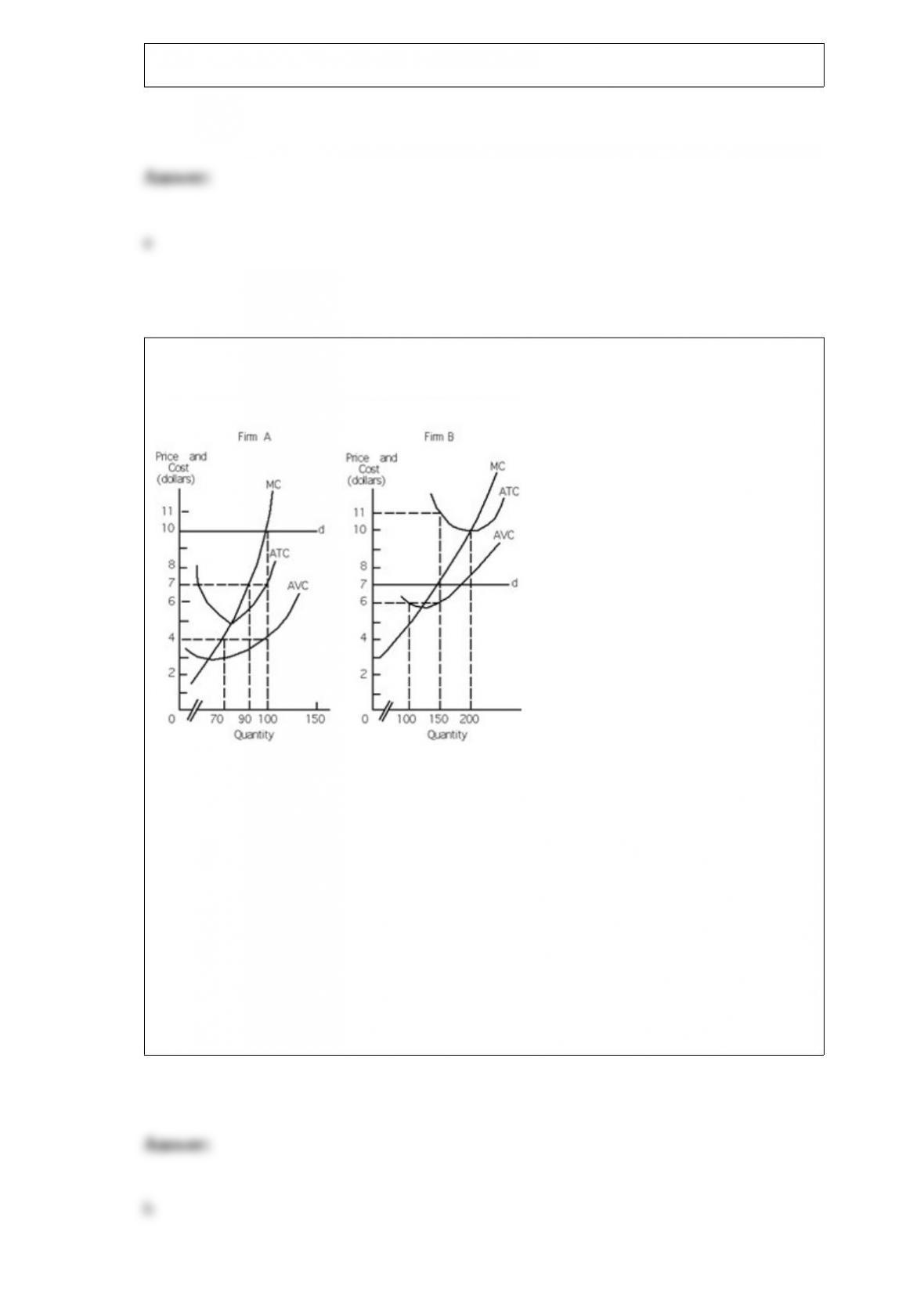
Exhibit 23-8
What is the total fixed cost of firm B at the profit-maximizing (or loss-minimizing)
level of output?
a. $5
b. $750
c. $90
d. $400
e. There is not enough information provided to answer this question.

Joe is currently in consumer equilibrium by consuming cheese and crackers, such that
the last cracker consumed yielded 8 utils and the last piece of cheese consumed yielded
12 utils. Assume the price of crackers is two cents per cracker and the price of cheese is
three cents per piece. If the price of crackers increases to four cents, Joe should
__________ his consumption of crackers and his marginal utility from crackers will
__________ and also __________ his consumption of cheese and his marginal utility
from cheese will __________.
a. increase; increase; increase; increase
b. increase; increase; decrease; decrease
c. increase; decrease; increase; decrease
d. decrease; increase; decrease; increase
e. decrease; increase; increase; decrease
Marginal social benefits are equal to
a. marginal private benefits + marginal internal benefits.
b. marginal private benefits – marginal internal benefits.
c. marginal private benefits + marginal external benefits.
d. marginal private benefits – marginal external benefits.
The administrative costs per dollar are lower for a large loan than for a small loan.
a. True
b. False
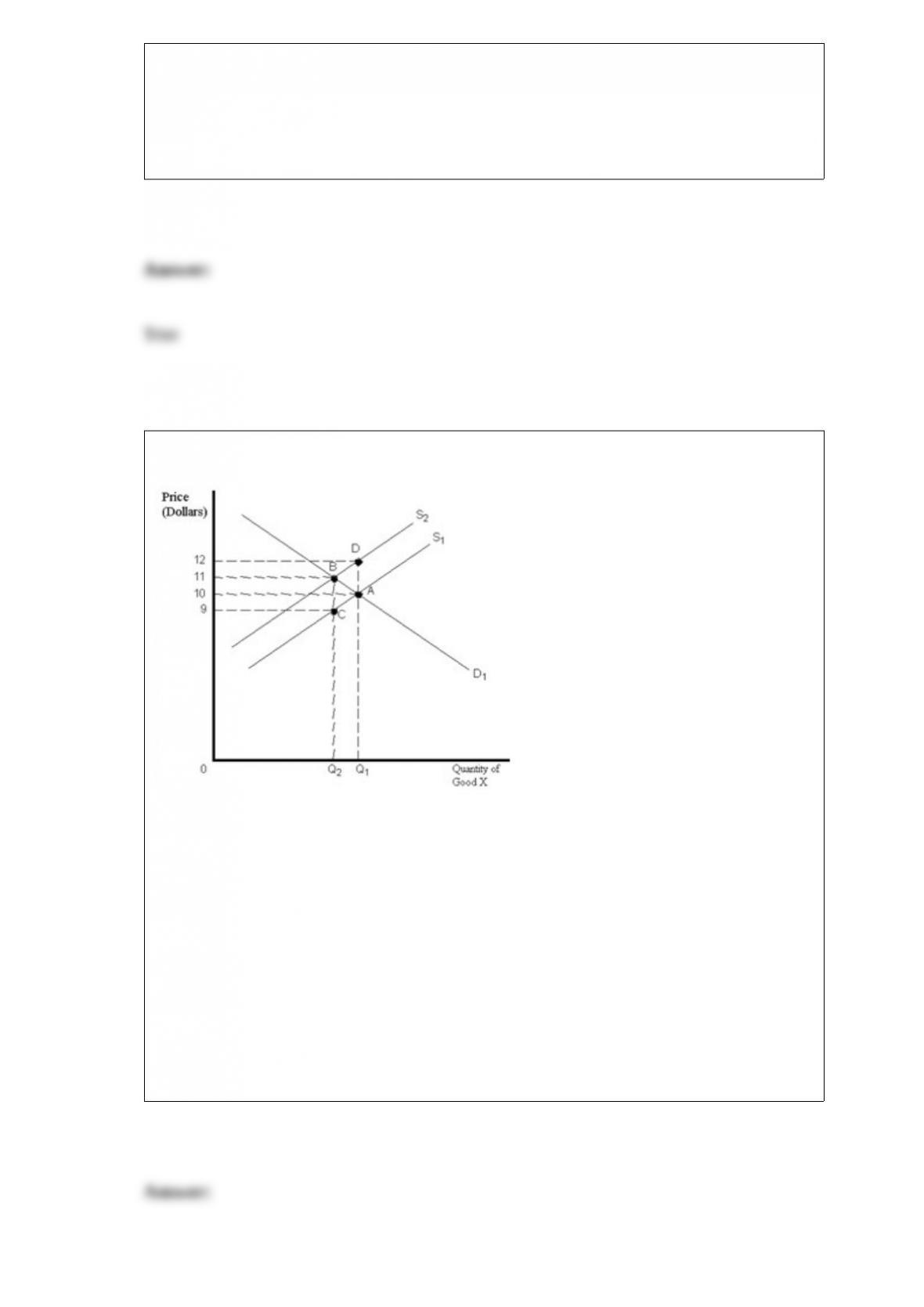
Exhibit 20-8
The market for good X is initially at point A. A tax is then placed on the production of
good X. It follows that the tax is equal to
a. $1 per unit.
b. $2 per unit.
c. $12 in total.
d. $10 in total.
e. none of the above

Which of the following statements is false?
a. Consumers receive more consumers’ surplus when tariffs do not exist.
b. Producers receive more producers’ surplus when tariffs do exist.
c. A tariff results in a net loss to society.
d. With a tariff, the gains to the winners are less than the losses to the losers.
e. none of the above
Which of the following statements is true?
a. At a high level of output, AFC is zero.
b. If the law of diminishing marginal returns did not exist, then the marginal cost curve
would not have an upward-sloping portion.
c. The marginal cost curve cuts the average fixed cost curve at its minimum.
d. There are no fixed costs in the short run.
e. none of the above