Jones buys two goods, A and B. Currently, Jones receives marginal utility of 24 utils
from good A and pays a price of $1.50 per unit. Jones receives a marginal utility of 43
utils from good B and pays a price of $1.99 per unit. Jones receives __________ per
dollar from good B as he does from good A.
a. the same marginal utility
b. more marginal utility
c. less marginal utility
d. more consumers’ surplus
e. less consumers’ surplus
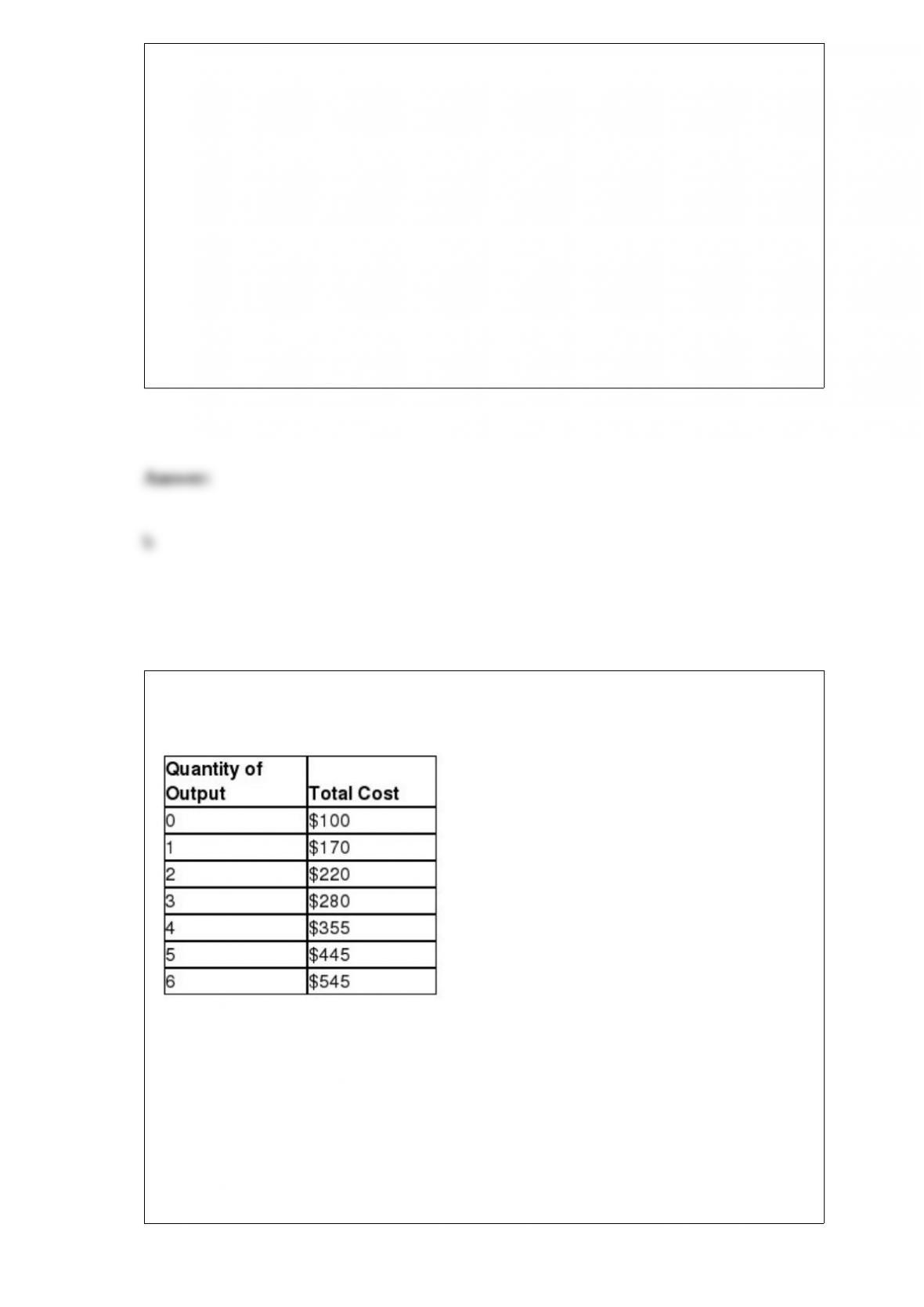
Refer to Exhibit 22-11. Average variable cost at three units of output is
Exhibit 22-11
a. $50.
b. $60.
c. $93.33.
d. $110.
e. There is not enough information provided to answer this question.
The results of the “ultimatum game” reveal that people
a. always behave irrationally.
b. tend to be more concerned with their relative income position in a group than with
their absolute position in the group.
c. tend to be more concerned with their absolute position in a group than with their
relative position in the group.
d. always behave rationally.
e. a and c
The slope of a horizontal line is always equal to zero.
a. True
b. False

Generally, negative externalities result in
a. too much of a good being produced.
b. the socially optimal output of a good being produced.
c. too little of a good being produced.
d. either a or c
e. any of the above
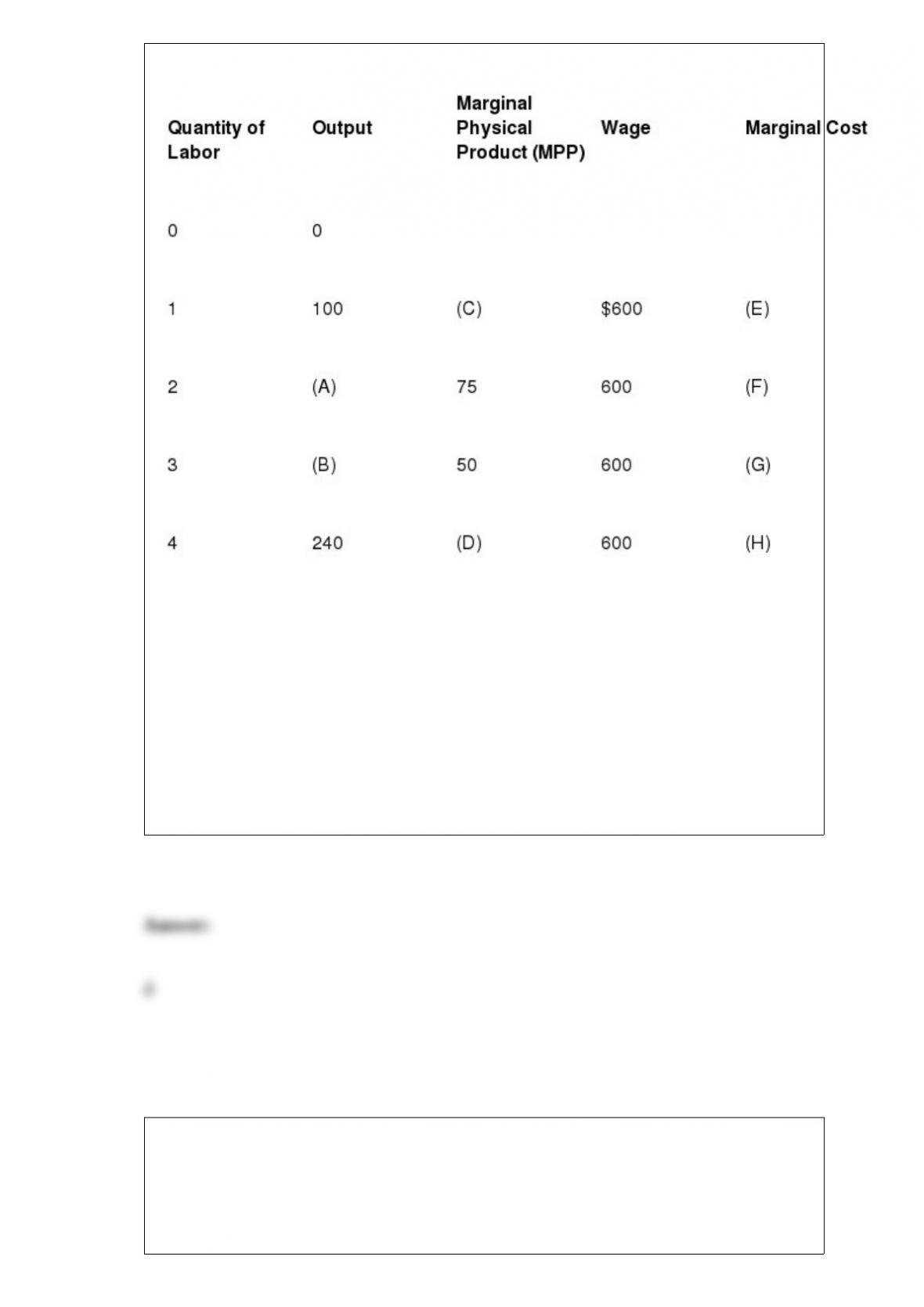
Refer to Exhibit 22-14. What is the marginal cost of producing this good with 1 and 2
laborers working [blanks (E) and (F)], respectively?
Exhibit 22-14
a. $600; $300
b. $60; $30
c. $8; $12
d. $6; $8
e. none of the above
Which of the following statements is true?
a. If the marginal cost curve is above the AFC curve, the AFC curve must be rising.
b. Average total cost equals average variable cost minus average fixed cost.

c. As output increases, the average variable cost curve gets closer to the average total
cost curve.
d. The AFC curve is horizontal as output increases.
What is the maximum value of the Herfindahl index?
a. 10
b. 100
c. 1,000
d. 10,000
e. There is no maximum value of the Herfindahl index.
Why can’t an economist say for certain that a monopolistic competitive firm will always
earn zero economic profits in the long run?
a. Barriers to entry are significant in monopolistic competition.
b. The very large number of buyers indicates that there will always be demand for the
firm’s product.
c. The firms in the industry do not produce identical products.
d. The firms practice price competition, so at least some firms will always be charging a
lower price than other firms and will sell more as a result.
e. The firms face a horizontal demand curve.
Producers’ surplus is the difference between the price __________ receive for a good
and the __________ price for which they would have __________ the good.
a. sellers; maximum; sold
b. buyers; maximum; bought
c. sellers; minimum; sold
d. buyers; minimum; bought
If there is freeway congestion at 8 a.m., we can reduce (or eliminate) the congestion by
a. building more freeways.
b. raising the price to drive on the freeway at 8 a.m.
c. encouraging workers to carpool..
d. a and b
e. a, b,and c
The higher the opportunity cost of making a new friend, the more likely one is to make
a new friend,ceteris paribus.
a. True
b. False
The people most likely to save are those with a
a. low rate of time preference since they only slightly prefer present consumption to
future consumption.
b. high rate of time preference since they greatly prefer present consumption to future
consumption.
c. low rate of time preference since they greatly prefer present consumption to future
consumption.
d. efficient rate of time preference since they do not prefer consuming luxury goods to
necessities.
e. roundabout rate of time preference since they don’t really care about consuming.
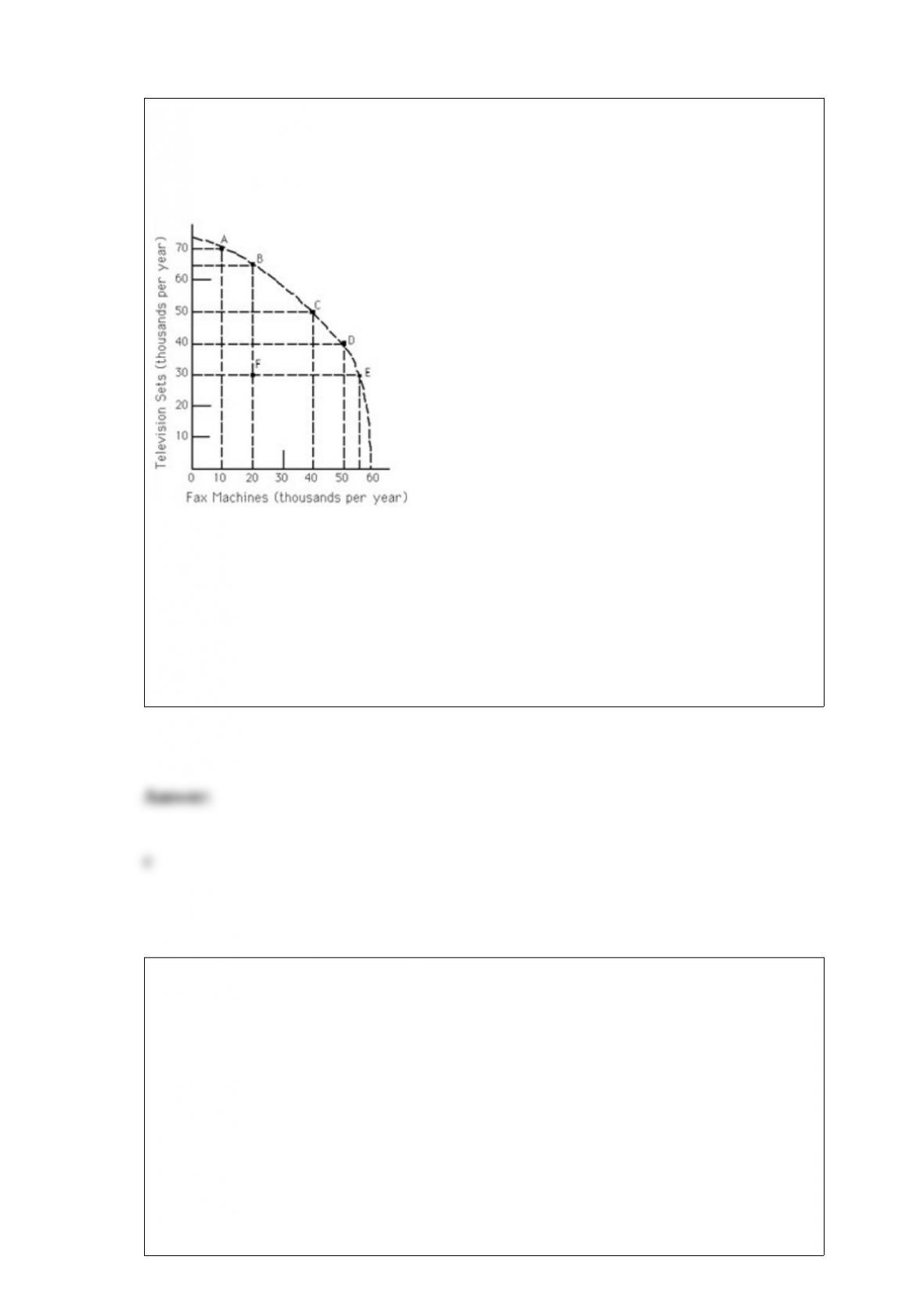
Refer to Exhibit 2-5. Given available resources and technology, this economy can
produce 50,000 television sets and 50,000 fax machines only if it chooses to
Exhibit 2-5
a. have an equal distribution of goods.
b. operate at both points C and D, simultaneously.
c. produce at point C.
d. produce at point D.
e. none of the above
A person who lives in a good-climate city says, “It’s expensive to live here, but at least
the climate is free.”In terms of a theory advanced in the textbook, this person has either
forgotten or is unaware that
a. New York City is not a good-climate city and it is expensive to live there. In other
words, not all good-climate cities are expensive and not all bad-climate cities are cheap.
b. part of the reason it’s expensive to live in the city is because of the good climate.
c. good-climate cities have more outdoor entertainment entities and activities and
thereforepeople have to pay higher taxes to support those entities and activities.

d. there is a sunshine tax in most of the country – the more hours of sunshine a day, the
higher the tax.
e. none of the above