
A tax is progressive if it raises a greater fraction of total tax revenue every year.
a. True
b. False
Society benefits from monopolistic competition because the firms are allocatively
efficient.
a. True
b. False
In an attempt to boost enrollment, in January, 1996, a private college in Iowa offered
free tuition for graduating high school seniors from the county where it is located. For
students who accepted the offer, how did this offer affect the opportunity cost of
attending college?
a. The opportunity cost did not change, since lost earnings were still a factor.
b. The opportunity cost became zero for the typical student.
c. The opportunity cost was very low, because the only cost was for books and supplies.
d. The opportunity cost did not change, since tuition was not a factor in computing
opportunity cost.

e. The opportunity cost was lower than if tuition was charged, but there was still a cost.
Milly Miser removes $250,000 from her mattress and opens a checking account. This
single transaction immediately increases the money supply by
a. $250,000.
b. $50,000.
c. $0.
d. −$250,000.
Figure 11-3
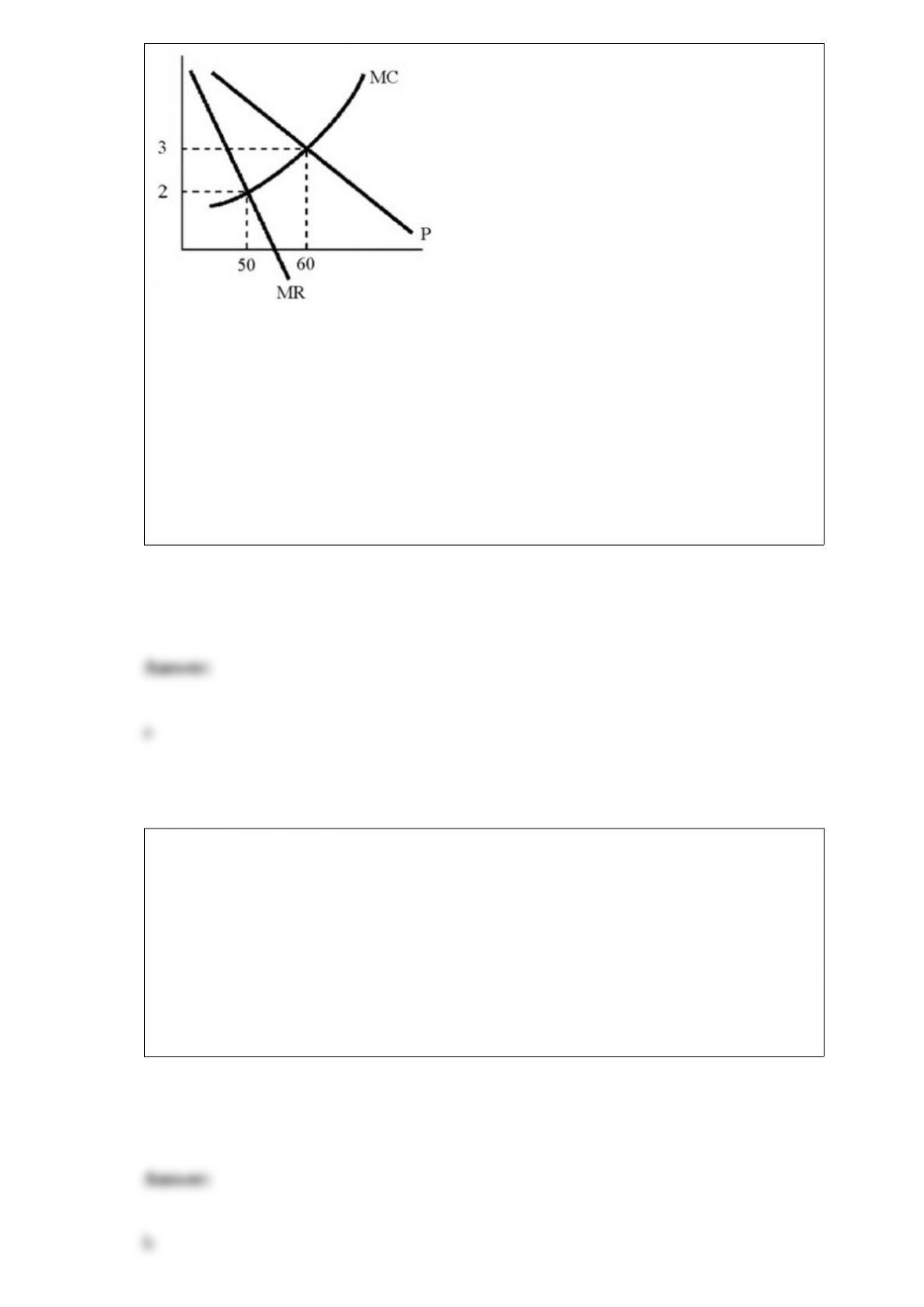
Using the graph in Figure 11-3, the profit-maximizing monopolist will charge a price
a. of more than $3.
b. of $3.
c. between $2 and $3.
d. of $2.
If nominal GDP is $7,700 billion and M1 is $1,000 billion, then velocity is
a. 10.7.
b. 7.7.
c. 7.1.
d. 7.0.

Assume that the government is considering different policies to increase total
expenditures in order to reduce unemployment. Which of the following would achieve
this objective?
a. decreasing taxes
b. increasing government spending
c. increasing transfer payments
d. All of the above are correct.
Business cycles in the United States after World War II have been
a. more severe than before the war.
b. less severe than before the war.
c. the same as the pre-war cycles.
d. easier to predict than the pre-war cycles.
From the end of World War II until the present, the price level has
a. slowly fallen over time.

b. fluctuated around a downward trend.
c. remained stable throughout the period.
d. fluctuated around an upward trend.
Innovative firms face competition much more quickly than they did one hundred years
ago.
a. True
b. False
On Naomi’s pig farm, Naomi hires all the labor used, grows all the grain fed to the pigs,
and owns the barn. The costs used to calculate the total cost curve include
a. only the cost of labor.
b. only the cost of labor and the cost of grain, which is completely consumed in the
period in which it is grown.
c. only the variable cost of growing grain.
d. the cost of labor, the cost of growing grain, and the opportunity cost of the barn.

The demand curve for funds is downward sloping because
a. the value of the MRP in terms of today’s money shrinks as the interest rate rises.
b. future returns must be discounted more when the interest rate rises.
c. as the interest rate rises, more and more investments become unprofitable.
d. All of the above are correct.
Policy makers should manage aggregate demand so that it grows in line with the
economy’s capacity to produce. This task is the realm of
a. growth policy.
b. stabilization policy.
c. labor policy.
d. inflation policy.

In the long run,
a. both monopolists and perfectly competitive firms produce at minimum long-run
average total cost.
b. a monopolist will exit the industry if he is earning zero economic profit.
c. a monopolist will always charge a higher price than he charges in the short run.
d. consumer surplus is smaller if an industry is a monopoly than if it is perfectly
competitive.
In comparison to the oversimplified formula for the multiplier, the real-world multiplier
is
a. lower.
b. higher.
c. almost equal to it.
d. higher if taxes are included.
Income is measured as
a. average cash holdings per time period.

b. change in cash holdings per time period.
c. some amount per time period.
d. some amount at a point in time.
Define the following terms and explain their importance to the study of economics.
a. monopolistic competition
b. oligopoly
c. cartel
d. oligopolistic interdependence

If the income effect of a change in the wage dominates the substitution effect, then
workers will want to work more when the wage increases.
a. True
b. False
The federal government collects taxes on
a. real capital gains.
b. nominal capital gains.
c. real capital losses.
d. nominal capital losses.

As manufacturing becomes more efficient, services can be expected to become more
costly.
a. True
b. False
The application of new technology refers to
a. imitation.
b. investment.
c. innovation.
d. education.
When equilibrium GDP is below potential GDP, jobs are
a. plentiful and unemployment is low.
b. plentiful and unemployment is high.
c. scarce and unemployment is high.
d. scarce and unemployment is low.

Which of the following situations is a clear application of the benefits principle of
taxation?
a. wealthier people are taxed more heavily
b. heavier vehicles are charged higher tolls on turnpikes
c. state government providing a free education to any child in the state
d. sales of measles vaccine exempt from sales tax
In 2000, many economists believed that the most serious macroeconomic problem
confronting the U.S. economy was an inflationary gap. Which policies would be
effective in dealing with this problem?
a. Increase transfer payments.
b. Increase government purchases.
c. Decrease personal income taxes.
d. Increase personal income taxes.

A straight-line demand curve has the same elasticity throughout its length.
a. True
b. False
The income of Lebron James, for example, is determined by
a. the position of the demand curve.
b. the number of athletes in the NBA.
c. his supply curve for labor services.
d. marginal rent.
A change in the price of important inputs will change the quantity supplied but will not
shift the supply curve.
a. True

b. False
A regulatory agency concerned with “universal service” must
a. prevent high profits in all markets.
b. prevent entry in high-profit markets.
c. prevent cross-subsidization.
d. guarantee marginal cost pricing.
Voluntary exchange
a. is usually beneficial to one party, but not the other.
b. is always beneficial to both parties.
c. is occasionally beneficial to both parties.
d. occurs only between nations, not between individuals.
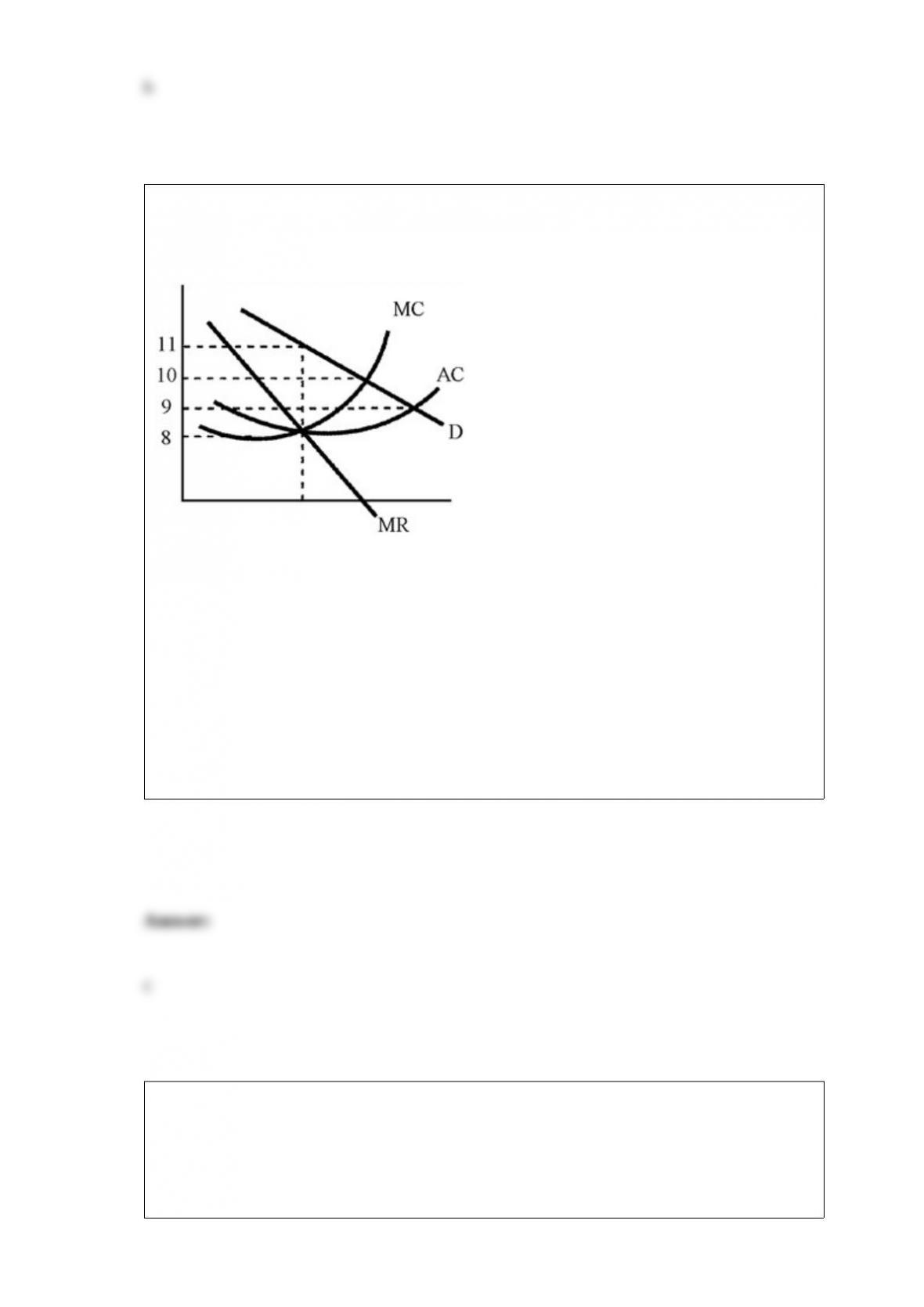
Figure 11-9
In Figure 11-9, how much more than the long-run competitive price will the
profit-maximizing monopolist charge?
a. $1
b. $2
c. $3
d. $11
In 2007, the value of the American dollar rose relative to the euro.
a. True
b. False

If an investor had a $25,000 long-term capital gain on a $100,000 investment from
1984 to 2010, her real rate of return was most likely
a. equal to the expected rate of inflation.
b. equal to the nominal rate of inflation.
c. zero.
d. negative.