An argument in favor of the Federal Reserve adopting inflation targeting is that in the
long run, the Fed can have an impact on inflation but not on real GDP.
In reality, the Fed is unable to use monetary policy to keep real GDP exactly at its
potential level.
One factor which brought on the recession of 2007-2009 was the financial crisis in
2008.
A snack shop inside a hotel in a busy city has a monopoly on food sales if it is the only
food vendor in the hotel that is open 24 hours a day.
As output increases, the distance between average total cost and average variable cost
increases.
In the United States, imports and exports make up more than half of GDP.
As nonunion construction workers replace a unionized work force, the average wage in
the construction sector is likely to rise.
If marginal benefit is greater than marginal cost, output is inefficiently high.
Under the Bretton Woods system, the World Trade Organization (WTO) provided
foreign currency loans to central banks and approved adjustments to the agreed upon
fixed exchange rates.
Autarky is a situation where one country does not trade with other countries.
If the firm is producing no output in the short run, then its total costs are zero.
If the substitution effect of a wage increase dominates the income effect, the labor
supply curve has a positive slope.

Quantity supplied refers to the amount of a good or service that a firm is willing and
able to supply at a given price.
Which of the following statements is true?
A) Individuals who have never been the best at doing anything cannot have a
comparative advantage in producing any product.
B) Individuals who have never been the best at doing anything can still have a
comparative advantage in producing some product.
C) Individuals who have never been the best at doing anything perform all tasks at a
higher opportunity cost than others.
D) Individuals who have never been the best at doing anything must have an absolute
advantage in at least ones task.
Orange juice drinkers want to consume more orange juice at a lower price. Which of the
following events would have this effect?
A) a decrease in the price of orange juice processing
B) an increase in the cost of fertilizer used for orange groves
C) a decrease in income, assuming orange juice is a normal good
D) a decrease in the population
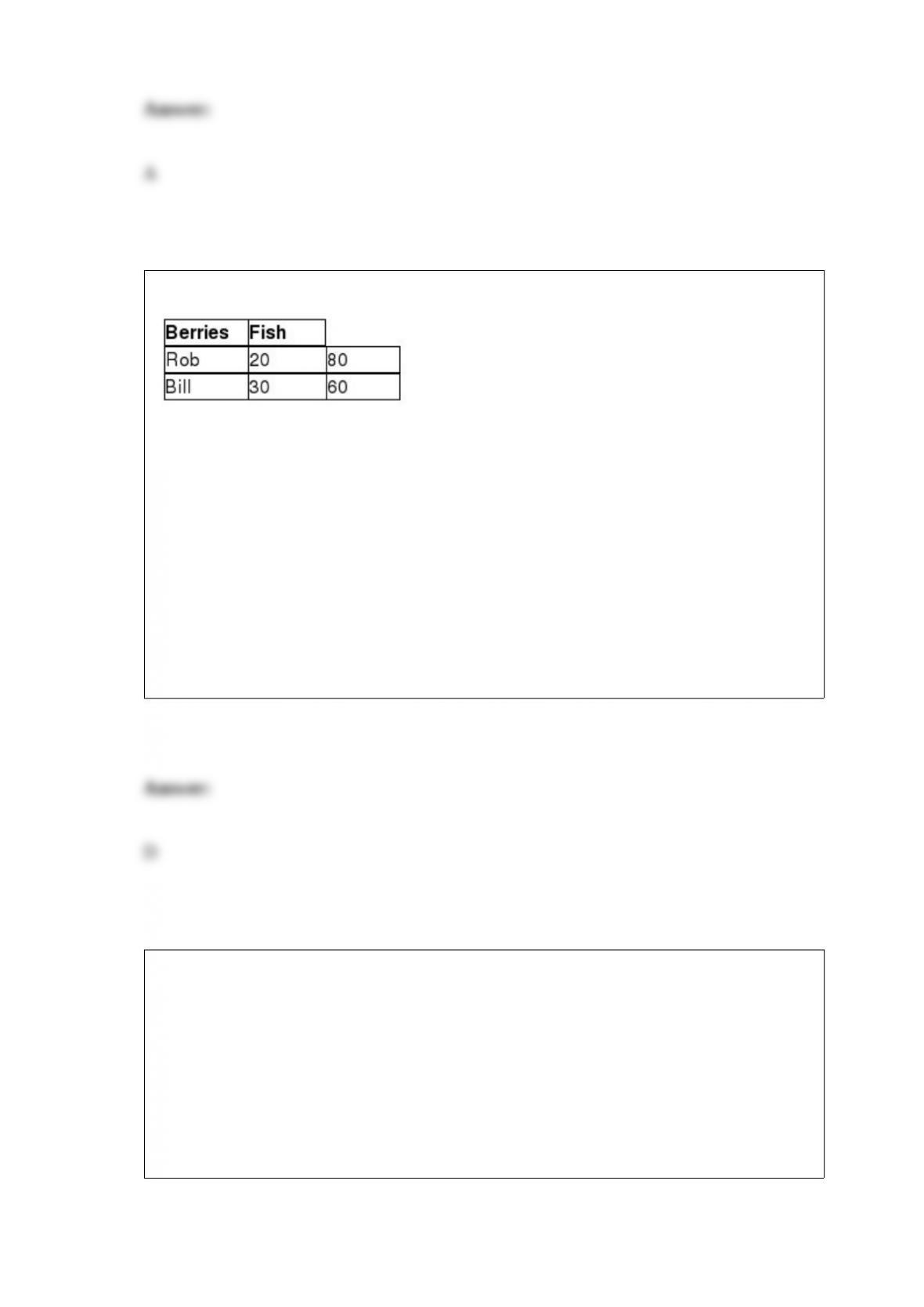
Table 7-1
Rob Crusoe and Bill Friday spent their week-long vacation on a desert island where
they had to find and make their own food. Rob and Bill spent one day each fishing and
picking berries. The table lists the pounds of output Rob and Bill produced. Use the
table above to select the statement that accurately interprets the data in the table.
A) Bill has a comparative advantage in catching fish.
B) Rob has a comparative advantage in picking berries.
C) Rob has a comparative advantage in catching fish and picking berries.
D) Bill has a comparative advantage in picking berries.
For a firm that can effectively price discriminate, who will be charged a lower price?
A) customers who have an elastic demand for the product
B) customers who have an inelastic demand for the product
C) buyers that are members of the largest market segment
D) buyers that are members of the smallest market segment

A decrease in the demand for soft drinks due to changes in consumer tastes,
accompanied by an increase in the supply of soft drinks as a result of reductions in
input prices, will result in
A) a decrease in the equilibrium quantity of soft drinks and no change in the
equilibrium price.
B) a decrease in the equilibrium price of soft drinks and no change in the equilibrium
quantity.
C) a decrease in the equilibrium price of soft drinks; the equilibrium quantity may
increase or decrease.
D) an increase in the equilibrium quantity of soft drinks; the equilibrium price may
increase or decrease.
A fractional reserve banking system is one in which banks hold less than 100 percent of
________ in reserves.
A) loans
B) deposits
C) securities
D) shareholder equity
Which of the following is not “crowded out” by higher interest rates as a result of
expansionary fiscal policy?
A) consumption
B) private investment
C) net exports
D) government spending
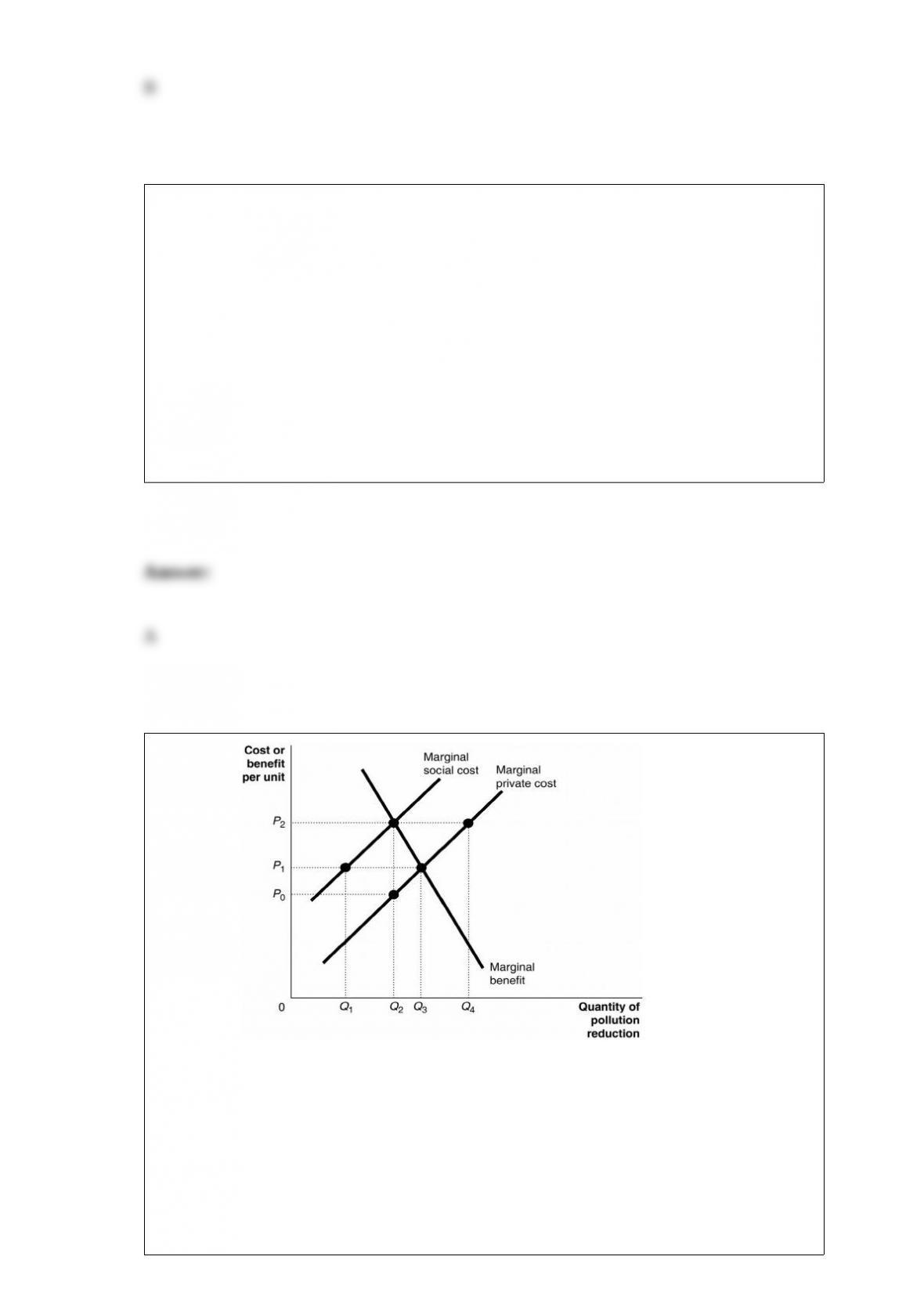
Figure 18-2
Consider the market for U.S. Dollars against the British pound shown in the graph
above. From this graph we can conclude that the dollar price of a British pound has
________ to ________ dollars per pound
A) decreased; 0.46
B) increased; 2.17
C) decreased; 2.00
D) increased; 0.50
If the price of steel increases drastically, the quantity of steel demanded by the building
industry will fall significantly over the long run because
A) buyers of steel are more sensitive to a price change if they have more time to adjust
to the price change.
B) buyers of steel are less sensitive to a price change if they have more time to adjust to
the price change
C) sales revenue in the building industry will fall sharply.
D) profits will fall by a greater amount in the long run than in the short run.
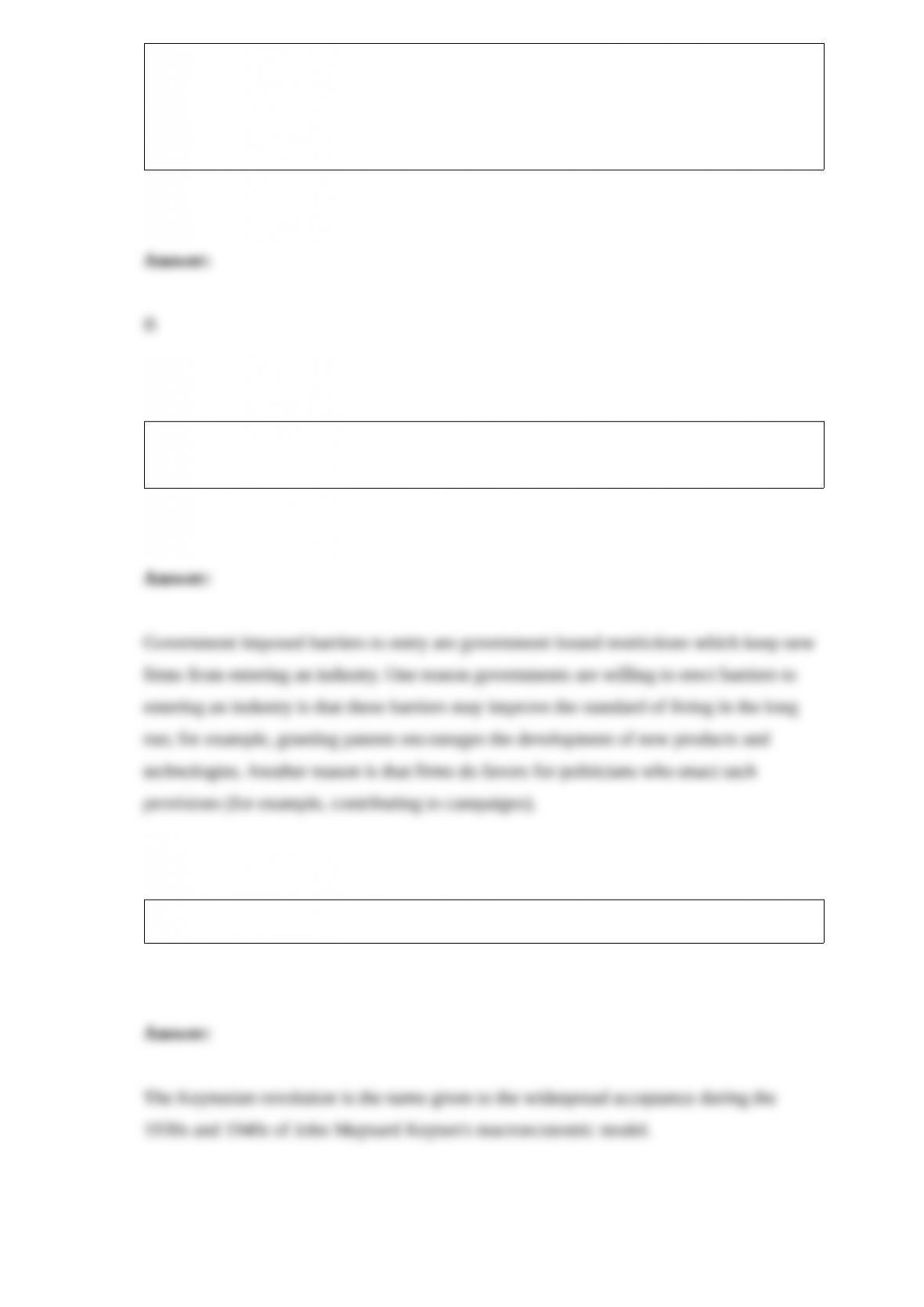
Figure 5-9 Companies producing
toilet paper bleach the paper to make it white. The bleach is discharged into rivers and
lakes and causes substantial environmental damage. Figure 5-9 illustrates the situation
in the toilet paper market.Suppose the government wants to use a Pigovian tax to bring
about the efficient level of production. What should the value of the tax be?
A) (P2-P1 per ton of output
B) (P2-P0 per ton of output
C) (P1-P0 per ton of output
D) P1 per ton of output
What is meant by the term “government-imposed barrier to entry”? Why would a
government be willing to impose barriers to entering an industry?
What does the phrase “Keynesian revolution” refer to?
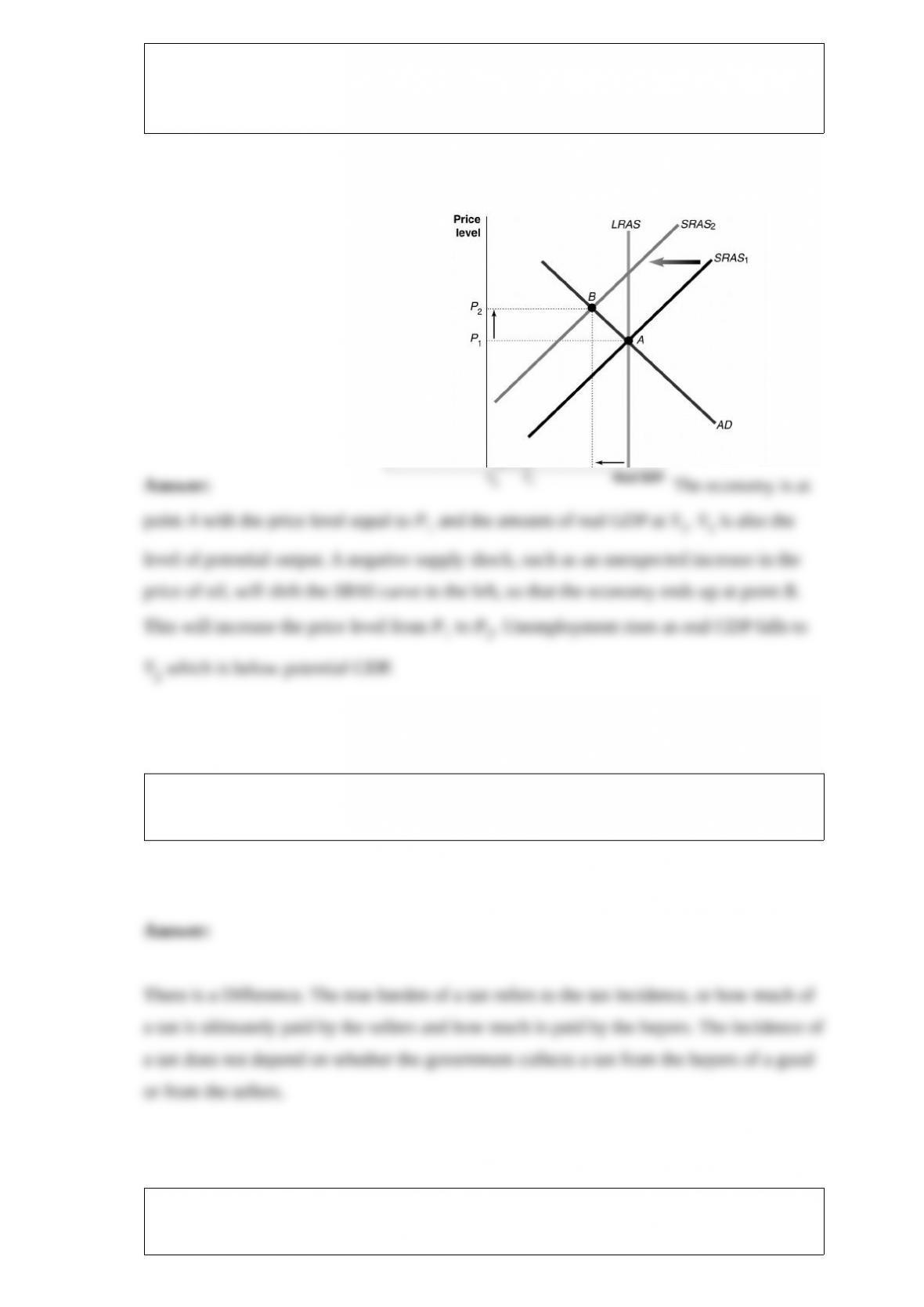
Beginning with long-run equilibrium, use the aggregate demand and aggregate supply
model to illustrate what happens in the short run when the economy suffers a negative
supply shock.
Is there a Difference between the “true burden” of a tax and who is legally required to
pay a tax? Briefly explain.
Using a supply and demand graph, illustrate the effect of the addition of a $10.00 unit
tax on digital cameras, where the entire tax burden falls on the seller. Assume the
equilibrium price before the tax is $125 and the equilibrium quantity is 50,000. What
happens to the price and quantity after the tax is implemented?