
Fine-tuning the economy
a. is made difficult because of the problem of forecasting the many destabilizing events
that regularly occur.
b. has rendered business fluctuations obsolete.
c. became more effective since econometric models were replaced by the leading
indicators.
d. has increased the likelihood of recurring depressions.
e. is now possible, but we lack the will to accomplish it.
The fact that all citizens, whether they pay taxes or not, benefit from expenditures on
national defense is an example of a(n)
a. unfair distribution of income.
b. external economy.
c. external diseconomy.
d. public good.
e. transfer payment.

According to Friedman and Phelps, the long-run Phillips curve is
a. horizontal.
b. vertical.
c. downward sloping from left to right.
d. first upward, then downward sloping from left to right.
e. shifting upward and out from the origin.
In a market economy, consumer purchases depend on their
a. costs and what they can charge.
b. production decisions.
c. income, tastes, and market prices.
d. expenses, supply, and levels of activity.
e. past outlook and state of technology.
The sales tax
a. is the major source of revenue for local government.

b. is never applied to food or medical purchases.
c. is usually at the rate of 1″2 percent.
d. is completely shifted to the consumer.
e. imposes a relatively greater burden on the poor.
The existence of relative scarcity
a. refers to the fact that people only desire what they cannot have.
b. is no longer relevant to the U.S. economy.
c. creates the need to choose how to allocate resources.
d. emphasizes the need to conserve free resources.
e. means that every country can produce enough to fully satisfy every citizen’s wants.
The following questions are based on the following demand schedule for wheat:
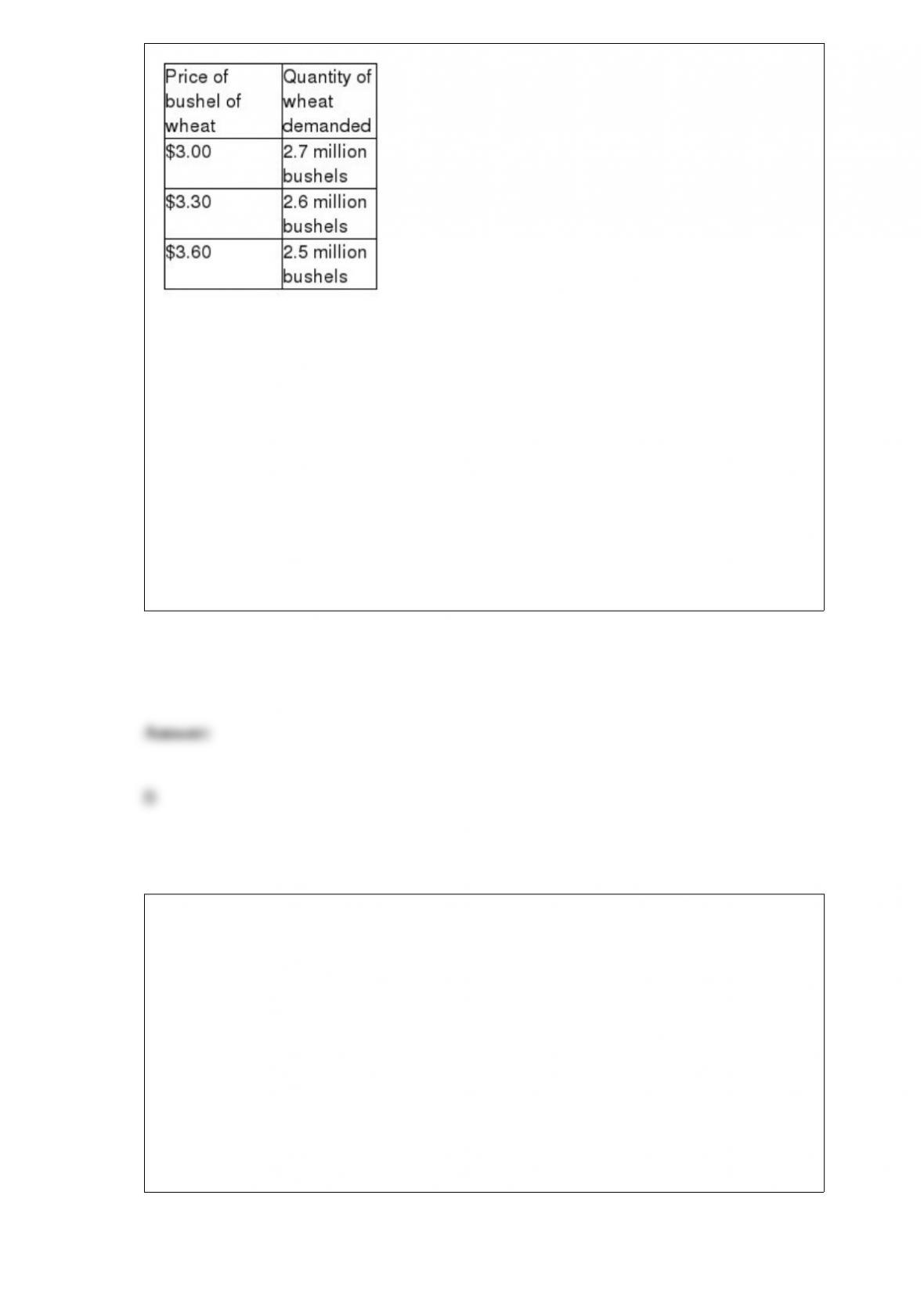
What is the arc price elasticity of demand for wheat when the price of a bushel is
between $3.30 and $3.60?
a. 0.33
b. 0.45
c. 0.79
d. 2.22
e. 3.00
The issuance of enforceable rules for waste disposal represents a pollution control
policy based on
a. direct regulation.
b. tax credits.
c. subsidies.
d. effluent fees.
e. financial incentives.

At the equilibrium price
a. scarcity is eliminated.
b. everyone is content.
c. there is no inflation.
d. price equals quantity.
e. quantity demanded equals quantity supplied.
In part, the wage-price spiral
a. is at the heart of demand-pull inflation.
b. is an example of too much money chasing too few goods.
c. is an outgrowth of a perfectly competitive market structure.
d. occurs when labor productivity rises faster than wage rates.
e. results from the presence of significant market power in the hands of firms and their
workers.

A variable input is one that
a. is undependable.
b. will be used as a last resort.
c. is unnecessary in a production function.
d. can be increased or decreased as output rises or falls.
e. is unaffected by changes in production.
Proposed causes of the Great Recession include all of the following EXCEPT
a. irresponsible lending practices.
b. the bubble mentality.
c. high interest rates implemented by the Federal Reserve.
d. legislation promoting home ownership.
e. unencumbered access to global capital markets.

The idea that the pursuit of private self-interest by consumers and firms also promotes
the public interest is called
a. roundabout production.
b. the circular flow.
c. opportunity cost.
d. the invisible hand.
e. innovation.
In part, supply-side inflation
a. is at the heart of demand-side inflation.
b. is an example of too little money chasing too many goods.
c. is an outgrowth of a perfectly competitive market structure.
d. occurs when labor productivity rises faster than wage rates.
e. results from significant price increases of important resources.

An oligopoly market structure prevails in an industry in which there are
a. no barriers to entry.
b. demand curves that slope upward to the right.
c. few firms.
d. conditions that keep individual firms’ sales low relative to the market.
e. no short- or long-run profits.
If the United States and Britain were both on the gold standard with the dollar worth
1/20 of an ounce of gold and the pound worth 1/5 of an ounce of gold, the exchange
rate in terms of the dollar to the pound would be
a. $0.10.
b. $0.50.
c. $1.
d. $4.
e. $5.
If disposable income rises by $100 billion and personal consumption expenditure rises

by $60 billion, what is the marginal propensity to save?
a. 0.60
b. 0.40
c. “0.40
d. “1.50
e. impossible to calculate from these figures
If the income elasticity of demand for a good is negative
a. changes in income have no effect on consumption of the good.
b. a decrease in income causes consumption of the good to fall.
c. an increase in income causes consumption of the good to fall.
d. consumption of the good may increase or decrease without any change in income.
e. and if the good’s price falls, income also falls.
If price elasticity of demand is 0.3, the demand for the commodity is
a. of unitary elasticity.

b. price postelastic.
c. price elastic.
d. price inelastic.
e. price preelastic.
The terms of trade is the
a. amount of goods a country can consume without diminishing its supply of gold.
b. quantity of imported goods a country can obtain in exchange for a unit of domestic
goods exported.
c. ratio of the increase in the domestic rate of unemployment for every 1 percent
increase in imports.
d. change in the value of one currency relative to another.
e. ratio of net exports to the GDP.
In addition to misallocating resources, monopolists are also accused of
a. being slow to innovate and adopt new technologies.

b. equating average costs with demand.
c. producing more of a good than society can absorb.
d. charging the highest prices they can possibly get.
e. maximizing per unit profits rather than total profits.
One of the first U.S. presidents to actively encourage the application of the antitrust
laws was
a. Grover Cleveland. d. Franklin D. Roosevelt.
b. Ronald Reagan. e. Andrew Jackson.
c. Theodore Roosevelt.
Answers to economic issues that depend on an individual’s values or preferences are
called ________ economics.
a. positive
b. passive
c. normative
d. mechanical
e. comparative
The phase of the business cycle in which output is lowest relative to its potential level is
the
a. peak.
b. trough.
c. recession.
d. expansion.
e. trend.
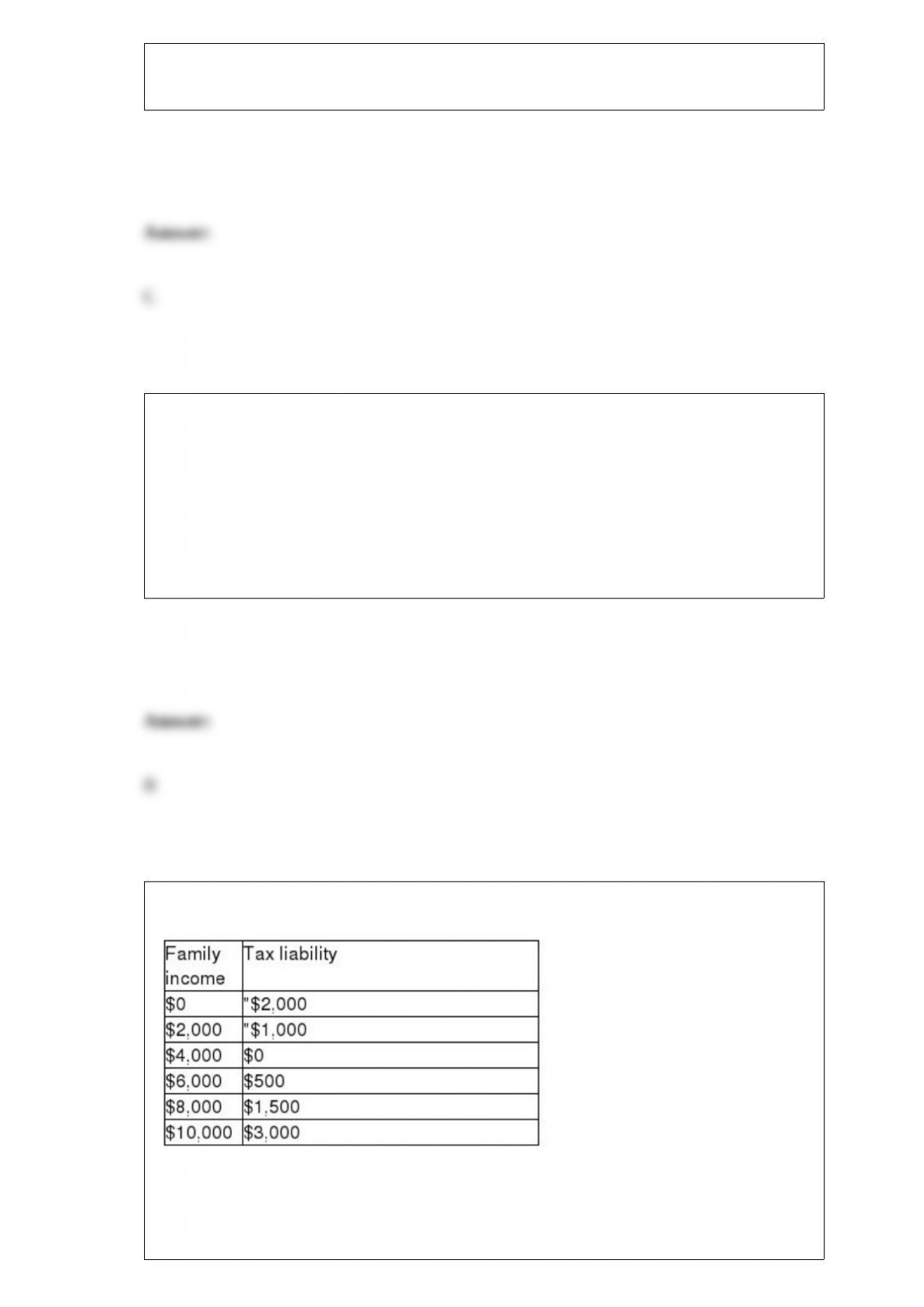
This table shows a payment schedule for a hypothetical negative income tax program.
From the table, it can be seen that
a. families with an income of $2,000 must pay taxes of $1,000.

b. $4,000 is the poverty level of income.
c. families earning $3,000 find their after-tax incomes increased to $3,500.
d. the tax rate on incomes above $4,000 is constant.
e. this tax scheme is a regressive tax.
After the stock market crash of 1987, the financial emergency of 1998, and September
11, 2001, the Federal Reserve Bank pursued a policy of
a. tightening the money supply and raising interest rates sharply.
b. maintaining steady growth in the money stock to reassure business.
c. flooding the banking system with excess liquidity to ease the threat of personal and
corporate bankruptcies.
d. temporary tax reductions on interest, dividends, and capital-gains income.
e. borrowing reserves from the International Monetary Fund.
The condition whereby firms aggressively undercut one another on price is known as
a. collusion.

b. perfect competition.
c. price warring.
d. profit sharing.
e. price leadership.
The addition to total output due to the addition of the last unit of an input is the
________ of the input.
a. cost d. marginal product
b. supply e. combined product
c. average product
The fundamental idea of fiscal policy is that
a. the government should spend more than it collects in taxes.
b. decision making should be left to the Council of Economic Advisers.
c. the government can change the equilibrium GDP by promoting a change in public
and/or private spending.
d. the government should always balance its budget.

e. unemployment is a less serious concern than inflation.
A major factor that weakened Standard Oil’s monopoly power prior to being broken up
by the Supreme Court in 1911 was
a. the discovery and development of the Texas and Oklahoma oil fields.
b. an increase in the demand for oil brought about by the increase in automobile
ownership.
c. the government regulation of Standard Oil as a natural monopoly.
d. the increased use of ethanol, which is made from corn, as a source of fuel.
e. the significant losses incurred while searching and drilling for oil.
The saving function assumes that personal saving depends primarily on
a. interest rates.
b. the amount of investment.
c. the difference between the average and marginal propensities to consume.
d. disposable income.
e. the unemployment rate.
In the United States collusive arrangements are difficult to accomplish and maintain for
long periods because
a. most U.S. industries are perfectly competitive.
b. most large firms already have monopoly privileges by government franchise.
c. of the existence of antitrust laws.
d. of the inability of colluding firms to estimate relevant demand and cost conditions.
e. of the need to include firms from all over the world in any collusive arrangement.