
The decline in the value of the dollar from 1985 to 1988 was beneficial to
a. American tourists travelling to Europe.
b. firms importing goods into America.
c. American exporting businesses.
d. foreigners holding U.S. government bonds.
Combating recession may require the government to
a. decrease aggregate supply.
b. increase aggregate demand.
c. decrease aggregate demand.
d. decrease government spending.
If there are many close substitutes available for a good, its elasticity of demand will be
higher.
a. True
b. False

Economic rent is a payment for a factor of production that elicits an increase in the
quantity supplied.
a. True
b. False
In contrast to the typical Republican Party laissez-faire policies, President Richard
Nixon in 1971 introduced
a. mandatory drug testing of cabinet officers.
b. monetary targets for the Federal Reserve Board.
c. wage and price controls.
d. mandatory gold purchases by the U.S. Treasury.
The U.S. debt problem is caused by the government only; individuals don’t go into debt.
a. True
b. False
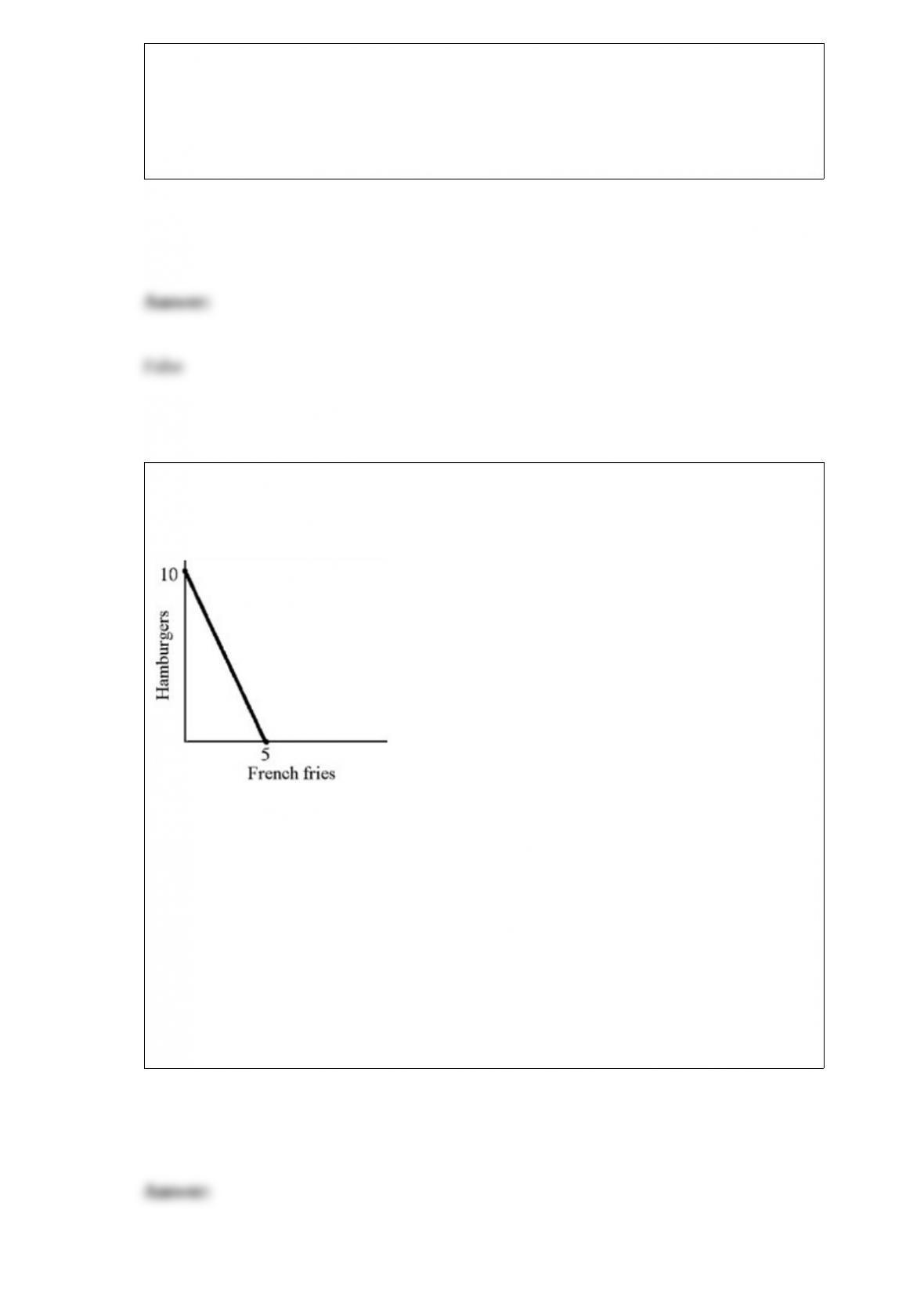
Figure 5-5
In Figure 5-5, if the household is spending enough of its budget to purchase 4 orders of
fries and the price of an order of fries is $2, the remainder of the budget available for
hamburgers is
a. $10.
b. $12.
c. $16.
d. $20.

Economists observed the following growth rates in the fourth quarter of 1995: real GDP
= 2.8 percent; M1 = 7.8 percent; GDP Deflator = 2.2 percent. Given this data, the
growth of velocity was approximately
a. −7.8 percent.
b. −5.0 percent.
c. −2.8 percent.
d. −2.2 percent.
e. −2.0 percent.
In the long run, foreign labor remains cheap when and if
a. it becomes highly efficient and competes successfully internationally.
b. countries erect barriers to trade between poor countries.
c. productivity increases more rapidly in poor countries than in rich countries.
d. it remains inefficient compared to other countries’ labor.

A profit-maximizing firm always
a. sells its output at P = MR.
b. produces at the output at which MR = 0.
c. hires labor until the MRP of labor = 0.
d. produces every unit of output for which MR > MC.
E-cash cards are considered a major portion of the modern money supply.
a. True
b. False
Individuals will have different value judgments about the appropriate rate of
unemployment and the appropriate rate of inflation.
a. True
b. False

Individuals and government have been contributors in harming the environment.
a. True
b. False
A recessionary gap exists when aggregate demand is above the full employment level of
output.
a. True
b. False
The difference between the purchase price of a financial asset and the sale price of the
asset is called a(n)
a. capital gain.
b. dividend.

c. profit.
d. investment.
Policy lags are typically much shorter for monetary policy than for fiscal policy.
a. True
b. False
One reason why critics argue that large firms should not be broken up is that in some
cases
a. large firms have a concentration of economic power.
b. large firms are less-efficient producers.
c. many smaller firms would be less-efficient producers.
d. there is no economic reason to break up large firms that may have some control over
the market.

Marxists and leaders of communist economies actually often admire the market
mechanism for its
a. efficiency in allocation of resources.
b. fairness in distribution of output.
c. maximization of net benefits for consumers.
d. effectiveness in achieving high rates of growth.
One implication of human capital theory is that college graduates should earn
substantially less than high school graduates.
a. True
b. False
Which of the following would a macroeconomist classify as capital?
a. a software program for an accounting firm

b. a share of stock in General Electric
c. a corporate bond from IBM
d. All of the above are types of capital.
A supply curve can be thought of as
a. a graphical display of “market potential.”
b. a graphical representation of the information in a supply schedule.
c. showing the maximum quantities that firms are able to produce.
d. a forecasting tool.
e. All of the above are correct.
Economic discrimination and prejudice
a. are synonymous.
b. must both exist in statistical discrimination.
c. often occur together.

d. are mutually exclusive.
A recent issue of the Wall Street Journal headlined a story, “Bond Prices End Lower.”
From this we can conclude
a. interest rates fell.
b. interest rates rose.
c. interest rates did not change.
d. stock prices fell.
The budget deficits of the 1980s and early 1990s differ from others in the post-World
War II era in that they were
a. a result of the Fed rather than a change in fiscal policy.
b. temporary rather than structural, and pose no threat to the economy.
c. not contracted to fight a war or end a recession.
d. contracted as part of a program to plan the economy.

Horizontal equity is a difficult concept to implement because
a. it is difficult to determine how unequally unequals should be treated.
b. it is difficult to measure ability to pay.
c. it is difficult to determine which people are equally situated.
d. people object to the use of absolute tax liability instead of percentage of income.
Falling energy prices could explain rising labor productivity in the 1990s
a. and the 1980s.
b. and the 1970s.
c. but not the 1980s.
d. but not the 1970s.

In a classic administrative snafu, the Army assigns trained classical musicians to
kitchen duty and places trained cooks in the military band. This is an example of
inefficiency in
a. output selection.
b. production planning.
c. product distribution.
d. market segmentation.
Supply and demand provides the basic explanatory framework for constructing both
microeconomic and macroeconomic models.
a. True
b. False
Requiring all firms to reduce emissions by the same percentage is
a. impossible.
b. inefficient.
c. inequitable.

d. unenforceable under the law.
Governments can deal with externalities through the use of
a. subsidies.
b. taxes.
c. price controls.
d. All of the above are correct.
Both approaches-Keynesian and monetarist-are ways of analyzing
a. aggregate supply.
b. aggregate demand.
c. the average price level.
d. government spending and expenditures.

If the demand for gasoline becomes more elastic over time,
a. the demand curve will shift out.
b. the demand curve will become flatter.
c. other things being equal, the equilibrium price of gasoline must fall.
d. other things being equal, the equilibrium quantity of gasoline must fall.