1) Consumer surplus is the reason why sometimes a shopper regrets having bought a
particular item.
2) One implication of the median-voter model as applied to a vote regarding how much
government involvement to have in the economy is that most voters would find the
resulting government involvement either too large or too small.
3) The short-run marginal-cost curve is upward-sloping because of the law of
diminishing marginal returns.
4) Marginal analysis is the valuation of insignificant or small benefits from doing
things.
5) Arbitrage refers to the buying and selling activities that cause an equalization of the
rates of return on assets that have substantially different characteristics.
6) A state government seeking to increase its excise-tax revenues is more likely to
increase the tax rate on items with elastic demand.
7) In the taste-for-discrimination model, an increase in the prejudice of employers will
decrease the demand for African-American workers, lower the African-American wage
rate and the ratio of African-American to white wages.

8) In 2010, the bottom 90% of households in the U.S. owned about how many percent
of total wealth in the nation?
A.65%
B.52%
C.36%
D.23%
9) If the marginal propensity to save is 0.2 in an economy, a $20 billion rise in
investment spending will increase:
A.GDP by $120 billion.
B.GDP by $20 billion.
C.saving by $25 billion.
D.consumption by $80 billion.
10) Which of the following best explains why the net flow of illegal immigrants to the
United States has been close to zero (particularly from 2009-2011)?
A.Increases in Mexican birth rates have made migration more costly.
B.Economic growth in Mexico exceeded U.S. growth from 2009-2011.
C.Immigration reform has reclassified many illegal immigrants as legal immigrants.
D.Dramatic cuts in social services to illegal immigrants has led many to return to their
country of origin.
11)
The graph above shows the production possibilities curve for an economy producing
two goods, X and Y. All of the following may allow the economy to produce
combination D in the future, except?
A.Lower unemployment
B.Increasing labor supply
C.Economic growth
D.Technological advances
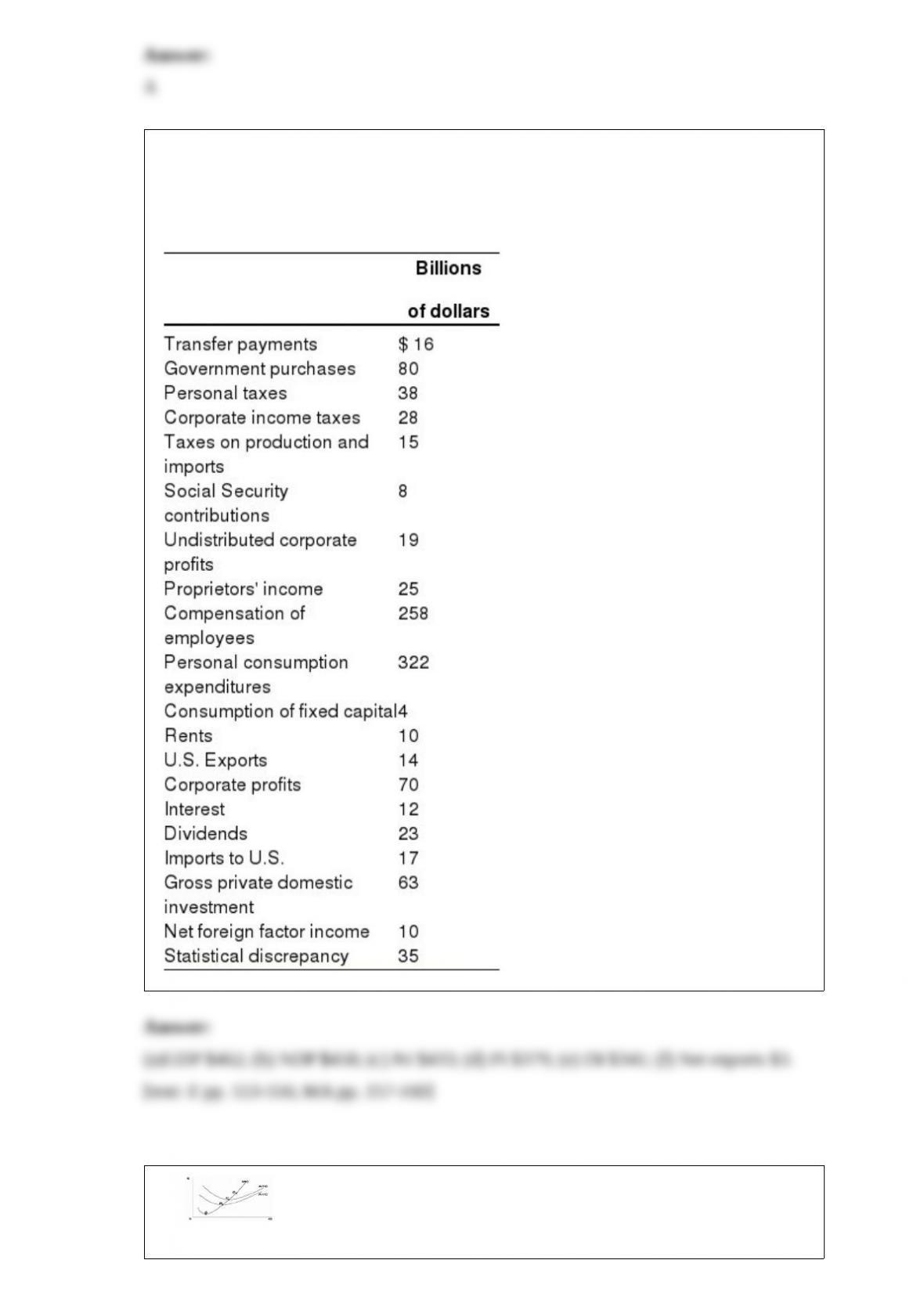
12) The following is a list of figures for a given year in billions of dollars. Using this
data, compute: (a) GDP; (b) NDP; (c) NI; (d) PI; (e) DI; (f) Net exports.
13)
Refer to the above graph. At which point is average product (AP) at its maximum?
A.Point A
B.Point B
C.Point C
D.Point D
14)
Refer to the above graph of a hypothetical market for health care. The efficiency loss
caused by the provision of health insurance covering four-fifths of the cost is given by
the area:
A.egf
B.edc
C.eab
D.cdab
15) When the interest rate in the economy was 10%, the price of a bond with no
expiration date and pays a fixed annual interest of $500 was $5,000. If the interest rate
in the economy falls to 6%, the price of this bond will be about:
A.$4,700
B.$5,030
C.$7,128
D.$8,333
16) Which of the following is a key difference between the economic activities of
government and those of private firms?
A.Private firms face the constraint of scarcity; government does not.
B.Government focuses primarily on equity; private firms focus only on efficiency.
C.Private economic activities create externalities; government activities do not.
D.Government has the legal right to force people to do things; private firms do not.

17) Depositors do not check their banks carefully for stability anymore, because of the
Federal deposit insurance program. This illustrates the problem of:
A.Adverse selection
B.Externalities
C.Moral hazard
D.Public goods
18) The table below shows the weekly demand for hamburger in a market where there
are just three buyers.
Refer to the above table. If the price of hamburger falls from $5 to $3, then the weekly
market quantity demanded will:
A.Increase from 24 to 52
B.Decrease from 52 to 24
C.Increase from 120 to 156
D.Increase from 29 to 55
19) If the dollar-yen exchange rate is $1 for 125 yen, then a Honda CR-V priced at
3,125,000 yen would cost a U.S. importer of such a vehicle:
A.$18,000
B.$21,000
C.$25,000
D.$28,000
20) Answer the question on the basis of the following aggregate demand and supply
schedules for a hypothetical economy:
Refer to the data. The equilibrium price level will be:
A.150
B.200
C.250
D.300
21) Social insurance programs partially replace income that has been lost due to the
following, except:
A.Retirement
B.Disabilities
C.Temporary unemployment
D.Resignation from a job
22) A bank’s required reserves can be calculated by:
A.Dividing its excess reserves by its required reserves
B.Dividing its required reserves by its excess reserves
C.Multiplying its checkable-deposit liabilities by the reserve ratio
D.Multiplying its checkable-deposit liabilities by its excess reserves
23) During and immediately following the severe recession of 2007-2009, commercial
bank reserves held on deposit in Federal Reserve Banks:
A.rose to a high of 50 percent of total checkable deposits held by banks.
B.fell significantly as commercial banks withdrew reserves to pay off heavy debt
obligations.
C.increased significantly because of Fed purchases of securities from commercial banks
and the paying of interest on bank reserves.
D.increased significantly because the Fed increased the required reserve ratio.
24) “Immigration can be viewed as an investment decision.” Explain.
25) Use the below axes to draw a supply and demand diagram that illustrates the
long-run situation in agriculture. Explain the problem.
26) Describe the law of diminishing marginal utility. On what assumptions is this law
based?
27) Use the graph below to explain the inflationary expenditure gap.
28) A representative for a business company stated at a recent press conference that,
“Unions provide little benefits to the economy, resulting in inefficiency and loss of
productivity.” Can you counter his statement?
29)
30) How does unanticipated deflation affect incomes, debts, and savings?

31)