
Suppose at a price of $4 and at a price of $6, John purchases 40 units of good X. Given
this information, we know that
a. John’s entire demand curve for good X is perfectly elastic.
b. John’s entire demand curve for good X is inelastic.
c. John’s demand for good X is perfectly inelastic between the prices of $4 and $6.
d. John’s demand for good X is perfectly elastic between the prices of $4 and $6.
e. John’s entire demand curve for good X is unit elastic.
According to the Coase theorem, under certain conditions the market can internalize
externalities.
a. True
b. False
The merger of a brewery with an aluminum can producer is an example of a

__________ merger.
a. horizontal
b. vertical
c. conglomerate
d. parallel
If the MU/P ratio for good X is less than the MU/P ratio for good Y, this means that
a. an individual is receiving more utility per dollar from good Y than good X.
b. the price of good X is lower than the price of good Y.
c. the price of good Y is lower than the price of good X.
d. the MU of good X is lower than the MU of good Y.
e. none of the above
In a perfectly competitive industry, there is a motive for __________ to advertise in
order to induce a rightward shift of the demand curve.
a. the typical firm

b. the industry as a whole
c. both the typical firm and the industry as a whole
d. neither the typical firm nor the industry as a whole
An indifference curve shows all
a. possible equilibrium positions on an indifference map.
b. equilibrium combinations of two products that are obtainable with a given money
income.
c. combinations of two products that will yield the same utility to a consumer.
d. possible combinations of two products that a consumer can purchase, given her
income and the prices of the products.
e. none of the above
A normal good is
a. any good that consumers normally buy.
b. any good for which other goods can substitute.
c. a good for which the demand rises as income falls.

d. a good for which the demand rises as income rises.
e. a good for which the quantity demanded rises as its price falls.
A firm defending itself in an antitrust suit would prefer the market it operates in to be
defined _____________, which ______________ the firm’s market share compared to
what it might be judged otherwise.
a. narrowly; raises
b. narrowly; lowers
c. broadly; raises
d. broadly; lowers
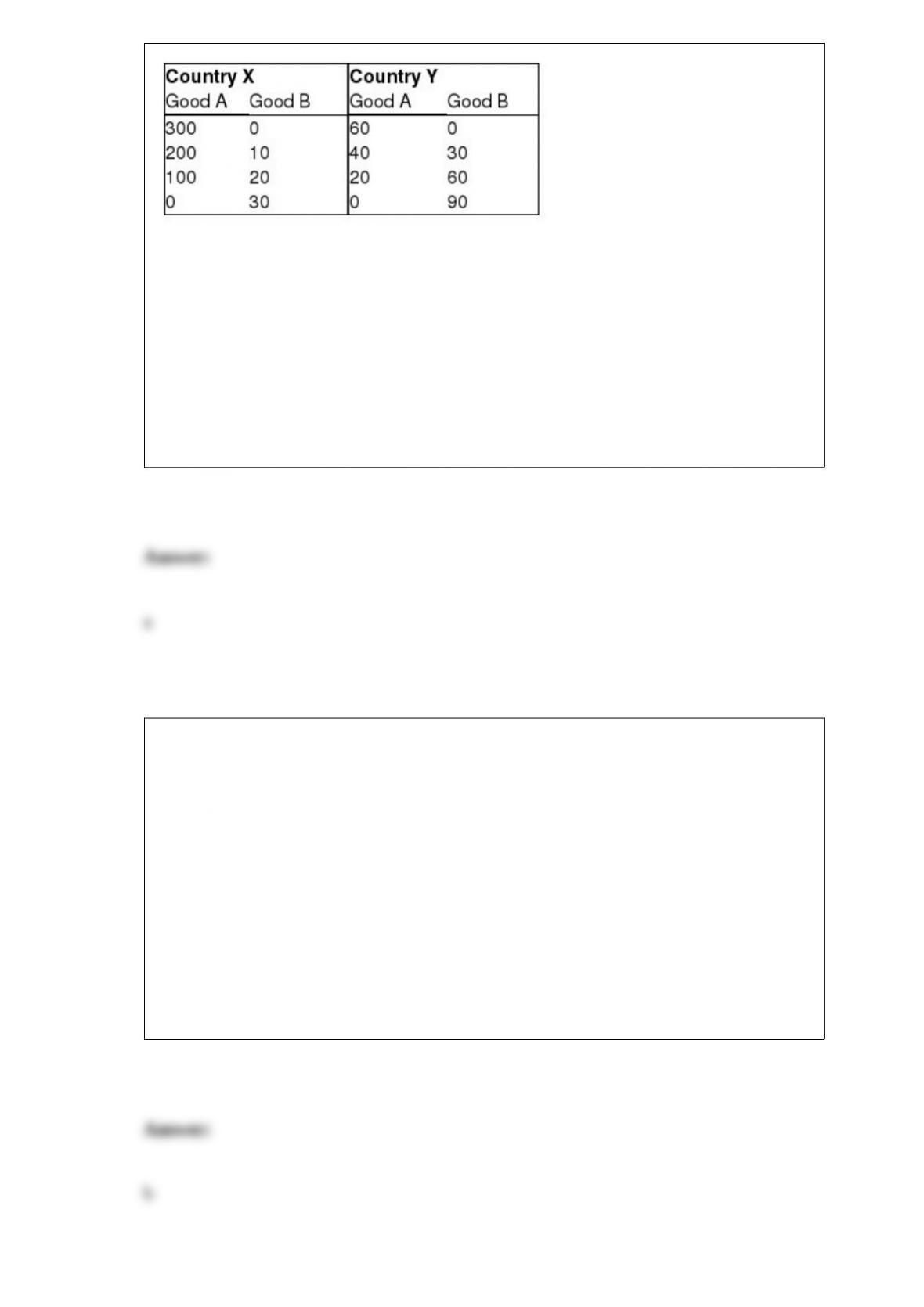
Refer to Exhibit 34-9. For country Y, the opportunity cost of producing one unit of good
B is __________ unit(s) of good A.
Exhibit 34-9
a. 1.5
b. 2
c. 2/3
d. 1/3
e. 3
Jack receives 30 utils from one apple, 45 utils from two apples, and 55 utils from three
apples. It follows that the marginal utility of the third apple is __________ utils and that
Jack’s __________utility rises as his __________ declines.
a. 55; marginal;total
b. 10; total; marginal
c. 130; total; marginal
d. 100; marginal; total
e. none of the above

Under a marketing quota system,
a. the government sets a limit on the quantity of a product that a farmer is allowed to
bring to market.
b. farmers are paid to take part of their land out of cultivation.
c. farmers are given limits as to the number of acres that can be used to produce a
particular product.
d. farmers are paid the difference between the market price of their product and a
governmentally determined price that would maintain an established price parity.
e. the government establishes a minimum price that farmers will be paid for their
product, which causes the farmers to cut back on the number of acres planted.
The law of demand states that price and quantity demanded are
a. directly related, ceteris paribus.
b. inversely related, ceteris paribus.
c. independent.
d. positively related, ceteris paribus.
Refer to Exhibit 32-2-(c). Two candidates are competing for an electorate consisting of
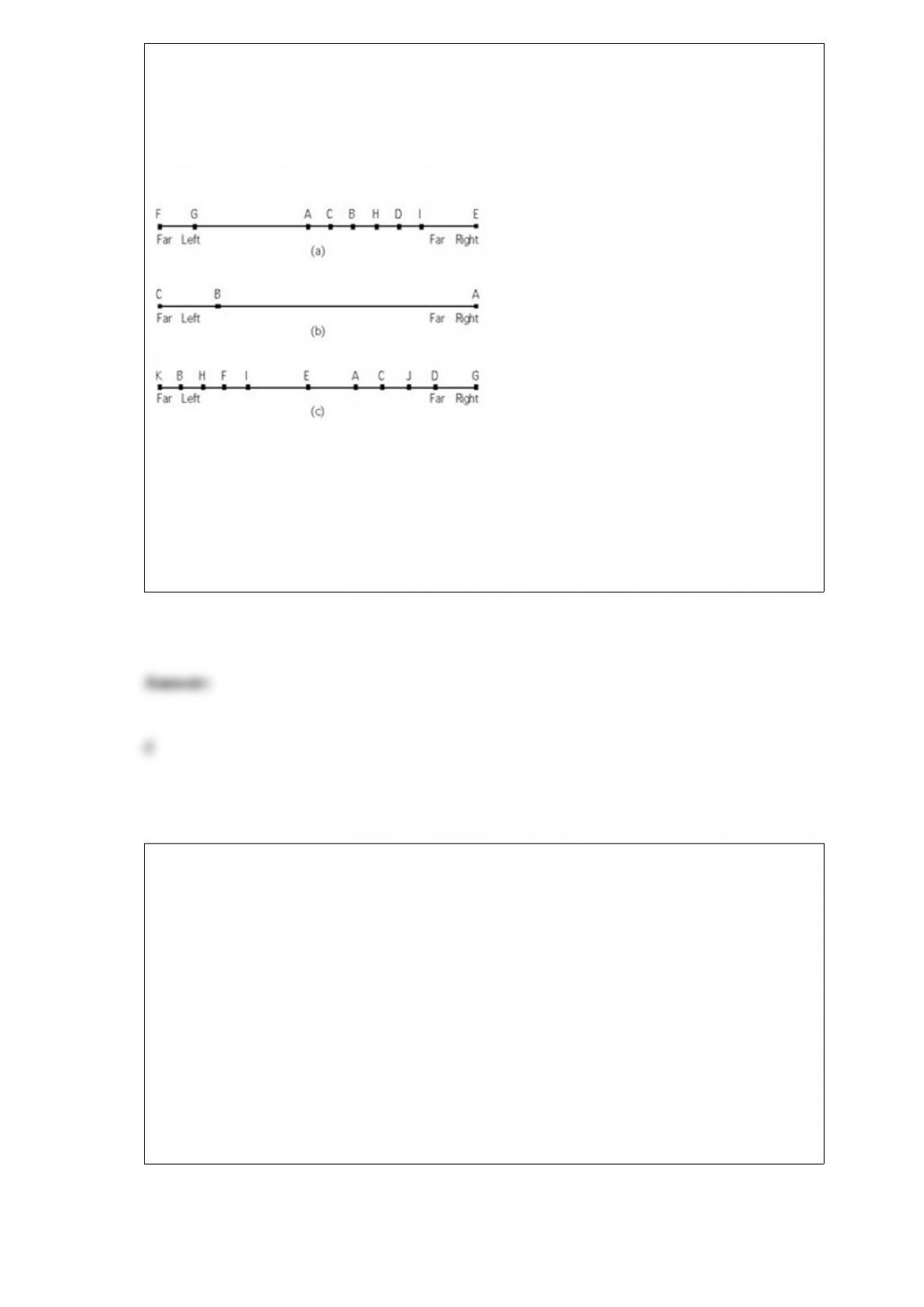
11 voters labeled A-K shown positioned with respect to their ideological stands on
issues. The median voter theory would predict that candidates will assume the
ideological position(s)
Exhibit 32-2
a. of voters K and G, respectively.
b. of voters H and J, respectively.
c. of voters I and A, respectively.
d. of voter E.
The firm’s factor demand curve is the
a. MRP curve if the firm is a price taker (perfectly competitive firm).
b. MRP curve if the firm is a price searcher (monopolist, monopolistic competitor,
oligopolist).
c. VMP curve if the firm is a price taker (perfectly competitive firm).
d. VMP curve if the firm is a price searcher (monopolist, monopolistic competitor,
oligopolist).
e. a, b, and c

Which of the following situations is used as a justification for government?
a. negative externalities
b. removal from the prisoner’s dilemma
c. nonexcludable goods
d. positive externalities
e. all of the above
If demand for a given good is perfectly elastic, it follows that
a. as price changes, quantity demanded does not change.
b. as price changes, quantity demanded changes by a larger percentage.
c. as price changes only a small percentage, quantity demanded falls to zero.
d. as income changes only a small percentage, quantity demanded changes by a very
large percentage.
e. none of the above

A firm that is perfectly competitive will continue to hire factor units as long as
a. MRP < MFC.
b. MRP > MFC.
c. VMP < MFC.
d. MC > MR.
The foreign exchange market is the market in which
a. foreigners buy U.S. real estate.
b. foreign stocks and bonds are bought and sold.
c. ideas from different countries are exchanged.
d. currencies of different countries are bought and sold.
e. none of the above
Which of the following statements is false?
a. Consumers receive more consumers’ surplus when tariffs do not exist.
b. Producers receive more producers’ surplus when tariffs do exist.
c. A tariff results in a net loss to society.
d. With a tariff, the gains to the winners are less than the losses to the losers.
e. none of the above
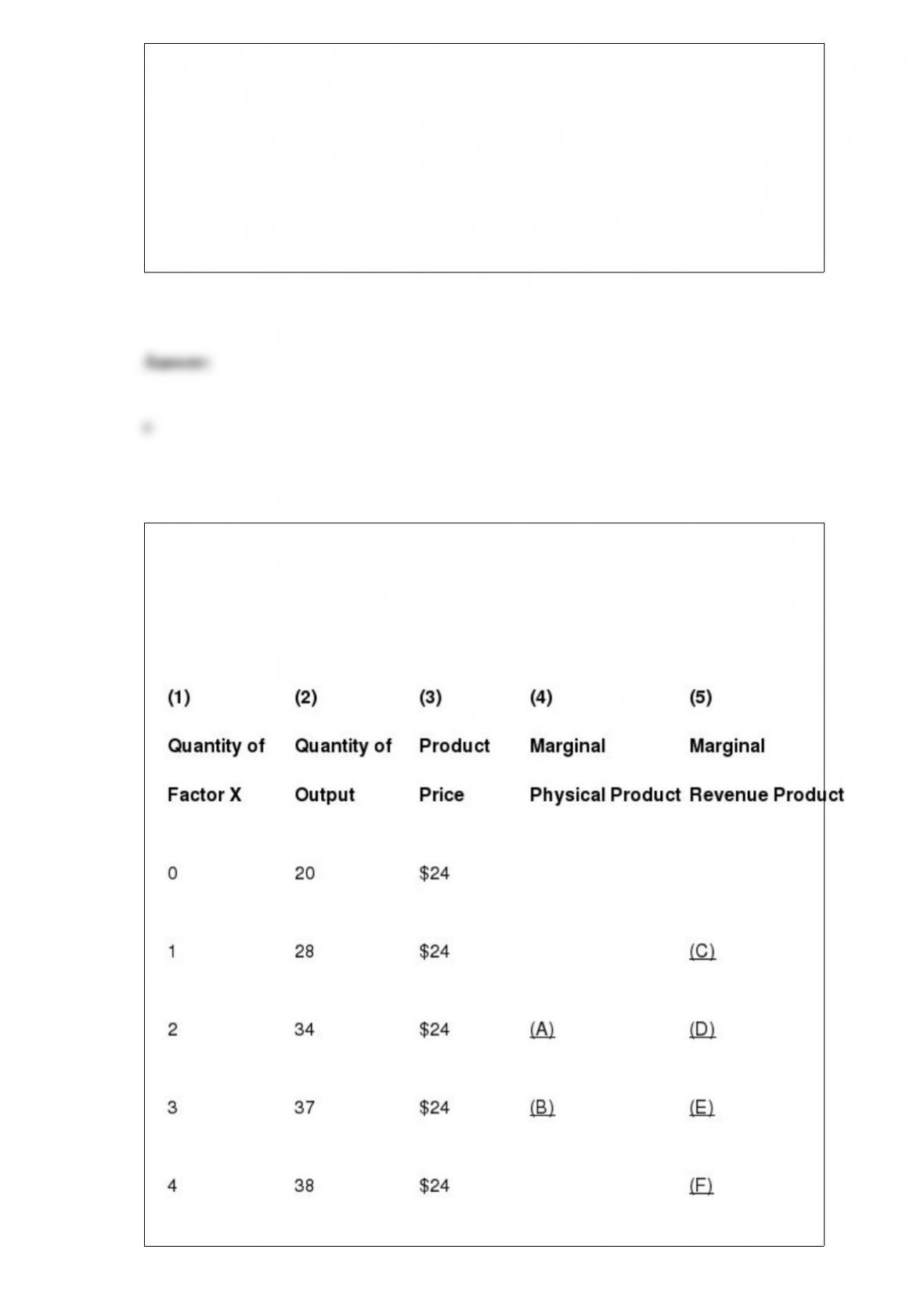
Refer to Exhibit 27-8. The dollar amounts that go in blanks (C) and (D) are,
respectively,
Exhibit 27-8

a. $192 and $144.
b. $8 and $8.
c. $190 and $270.
d. $90 and $80.
e. There is not enough information to answer the question.