
Why do most firms in monopolistic competition typically make zero profit in the long
run?
A) because firms produce differentiated products
B) because the lack of entry barriers would compete away profits
C) because firms do not produce at their minimum efficient scale
D) because the total market is not large enough to accommodate so many firms
In a study conducted by Marianne Bertrand and Sendhil Mullianthan, identical resumes
were sent in response to help wanted ads in newspapers, with half of the resumes
assigned an African-American-sounding name and half assigned a white-sounding
name. The study found that
A) employers were equally likely to interview workers with white-sounding names and
with African-American-sounding names.
B) employers were 50 percent less likely to interview workers with
African-American-sounding names.
C) employers were 50 percent less likely to interview workers with white-sounding
names.
D) no employers chose to interview workers with African-American-sounding names.

Consider three pricing strategies that the firm can pursue:
a. optimal two-part tariff pricing
b. perfect price discrimination
c. single-price monopoly pricing
Of these three strategies, which method gives the firm the highest profit?
A) optimal two-part tariff pricing
B) perfect price discrimination
C) single-price monopoly pricing
D) The profit is the same under optimal two-part tariff pricing and perfect price
discrimination and the profit is higher than under single-price monopoly pricing.
Measures of poverty (for example, the poverty line) and the distribution of income (for
example, the Lorenz curve and the Gini coefficient) are misleading for which of the
following two reasons?
A) First, these measures do not take into account income mobility over time. Second,
these measures ignore the effects of government programs meant to reduce poverty.
B) First, none of these measures are adjusted for inflation. Second, they do not measure
income on a per capita basis.
C) First, these measures fail to include the income U.S. citizens earn working for
foreign firms that have operations located in the United States. Second, these measures
fail to include income foreign citizens earn working for U.S. firms that have operations
in foreign countries.
D) First, these measures fail to include dividend and interest income earned on stocks
and bonds. Second, these measures fail to include the value of goods and services
citizens make for their own consumption that are not sold in markets.

A firm that is the only seller of a good or service that does not have a close substitute is
called
A) a monopoly.
B) an oligopolist.
C) a market maker.
D) a price maker.
Figure 18-2
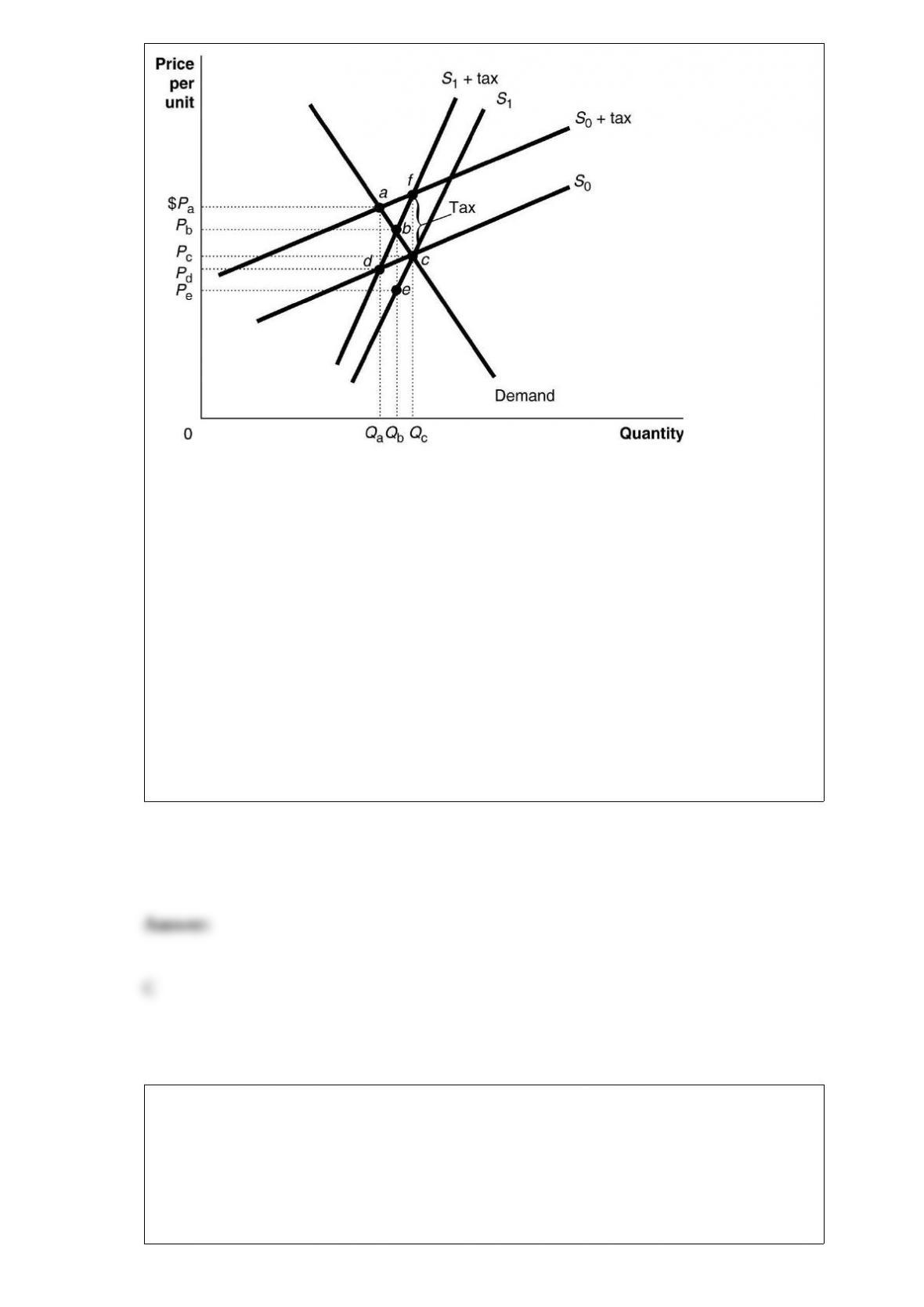
Figure 18-2 shows a demand curve and two sets of supply curves, one set more elastic
than the other.
Refer to Figure 18-2. If the government imposes an excise tax of $1.00 on every unit
sold, the producer’s burden of the tax
A) is greater under the more elastic supply curve S0.
B) is greater under the less elastic supply curve S0.
C) is greater under the less elastic supply curve S1.
D) is the same under either supply curve because there is a single demand curve that
captures buyers’ market behavior.
Which of the following is an example of a factor that a firm’s owners and managers can
control in making the firm successful?
A) the ability to produce the product at a lower cost
B) changing consumer tastes
C) a rise in the price of a key input, for example, a rise in the price of oil leads to higher
energy costs
D) the number of competitors in the market
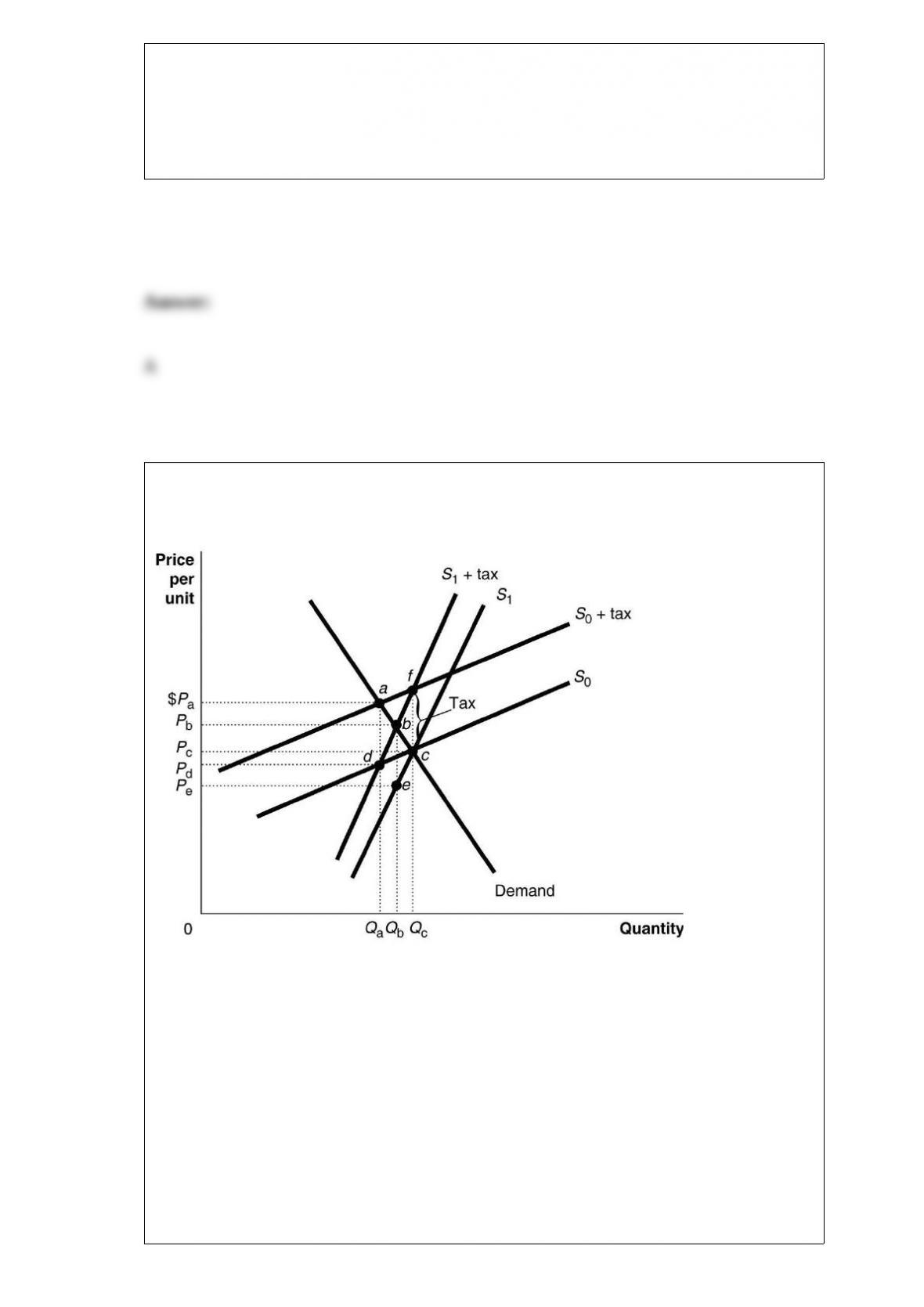
Figure 18-2
Figure 18-2 shows a demand curve and two sets of supply curves, one set more elastic
than the other.
Refer to Figure 18-2. If the government imposes an excise tax of $1.00 on every unit
sold,
A) the deadweight loss is identical under either supply curve.
B) the deadweight loss is greater under the supply curve S1.
C) the deadweight loss is greater under the supply curve S0.
D) there is no deadweight loss since revenue raised is used to fund government projects.
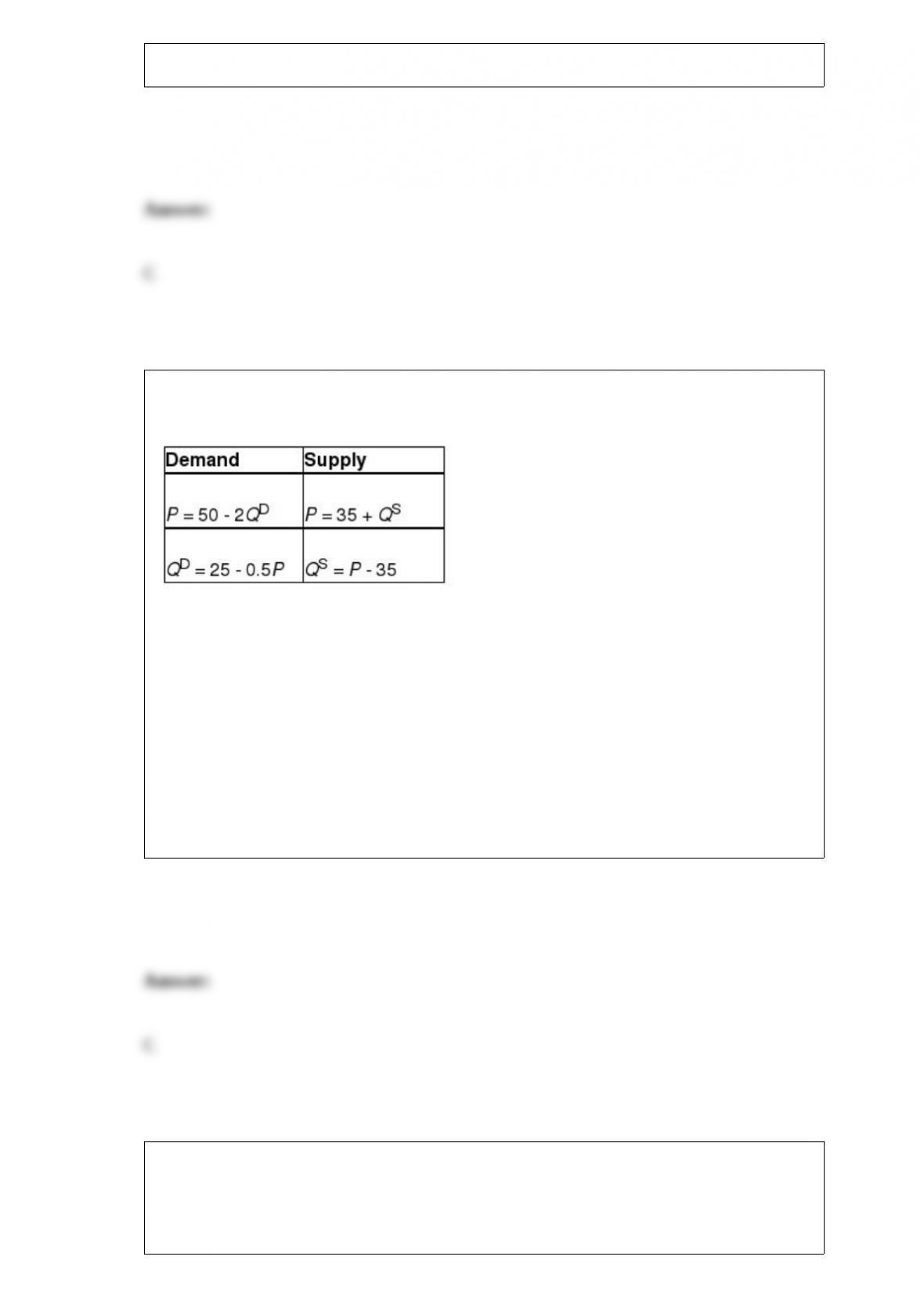
Table 4.7
Refer to Table 4-7. The equations above describe the demand and supply for Bubba’s
Fried Jellybeans. The equilibrium price and quantity for Bubba’s Fried Jellybeans are
$40 and 5 thousand units. What is the value of consumer surplus?
A) $5 thousand
B) $12.5 thousand
C) $25 thousand
D) $37.5 thousand
Which of the following is a normative economic statement?
A) The price of gasoline is too high.
B) The current high price of gasoline is the result of strong worldwide demand.
C) When the price of gasoline rises, the quantity of gasoline purchased falls.
D) When the price of gasoline rises, transportation costs rise.
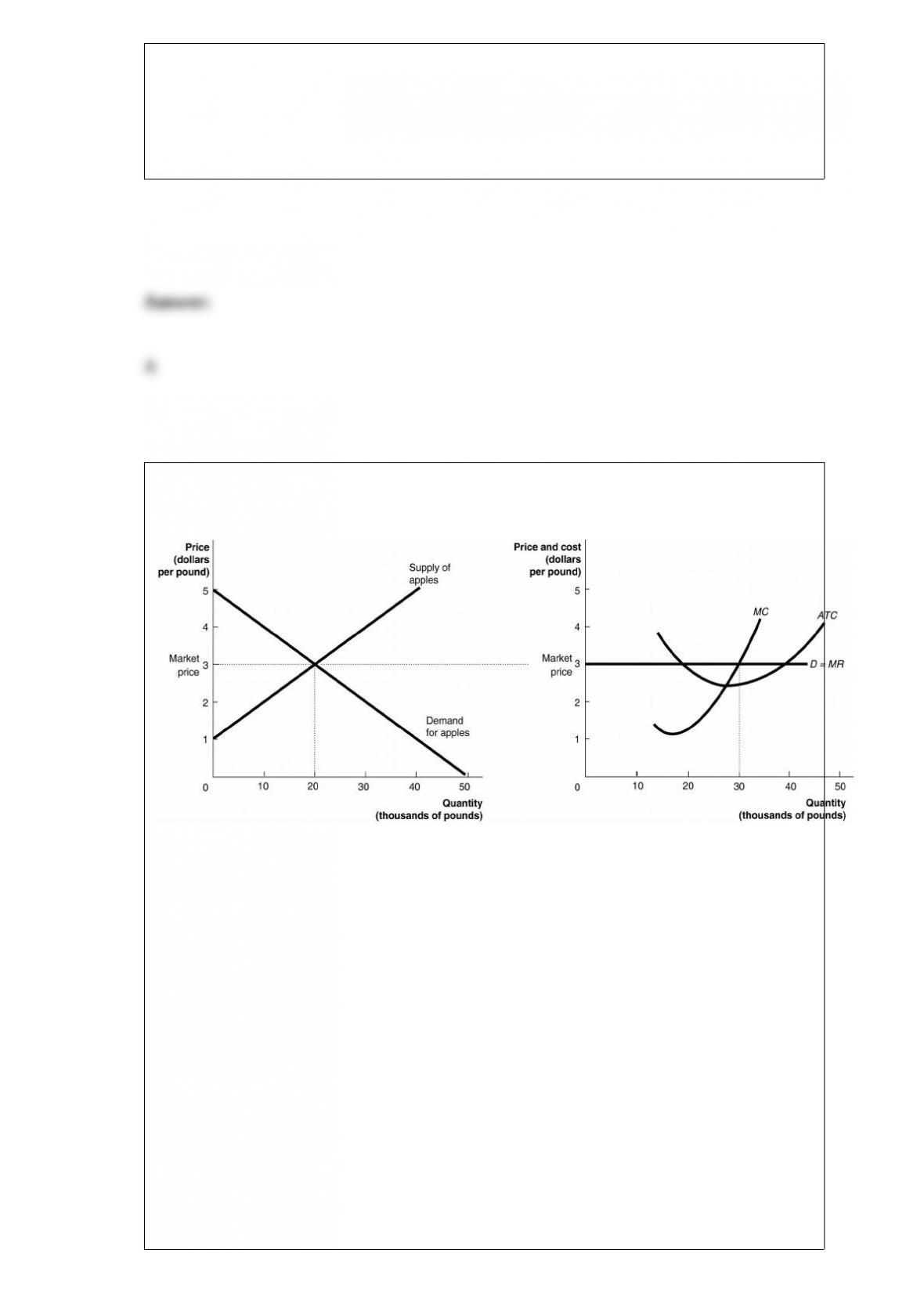
Figure 12-17
The graphs in Figure 12-17 represent the perfectly competitive market demand and
supply curves for the apple industry and demand and cost curves for a typical firm in
the industry.
Refer to Figure 12-17. Which of the following statements is true?
A) The firm will produce 30 thousand pounds of apples in the short run and earn an
economic profit. New firms will enter the market and shift the market supply curve to
the left.
B) The firm will produce 30 thousand pounds of apples in the short run and earn an
economic profit, but it would earn a greater profit if it produced at the lowest point on
the ATC curve.
C) The firm will produce 30 thousand pounds of apples in the short run and earn an
economic profit. New firms will enter the industry; as a result, the firm will be forced to
exit the industry in the long run.
D) The firm will produce 30 thousands pounds of apples in the short run and earn an
economic profit. In the long run the firm will break even.
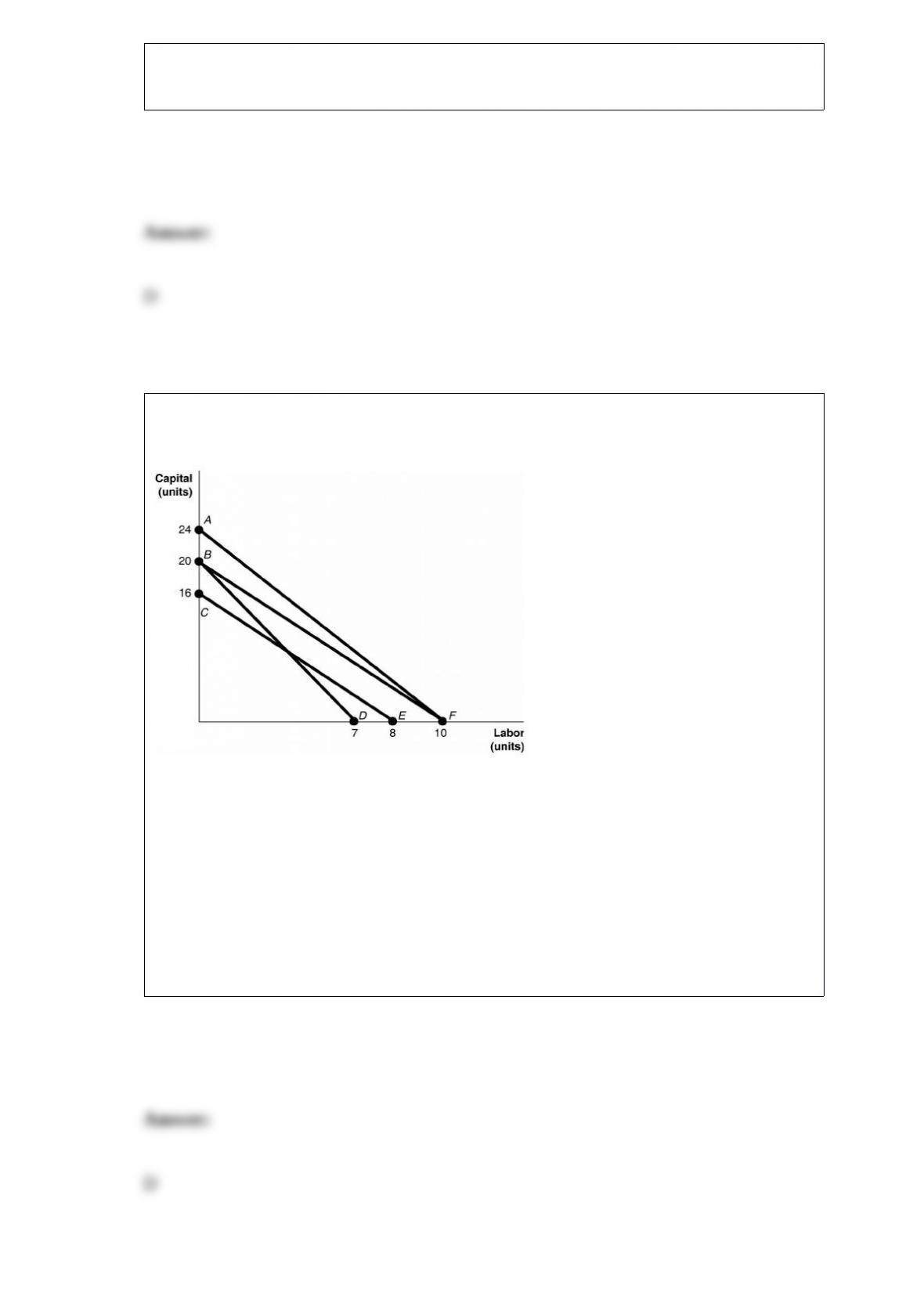
Figure 11-13
Refer to Figure 11-13. The lines shown in the diagram are isocost lines. A movement
from CE to BD occurs when
A) the price of capital increases while the price of labor remains unchanged.
B) the price of labor decreases while the price of capital remains unchanged.
C) the price of capital increases while the price of labor decreases.
D) the price of capital decreases while the price of labor increases.

If the quantity of walkie-talkies supplied increases by 5 percent when price increases by
12 percent, then
A) the supply of walkie-talkies is inelastic.
B) the supply of walkie-talkies is elastic.
C) the walkie-talkie supply curve will shift to the right.
D) the walkie-talkie supply curve will shift to the left.
Pookie’s Pinball Palace restores old Pinball machines. Pookie has just spent $300
purchasing and cleaning a 1960s-era machine which he expects to sell for $2,000 once
he is finished with the restoration. After having spent $300, Pookie discovers that he
will need to rewire the entire machine at a cost of $1,100 in order to finish the
restoration. Alternatively, he can sell the machine “as is” now for $1,000. What is the
marginal cost of completing the task?
A) $300
B) $800
C) $1,100
D) $1,400
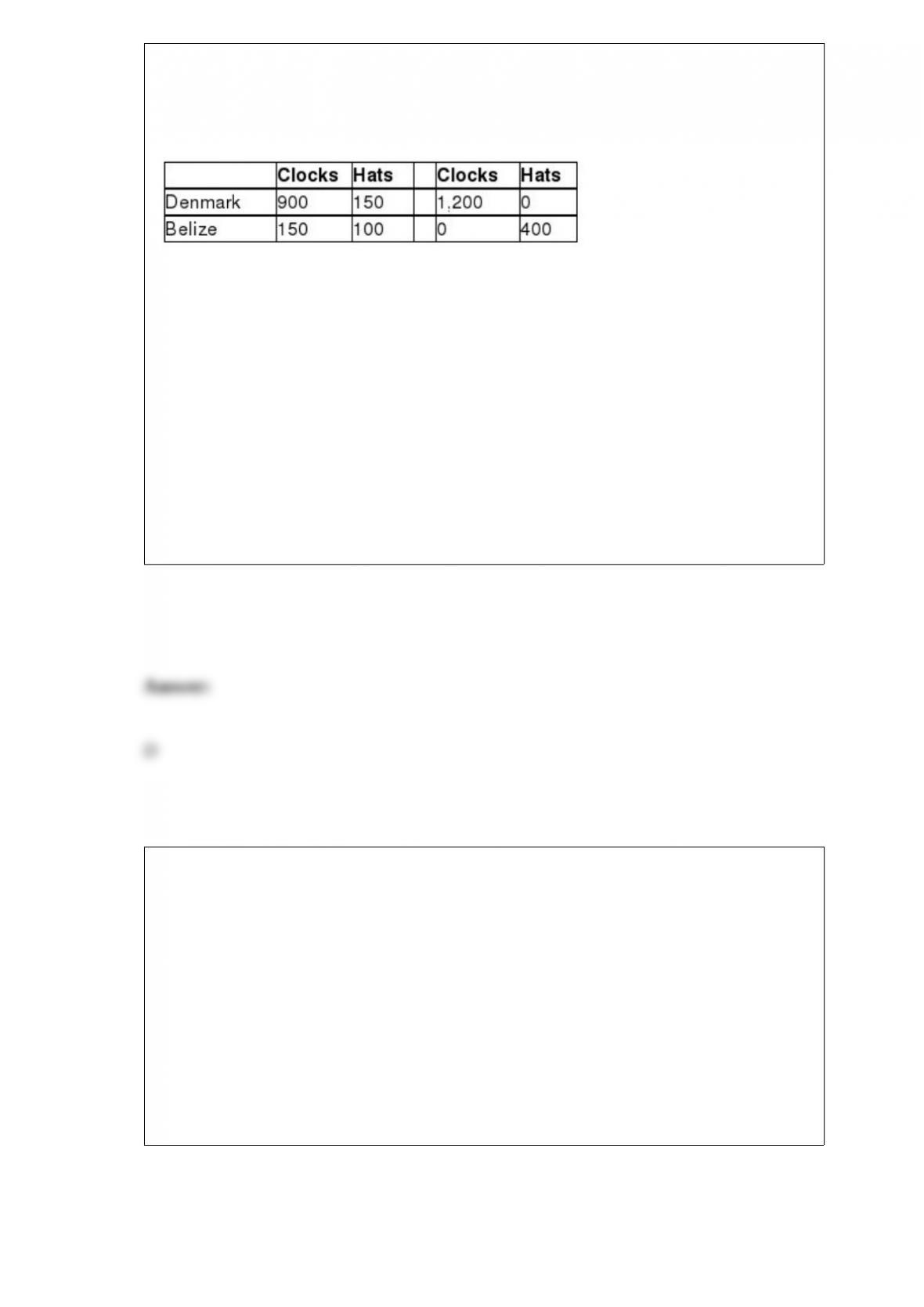
Table 9-6
Production and
Consumption Production
Without Trade With Trade
Denmark and Belize can produce both clocks and hats. Table 9-6 shows the production
and consumption quantities without trade, and the production numbers with trade.
Refer to Table 9-6. All of the following are terms of trade that could possibly benefit
both countries except
A) 1 hat : 2 clocks
B) 1 hat : 4 clocks
C) 1 hat : 5 clocks
D) 1 hat : 8 clocks
A monopolistically competitive firm chooses
A) both the quantity of output to produce and the price at which it will sell its output.
B) the price of the product it sells but market forces determine the quantity it will be
able to sell.
C) the quantity of output to produce but the price of the product it sells is determined
collectively by all firms in the industry.
D) the price of the product it sells but the quantity of output to produce is agreed upon
by all firms in the industry.
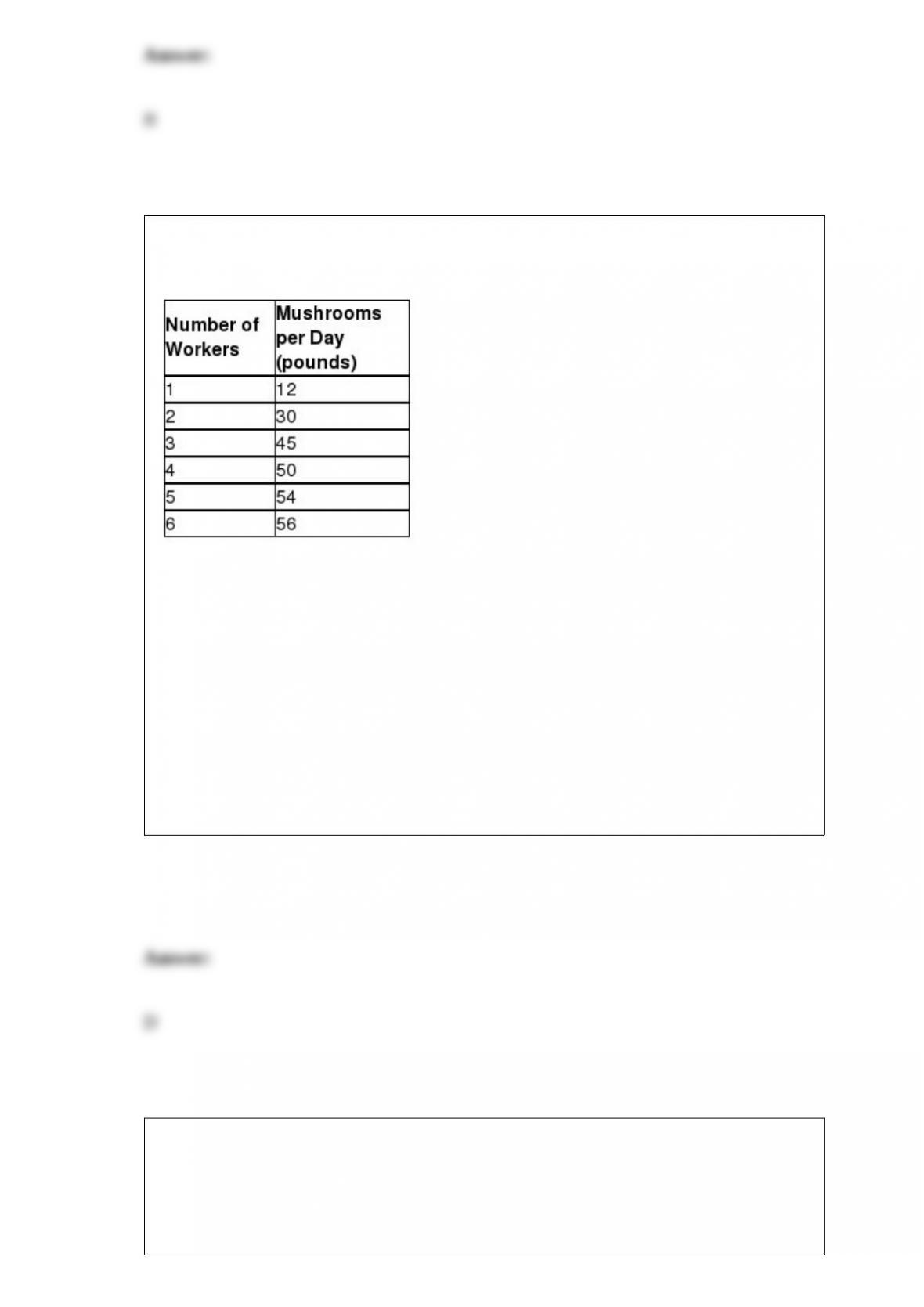
Table 11-1
Table 11-1 shows the technology of production at the Matsuko’s Mushroom Farm for
the month of May.
Refer to Table 11-1. What is the marginal product of the 4th worker?
A) 137 pounds
B) 50 pounds
C) 5 pounds
D) 5 pounds
If, for a given percentage increase in price, quantity demanded falls by a
proportionately smaller percentage, then demand is
A) unit elastic.

B) perfectly elastic.
C) relatively inelastic.
D) relatively elastic.
An isocost line shows
A) combinations of two inputs that result in the same total cost for a firm.
B) combinations of two inputs that result in the same total output for a firm.
C) combinations of the two inputs that result in the same profit for a firm.
D) the different levels of total cost that result from various combinations of two inputs.
The first example used to explain comparative advantage used two countries (England
and Portugal) and two goods (wine and cloth) to show that
A) each country would be better off from trade if it had an absolute advantage in
producing one of the goods.
B) each country would have a comparative advantage in the production of the good for
which it had an absolute advantage.
C) mutually beneficial trade was possible between two countries even if one had an
absolute advantage in the production of both goods.

D) mutually beneficial trade was possible between two countries even if one had a
comparative advantage in the production of both goods.
Jake sells Star Wars memorabilia on eBay. His annual revenue is $42,000 per year, and
the explicit costs of his business are $10,000. What is his accounting profit?
A) $10,000
B) $22,000
C) $32,000
D) $42,000
Pollution is an example of a
A) public good.
B) positive externality.
C) private cost.
D) negative externality.
Which of the following would cause an increase in the equilibrium wage?
A) The supply of labor increases more than the demand for labor.
B) The supply of jobs increases less than the demand for jobs.
C) The demand for labor increases faster than the supply of labor.
D) The supply of labor increases and the demand for labor decreases.
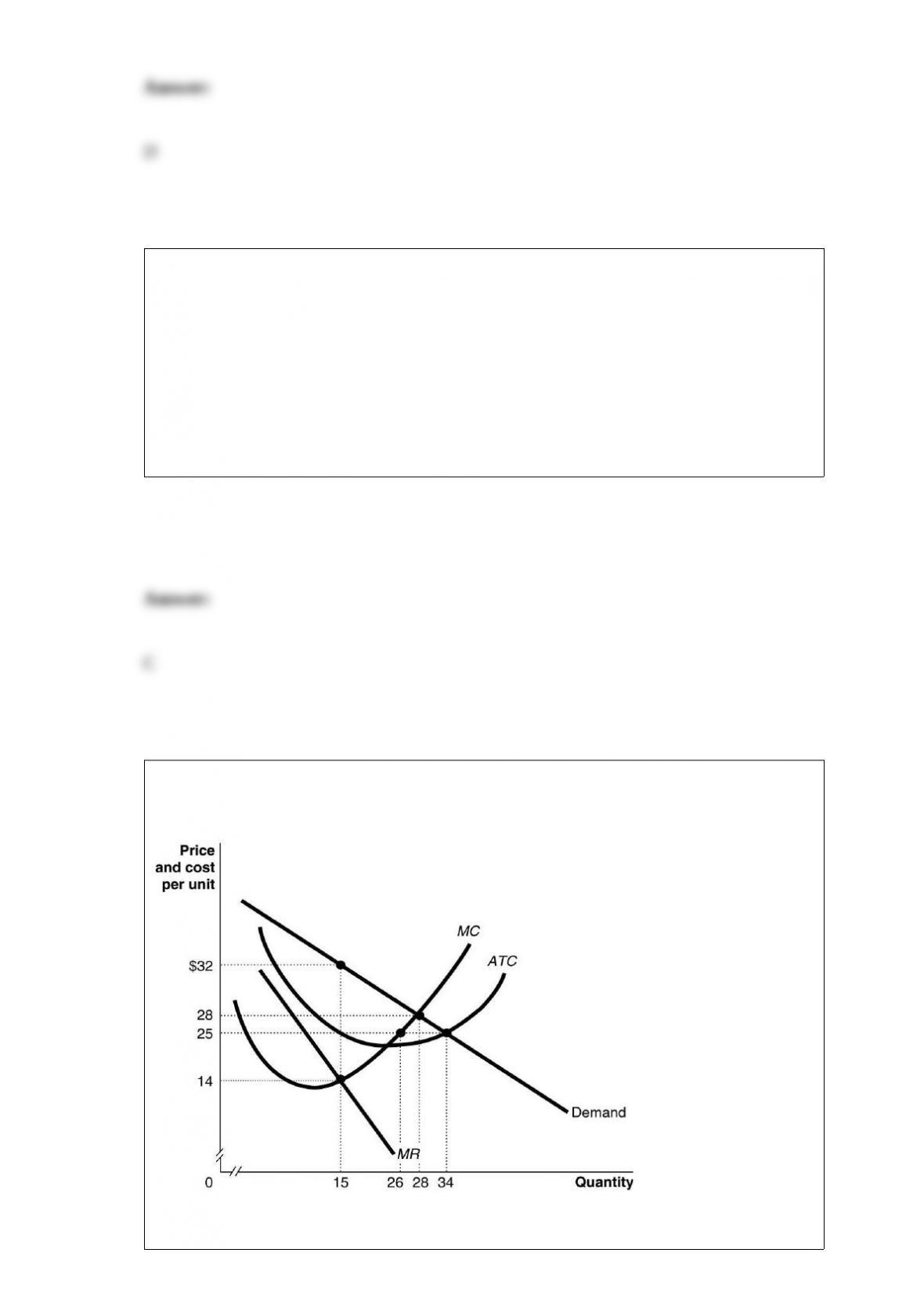
Figure 15-18
Refer to Figure 15-18 to answer the following questions.
a. What quantity will this monopoly produce and what price will it charge?
b. Suppose the government decides to regulate this monopoly and imposes a price
ceiling of $25. Now what quantity will the monopoly produce and what price will it
charge?
c. Will every consumer who is willing to pay the ceiling price of $25 be able to buy the
product? Briefly explain.
Opera Estate Girls’ School is considering increasing its tuition to raise revenue. If the
school believes that raising tuition will increase revenue it is assuming that the demand
for attending the school is
A) inelastic.
B) elastic.
C) unit elastic.
D) perfectly elastic.

Suppose a price floor on sparkling wine is proposed by the Health Minister of the
country of Vinyardia. What will be the likely effect on the market for sparkling wine in
Vinyardia?
A) Quantity demanded will decrease, quantity supplied will increase, and a surplus will
result.
B) Quantity demanded will increase, quantity supplied will decrease, and a surplus will
result.
C) Quantity demanded will decrease, quantity supplied will increase, and a shortage
will result.
D) Quantity demanded will increase, quantity supplied will decrease, and a shortage
will result.
Which of the following is an example of spending on goods and services in the circular
flow model?
A) Belinda purchases a new computer for her tax-preparation business.
B) Javier buys 800 square feet of wood flooring for his vacation home.
C) Celeste buys fresh herbs at the farmers’ market to use in her restaurant.
D) Timmy purchases a new examination table for use in his veterinary clinic.

When you purchase a new pair of jeans you do so in the
A) factor market.
B) input market.
C) product market.
D) resource market.
Which of following is the best example of a monopoly if we use a broader definition of
monopoly?
A) Spuds McKenzie, a wealthy potato farmer in Idaho
B) Cheap Gas, one of two gasoline stations in a large rural community
C) Santos Tacos, the only taqueria in the small town of Santosville
D) Zippie Rentals, a sports car rental service in the downtown Boston area
The process of countries becoming more open to foreign trade and investment is known
as
A) autarky.
B) foreign exchange.

C) globalization.
D) protectionism.
The minimum amount that investors must earn on the funds they invest in a firm,
expressed as a percentage of the amount invested, is referred to as
A) the explicit costs of production.
B) net worth.
C) net income.
D) a normal rate of return.
A study discussed in the Making the Connection feature in the text found that there is
________ that some consumers are not well aware of prices, even for goods they buy
regularly.
A) no evidence
B) substantial evidence
C) little evidence
D) no reason to believe