1) Because majority voting fails to incorporate the strength of the preferences of
individual voters, it:
A.creates negative externalities.
B.produces economically inefficient outcomes under some circumstances.
C.leads to market failure.
D.leads to politics dominated by special interest groups.
2) If a $20 billion increase in government expenditures increases equilibrium GDP by
$50 billion then:
A.the multiplier is 2.
B.the MPC for this economy is .6.
C.inflation is occurring.
D.the MPS for this economy is .6.
3) When economists say that money serves as a store of value, they mean that it is:
A.a way to keep wealth in a readily spendable form for future use.
B.a means of payment.
C.a monetary unit for measuring and comparing the relative values of goods.
D.declared as legal tender by the government.
4) suppose the price elasticity coefficients of demand are 1.43, 0.67, 1.11, and 0.29 for
products w, x, y, and z respectively. a 1 percent decrease in price will increase total
revenue in the case(s) of:
a.w and y
b.y and z
c.x and z
d.z and w
5) One of the strengths of monetary policy relative to fiscal policy is that monetary
policy:
A.can be implemented more quickly.
B.is subject to closer political scrutiny.
C.does not produce a net export effect.
D.entails a larger spending income multiplier effect on real GDP.
6)
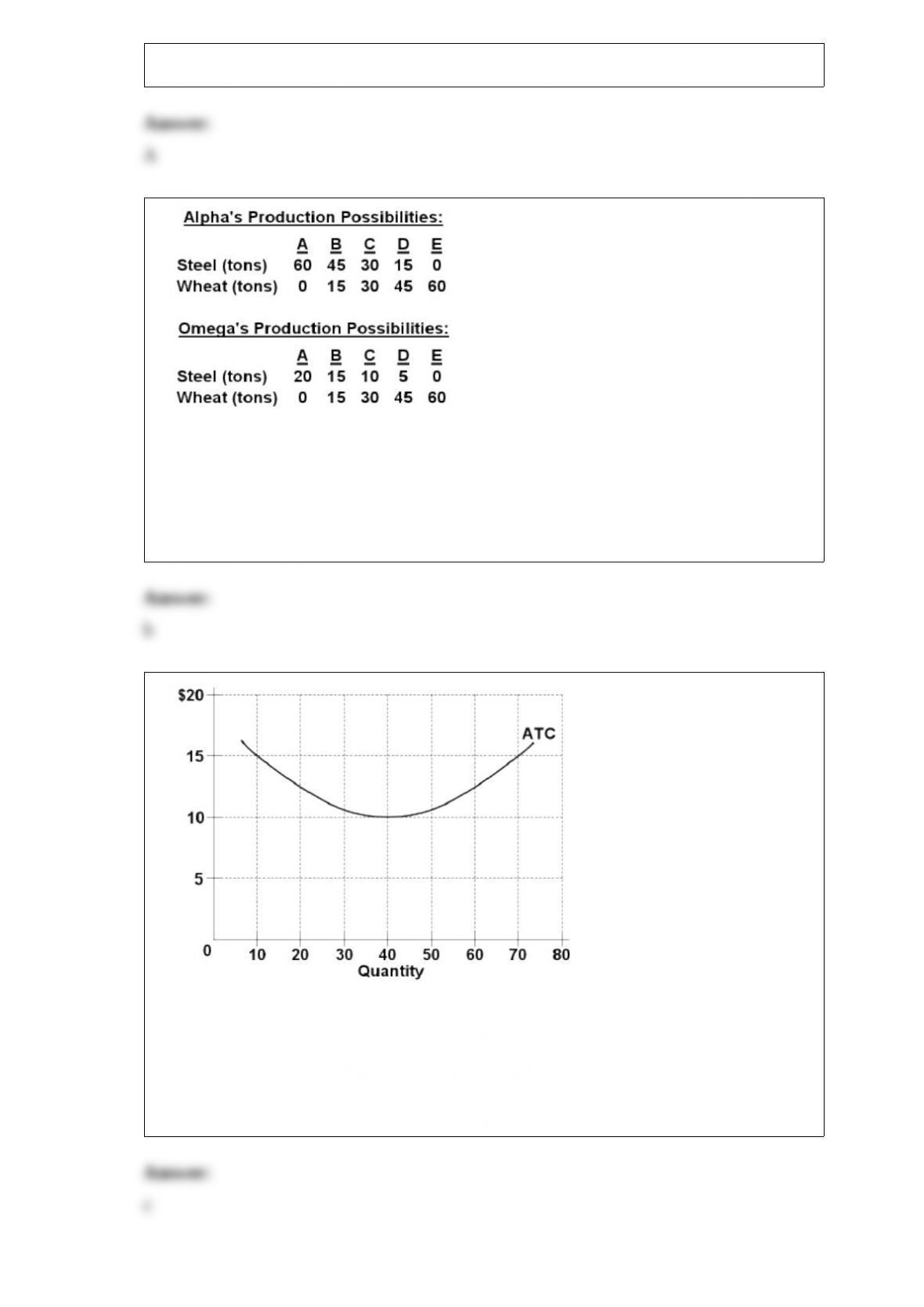
refer to the above data. the domestic opportunity cost of producing 1 ton of steel in
alpha is:
a. ton of wheat.
b.1 ton of wheat.
c.15 tons of wheat.
d.30 tons of wheat.
7)
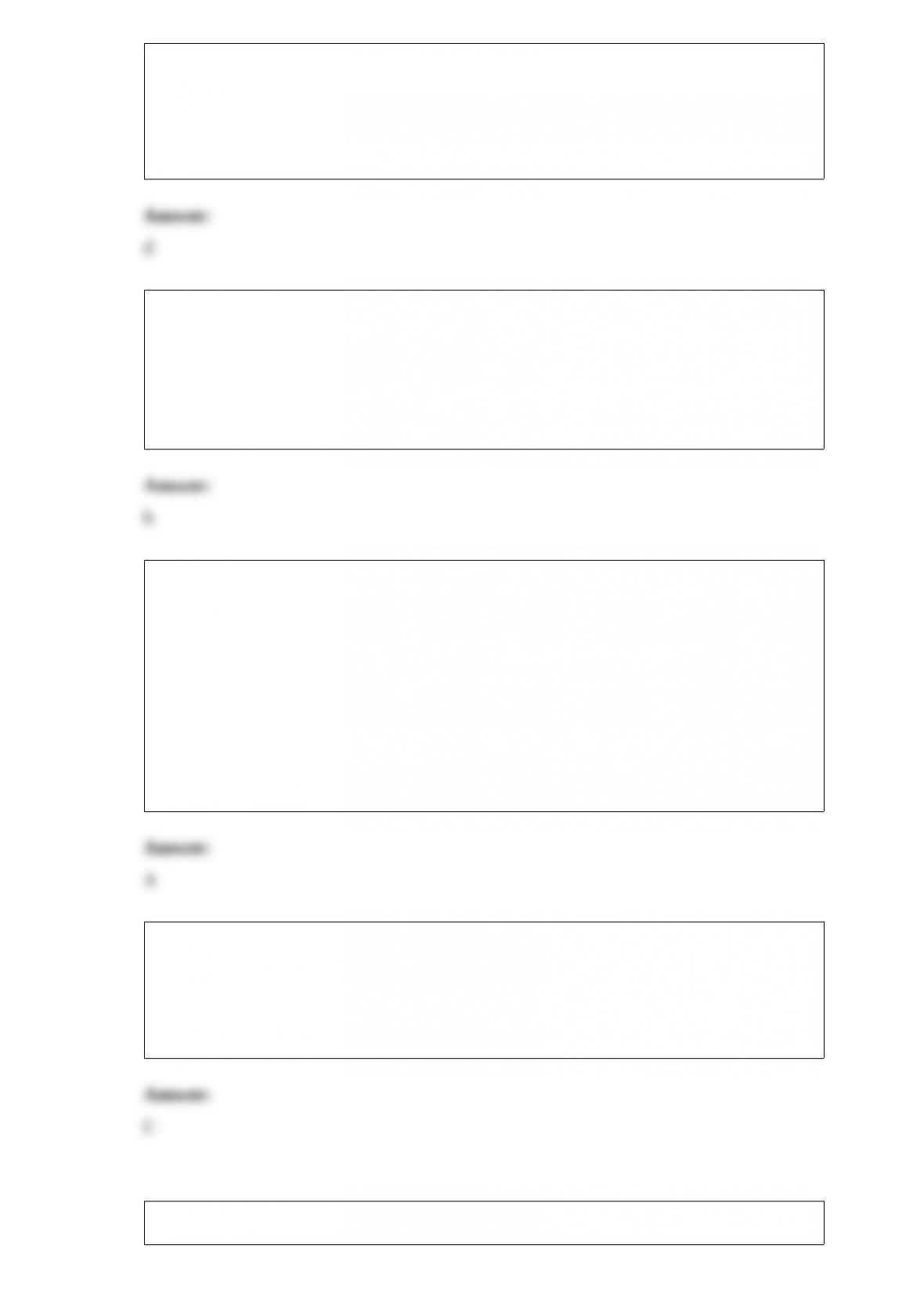
refer to the above diagram showing the average total cost curve for a purely competitive
firm. at the long-run equilibrium level of output, this firm’s total cost:
a.is $10.
b.is $40.
c.is $400.
d.cannot be determined from the information provided.
8) if the japanese yen appreciates relative to the swedish krona, then the krona:
a.will be more expensive to the japanese.
b.may either appreciate or depreciate relative to the yen.
c.will appreciate relative to the yen.
d.will depreciate relative to the yen.
9) what do wages paid to blue-collar workers, interest paid on a bank loan, forgone
interest, and the purchase of component parts have in common?
a.none are either implicit or explicit costs.
b.all are opportunity costs.
c.all are implicit costs.
d.all are explicit costs.
10) Answer the next question(s) on the basis of the following information: An economy
is employing 2 units of capital, 5 units of raw materials, and 8 units of labor to produce
its total output of 640 units. Each unit of capital costs $10, each unit of raw materials,
$4, and each unit of labor, $3.
Refer to the above information. If the per unit price of raw materials rises from $4 to $8
and all else remains constant, the aggregate:
A.supply curve would shift to the left.
B.supply curve would shift to the right.
C.demand curve would shift to the left.
D.demand curve would shift to the right.
11) All else equal, a large decline in the real interest rate will shift the:
A.investment demand curve leftward.
B.investment demand curve rightward.
C.investment schedule upward.
D. investment schedule downward.
12) as a firm produces successive units of output in the short run we would expect:
a.tvc to increase initially by declining amounts, but eventually increase by increasing
amounts.
b.tvc to increase initially by increasing amounts, but eventually by decreasing amounts.
c.tfc to increase by constant amounts.
d.the sum of tvc and tfc to increase initially by increasing amounts, but eventually by
decreasing amounts.
13) Suppose that by devoting all of its resources to the production of A, the nation of
Econia can produce 50 A. By devoting all of its resources to the production of B,
Econia can produce 25 B. The comparable figures for the nation of Optima are 5 A and
5 B. According to the principle of comparative advantage, which nation will specialize
in which product? What are the limits to the terms of trade?
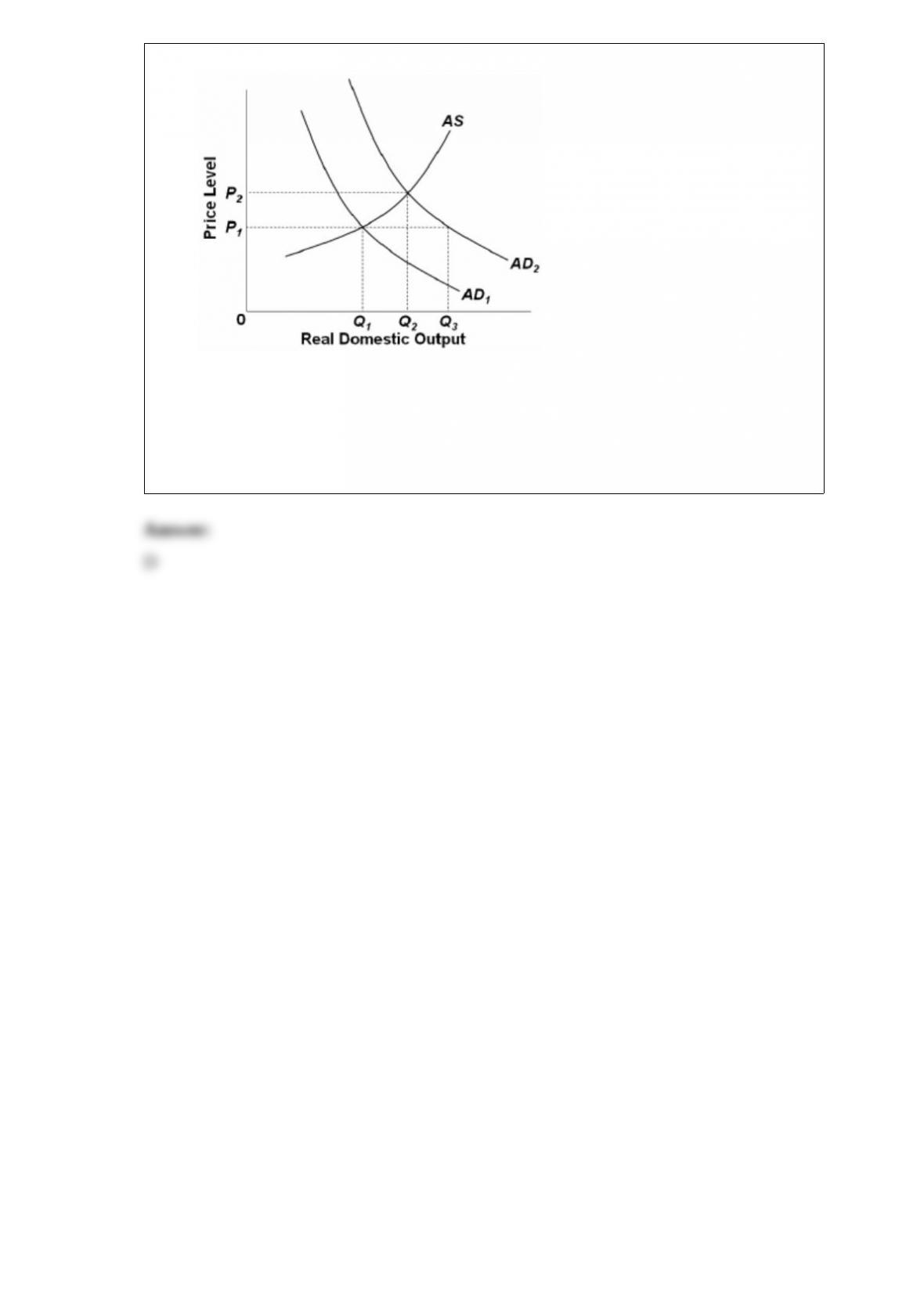
14)
Refer to the above diagram. If equilibrium real output is Q2, then:
A.aggregate demand is AD1.
B.the equilibrium price level is P1.
C.producers will supply output level Q1.
D.the equilibrium price level is P2.