
The quantity supplied of land is constant regardless of price. Suppose a tax is imposed
on the rental price of land. Who will pay the greater share of such a tax?
a. The buyers will pay the entire share.
b. The sellers will pay the entire share.
c. The buyers and the sellers will pay equal shares.
d. The buyers will bear the greater share of the tax.
Marginal productivity theory states that if a firm sells its product in a perfectly
competitive product market it will necessarily pay its factors their VMP.
a. True
b. False
If there is always a three-for-one tradeoff between goods X and Y, then the PPF
between X and Y is
a. a downward-sloping curve that is bowed outward.
b. a downward-sloping curve that is bowed inward.
c. a downward-sloping straight line.
d. an upward-sloping straight line.
If people want more cars than there are cars available, then it is necessarily true that
a. cars are scarce.
b. there is a surplus of cars.
c. there is a decreased supply of cars.
d. none of the above
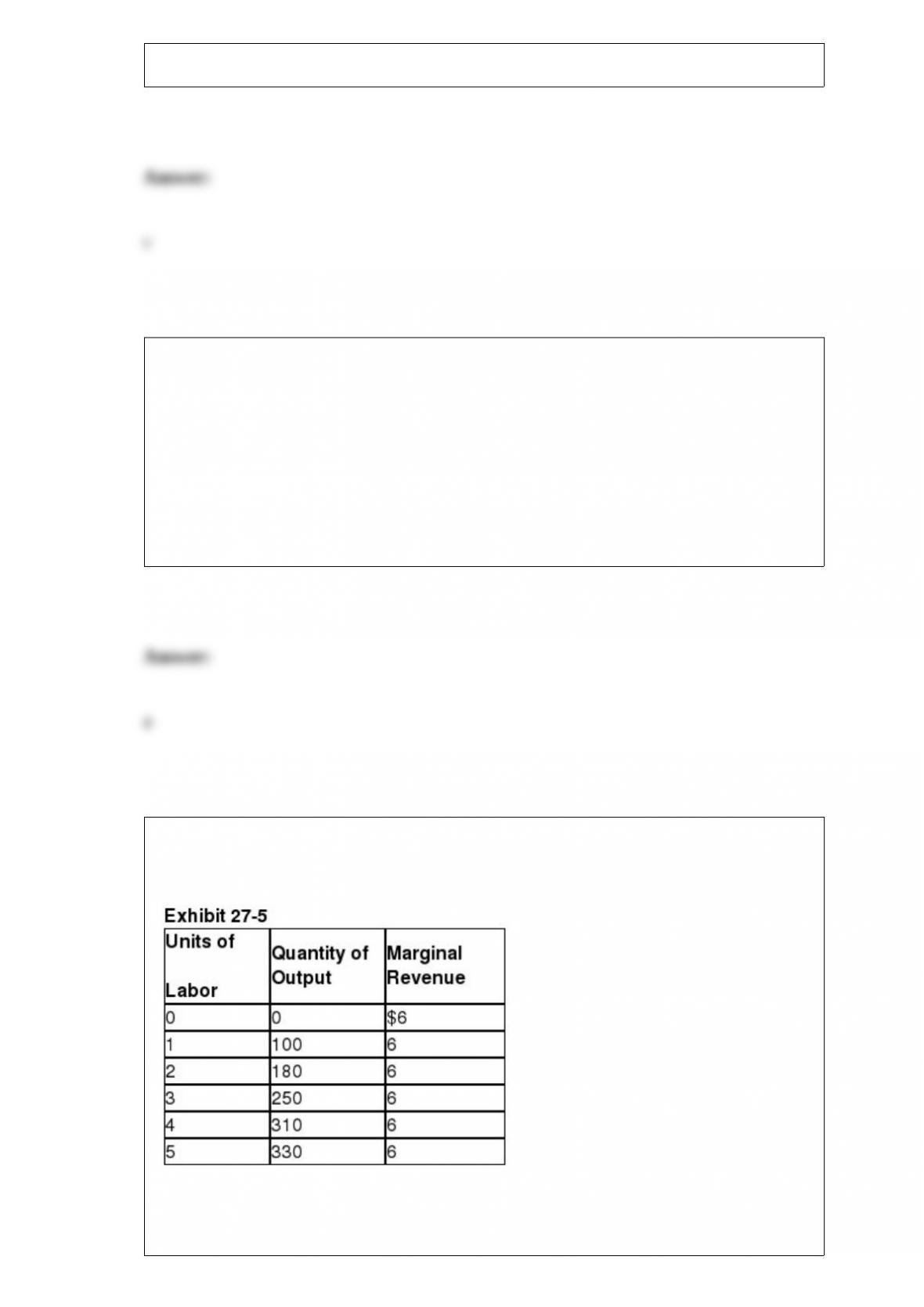
Refer to Exhibit 27-5. The marginal revenue product of the first unit of labor is
a. $600.

b. $60.
c. $100.
d. $9.
For a single-price monopoly, marginal revenue is
a. equal to price for the first unit of output.
b. less than price for all units of output after the first unit.
c. greater than price.
d. horizontal.
e. a and b
A good can have high total utility and low marginal utility.
a. True
b. False
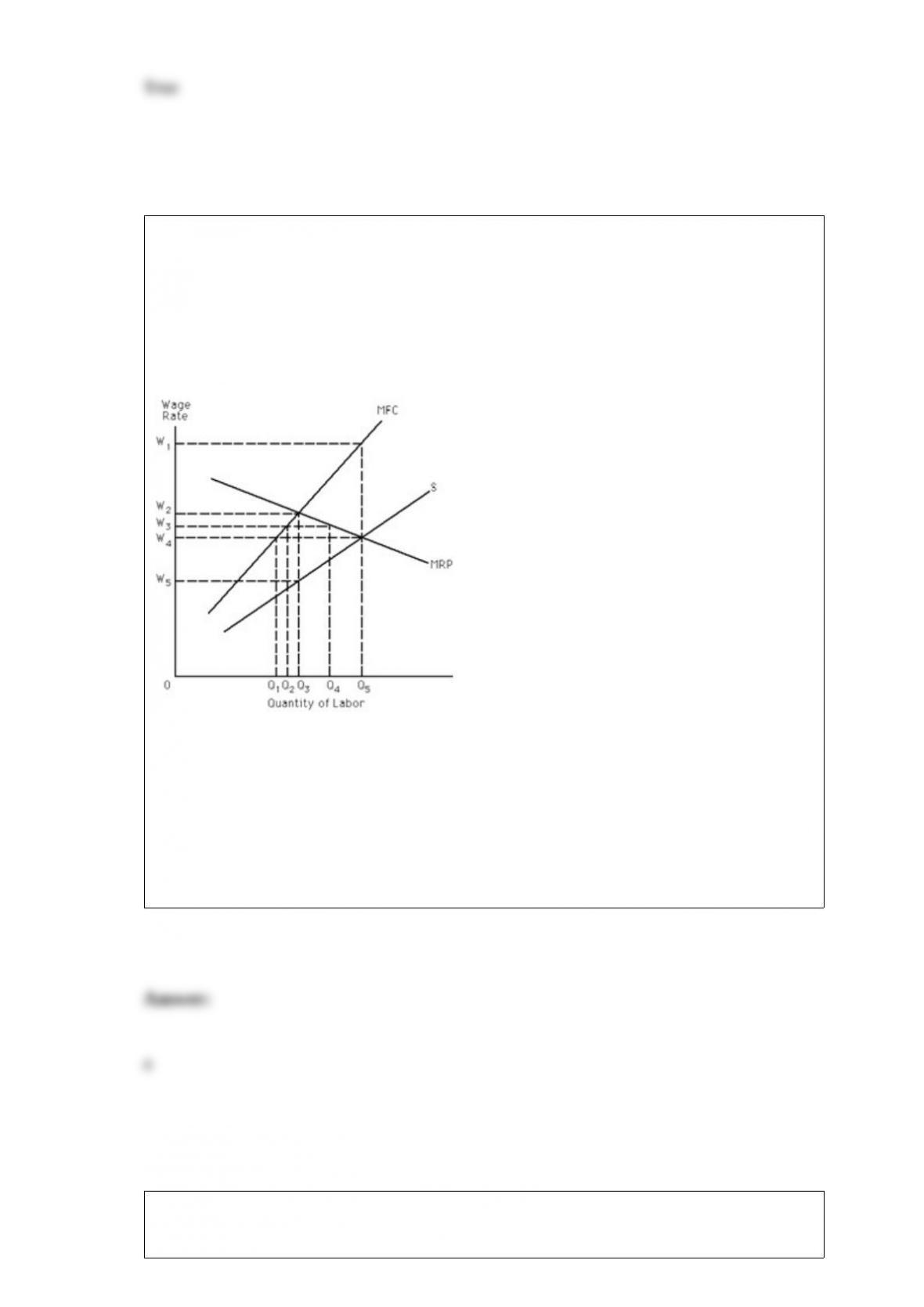
Refer to Exhibit 28-9. Let DA and DB represent demand for labor curves facing unions
A and B, respectively. As a result of their efforts, both unions succeed in increasing the
wage rate from W1 to W2. In terms of the wage-employment trade-off, the wage
increase
Exhibit 28-8
a. had a larger impact on employment for union A than for union B.
b. had a larger impact on employment for union B than for union A.
c. had the same impact on employment in both unions.
d. cannot be determined without further information.
Price is the only rationing device that can be used in a modern economy.
a. True
b. False
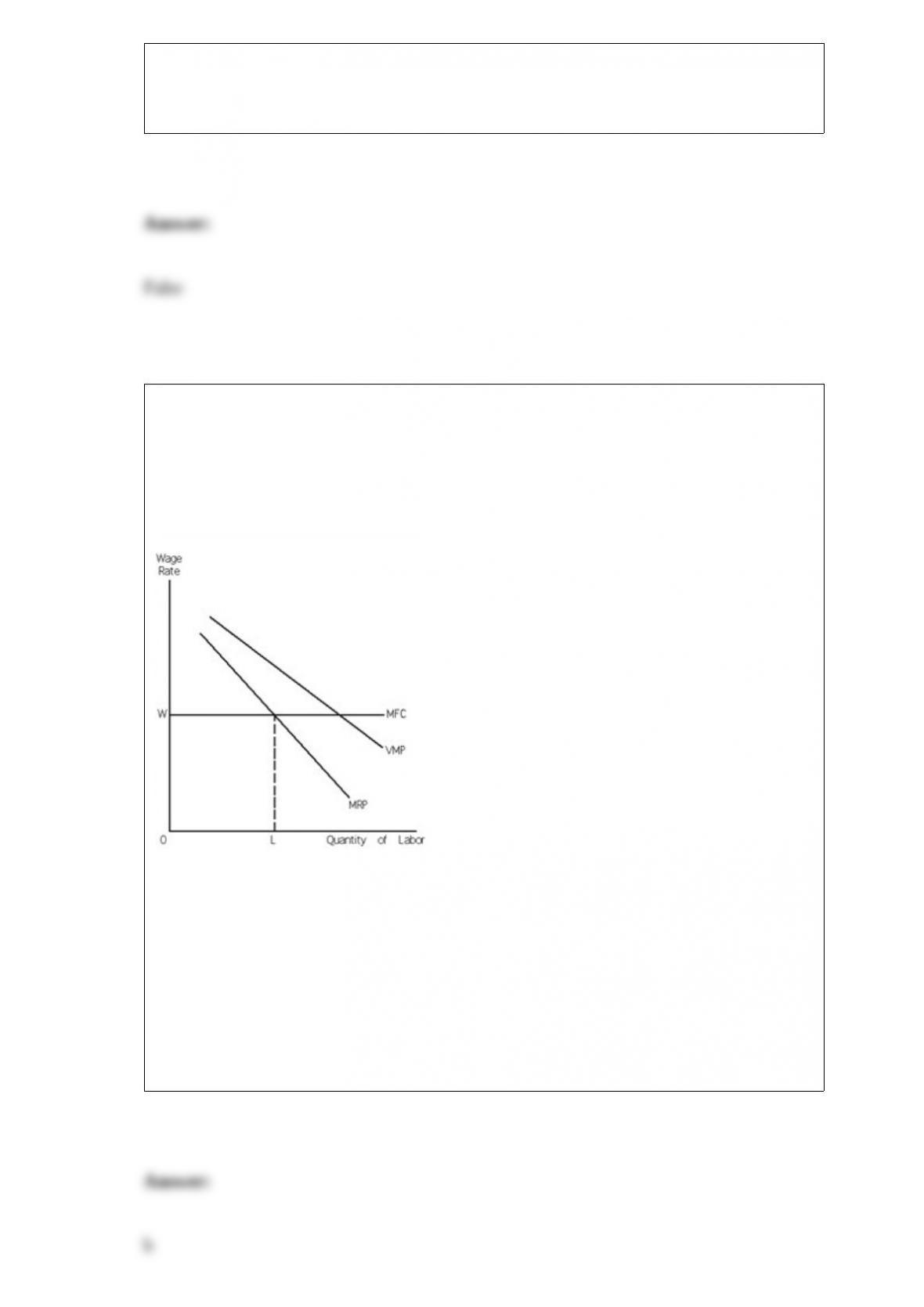
Refer to Exhibit 28-6. L and W are the equilibrium quantity of labor employed and the
wage rate respectively. A person arguing that a worker is being exploited if she is paid
less than the value of her marginal product would say that the exhibit is an illustration
of the fact that
Exhibit 28-6
a. perfect competition entails labor exploitation.
b. monopoly entails labor exploitation.
c. monopoly entails no labor exploitation.
d. monopsony entails labor exploitation.
e. monopsony entails no labor exploitation.

Refer to Exhibit 3-10. 100 units of X will be exchanged in this market if the price is
Exhibit 3-10
a. $30.
b. $20.
c. $10.
d. a or c
e. none of the above
A monopoly exhibits resource-allocative efficiency if it
a. is a single-price monopolist.
b. is a perfectly price-discriminating monopolist.
c. engages in second-degree price discrimination.
d. engages in third-degree price discrimination.
e. all of the above

If a firm earns normal profit, then it has generated revenues
a. equal to the sum of implicit and explicit costs.
b. greater than total opportunity costs.
c. sufficient to cover explicit costs, but not implicit costs.
d. sufficient to cover implicit costs, but not explicit costs.
A monopolistic competitor has a demand curve that is ___________ elastic than a
perfectly competitive firm’s demand curve and ______________ a monopolistic firm’s
demand curve.
a. less; more elastic than
b. less; less elastic than
c. more; more elastic than
d. less: equally as elastic as
Opportunity cost is the value of
a. the best (or most highly valued) forfeited alternative.
b. the chosen alternative.

c. a free good.
d. all forfeited alternatives.
An American good with a price tag of $89 costs 809 pesos. The exchange rate must be
approximately
a. $11.00 = 1 peso
b. $0.11 = 1 peso
c. $0.89 = 1 peso
d. $0.09 = 1 peso
e. none of the above
A person buys a bond with a face value of $10,000 for $9,325. Each year until the
maturity date the bond buyer receives $750 from the issuer of the bond. The yield on
the bond is
a. 8.04 percent.
b. 7.5 percent.
c. 10.0 percent.
d. 6.75 percent.
e. There is not enough information to answer the question.
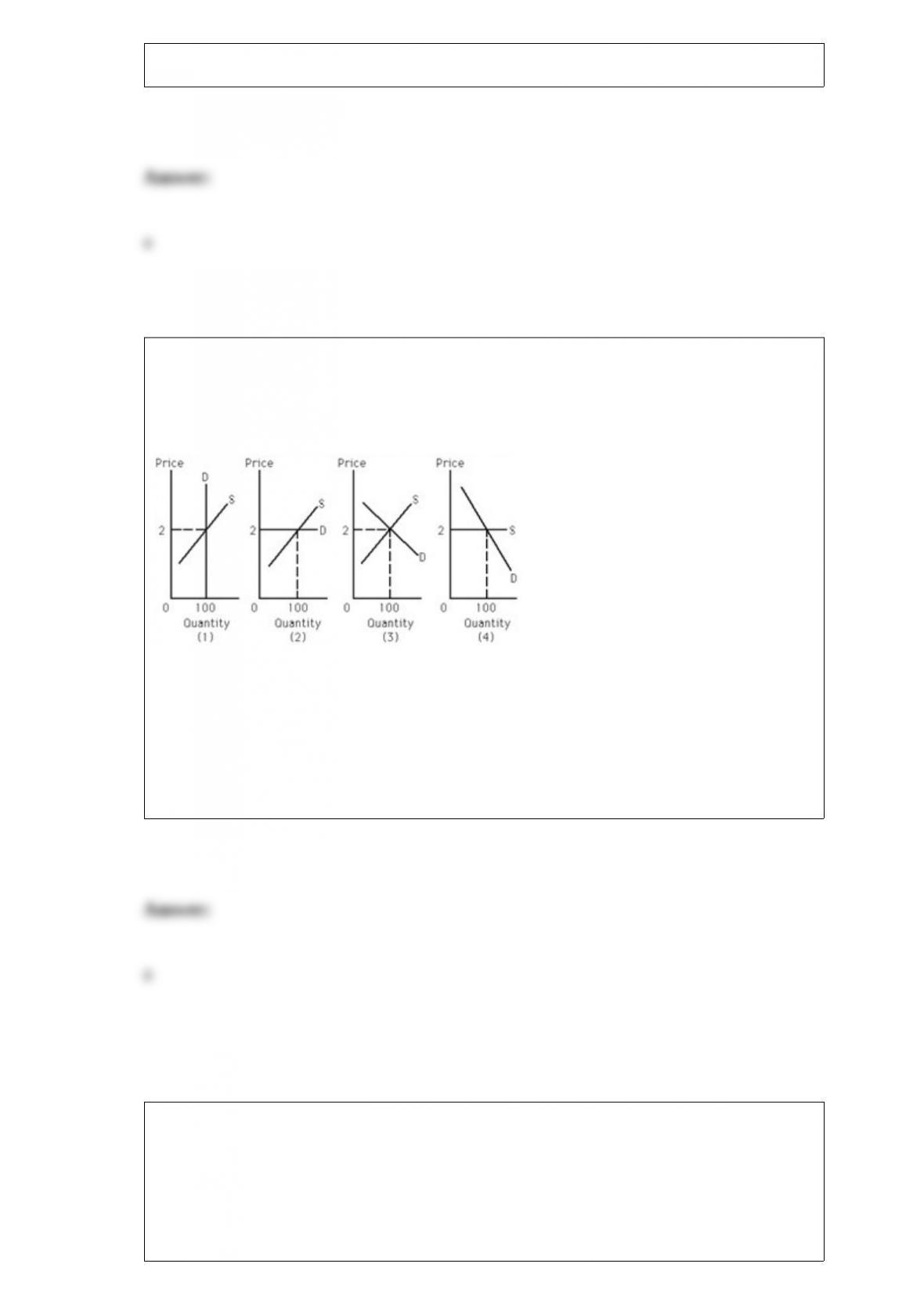
Refer to Exhibit 20-7. If the government wants to impose a per-unit tax in order to raise
revenues, which of the depicted markets should it choose in order to maximize tax
revenues?
Exhibit 20-7
a. (1)
b. (2)
c. (3)
d. (4)
Generally, the monopolistic competitor is in long run equilibrium when
a. MR = MC and P = ATC.
b. P = MC = ATC.

c. P = MC and P > ATC.
d. MR = MC = ATC.
e. b and d
Equilibrium price is $19 in a perfectly competitive market. For a perfectly competitive
firm, MR = MC at 120 units of output. At 120 units, ATC is $11, and AVC is $8. The
best policy for this firm is to __________ in the short run. Also, this firm earns
__________ of __________ if it produces and sells 120 units. Finally, the difference
between total revenue and total fixed cost for this firm is __________.
a. continue to produce; profits; $960; $1,920
b. continue to produce; losses; $960; $1,000
c. shut down; losses; $1,200; $2,300
d. continue to produce; profits; $1,920; $1,960
e. none of the above
If an industry advertises, then it
a. is definitely not a perfectly competitive industry.
b. must be a perfectly competitive industry.

c. may or may not be a perfectly competitive industry.
d. is not using its resources wisely.
e. will surely be able to increase its sales.
The horizontal demand curve faced by the perfectly competitive firm implies that the
firm can sell an infinite amount of the product at the equilibrium price.
a. True
b. False
Economists often evaluate a theory in terms of how consistently and accurately it
predicts what happens.Implicit in this position is the belief that
a. if the theory’s predictions are consistently accurate, then there is a fairly good chance
that the theory is a good explanation of how things work.
b. if the theory’s predictions are consistently accurate, then there is a fairly good chance
that the theory will be accepted by others.
c. if the theory’s predictions are consistently accurate, then there is a fairly good chance
thatthe theory’s assumptions (even if they initially seem unrealistic) capture something
that is essential to explaining what it is that the theory is trying to explain.
d. all of the above
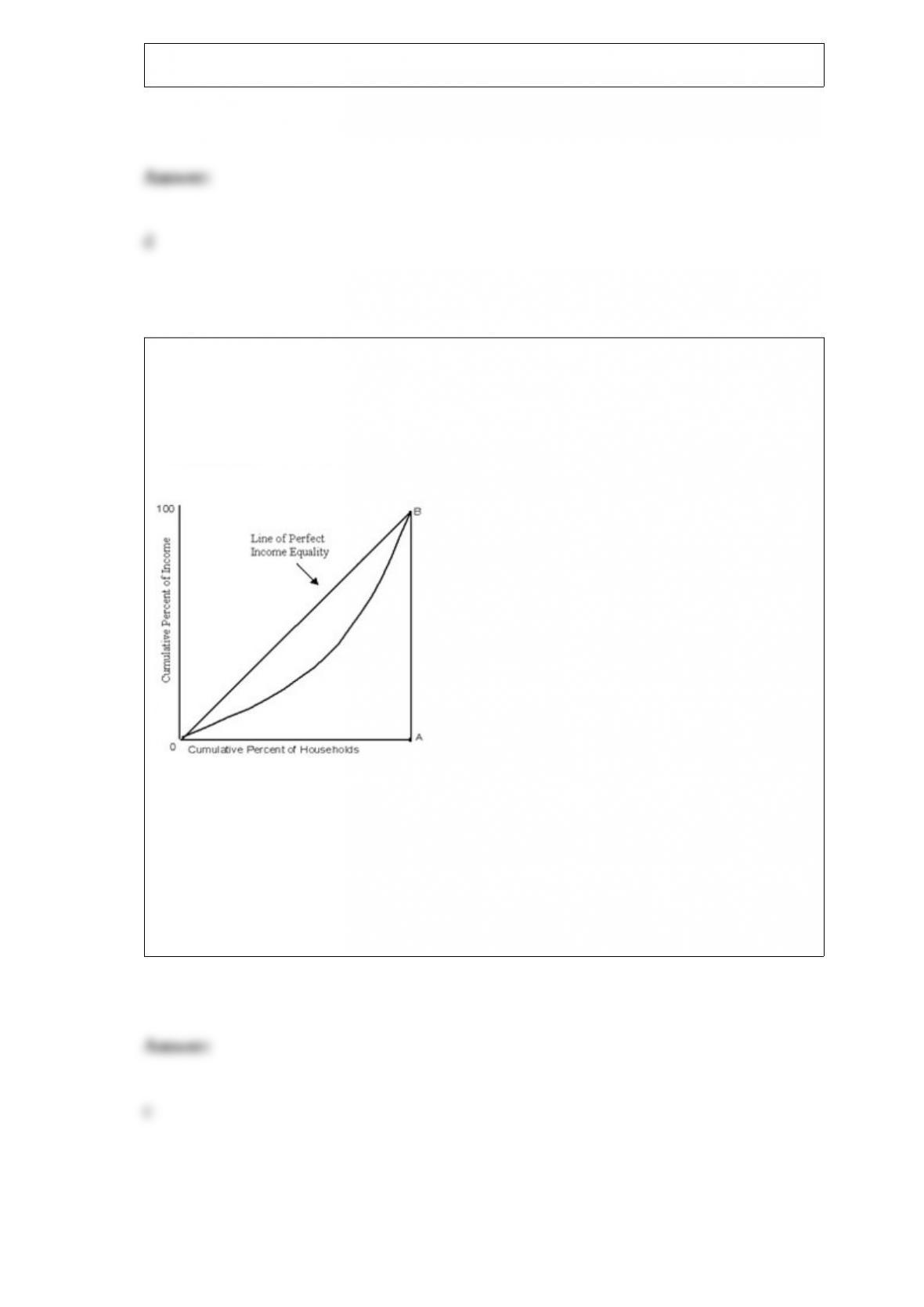
Refer to Exhibit 29-1.If the Gini coefficient is some number greater than 0, but less than
1, then the Lorenz curve could be
Exhibit 29-1
a. line AB.
b. line OB.
c. the curve connecting point O to point B.
d. the horizontal axis from 0 to A and the line AB.
e. point B.
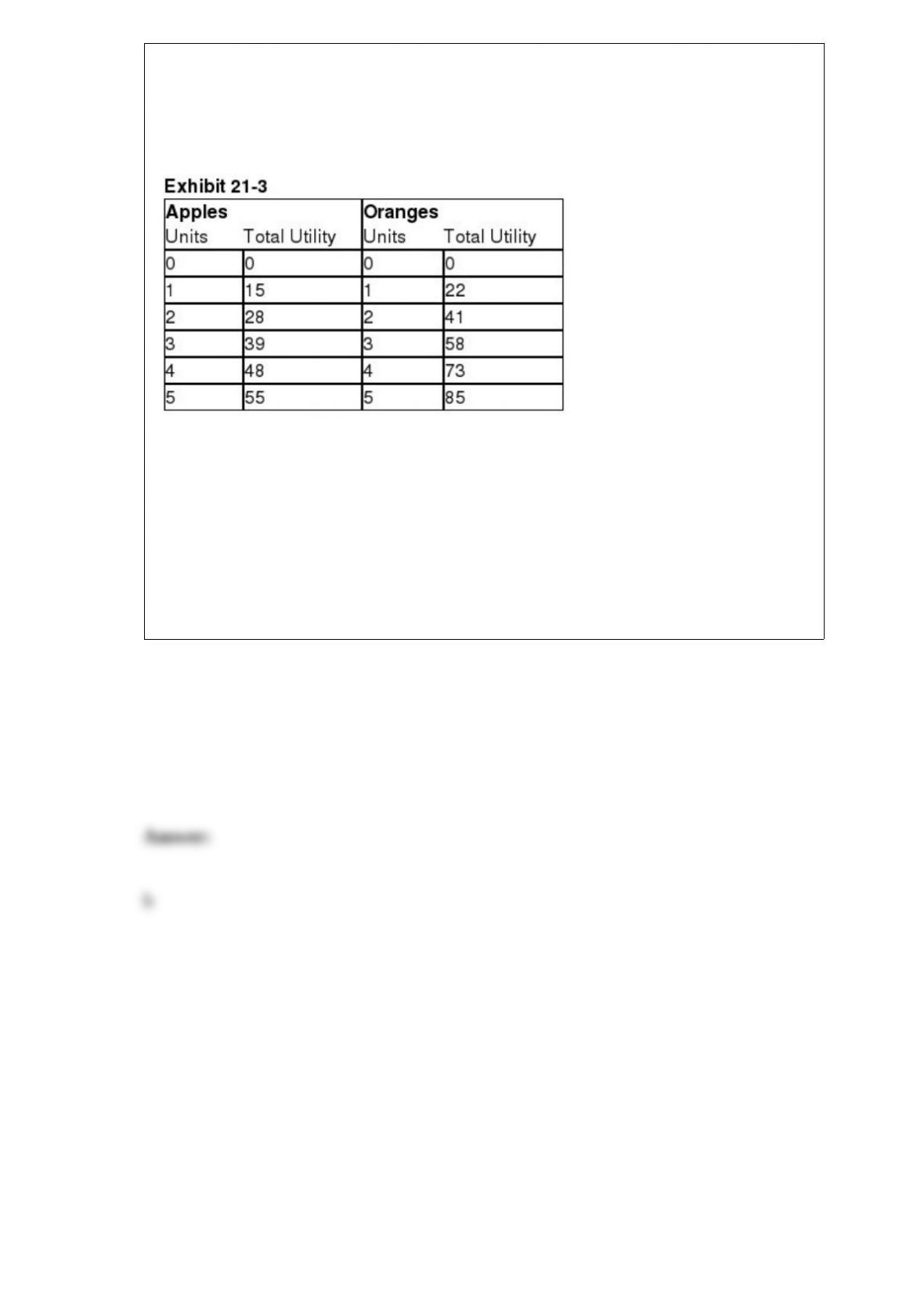
Refer to Exhibit 21-3. Linda spends $5 a week on apples and oranges. If the price of
both goods is $1 per unit, how many apples and oranges, respectively, does she
purchase per week if she wants to maximize her utility?
a. 0 and 5
b. 1 and 4
c. 2 and 3
d. 3 and 2
e. none of the above