
An increase in government spending may expedite recovery from a recession in the
short run, but in the long run this policy may
A) reduce investment in new capital.
B) make domestic businesses less competitive in international markets as the dollar
appreciates in value.
C) raise interest rates and reduce consumer expenditures on automobiles and new
houses.
D) All of the above are correct.
Lack of investment in strong education and health care systems
A) causes a deterioration in human capital and a decline in labor productivity.
B) causes a decline in physical capital and a decline in labor productivity.
C) increases human capital and cause a decline in labor productivity.
D) causes a deterioration in human capital and an increase in physical capital.
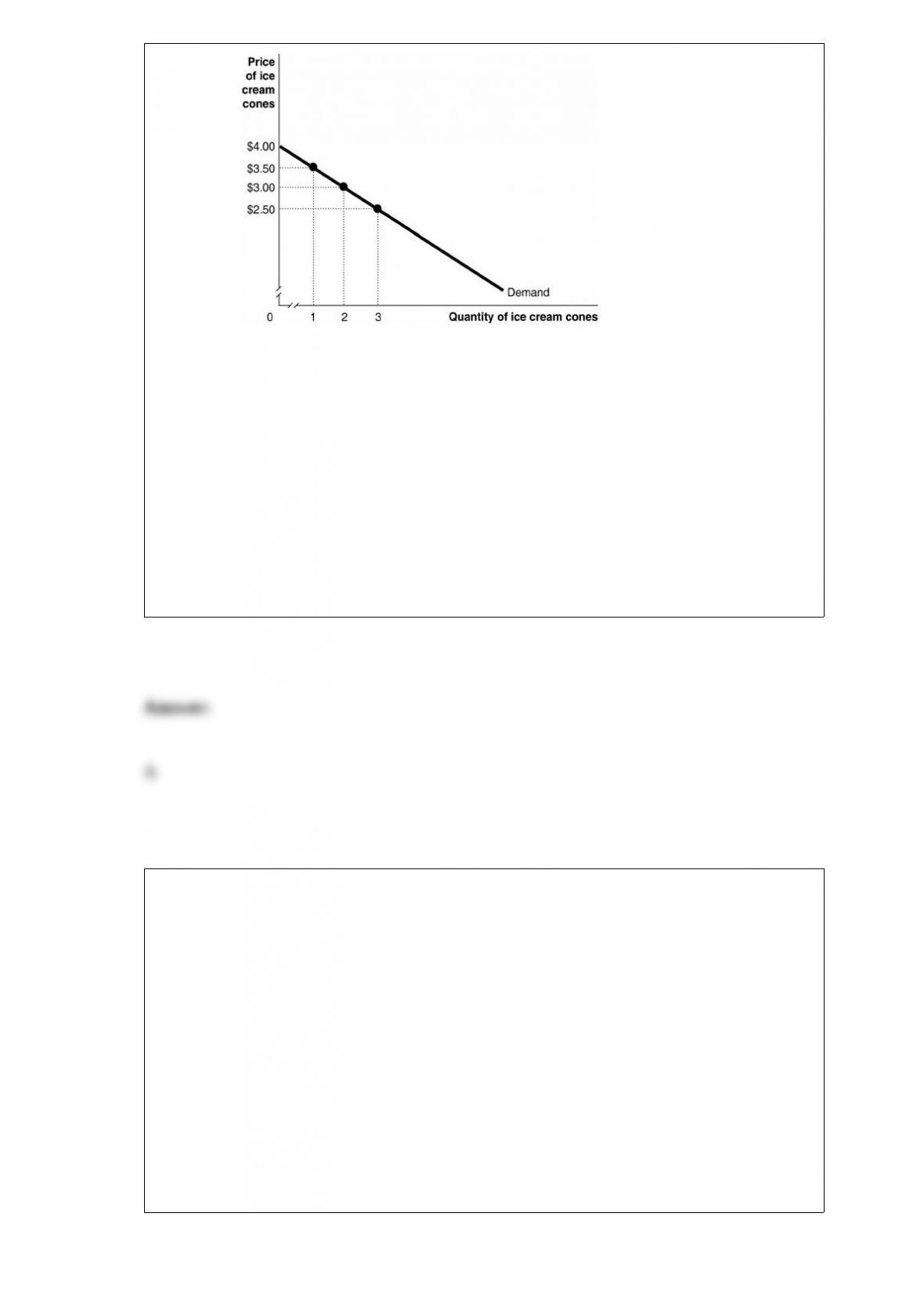
Figure 4-1 Figure 4-1 shows Kendra’s
demand curve for ice-cream cones.
If the market price is $3.00, what is the consumer surplus on the second ice cream
cone?
A) $0
B) $0.50
C) $3.00
D) $5.50
Stan owns a software design business. He obtained a bank loan to buy computer
equipment for his business. He pays $1,000 per month for interest on the loan. He has
10 employees, each of whom is paid $4,000 per month. Because his business has been
successful, next month he will increase employee wages to $5,000. If the revenue from
his business remains at its current level, Stan is considering an addition to his office.
Which of the following statements regarding Stan’s business is false?
A) The payments Stan makes to his employees are variable costs and explicit costs.
B) The monthly payment Stan makes for his bank loan is an implicit cost.
C) The monthly payment Stan makes for his bank loan is a fixed cost.
D) The time and effort Stan spends on his software design business is an implicit cost.

The Coffee Nook, a small cafe near campus, sells cappuccinos for $2.50 and Russian
tea cakes for $1.00 each. What is the opportunity cost of buying a Russian tea cake?
A) 2 1/2 cappuccinos
B) 2/5 of a cappuccino
C) $2.50
D) $1.00
The present value of $475 received 3 years in the future would be calculated as which
of the following when the interest rate is 6 percent?
A) 475/(1.6)3
B) 475/(1.06)3
C) 475 1.6 3
D) 3.06/475

Which of the following displays these two characteristics: rivalry and nonexcludability?
A) a public good
B) a private good
C) a quasi-public good
D) a common resource
Which of the following would cause a decrease in the equilibrium price and decrease in
the equilibrium quantity of papayas?
A) a decrease in supply and an increase in demand
B) a decrease in demand
C) an increase in supply and an increase in demand greater than the increase in demand
D) a decrease in supply and a decrease in demand
Sheldon Cleaver commented on the difficulty people have in overcoming poverty in the
United States: “Most people whose incomes fall below the poverty line have difficulty
pulling themselves above the line in future years. In this sense, poverty becomes a
vicious cycle. I believe the psychological damage households face when they are
branded with the ‘poverty’ label in our society is a major factor in their remaining in
poverty. Despair is a major reason why the percentage of people with incomes that lie
below the poverty line never falls below 10 percent.” Which of the following correctly
evaluates Cleaver’s statement?

A) Cleaver is correct. Economists often fail to take into account psychological factors
when they analyze poverty and the distribution of income in the United States. Policies
must take such factors into account if we are to make progress in eliminating poverty.
B) Cleaver is correct when he notes that poverty is a chronic problem. The best way to
reduce poverty is to force the poor to become better educated so that they can work
their way out of poverty.
C) Cleaver is correct, but he is looking at the wrong statistic. The official poverty line
understates the true degree of poverty in the United States.
D) Cleaver assumes that all those with incomes below the poverty line in one year
remain in poverty in subsequent years. In fact, research has shown that the number of
people who remain in poverty for many years is much smaller than the number who are
in poverty during any one year.
If Ewan is consuming his utility maximizing bundle and the price of one good falls,
what happens to the marginal utility per dollar spent on this good (MU/P), and what
should Ewan do?
A) MU/P has increased and Ewan should buy more of this good.
B) MU/P has increased and Ewan should buy less of this good.
C) MU/P has decreased and Ewan should buy more of this good.
D) MU/P has decreased and Ewan should buy less of this good.
Which of the following is not a characteristic of oligopoly?

A) the ability to influence price
B) a small number of firms
C) low barriers to entry
D) interdependent firms