
Market power in the United States causes a huge loss of economic efficiency.
Answer:
Examining the conditions that could lead to inflation in an economy is an example of
microeconomics topic.
Answer:
An increase in the inflation rate increases employment only if the increase in inflation is
unexpected.
Answer:
Net exports equals the balance of trade surplus.
Answer:

For all points above the 45-degree line, planned aggregate expenditure will be less than
GDP.
Answer:
If changes in inflation are higher than expected,
A) the short-run Phillips curve will be positively sloped, but not vertical.
B) the short-run Phillips curve will be negatively sloped.
C) the short-run Phillips curve will be vertical.
D) the long-run Phillips curve will be negatively sloped.
Answer:
The demand curve for corn is downward sloping. If the price of corn, an inferior good,
falls
A) the income effect which causes you to reduce your corn purchases is smaller than
the substitution effect which causes you to increase your corn purchases, resulting in a
net increase in quantity demanded.
B) the income effect which causes you to increase your corn purchases is larger than the
substitution effect which causes you to reduce your corn purchases, resulting in a net
increase in quantity demanded.
C) both the income and substitution effects reinforce each other to increase the quantity
demanded.
D) the income and substitution effects offset each other but the price effect of an
inferior good leads you to buy less corn.
Answer:
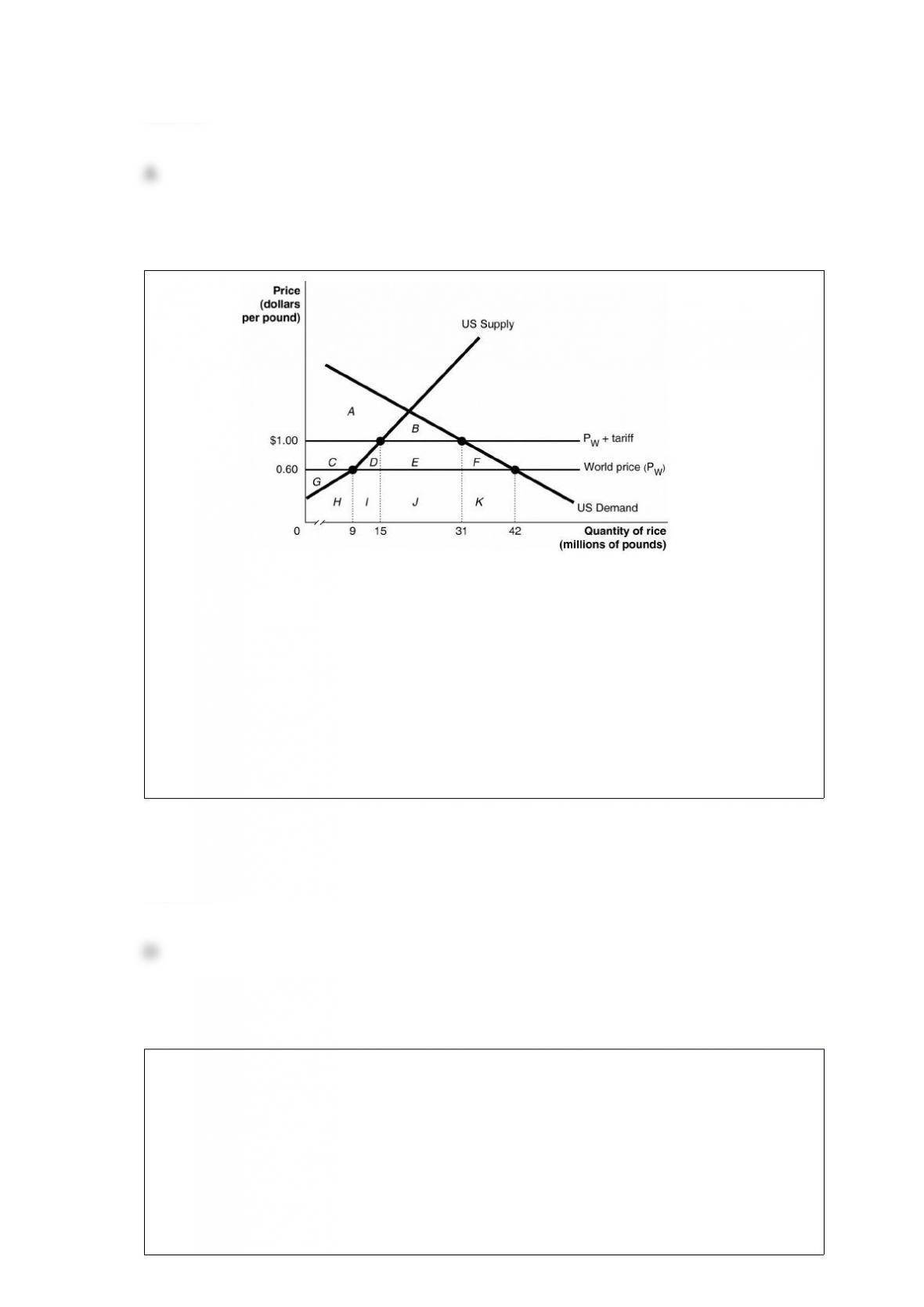
Figure 9-2 Suppose the U.S.
government imposes a $0.40 per pound tariff on rice imports. Figure 9-2 shows the
impact of this tariff. Without the tariff in place, the United States consumes
A) 9 million pounds of rice.
B) 15 million pounds of rice.
C) 31 million pounds of rice.
D) 42 million pounds of rice.
Answer:
For years economists believed that market structure explained the ability of some firms
to earn economic profits. Today, economists and business strategists put greater
emphasis on
A) the number of years a firm has been in business and the average price of the
products sold by the firm.
B) the number of countries in which a firm conducts business and the number of

employees the firm has in each country.
C) the characteristics of individual firms and the strategies their managements use to
continue to earn economic profits.
D) the size of a firm relative to the industry average and the number of firms in the
domestic industry.
Answer:
Which is the largest component of aggregate expenditure?
A) planned investment expenditures
B) consumption expenditures
C) government expenditures
D) net export expenditures
Answer:
Table 2-12
Table 2-12 shows the number of labor hours required to produce a canoe and a sailboat
in Guatemala and Honduras.
Does either Guatemala or Honduras have an absolute advantage and if so, in what
product?

A) Guatemala only has an absolute advantage in producing canoes.
B) Honduras only has an absolute advantage in producing canoes.
C) Guatemala has an absolute advantage in producing both products.
D) Honduras only has an absolute advantage in producing sailboats.
Answer:
Many firms use odd pricing€charging prices such as $.99 instead of $1.00 and $9.99
instead of $10.00. One reason for this pricing strategy is that consumers will somehow
believe that the difference in price appears to be greater than it actually is. Researchers
conducted consumer surveys to determine whether this is actually the case. What was
the result of these surveys?
A) The surveys found that small differences in price cause small differences in quantity
demanded. There is no evidence that odd pricing makes economic sense.
B) Although the results were not conclusive, there is some evidence that odd pricing
makes economic sense.
C) The surveys found indifference regarding this strategy among most consumers, but
hostility among other consumers. The latter group resented what they viewed as an
attempt to fool them into buying products with odd prices. Researchers concluded that
odd pricing is counterproductive.
D) The survey results were inconclusive because most consumers gave unreliable
responses to the survey questions.
Answer:
Changes in the price level

A) increase the level of aggregate supply in the long run.
B) decrease the level of aggregate supply in the long run.
C) do not affect the level of aggregate supply in the long run.
D) increase the level of aggregate supply in the long run only at very high levels of
output.
Answer:
Because knowledge capital is nonexcludable and nonrival, firms have an incentive to
________ the research and development of other firms.
A) make bids on
B) not use
C) ignore
D) free ride on
Answer:
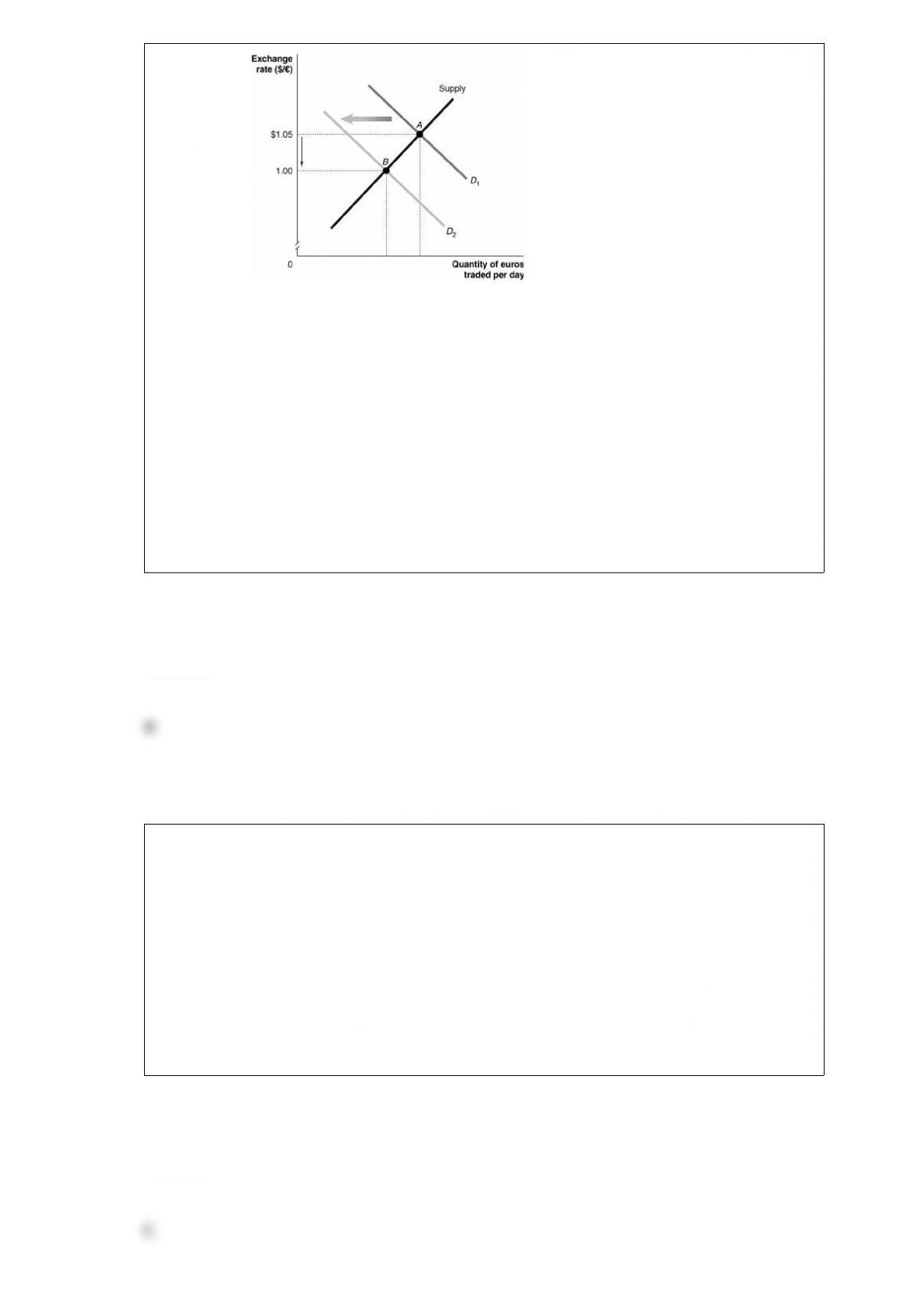
Figure 30-1
Which of the following would cause the change depicted in the figure above?
A) U.S. productivity falls relative to European productivity.
B) Americans increase their preferences for goods produced in the EU relative to
American goods.
C) The European Union increases its quotas on Italian wine.
D) The price level of goods produced in the EU decreases relative to the price level of
goods produced in the United States.
Answer:
Which of the following is a true statement about the length of recessions and
expansions in the United States economy?
A) After 1950, the length of expansions equaled the length of recessions.
B) After 1950, the length of expansions were much less than the length of recessions.
C) After 1950, the length of expansions were much longer than the length of recessions.
D) After 1950, the length of expansions were brief and almost nonexistent.
Answer:

Seth is a competitive body builder. He says he has to have his 12-oz package of protein
powder to “feed his muscles” every day. On the basis of this information, what can you
conclude about his price elasticity of demand for protein powder?
A) It is elastic.
B) It is perfectly elastic.
C) It is perfectly inelastic.
D) The price elasticity coefficient is 0.
Answer:
An increase in the discount rate ________ bank reserves and ________ the money
supply if banks respond appropriately to the change in the rate.
A) increases; increases
B) increases; decreases
C) decreases; increases
D) decreases; decreases
Answer:
The measure of production that values production using current prices is called

A) value-added GDP.
B) nominal GDP.
C) real GDP.
D) underground GDP.
Answer:
How can a corporation’s board of directors and its managers try to reduce the
principal-agent problem?
Answer:
To maximize profit, a firm will produce the level of output where MR = MC. If a firm
actually makes a profit depends on the relationship of price to average total cost. What
are the three possible relationships between price and average total cost that determine
if a firm will make a profit, experience a loss, or break even?
Answer:
If firms do not earn economic profits in a competitive equilibrium, why would the firms
choose to stay in business?
Answer:
What actions should the Fed take if it believes the economy is about to experience a
high rate of inflation?
Answer:
Japan experienced periods of deflation € a declining price level € during the 1990s.
During a deflationary period, which would be higher: nominal GDP or real GDP? Why?
Assume that the base year of choice is prior to the deflationary period.

Answer:
What is a household? How do households interact with firms in a market?
Answer:
Illustrate and explain the effects of tax reduction and simplification using the dynamic
aggregate demand and supply model. To simplify the analysis, assume that aggregate
demand is not affected by the tax cut.
Answer:
In Year 1 suppose the economy is at potential GDP and that the federal budget deficit
equals $100 billion. In Year 2 the federal budget deficit rises to $150 billion, but the
cyclically adjusted budget deficit falls to $75 billion. How can the actual budget deficit
rise and the cyclically adjusted budget deficit fall?
Answer: