
Refer to Exhibit 20-l. The demand for the good represented by demand curve D3 is
Exhibit 20-1
a. inelastic.
b. elastic.
c. unit elastic.
d. perfectly elastic.
e. more elastic at higher prices than at lower prices.
If the demand for a good is unit elastic, then
a. the percentage change in quantity demanded is greater than the percentage change in
price.
b. the percentage change in quantity demanded is less than the percentage change in
price.
c. the percentage change in quantity demanded is equal to the percentage change in
price.
d. quantity demanded is extremely responsive to changes in price.
e. quantity demanded is not responsive to changes in price.
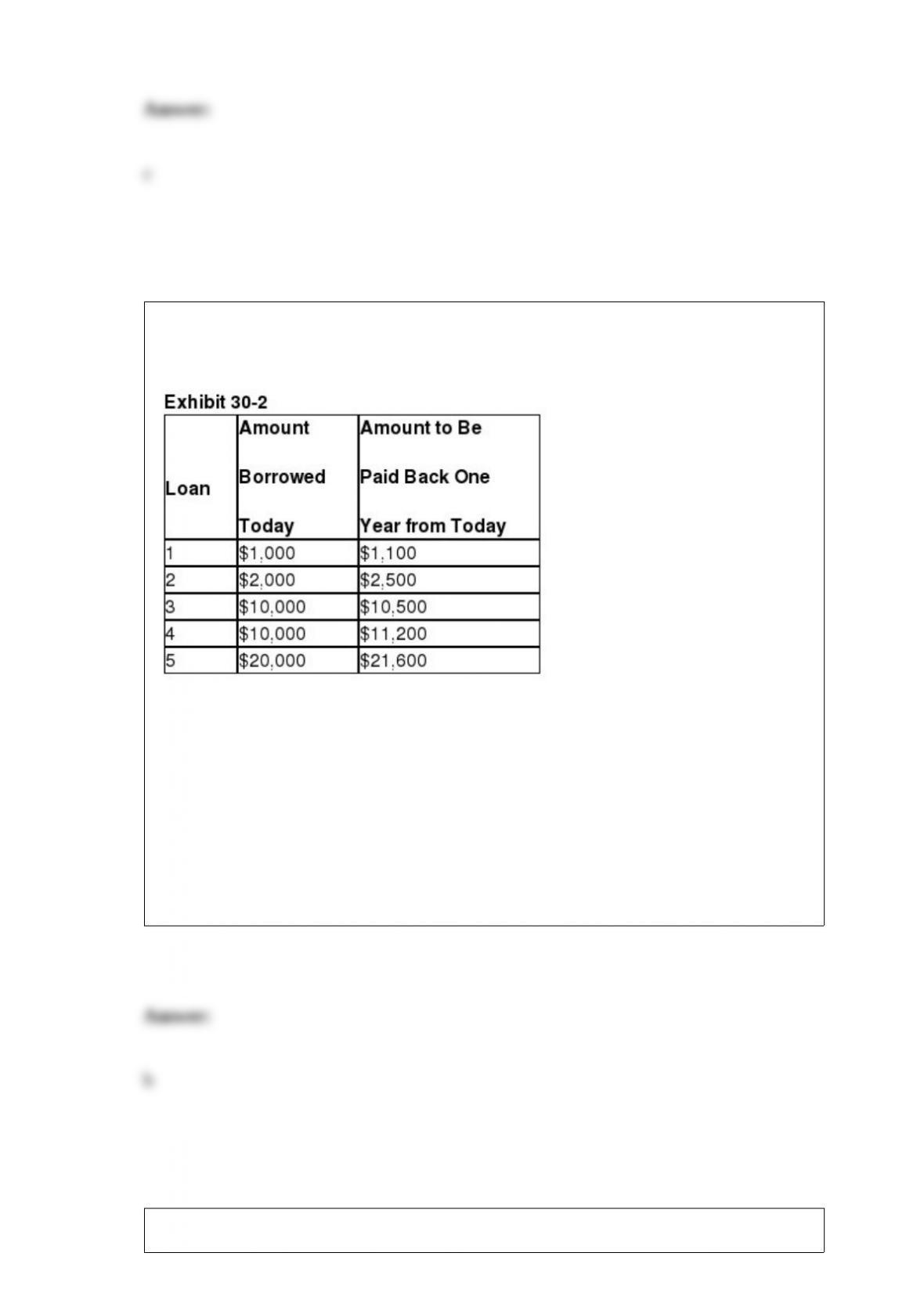
Refer to Exhibit 30-2. The interest and interest rate for loan 4 are, respectively,
a. $11,200 and 12.0 percent.
b. $1,200 and 12.0 percent.
c. $11,200 and 11.2 percent.
d. $1,200 and 11.2 percent.
e. none of the above
Increased productivity in the agricultural sector in conjunction with an inelastic demand

curve for agricultural goods has caused a(n) __________ in output, a(n) __________ in
price, and __________ revenues for farmers.
a. increase; decrease; higher
b. increase; decrease; lower
c. decrease; increase; higher
d. decrease; increase; lower
e. increase; increase; higher
Which of the following statements is true?
a. When production of a good yields positive externalities but output is currently at the
market level, then a change in output to the socially optimal level will certainly be for
the worse.
b. When production of a good yields negative externalities but output is currently at the
market level, then a change in output to the socially optimal level will cause benefits to
increase by an amount greater than costs will increase.
c. When production of a good yields positive externalities but output is currently at the
market level, then a change in output to the socially optimal level will cause benefits to
increase by an amount less than costs will increase.
d. a, b, and c
e. none of the above
In a foreign exchange market diagram with pesos per dollar on the vertical axis, the
quantity of __________ would be on the horizontal axis, and the U.S. demand for
Mexican goods would help to determine the __________ curve.
a. dollars; demand
b. dollars; supply
c. pesos; demand
d. pesos; supply
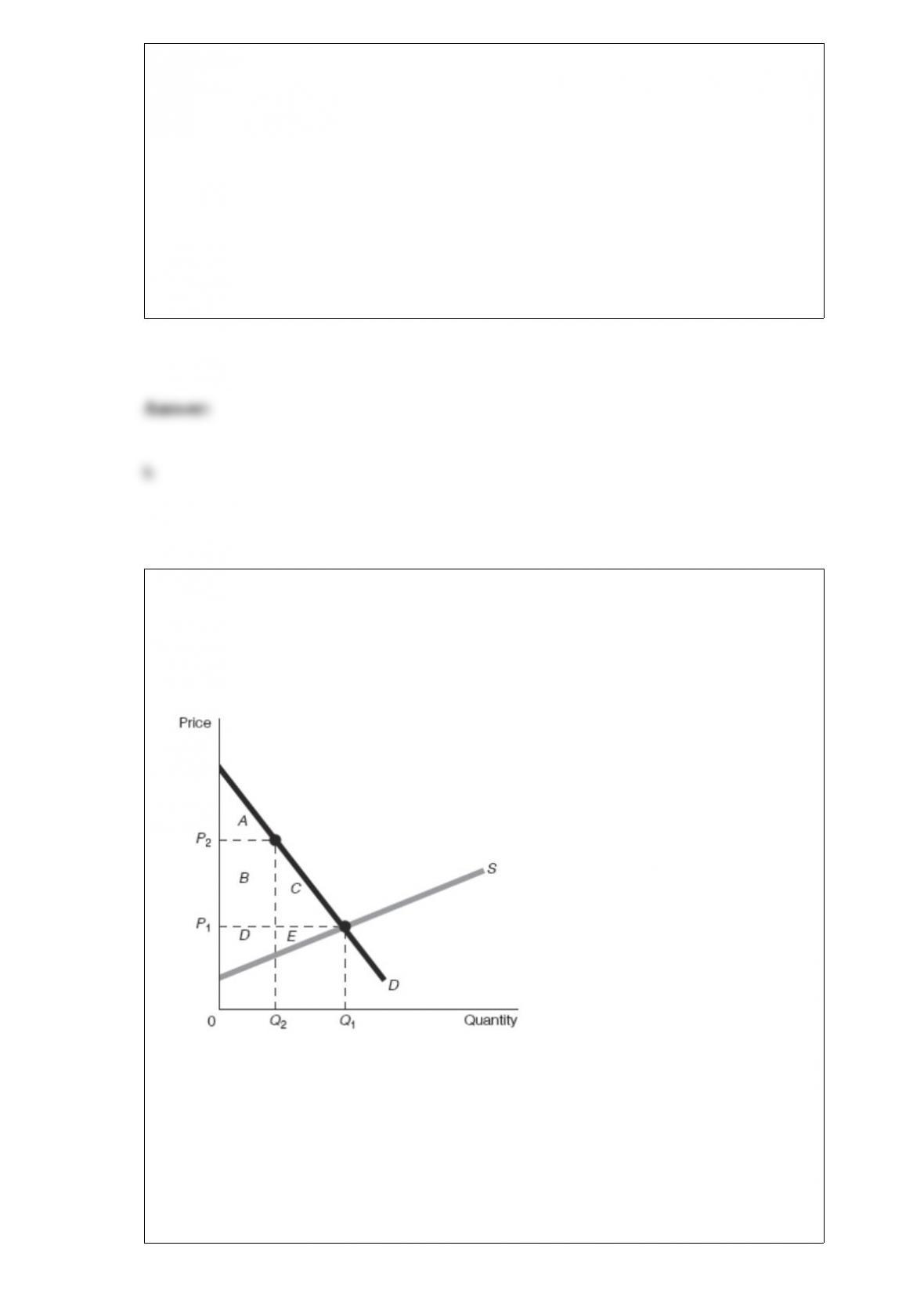
Refer to Exhibit 32-4.Suppose that producers of this good engage in rent seeking which
results in the government imposing a price floor of P2.The gain in producers’ surplus
that occurs due to the price floor is
Exhibit 32-4
a. B + C
b. A + B + C + D + E
c. A + B + C
d. C + E

e. B
In 2012, approximately 15 percent of the total population in the United States were
living below the poverty line.
a. True
b. False
Price discrimination occurs when a seller charges different prices for its product and the
price differences result from differences in the costs of production.
a. True
b. False

A theory predicts that the more a student studies, the higher his or her grades will
be.This theory is
a. not falsifiable.
b. falsifiable.
c. too difficult a theory to test.
d. inconsistent with the fact that some students study less than other students, yet
receive higher grades.
e. b and d
Equilibrium price is $22 in a perfectly competitive market. For a perfectly competitive
firm, MR = MC at 200 units of output. At 200 units, ATC is $23, and AVC is $18. The
best policy for this firm is to __________ in the short run. Also, this firm earns
__________ of __________ if it produces and sells 200 units. Finally, the difference
between total variable cost and total fixed cost for this firm is __________.
a. continue to produce, profits, $1800, $3,600
b. shut down, losses, $200, $3,600
c. continue to produce, losses, $200, $2,600
d. shut down, profits, $200, $1,800
e. none of the above

In the case of a negative externality, the entire marginal social cost curve lies
a. below the entire marginal private cost curve by the amount of the external costs
associated with the negative externality.
b. below the entire demand curve by the amount of the external costs associated with
the negative externality.
c. above the entire marginal private cost curve by the amount of the external costs
associated with the negative externality.
d. above the entire demand curve by the amount of the external costs associated with
the negative externality.
e. none of the above
If the consumption of a good by one person reduces the amount of it that can be
consumed by others, the good is
a. excludable.
b. nonexcludable.
c. rivalrous in consumption.
d. nonrivalrous in consumption.
The least-cost rule requires that, for every factor, the ratio of the
a. marginal physical product to factor price must be equal.
b. marginal revenue product to factor price must be equal.
c. marginal revenue product to output must be equal.
d. marginal cost to factor price must be equal.
e. b and c
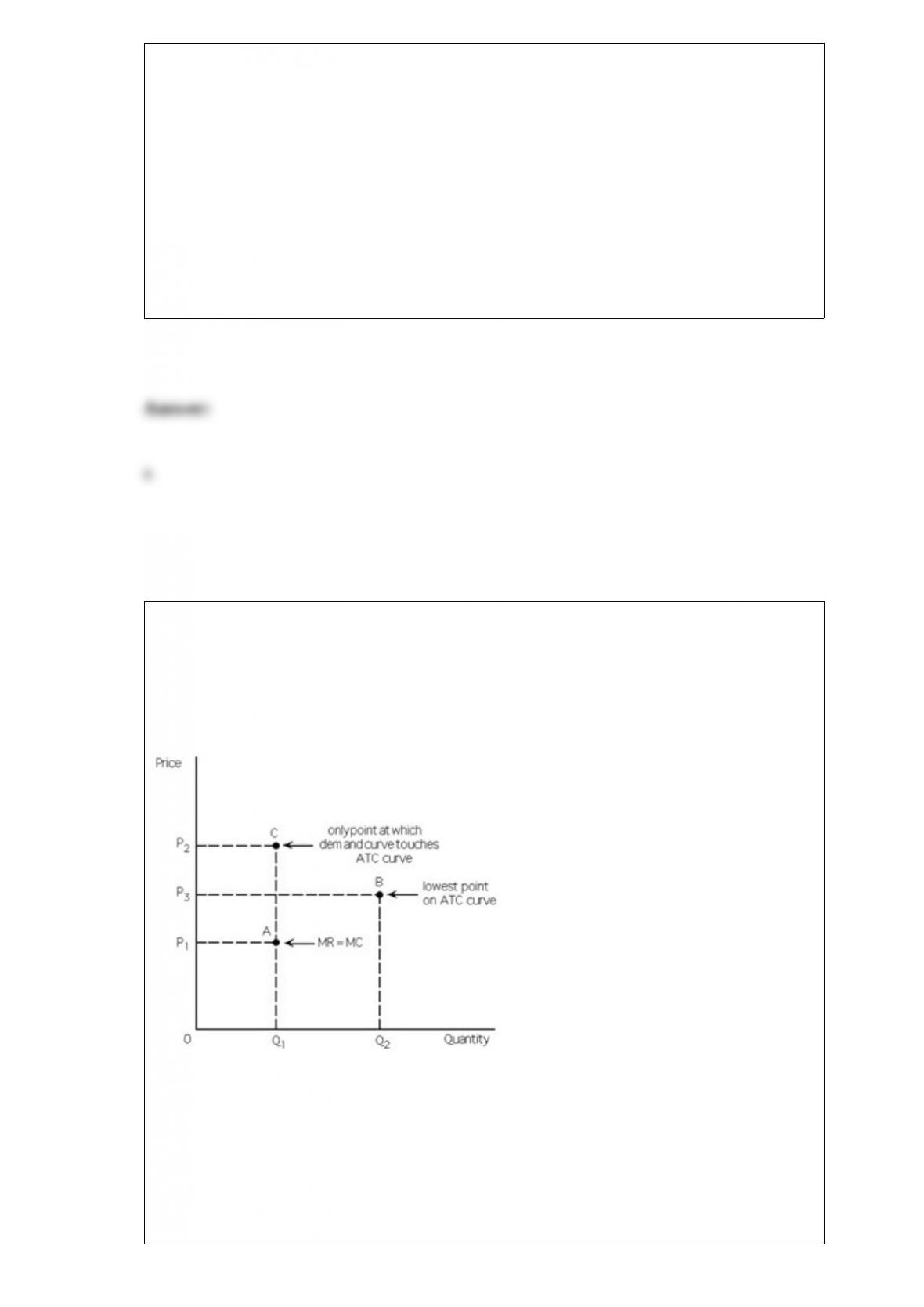
Refer to Exhibit 25-6. The monopolistic competitor is producing __________ quantity
of output and charging a price of __________.
Exhibit 25-6
a. Q1; P3
b. Q2; P3
c. Q1; P2
d. Q1; P1
e. Q2; P1
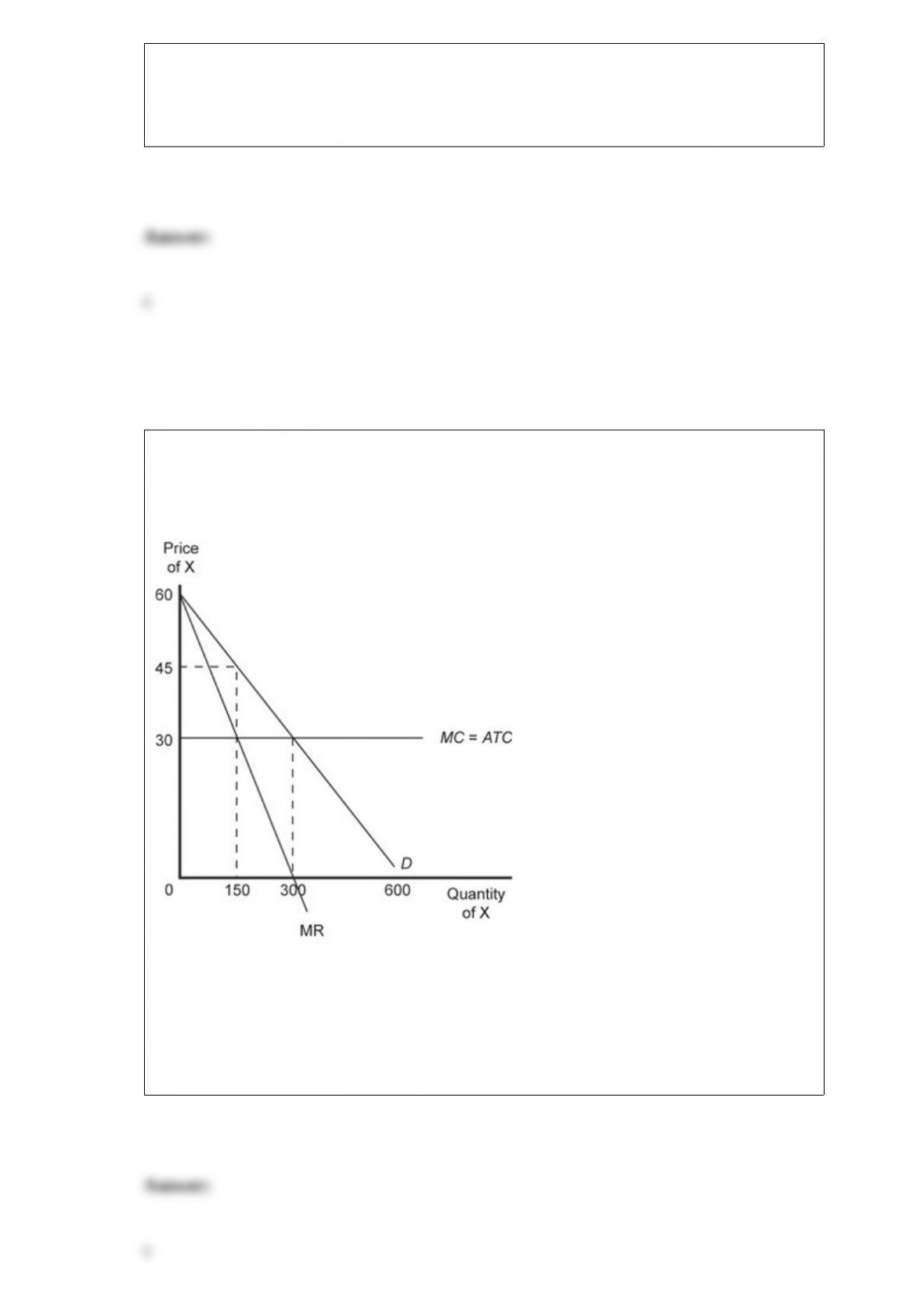
Refer to Exhibit 24-7. Let D be the demand curve facing a perfectly
price-discriminating monopolist. The lowest price this monopolist will charge is
Exhibit 24-7
a. $60.
b. $45.
c. $30.
d. $0.

If, under a fixed exchange rate system, the dollar price of a Mexican peso is above its
equilibrium level, then the
a. dollar is undervalued.
b. peso is undervalued.
c. dollar has appreciated.
d. peso has depreciated.
Some years ago, chemists at 3M Corporation were trying to create a super-strong glue.
Somehow they got their molecules twisted and came up with one of the weakest glues
ever made. But, rather than pouring it down the drain, they tried coating some paper
with it, and the “Post-It Note” was born. In this case, 3M was acting asa(n)
a. utility.
b. rationer.
c. entrepreneur.
d. abstraction.
Shirking, being a form of __________, is a good that individuals may consume more of

the __________ its cost.
a. work; higher
b. work; lower
c. leisure; higher
d. leisure; lower
Points that lie inside (or below) the PPF are
a. unattainable.
b. attainable and productive efficient.
c. attainable but productive inefficient.
d. attainable and neither productive efficient nor productive inefficient.
An economy is productive efficient if it produces
a. more than enough food to feed everyone.
b. more goods and services in each successive year.
c. maximum output with given resources and technology.
d. enough output so that no one lives in poverty.
In the short run, if price (P) is less than average total cost (ATC) will a perfectly
competitive firm necessarily shut down?Explain why or why not using a hypothetical
numerical example.
Describe the difference between market coordination and managerial coordination.
Give an example of each to support your answer.
Describe the difference between the “traditional” view of labor unions and the “labor
union as a collective voice” view of labor unions with respect to the impact that labor
unions have on productivity and efficiency.
Describe how the substitution effect and the income effect influence the slope of an
individual’s supply curve of labor.
Explain what productive efficiency means.Describe how productive efficiency is
represented by a PPF.