
Marginal revenue product of labor for a competitive seller is
A) the change in total product from hiring one more worker.
B) equal to the marginal product of labor multiplied by the output price.
C) the output price multiplied by the quantity sold.
D) the marginal revenue of the product multiplied by the output price.
Consider an industry that is made up of nine firms each with a market share (percent of
sales) as follows:
a. Firm A: 30%
b. Firm B: 20%
c. Firms C, D and E: 10% each
d. Firms F, G, H and J: 5% each What is the value of the Herfindahl-Hirschman Index
and how is the industry categorized?
A) 1700; moderately concentrated
B) 1425; moderately concentrated
C) 1600; moderately concentrated
D) 2600; highly concentrated
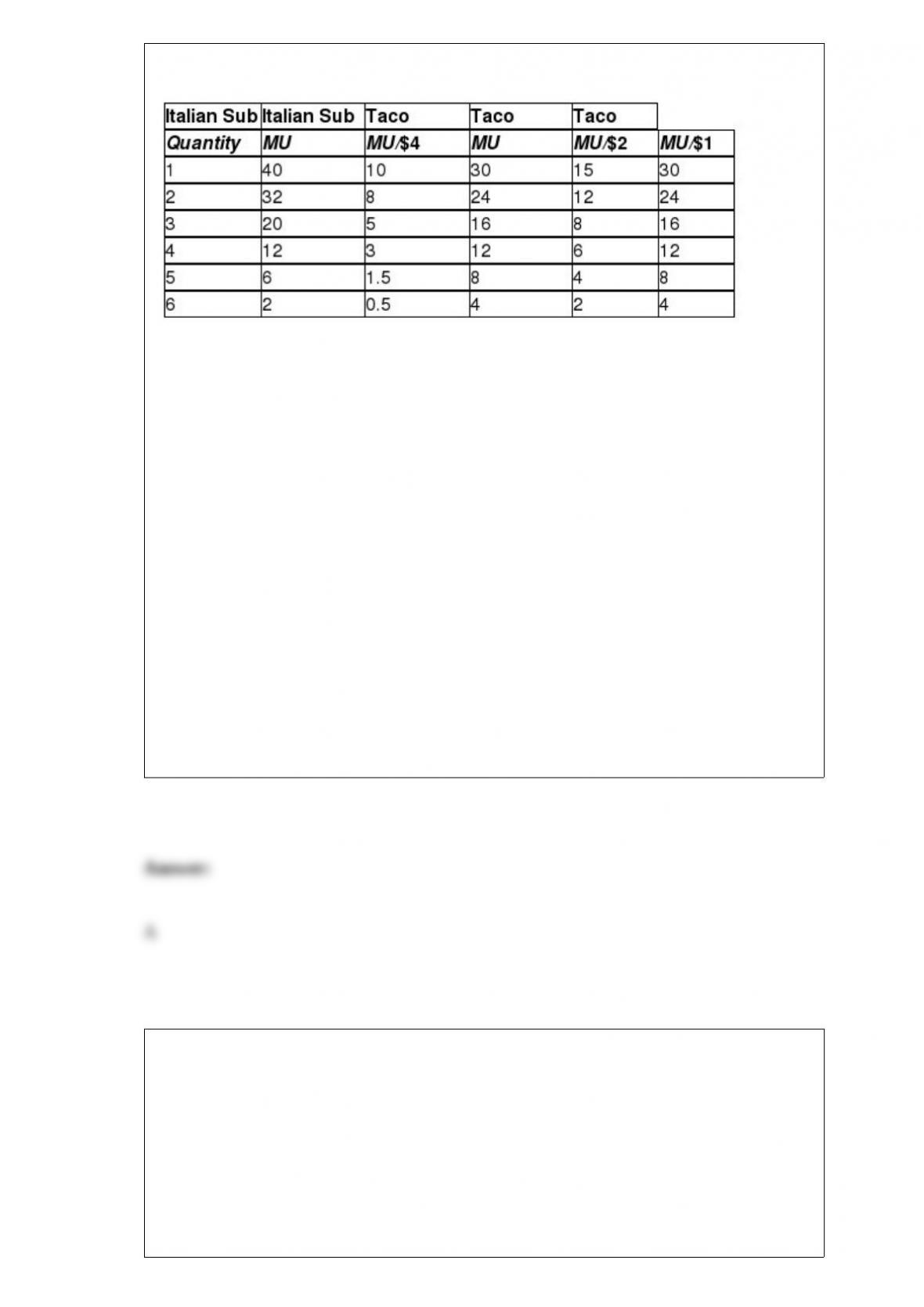
Table 10-5
which lists the values of Harry Taber’s marginal utility and marginal utility per dollar
for Italian submarine (sub) sandwiches and tacos. Assume that the price of the sub
sandwiches is $4 and the price of tacos is $2. When Harry’s income is $14 he buys two
Italian sub sandwiches and three tacos. The last column lists the values of the marginal
utility per dollar for tacos when the price of tacos decreases to $1. Complete this
statement: As a result of the change in price, the marginal utility of each taco Harry
consumes increases and
A) the substitution effect of the price change will cause Harry to buy more tacos and
fewer subs.
B) the substitution effect of the price change will cause Harry to buy more tacos if they
are a normal good, and fewer tacos if they are an inferior good.
C) the substitution effect will cause Harry to buy another sub because his purchasing
power has increased.
D) the substitution effect will cause Harry to buy fewer tacos.
Of the $840 billion American Recovery and Reinvestment Act stimulus package which
was enacted in 2009, the largest spending increase occurred in which category?
A) energy and the environment
B) military, veterans, and homeland security
C) health care, social services, and education

D) transportation and housing
Which of the following best describes the “wealth effect”?
A) When the price level falls, the real value of household wealth falls.
B) When the price level falls, the nominal value of household wealth falls.
C) When the price level falls, the nominal value of household wealth rises.
D) When the price level falls, the real value of household wealth rises.
A patent is an example of
A) how ownership of a key input creates a barrier to entry.
B) a government-imposed barrier to entry.
C) occupational licensing.
D) how market failure can lead to oligopoly.
Some economists argue that the productivity slowdown from mid-1970s to mid-1990s
actually didn’t happen, but just “appeared” to happen because
A) services were becoming a more important part of the economy, and it was hard to
measure increases of output from services.
B) new environmental laws had passed and forced firms to spend to reduce pollution,
and this spending did not raise output.
C) increased spending on health and safety raised worker productivity.
D) A and B
E) B and C
Figure 30-5
The Chinese government pegs the yuan to the dollar, at one of the specified exchange
rates on the graph, such that it overvalues its currency. Using the figure above, this
would generate
A) a shortage of yuan equal to 500 million.
B) a shortage of yuan equal to 100 million.
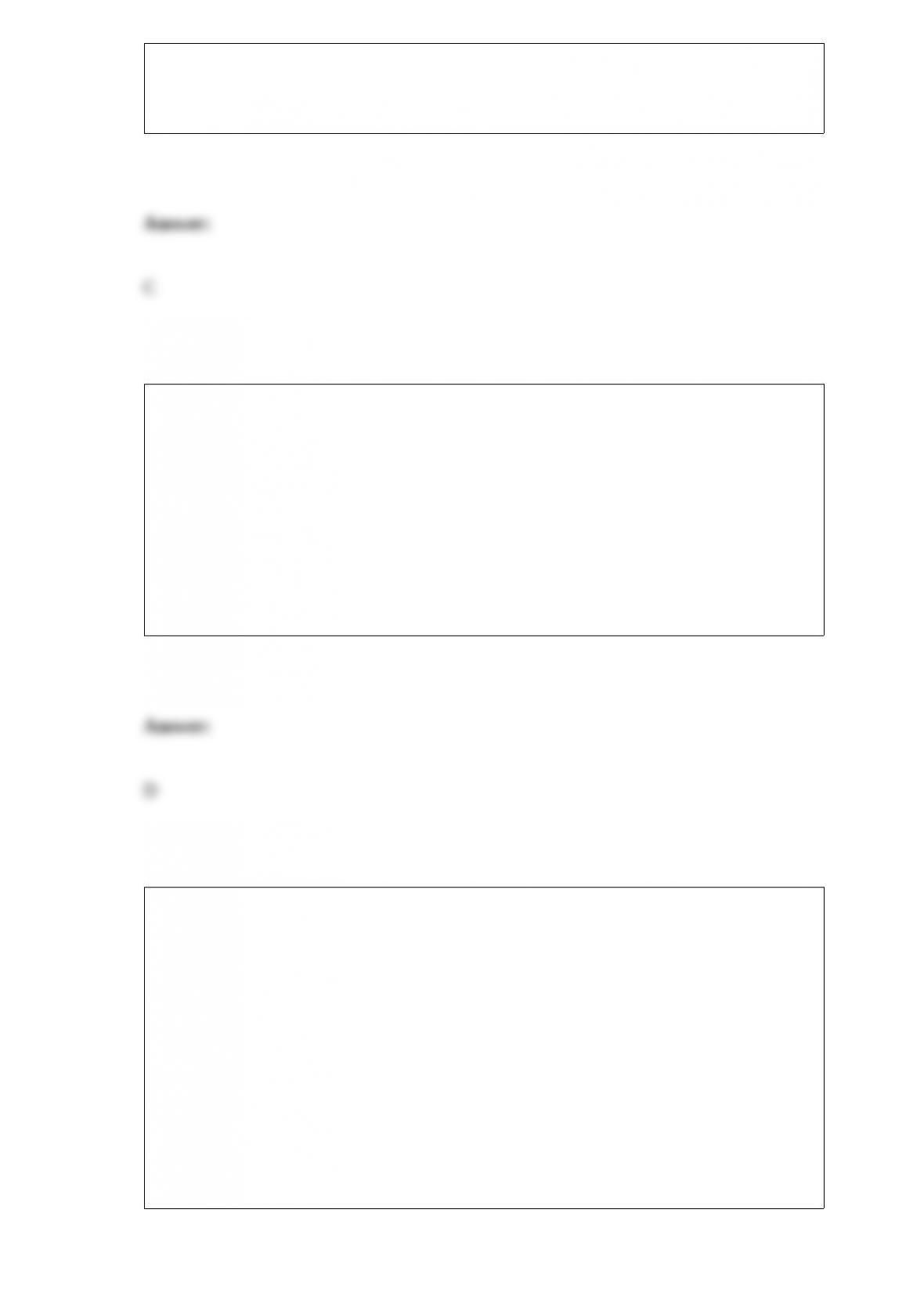
C) a surplus of yuan equal to 200 million.
D) a surplus of yuan equal to 700 million.
Which of the following explains the changes in the U.S. adult male labor force
participation rate since 1948?
A) More men are joining the military as compared to the past.
B) More men are retiring later in life as compared to the past.
C) Fewer men consider themselves discouraged workers as compared to the past.
D) Younger men are remaining in school longer as compared to the past.
Which of the following is explained by the law of diminishing marginal utility?
A) The marginal utility of Isabel’s second bottle of Coca-Cola is greater than the
marginal utility of her third bottle of Coca-Cola.
B) The marginal utility of Isabel’s second bottle of Coca-Cola is greater than the
marginal utility of her third pretzel.
C) The marginal utility of Isabel’s second bottle of Coca-Cola is greater than the
marginal utility of her friend Margie’s third pretzel.
D) The total utility of one bottle of Coca-Cola is greater than the total utility of two
bottles of Coca-Cola.