
From the standpoint of society, a stable Phillips curve indicates that
a. it is possible to have lower rates of inflation and unemployment simultaneously.
b. policies to increase employment also increase the price level.
c. wage increases that exceed productivity increases result in lower prices.
d. government policy makers need to make no fundamental choices between price
stability and unemployment.
e. full employment can be defined as the unemployment rate at which price increases
equal productivity increases.
A sales or excise tax
a. is often considered to be an incidental tax.
b. has a very high collection cost relative to its yield.
c. is another name for a supply-side tax.
d. imposes a greater relative burden on the rich.
e. in general is paid by both the buyer and the seller.
For the crude quantity theory of money to hold, it must be assumed that

a. the money supply is held constant.
b. velocity varies directly with the money supply.
c. velocity varies inversely with the money supply.
d. the economy operates at less than full employment.
e. the ratio of velocity to real output is constant.
The federal budget surpluses experienced at the turn of the twenty-first century
disappeared largely because of
a. multiyear tax cuts in 2001 and 2003.
b. federal spending on homeland security.
c. the war and reconstruction of Iraq.
d. the recession of 2001.
e. all of the above, which contributed to the return of federal budget deficits.
Which of the following is most likely to be a variable input in the transportation of
crude oil?

a. a 26-inch diameter pipeline
b. a large crude oil carrier under long-term contract to Exxon
c. electricity required to run the pumps used in the pipeline
d. oil unloading facilities at a refinery
e. an oil drilling platform in the Gulf of Mexico
Which of the following would be conducive to developing and commercializing a new
technology?
a. keeping personal tax rates low to encourage consumption
b. using monetary policy to keep interest rates high
c. policies to encourage investment in plant and equipment
d. eliminating tax provisions that allow firms to depreciate their plant and equipment
e. providing more funds for low-income families
With regard to the effectiveness of stabilization policies, the new classical
macroeconomists conclude that
a. the price level is fixed, so government stabilization efforts are unnecessary.
b. only unexpected changes in the price level will induce changes in national output.
c. traditional demand-based stabilization policies work effectively if the money supply
is fixed.
d. firms and individuals do not formulate expectations rationally, so government must
step in.
e. money wage adjustments lag behind nominal adjustments, requiring the Fed to
expand credit.
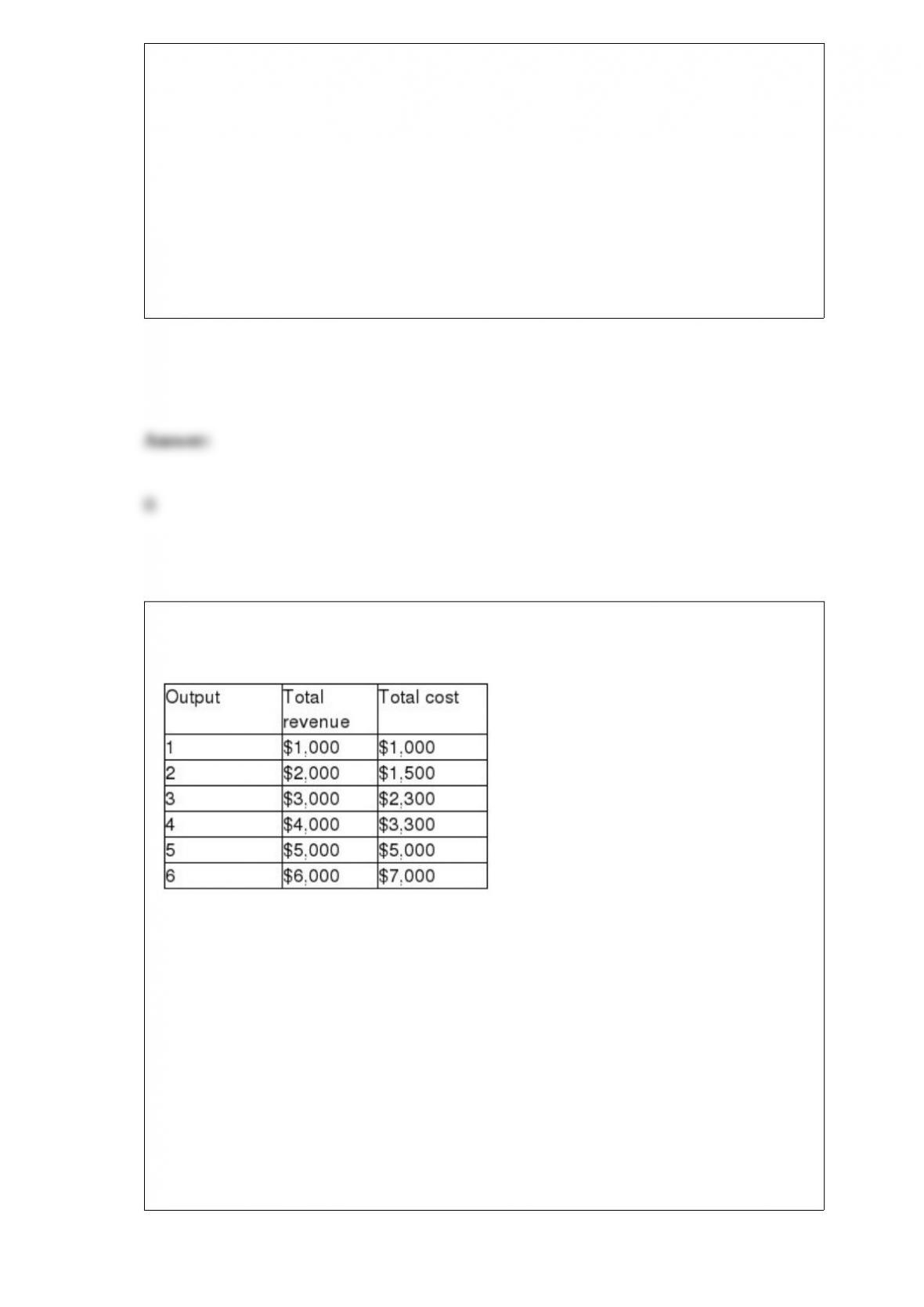
The following questions are based on the following cost and revenue schedule for the
Presto Piano Company:
The profit-maximizing rate of output for the perfectly competitive firm occurs where
marginal cost equals
a. output.
b. average cost.
c. total cost.
d. total revenue.
e. price.

The percentage change in the quantity demanded of one commodity resulting from a 1
percent change in the price of a complementary commodity is called the ________
elasticity of demand.
a. income
b. price
c. cross
d. equilibrium
e. arc
The 1990 budget agreement between President Bush and Congress incorporated
a. an increase in both the income tax and some excise tax rates.
b. substantial reductions in defense spending with no change in taxes.
c. a significant increase in the money supply to cover the revenue shortfall.
d. a line-item veto option the president can use to ensure a balanced budget.
e. a supply-side tax cut designed to improve worker incentives.

A major concern economists have regarding the introduction of a common European
currency is the
a. damage it will cause to the international status of the U.S. dollar.
b. fact that it would be a weaker currency than the individual country currencies it
replaces.
c. potential social and political problems that may arise should Europe experience an
asymmetric shock.
d. likelihood that the currencies it replaces will continue to be used in so-called
underground transactions.
e. absence of any preconditions for countries wanting to join the EMU.
A husband and wife both work during the week and decide that on Saturday morning
the inside of the house must be cleaned and the yard must be mowed and weeded. If it
takes the husband four hours to clean the house and two hours to do the yard work, and
the wife can do these tasks in two hours and one hour, respectively
a. the husband has a comparative advantage in yard work.
b. the husband has a comparative advantage in cleaning.
c. the wife has a comparative advantage in both tasks.
d. neither has a comparative advantage in either task, but the wife has an absolute
advantage in both.
e. the wife should let the husband do both tasks so he can improve his time.

The stagflation of the 1970s and the New Economy of the 1990s were similar in that
both
a. resulted in periods of low unemployment and stable prices.
b. were created by high levels of government spending and large budget deficits.
c. demonstrated the inability of a market economy to provide adequately for individuals’
economic well-being.
d. were relatively unaffected by international economic forces and events.
e. were products of significant shifts in the aggregate supply curve relative to shifts in
the aggregate demand curve.
What will the price be if five firms that are the only producers of a product form a cartel
and charge a uniform price, if marginal costs are constant at $36 and the demand for the
product is as follows? (Hint: MR = 100 ” 4Q.)

a. $70
b. $68
c. $66
d. $64
e. $62
In the current debate over economic policy, the new classical macroeconomists argue
that
a. the economy is at a full-employment equilibrium when money demand equals
aggregate demand.
b. fiscal policy is effective in stabilizing the economy.
c. prices are upwardly flexible.
d. economic instability results primarily from the spending behavior of the private
sector.
e. discretionary monetary and fiscal policies are ineffective in eliminating recessionary

and inflationary gaps and may even promote instability.
Economists who favor the use of the rate of growth of the money supply as an indicator
of monetary tightness or ease argue that if the Fed increases the money supply to keep
interest rates stable, it is in danger of
a. promoting a recession.
b. reducing the demand for money.
c. reducing the monetary base.
d. increasing the price level.
e. pursuing a tight money policy.
Once an economy is at full employment, further growth can occur only by
a. running a budget deficit.
b. expanding the money supply.
c. promoting slack in labor markets by reducing employment.
d. increasing the capital-output ratio above its full-employment values.
e. influencing factors that cause potential output to expand.
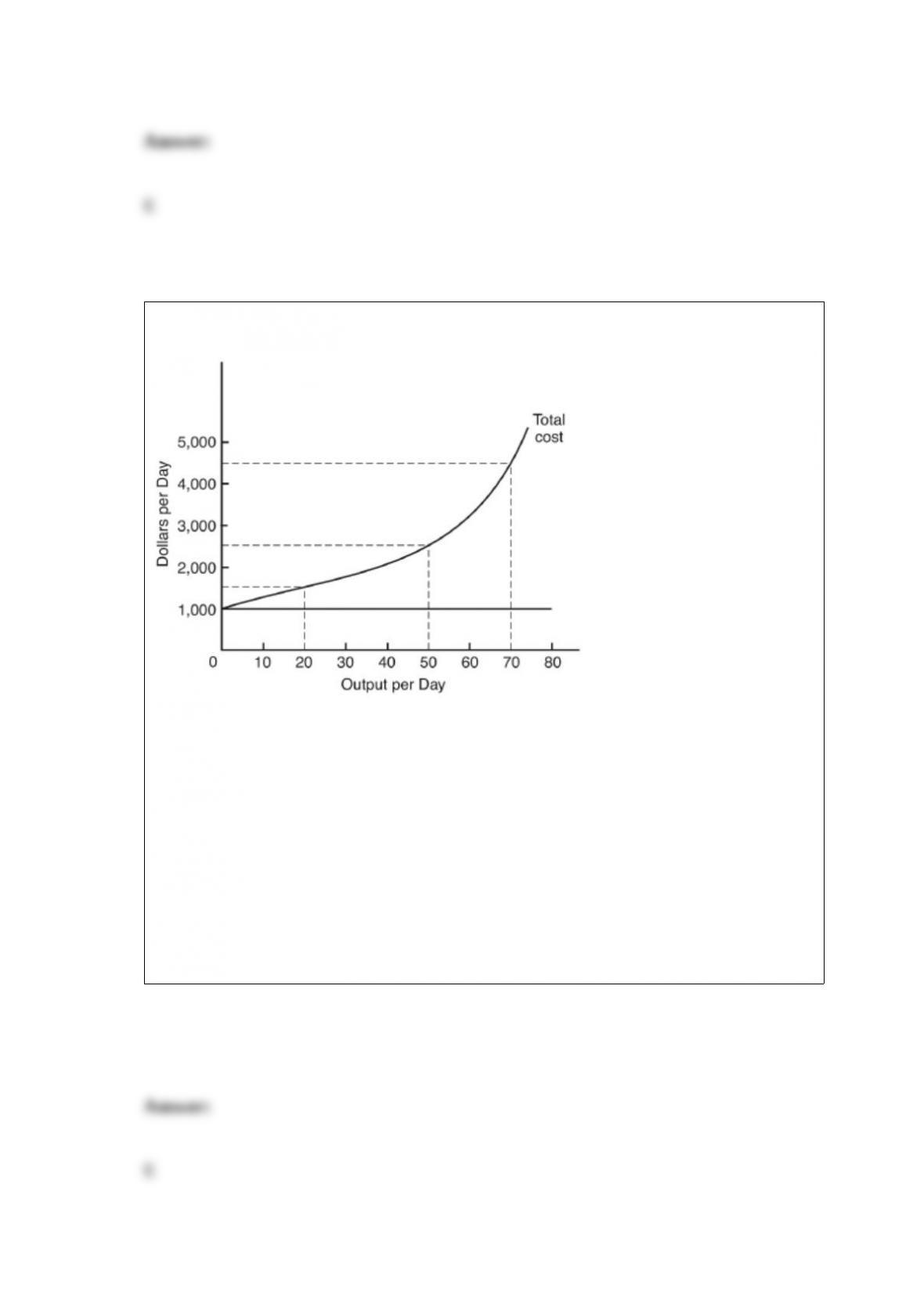
The following questions are based on the following graph:
In the short run, a firm’s total costs are the sum of ________ costs and ________ costs.
a. average; marginal
b. input; output
c. fixed; average
d. marginal; variable
e. variable; fixed

Which of the following is the best example of derived demand?
a. Advertising creates a demand for a new product.
b. Increased oil prices reduce the demand for large automobiles.
c. An increase in wages causes firms to substitute capital for labor.
d. A decrease in the demand for grapes reduces the demand for grape pickers.
e. The market demand schedule is derived by summing all individual demand curves.
In the late 1990s and early 2000s, in the United States
a. negative increases in productivity were experienced.
b. productivity growth improved, returning to levels closer to those of the 1960s.
c. increases in productivity averaged zero.
d. productivity achieved the lowest values in history.
e. the measurement of productivity was discontinued because of the ambiguity
surrounding its interpretation.
When individuals do not pay the true social costs of their actions

a. these costs disappear.
b. they refrain from undertaking these actions.
c. there must be no divergence between the private and social costs of these actions.
d. social benefits exceed social costs.
e. others in society pay the costs of these actions.
In a simple Keynesian model, a decrease in government spending
a. shifts the C + I + G line upward.
b. reduces potential GDP below its full-employment level.
c. causes price levels to rapidly increase.
d. means the C + I + G line intersects the 45-degree line at a reduced GDP.
e. affects the composition of GDP but not its value.
To construct an aggregate demand curve, one must assume that
a. the quantity of money is fixed.
b. the price level is fixed.
c. interest rates are fixed.

d. real output is fixed.
e. aggregate supply is fixed.
The government program that in 1996 replaced the existing Aid to Families with
Dependent Children program is called
a. the Family Assistance Plan.
b. the Equal Pay Act.
c. the Job Corps.
d. the Family Income Continuation Arrangement.
e. Temporary Assistance for Needy Families.
A bank’s legal reserve requirements consist of
a. the bank’s holdings of cash and deposits with the Federal Reserve Bank.
b. the value of a bank’s assets.
c. checkable deposits plus net worth.
d. the difference between bank assets and liabilities.
e. the sum of direct and indirect transfers plus deposits.

In 1996 the Fed tried to address its concern that the stock market might be overvalued
by
a. reducing interest rates.
b. “talking” the market down.
c. encouraging households to spend more on consumption.
d. increasing excess reserves in the banking system.
e. applying the rule of reason principle.
In the model of consumer behavior
a. individuals can choose whatever market basket they want.
b. individuals are capable of making consistent choices reflecting their preferences.
c. for most commodities, total utility falls steadily as more is consumed.
d. an individual’s desire for a specific good in a given time period is infinite.
e. marginal utility at first decreases, then increases.

For an economy at full employment to increase its per capita growth rate, it must
a. operate inside its production possibilities curve.
b. devote more resources to the production of capital goods.
c. shift the production possibilities curve inward.
d. ignore the central questions.
e. maintain existing levels of consumer production.
Efforts by a union representative to organize a union are protected from employer
interference by the ________ Act.
a. Taft-Hartley
b. Landrum-Griffin
c. Norris-La Guardia
d. Sherman
e. Wagner
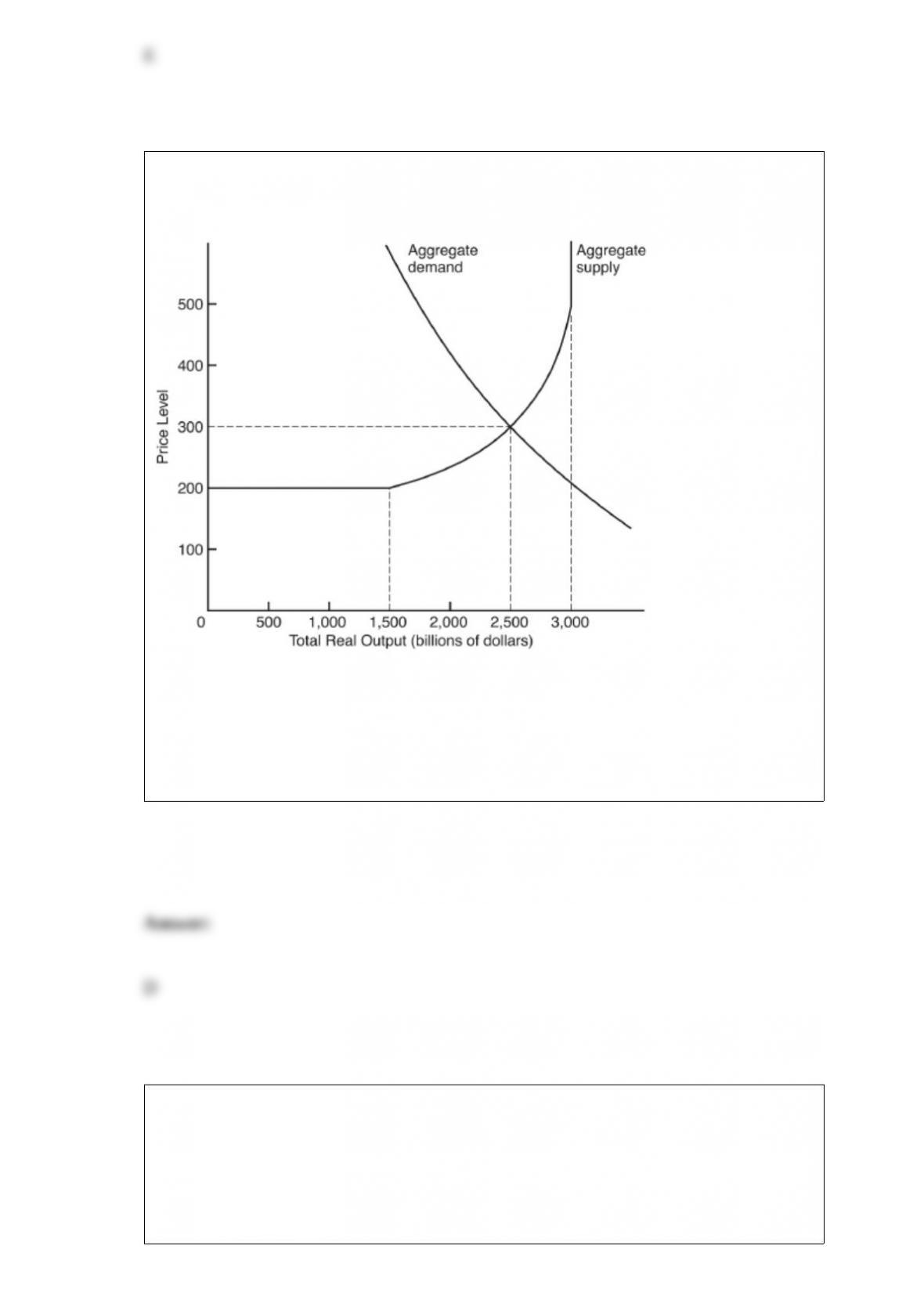
The following questions are based on the following diagram:
Full employment of the economy’s resources occurs when
a. the price level drops below 200.
b. the price level is 200.
c. real output is $1,500 billion.
d. real output is $3,000 billion.
e. aggregate demand equals aggregate supply.
The liabilities of a commercial bank include
a. loans.
b. time and demand deposits.

c. net worth.
d. deposits at the Federal Reserve Bank.
e. shares of stock.