One major reason for the law of demand is that
a. one price changing requires at least one other price to change in the opposite
direction.
b. people substitute relatively lower-priced goods for relatively higher-priced goods.
c. a higher price never reduces quantity demanded by enough to lower total revenue.
d. people are willing to produce more units at a higher price.
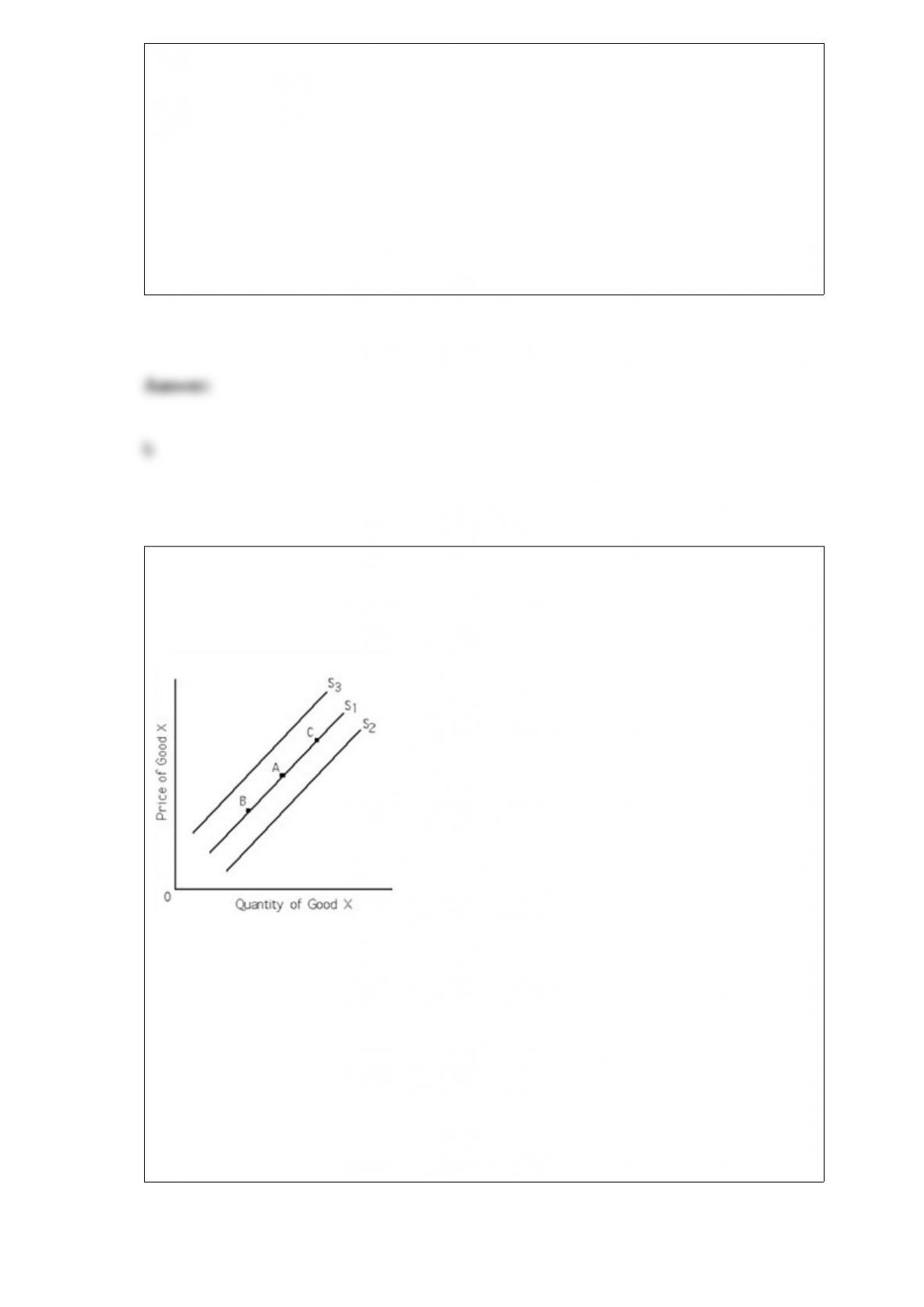
Refer to Exhibit 3-7. If S1 is the relevant supply curve, an increase in the price of good
X may cause
Exhibit 3-7
a. the supply of good X to shift from S1 to S2
b. the supply of good X to shift from S1 to S3.
c. a movement along S1 perhaps from point A to point B.
d. a movement along S1 perhaps from point A to point C.
e. no change in the quantity supplied of good X.

One can determine the consumers’ surplus if the _______________ are known
a. tax paid
b. maximum buying price
c. price paid
d. maximum buying price and price paid
e. maximum buying price and tax paid
A rationing device is a method used to resolve who gets what of available goods and
resources.
a. True
b. False
When a positive externality exists, the market is said to fail because it overproduces the
good associated with the positive externality.

a. True
b. False
You turn to the bond market page of a newspaper and look under the column headed
“Bonds” and see that it says, “Alpha 7 1/2 25” this information indicates that
a. the coupon rate on this bond is 7.5 percent.
b. the year this bond matures is 2025.
c. the current yield on this bond is 7.5 percent.
d. the current yield on this bond has risen 0.25 percent since the previous trading day.
e. a and b
Refer to Exhibit 30-3. The real interest rate in year 3 is
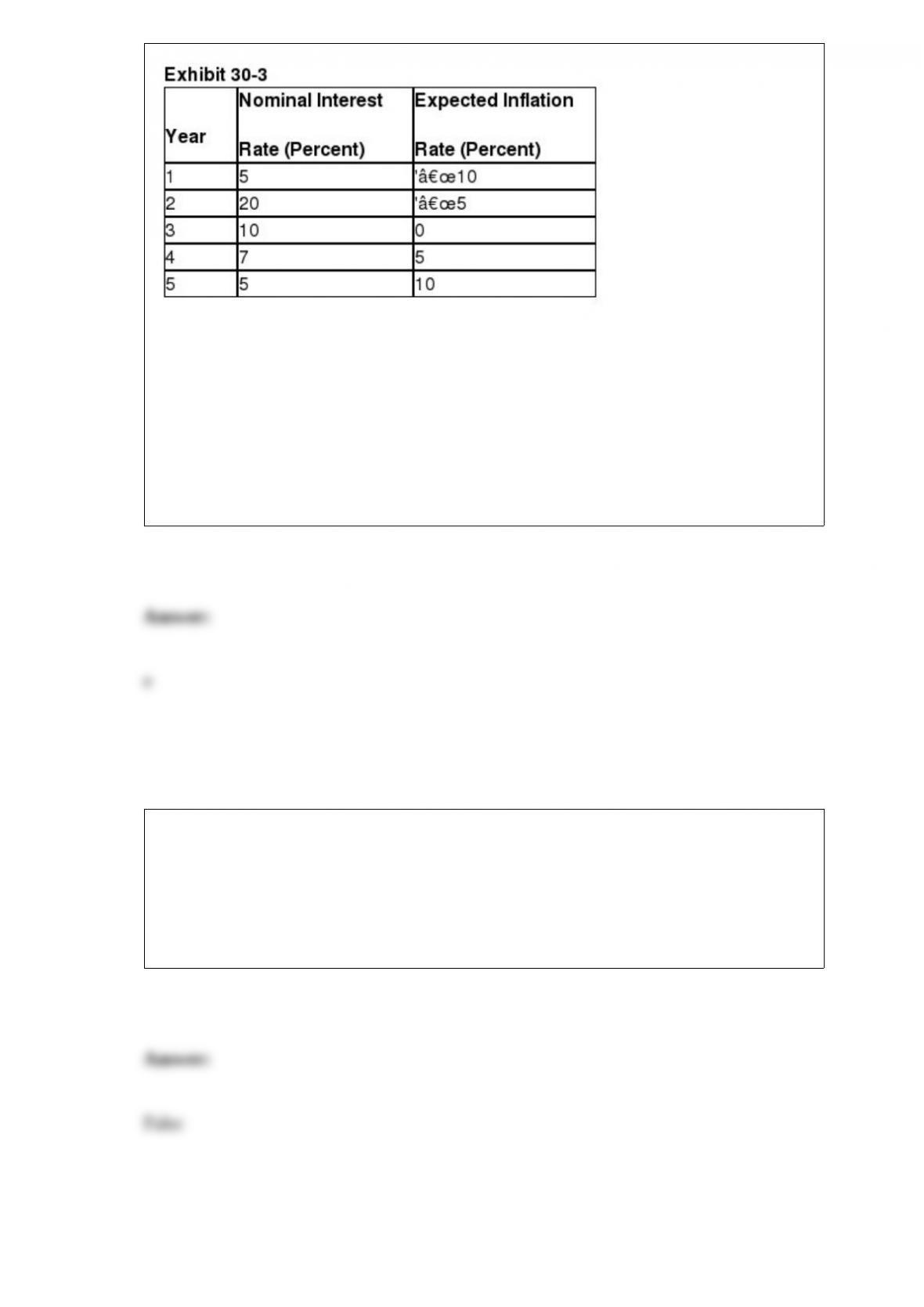
a. 5 percent.
b. -5 percent.
c. 0 percent.
d. -10 percent.
e. 10 percent.
A perfectly competitive firm should shut down production in the short run if price is
less than average fixed cost at the loss-minimizing level of output.
a. True
b. False
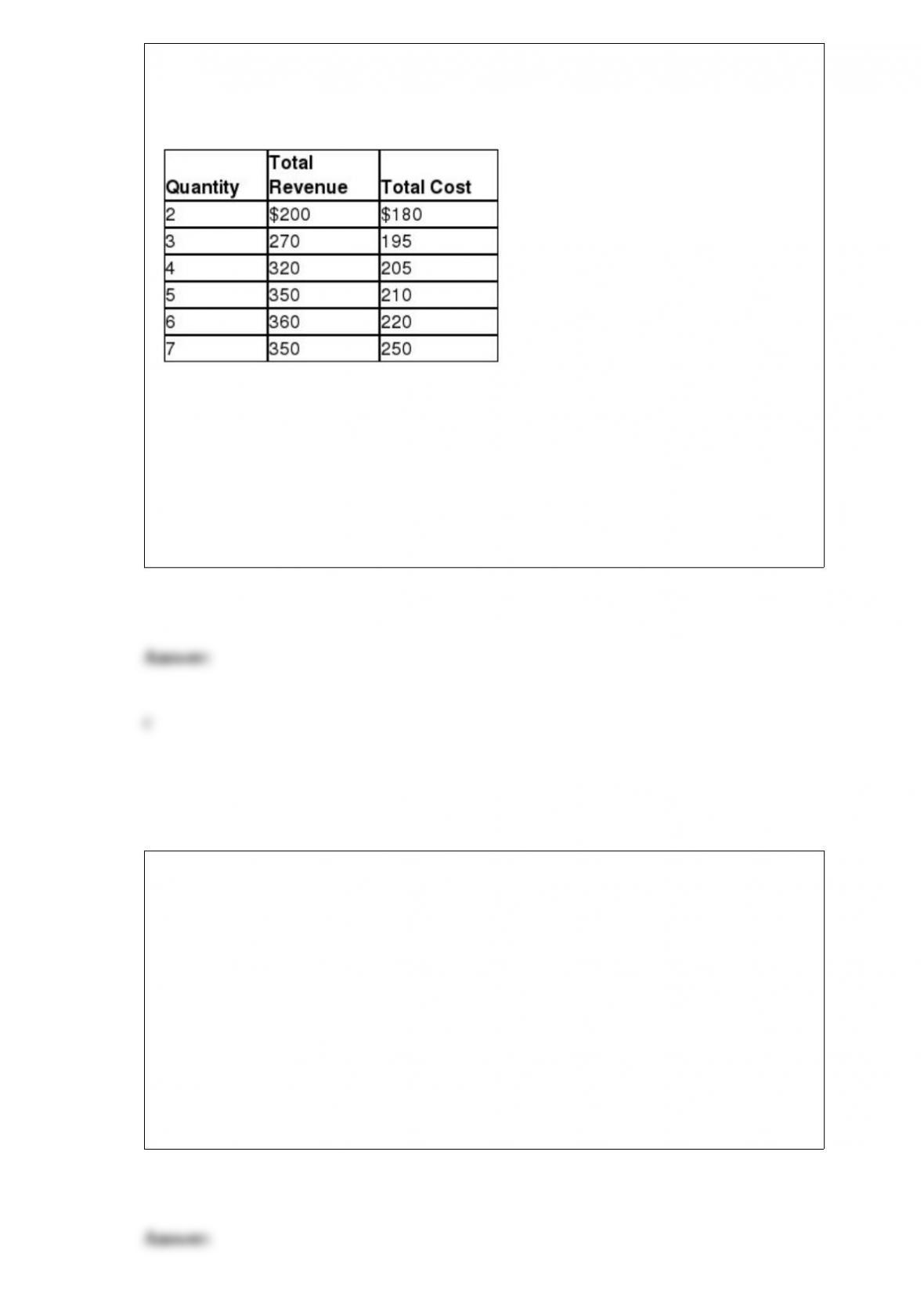
Refer to Exhibit 25-8. The maximum profits earned by a monopolistic competitive firm
will be
Exhibit 25-8
a. $115.
b. $75.
c. $140.
d. $100.
If the demand for a product is perfectly elastic, a tax of $1 per unit imposed on sellers
will
a. increase the market price by $1 per unit.
b. increase the market price by less than $1 per unit.
c. decrease the market price by $1 per unit.
d. decrease the market price by less than $1 per unit.
e. not affect the market price.

To an economist, freeway congestion is a sign that the price to drive on the freeway is
a. below its equilibrium level.
b. at its equilibrium level.
c. above its equilibrium level.
d. either a or c
e. none of the above
Scarcity occurs in both wealthy societies and poor societies.
a. True
b. False
Which of the following is not a condition of price discrimination?
a. The seller must be a price searcher.

b. The seller must be able to distinguish among customers who would be willing to pay
different prices.
c. The possibility of arbitrage must not exist.
d. The seller must have zero fixed costs.
e. The seller must exercise some control over price.
When a negative externality exists, _______________________ and thus
_______________ intervention may be needed to achieve efficiency.
a. external costs are necessarily greater than private costs; government
b. social costs equal private costs; no government
c. social costs are less than private costs; government
d. social costs are greater than private costs; government
e. none of the above
The effect of a drought on the price of an agricultural product will be greater the more
__________ the demand for the agricultural product.
a. price inelastic
b. price elastic
c. income elastic
d. a and c
e. b and c
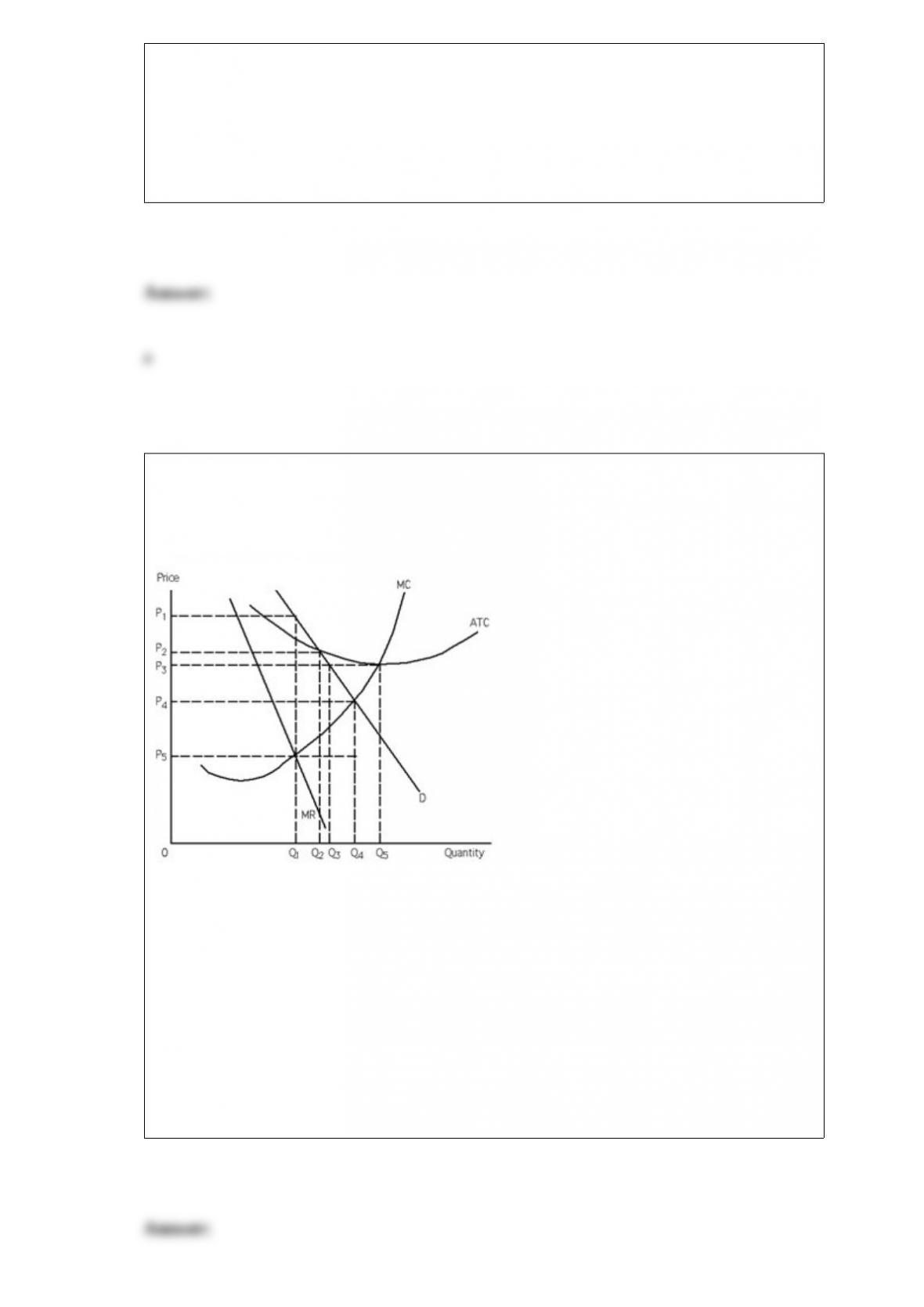
Refer to Exhibit 26-4. With no regulation, the profit-maximizing firm would supply
__________ units of output.
Exhibit 26-40
a. Q1.
b. Q2.
c. Q3.
d. Q4.
e. Q5.

Price rises from $10 to $12, and the quantity demanded falls from 200 units to 180
units. What is the price elasticity of demand between these two prices?
a. 0.58
b. 3.67
c. 1.73
d. 0.27
Public choice deals with
a. negative and positive externalities.
b. public-sector decision making.
c. how people choose between several mutually exclusive options.
d. bond, stock, and money markets.
e. none of the above

In long-run competitive equilibrium SRATC = LRATC, because if SRATC > LRATC
(at the quantity of output at which MR = MC) firms would
a. have an incentive to change their plant size to produce their current output.
b. not be covering their total fixed costs.
c. not be covering their total variable costs.
d. a and b
e. b and c
The endowment effect
a. states that we value an item more highly if we own it than if we do not own it.
b. is the same as compartmentalizing.
c. states that people are often willing to make themselves worse off in order to make
someone else worse off.
d. states that people are often willing to make themselves worse off in order to make
someone else better off.
e. a and d
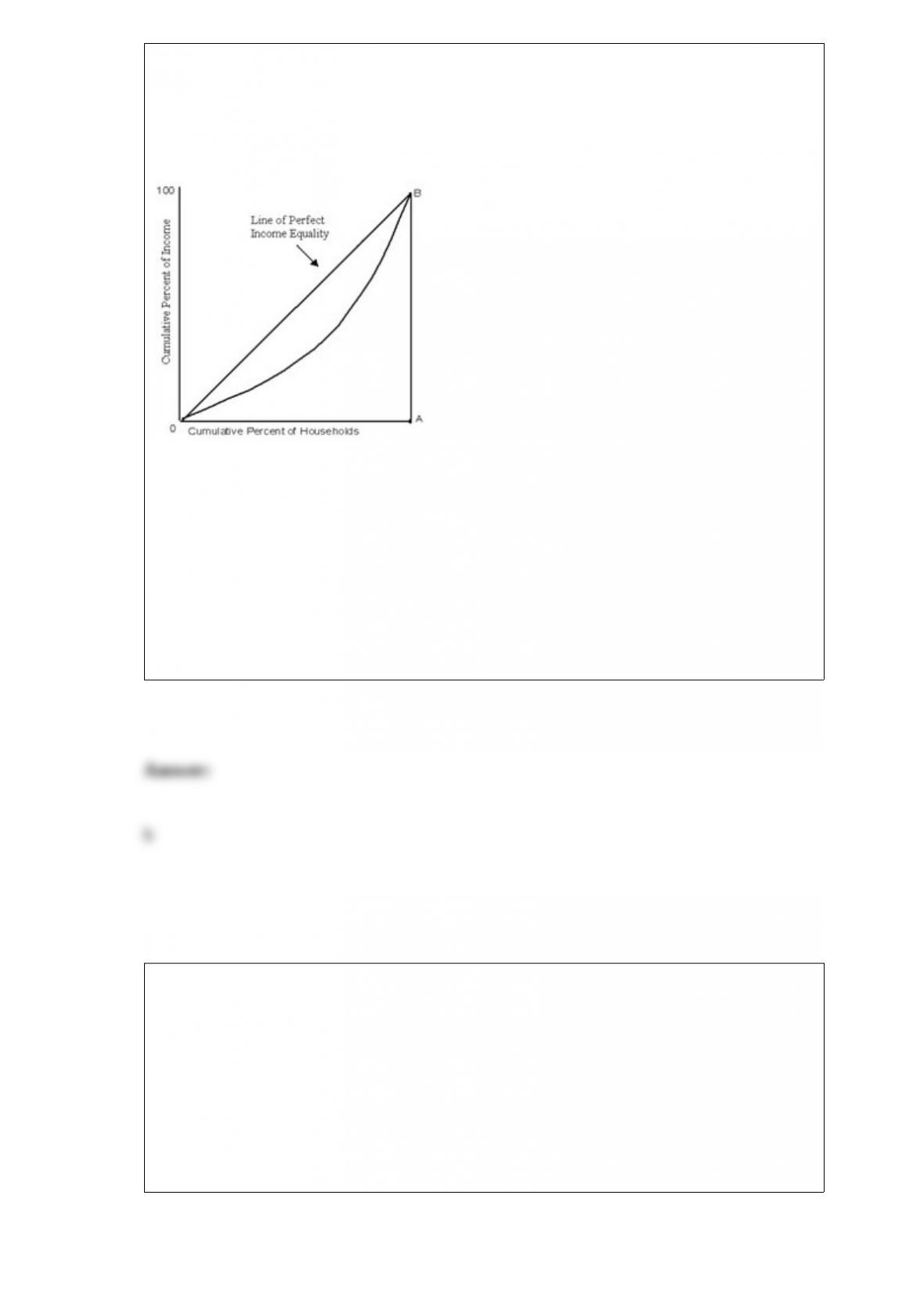
Refer to Exhibit 29-1. If the Gini coefficient equals 0, then the Lorenz curve is
Exhibit 29-1
a. point A.
b. line OB.
c. the horizontal axis from 0 to A.
d. line AB.
e. the horizontal axis from 0 to A and the line AB.
Studies shows that income elasticity of demand for food is
a. less than 1, but greater than 0.
b. more than 1, but less than 2.
c. less than 0.
d. more than 2.