
1) a price floor means that:
a.inflation is severe in this particular market.
b.sellers are artificially restricting supply to raise price.
c.government is imposing a maximum legal price that is typically below the equilibrium
price.
d.government is imposing a minimum legal price that is typically above the equilibrium
price.
2) a normative statement is one that:
a.is based on the law of averages.
b.applies only to microeconomics.
c.applies only to macroeconomics.
d.is based on value judgments.
3) which of the following is not correct? a typical production possibilities curve:
a.indicates how much of two products a society can produce.
b.reveals how much each additional unit of one product will cost in terms of the other
product.
c.specifies how much of each product society should produce.
d.indicates that to produce more of one product society must forgo larger and larger
amounts of the other product.
4) (Last Word) Between 1995 and 2004:
A.the distribution of U.S. household wealth became more unequal.
B.the distribution of U.S. household wealth become less unequal.
C.median U.S. household wealth, adjusted for inflation, surpassed average household
wealth.
D.median U.S. household wealth, adjusted for inflation, declined.
5) An adverse aggregate supply shock could result from:
A.a sharp rise in productivity.
B.a rapid rise in oil prices.
C.a decline in wages.
D.an appreciation of the dollar.
6) the supply curve shows the relationship between:
a.price and quantity supplied.
b.production costs and the amount demanded.
c.total business revenues and quantity supplied.
d.physical inputs of resources and the resulting units of output.
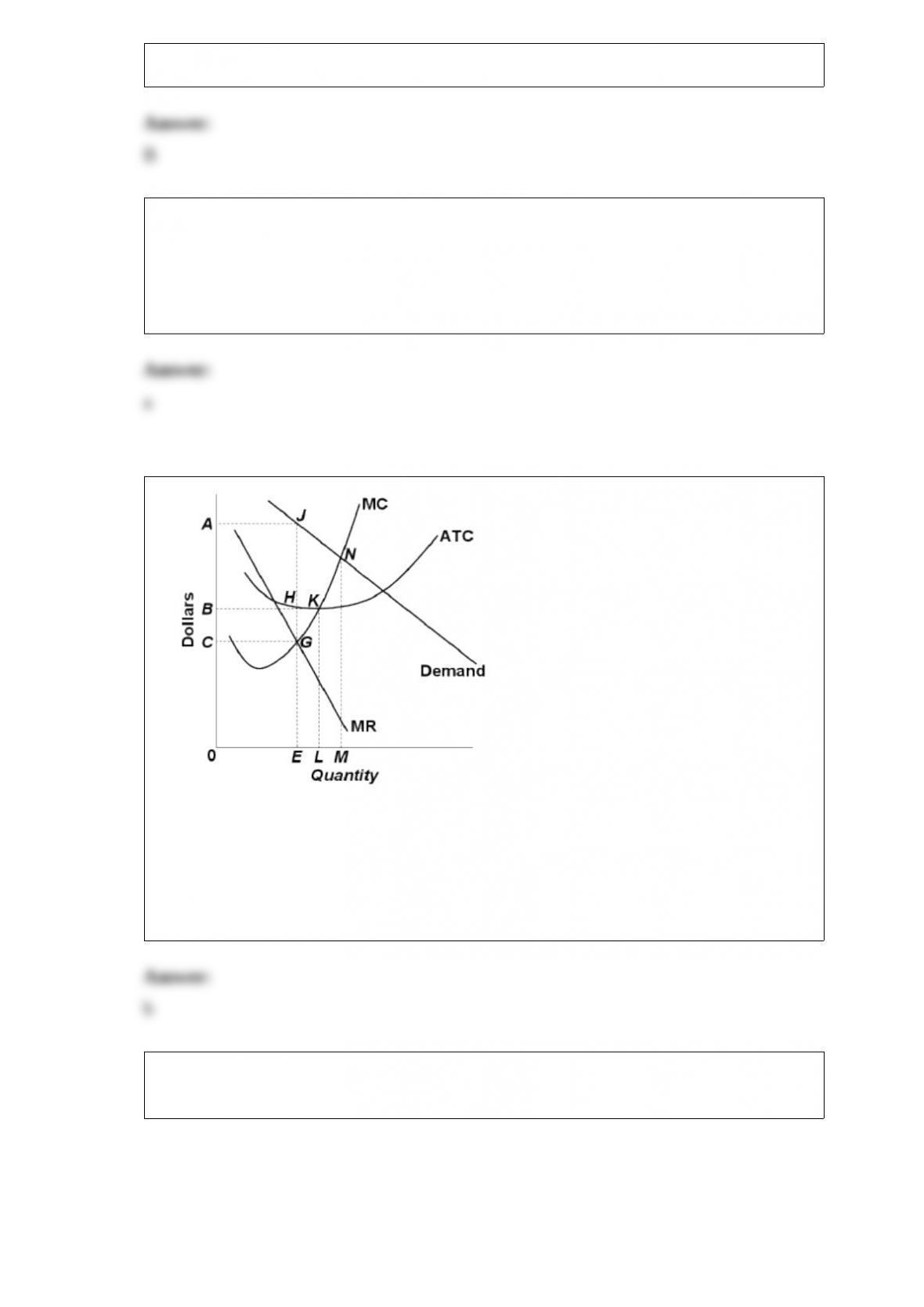
7)
refer to the above diagram. at the profit-maximizing level of output, total revenue will
be:
a.nm times 0m
b.0aje
c.0egc
d.0ehb
8) the following production possibilities data for landia and scandia:
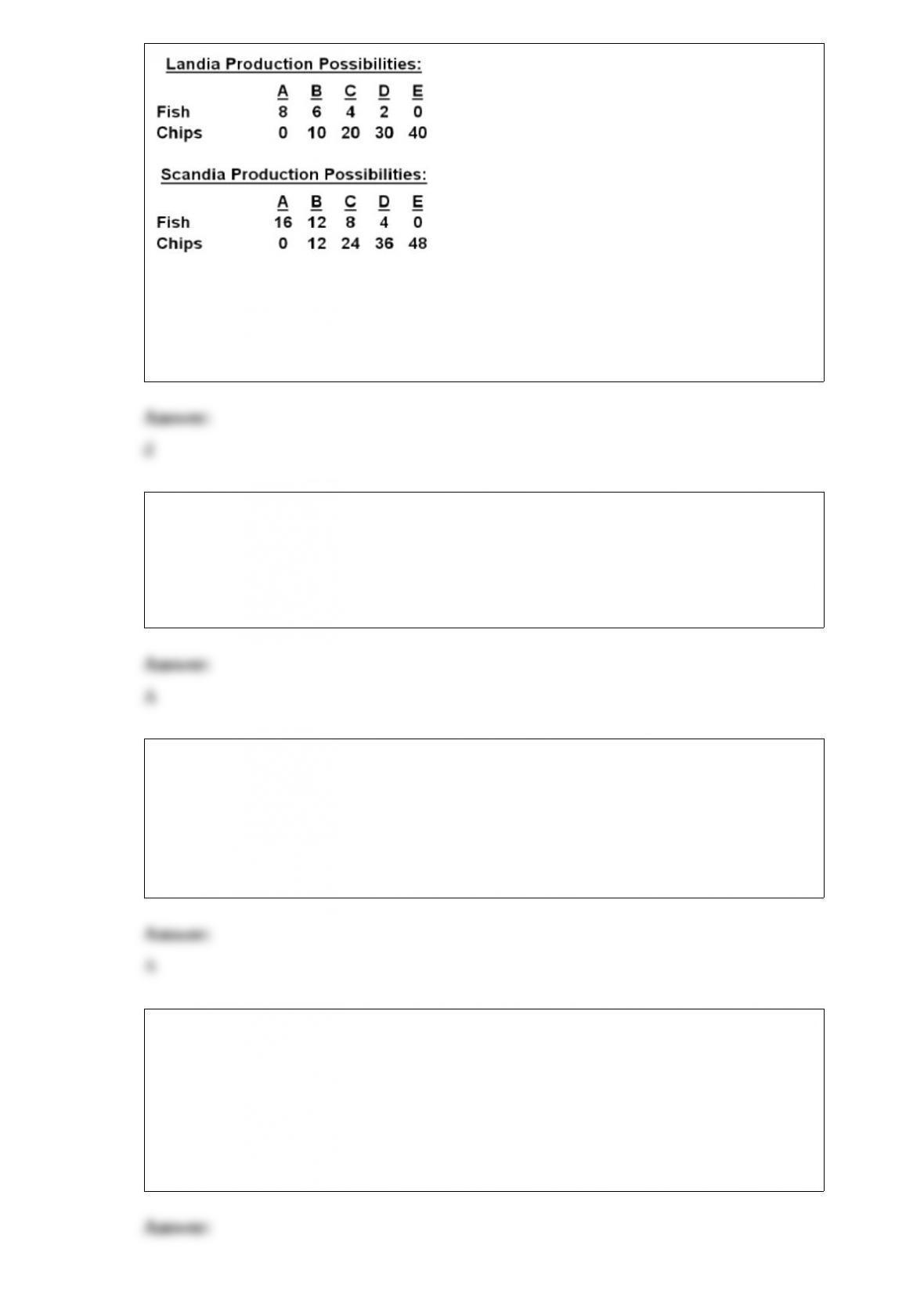
refer to the above data. the domestic opportunity cost of 1 fish in landia is:
a.10 chips.
b.2 chips.
c.4 chips.
d.5 chips.
9) Economic rent refers to the price paid for land and other natural resources that:
A.are fixed in total supply.
B.vary directly with their market prices.
C.vary inversely with their market prices.
D.are available in nearly unlimited quantities.
10) To say that the Federal Reserve Banks are quasi-public banks means that:
A.they are privately owned, but managed in the public interest.
B.they deal only with banks of foreign nations and do not have direct business contact
with U.S. banks.
C.they deal only with commercial banks, and not the public.
D.they are publicly owned, but privately managed.
11) purely competitive industry x has constant costs and its product is an inferior good.
the industry is currently in long-run equilibrium. the economy now goes into a
recession and average incomes decline. the result will be:
a.an increase in output and in the price of the product.
b.an increase in output, but not in the price, of the product.
c.a decrease in the output, but not in the price, of the product.
d.a decrease in output and in the price of the product.

12) as a proportion of domestic output, taxes in the united states:
a.are lower than in most other industrially advanced countries.
b.are higher than in most other industrially advanced countries.
c.are approximately the same as in most other industrially advanced countries.
d.doubled in the 1990s.
13) In the last-half of the 1990s, Japan:
A.successfully used monetary policy to overcome recession.
B.had poor success using monetary policy to overcome recession.
C.abandoned monetary policy in favor of fiscal policy in fighting inflation.
D.successfully used monetary policy to reduce rapid inflation.
14) an effective price floor on wheat will:
a.force otherwise profitable farmers out of business.
b.result in a shortage of wheat.
c.result in a surplus of wheat.
d.clear the market for wheat.
15) in the long run:
a.all costs are variable costs.
b.all costs are fixed costs.
c.variable costs equal fixed costs.
d.fixed costs are greater than variable costs.