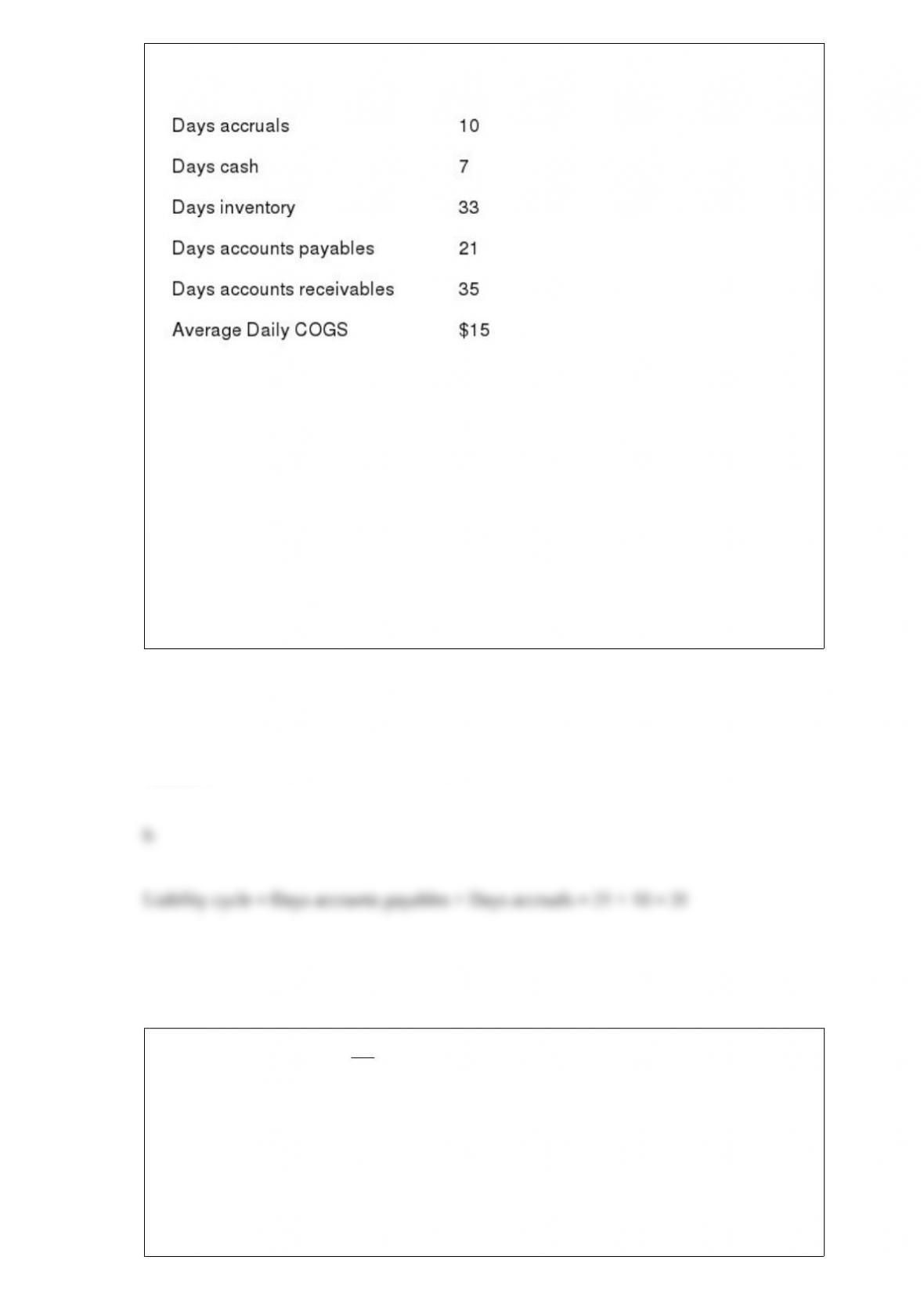
Use the following firm working capital cycle information.
What is the firm’s liability cycle?
a. 21 days
b. 31 days
c. 65 days
d. 75 days
e. 121 days
Answer:
Which of the following is not one of the five Cs of bad credit?
a. Complacency
b. Contention
c. Contingencies
d. Competition

e. Carelessness
Answer:
Keeping all other factors constant, banks can reduce the volatility of net interest income
by:
a. adjusting the dollar amount of rate-sensitive assets.
b. adjusting the dollar amount of fixed-rate liabilities.
c. using interest rate swaps.
d. Bank can reduce volatility of net interest income by doing all of the above.
e. a. and c. only
Answer:
_______________________ represents the amount of long-term financing required for
current assets.
a. Permanent working capital
b. Seasonal working capital
c. Secondary working capital

d. Perpetual working capital
e. Passive working capital
Answer:
Which act separated commercial banking, investment banking and insurance into three
separate industries?
a. Glass-Steagall Act
b. Bank Holding Company Act
c. McFadden Act
d. Federal Reserve Act
e. Competitive Equality Banking Act
Answer:
A spreader:
a. is a type of hedger.
b. takes relatively high-risk positions.

c. is also known as a scalper.
d. All of the above.
e. None of the above.
Answer:
The underwriting process involves all of the following except:
a. helping a firm design a security to meet all legal requirements.
b. identifying potential buyers.
c. pricing the security.
d. selling the security to the market place.
e. All of the above are part of the underwriting process.
Answer:
Which of the following would be considered a “positive” loan covenant?
a. Days receivables outstanding cannot exceed 30 days
b. No change in senior management

c. Capital outlays cannot exceed $1,000,000 per year
d. No additional liens may be placed on the collateral
e. The bank must approve any firm mergers or acquisitions
Answer:
When a bank’s claim to collateral is superior to all other creditors, the claim is said to
be:
a. developed.
b. guaranteed.
c. certified.
d. perfected.
e. endorsed.
Answer:
Prior to the Basel Agreement, capital requirements were established without regard to:
a. the bank’s liquidity risk.
b. the bank’s asset quality.

c. the size of the bank’s assets.
d. the bank’s operational risk.
e. the bank’s interest rate risk.
Answer:
Macaulay’s duration:
a. is a weighted average of the time until cash flows are received.
b. is always greater than maturity.
c. is never equal to maturity.
d. directly indicates how much the price of a security will change given a change in
interest rates.
e. estimates when embedded options will be used.
Answer:
A brokered deposit would most likely take which of the following forms?
a. Demand deposit

b. NOW account
c. Jumbo CDs
d. Savings account
e. Small time deposit
Answer:
If the spot rate is 1.67CAN$/US$ and the 1-month forward rate is 1.70CAN$/US$:
a. the Canadian dollar is selling at a premium.
b. the Canadian dollar is selling at a discount.
c. the U.S. dollar is selling at a discount.
d. the U.S. dollar is selling at par.
e. none of the above
Answer:
If a bond is a premium bond, then:
a. the yield to maturity is less than the coupon rate.

b. the yield to maturity is greater than the coupon rate.
c. the yield to maturity is equal to the coupon rate.
d. its duration must be greater than its maturity.
e. its duration must be equal to its maturity.
Answer:
Which of the following is an example of a non-installment loan?
a. Credit card
b. 30-year mortgage
c. Bridge loan
d. 5-year auto loan
e. Home equity line of credit
Answer:
Which of the following refers to a lender’s tendency to ignore circumstances in which a
loan might default?
a. Complacency

b. Contention
c. Contingencies
d. Competition
e. Carelessness
Answer:
If rate-sensitive assets equal $600 million and rate-sensitive liabilities equals $800
million, what is the expected change in net interest income if rates fall by 1%?
a. Net interest income will increase by $2 million.
b. Net interest income will fall by $2 million.
c. Net interest income will increase by $20 million.
d. Net interest income will fall by $20 million.
e. Net interest income will be unchanged.
Answer:

The _________ expanded the FDIC’s authority for open bank assistance.
a. Depository Institutions Act (Garn-St. Germain)
b. Competitive Equality Banking Act
c. Financial Institutions Reform, Recovery and Enforcement Act
d. Federal Deposit Insurance Corporation Improvement Act
e. Depository Institutions Deregulation and Monetary Control Act
Answer:
The “provision for loan and lease losses”:
a. are the realized losses from the previous accounting period.
b. represents management’s estimate of potential lost revenue from bad loans.
c. determined by the Federal Reserve for all banks.
d. does not affect net income.
e. is another name for a bank’s “burden.”
Answer:
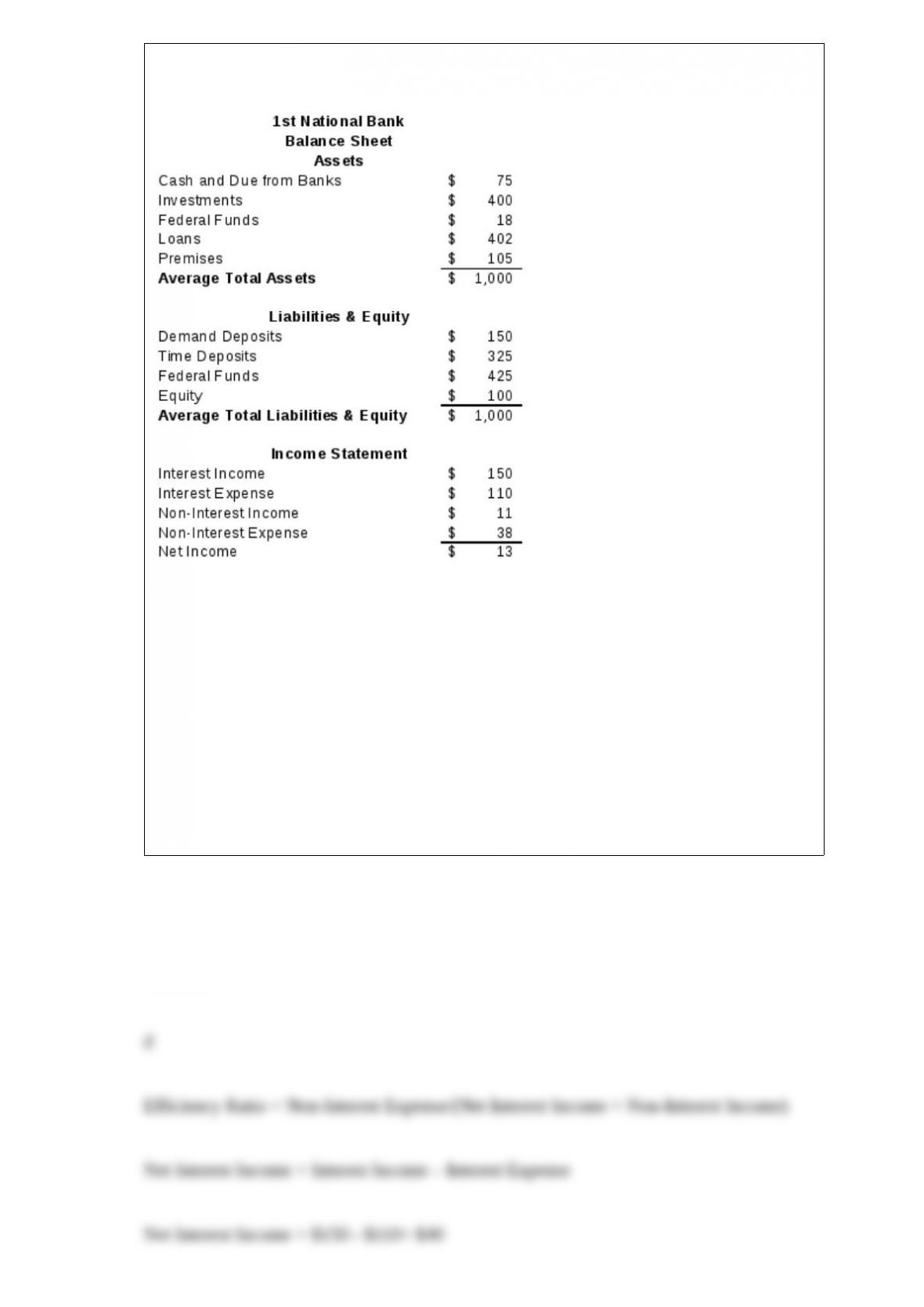
Use the following information.
What is 1st State’s efficiency ratio?
a. 2.5%
b. 17.5%
c. 25.0%
d. 74.5%
e. 82.5%
Answer:

What is the return on equity for a bank that has an equity multiplier of 9, an interest
expense ratio of 6%, and a return on assets of 1.2%?
a. 10.8%
b. 6.0%
c. 8.0%
d. 4.8%
e. 0.65%
Answer:
Which of the following would require a short hedge?
a. The bank anticipates a decline in interest rates.
b. The bank has a positive GAP.
c. The bank is liability sensitive.
d. All of the above require a short hedge.
e. None of the above require a short hedge.

Answer:
The check-clearing services of correspondent banks are often used because:
a. the respondent bank is required to purchase a minimum amount of services.
b. it reduces required reserves.
c. the correspondent bank may be marketing their own services in a local community.
d. it often reduces float.
e. it decreases interest income.
Answer:
Which of the following does not directly influence the amount of required reserves a
bank must hold?
a. The required reserve ratio.
b. The dollar amount of cash items in process of collection.
c. The dollar amount of demand deposits outstanding.
d. The dollar amount of money market deposit accounts outstanding.
e. The dollar amount of NOW accounts outstanding.

Answer:
Which of the following has the greatest weight in determining a consumer’s FICO
score?
a. Current credit use
b. Credit mix
c. Payment history.
d. Length of credit history
e. Number of applications for new credit
Answer:
A credit default swap:
a. transfers the credit risk in a fixed income instrument from one counterparty to
another.
b. is not considered a credit derivative.
c. provides the buyer with periodic payments.
d. can only be traded if the seller owns the underlying instrument.
e. all of the above.

Answer:
The “initial margin” on a futures contract:
a. is a cash deposit the buyer places with the seller as good faith money.
b. can be cash or U.S. government securities placed with an exchange member.
c. are U.S. government securities the buyer places with the seller for safekeeping.
d. are the first installment on the payment for a futures contract.
e. is the amount by which the futures contract is initially “in the money.”
Answer:
Use the following bank information.
What is the bank’s duration gap?
a. 0.53
b. 0.73
c. 0.91
d. 2.03
e. 4.58

Answer:
Which of the following would generally not be considered a speculator?
a. Hedger
b. Day trader
c. Scalper
d. Position trader
e. All of these are consider speculators.
Answer:
A 20-year annual coupon bond is currently selling for its par value of $10,000 with an
annual yield of 7%. If the bond is callable at par, what is the effective duration of the
bond, assuming rates change by 2%? The price of the bond at a 9% interest rate equals
$8,174.29.
a. 25.00 years

b. 20.00 years
c. 5.52 years
d. 4.56 years
e. 3.68 years
Answer:
Trust preferred stock:
a. does not pay any dividends
b. has priority over all other claims.
c. is issued through a “preferred” bank subsidiary.
d. effectively allows banks to pay dividends that are tax deductible.
e. All of the above.
Answer:

Today, most industrial loan companies are located in Florida.
Answer:
Which of the following is true regarding subordinated debt?
a. Subordinated debt claims come before the claims of depositors.
b. Principal payments are not mandatory.
c. Transaction costs on issuing new debt are lower than when issuing new equity.
d. Interest payments on subordinated debt are tax-deductible.
e. New subordinated debt dilutes existing shareholder equity.
Answer:
BMW Bank is chartered by the:
a. state of Utah.
b. FDIC.
c. Federal Reserve.
d. Office of the Comptroller of the Currency.

e. National Credit Union Administration.
Answer:
A forward market exchange in foreign currencies is an agreement to exchange:
a. currencies in the future at an unspecified time at an exchange rate determined at the
time the contract is agreed to.
b. currencies in the future at a specified time at an unknown exchange rate.
c. currencies in the future at an unspecified time at an unknown exchange rate.
d. a product for a foreign currency in the future at a specified time.
e. currencies in the future at a specified time at an exchange rate determined at the time
the contract is signed.
Answer: