The spreading of fixed costs over more output explains why the long-run average cost
falls as output rises.
The demand curve for a foreign currency
a. slopes upward
b. slopes downward
c. is horizontal
d. has a slope of 45 degrees
e. is vertical
If the Fed has a goal of stable real GDP and the government announces a tax cut, which
of the following would occur?
a. Money demand would not change, real GDP would not change, the interest rate
would decrease, and there would be partial crowding out.
b. Money demand would not change, real GDP would not change, the interest rate
would increase, and there would be complete crowding out.
c. Money demand would increase, real GDP would not change, the interest rate would
increase, and there would be partial crowding out.
d. Money demand would not change, real GDP would increase, the interest rate would
decrease, and there would be complete crowding out.
e. Money demand would increase, real GDP would not change, the interest rate would
decrease, and there would be complete crowding out.
The most powerful person at the Fed is
a. a director of a Federal Reserve bank
b. a member of the Board of Governors
c. a district bank president
d. the president of the U.S.
e. the chairman of the Board of Governors
To develop a useful picture of a firm’s behavior, economists assume that the

Which of the following would lead to a rightward movement along the demand curve
for British pounds?
a. An increase in the dollar price of a pound
b. A decrease in U.S. GDP
c. A renewed interest in British beef products
d. A decrease in the dollar price of a pound
e. An increase in U.S. GDP.
When many banks fail simultaneously, this is known as a
a. run on the bank
b. depression
c. recession
d. banking panic
e. Federal Reserve crisis
A decrease in the interest rate shifts the money demand curve to the right.
A floating exchange rate is one that is allowed to move freely between two points that
have been determined by an exchange treaty.
The behavior of firms is best understood by focusing on

Countercyclical fiscal policy has a serious problem with
a. the timing of its enactment and impact.
b. the easy reversibility of policy.
c. the tendency of the Federal Reserve to immediately counter Congressional action.
d. the courts as it has been held to be unconstitutional.
e. Presidential executive orders.
Of the recessions and expansions from 1950 to 1990, the common events were
a. reactions to war and oil prices
b. tax increases and tax cuts
c. changes in exports
d. Decreases in welfare spending
e. Increases and decreases in health care spending
Which of the following is not true of an economic expansion?
a. The economy is overheated.
b. There is too much spending.
c. Production exceeds equilibrium output.
d. The aggregate expenditure line is too low to create an intersection at full-employment
output.
e. Unemployment will be unusually low.
If demand is perfectly elastic, then
Suppose GDP for 2009 was $1,500, wages and salaries were $800, rent payments were
$200, consumption was $1000, and interest payments were $200. What must the value
of profits have been?
a. $200
b. $500
c. $0
d. $100
e. $300
When aggregate expenditure at a particular level of GDP is more than output,
a. output will increase
b. output will decrease
c. output will remain constant
d. there is not enough information to determine what happens to output
e. prices will rise
In general, a higher-than-anticipated inflation rate
a. helps everyone
b. hurts everyone
c. helps creditors and harms debtors
d. helps debtors and harms creditors
e. helps sellers
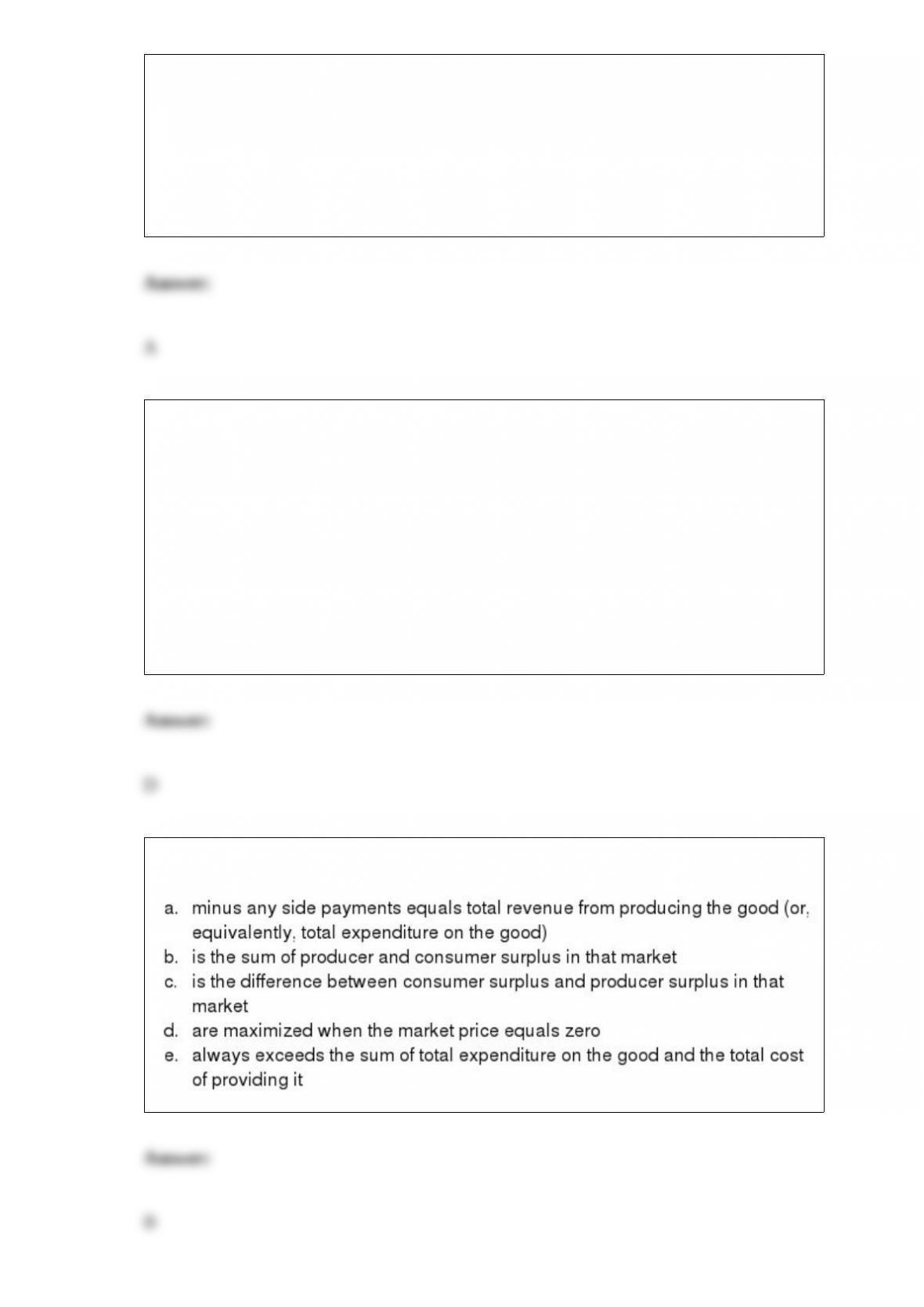
Total net benefits gained in a market