
The more excess reserves banks choose to keep,
A) the larger the deposit multiplier.
B) the smaller the deposit multiplier.
C) the higher the required reserve ratio.
D) the lower the required reserve ratio.
Countries that engage in trade will tend to specialize in the production of goods and
services in which they have ________ and will ________ these goods and services.
A) a comparative advantage; import
B) an absolute advantage; export
C) a comparative advantage; export
D) an absolute advantage; import
The Sarbanes-Oxley Act of 2002 was passed in response to what event?
A) a series of accounting scandals
B) unexpected increases in dividend payments to stockholders at various corporations
C) volatility in NASDAQ indexes
D) historically low bond prices

The first important law regulating monopolies in the United States was
A) the Grant Act, which was passed in 1890.
B) the Clayton Act, which was passed in 1890.
C) the Sherman Act, which was passed in 1890.
D) the Federal Trade Commission Act, which was passed in 1914.
In the United States, private health insurance companies
A) are all for-profit firms.
B) are all not-for-profit firms.
C) can be either for-profit or not-for-profit firms.
D) are all government-run firms.

When President Obama took office in January 2009, he pledged to pursue an
expansionary fiscal policy to try to pull the economy out of the recession. The next
month, Congress passed the American Recovery and Reinvestment Act of 2009, a $840
billion package of ________ that was the largest fiscal policy action in U.S. history.
A) spending increases and tax cuts
B) interest rate reductions and increases in the money supply
C) treasury bond purchases and mortgage-backed securities purchases
D) commercial and investment bank bailouts
Suppose the cross-price elasticity of demand between grapefruit juice and orange juice
is approximately 6. What does this mean?
A) A 1 percent decrease in the price of grapefruit juice leads to a 6 percent increase in
orange juice consumption.
B) A 6 percent increase in the price of grapefruit juice leads to a 1 percent increase in
orange juice consumption.
C) If the price of grapefruit juice rises by $1, 6 more cartons of orange juice will be
purchased.
D) The demand for orange juice is 6 times more than the demand for grapefruit juice.
Article Summary. Although growing at only half the average rate following the
seven previous recessions, consumer spending has increased 9 percent since the
end of the 2007-2009 recession, and consumer confidence has been on the rise as

household finances, the job market, and the housing market continue to improve.
The Federal Reserve projects a 3% – 3.5% growth rate for the economy in 2014,
up from the recent average of 2%. Debt payments have fallen to an average of
15.69% of after-tax income for households, the lowest level in 30 years, and lower
debt payments leave households with more to spend on consumer goods. Source:
Neil Shah, “Pocketbooks Begin to Open As Household Wealth Grows,” Wall Street
Journal, June 25, 2013.
The increase in consumer spending discussed in the article summary was due in part to
an improving housing market. This reason for the increase in consumer spending is
most closely related to which of the following variables that determine the level of
consumption?
A) the interest rate
B) current disposable income
C) household wealth
D) the price level
Jeremy is thinking of starting up a small business selling NASCAR memorabilia. He is
considering setting up his business as a sole proprietorship. What is one advantage to
Jeremy of setting up his business as a sole proprietorship?
A) As a sole proprietor, Jeremy would face limited liability.
B) As a sole proprietor, Jeremy would have the ability to share risk with shareholders.
C) As a sole proprietor, Jeremy would have both ownership and control over the
business.
D) All of the above would be advantages of setting up his business as a sole
proprietorship.
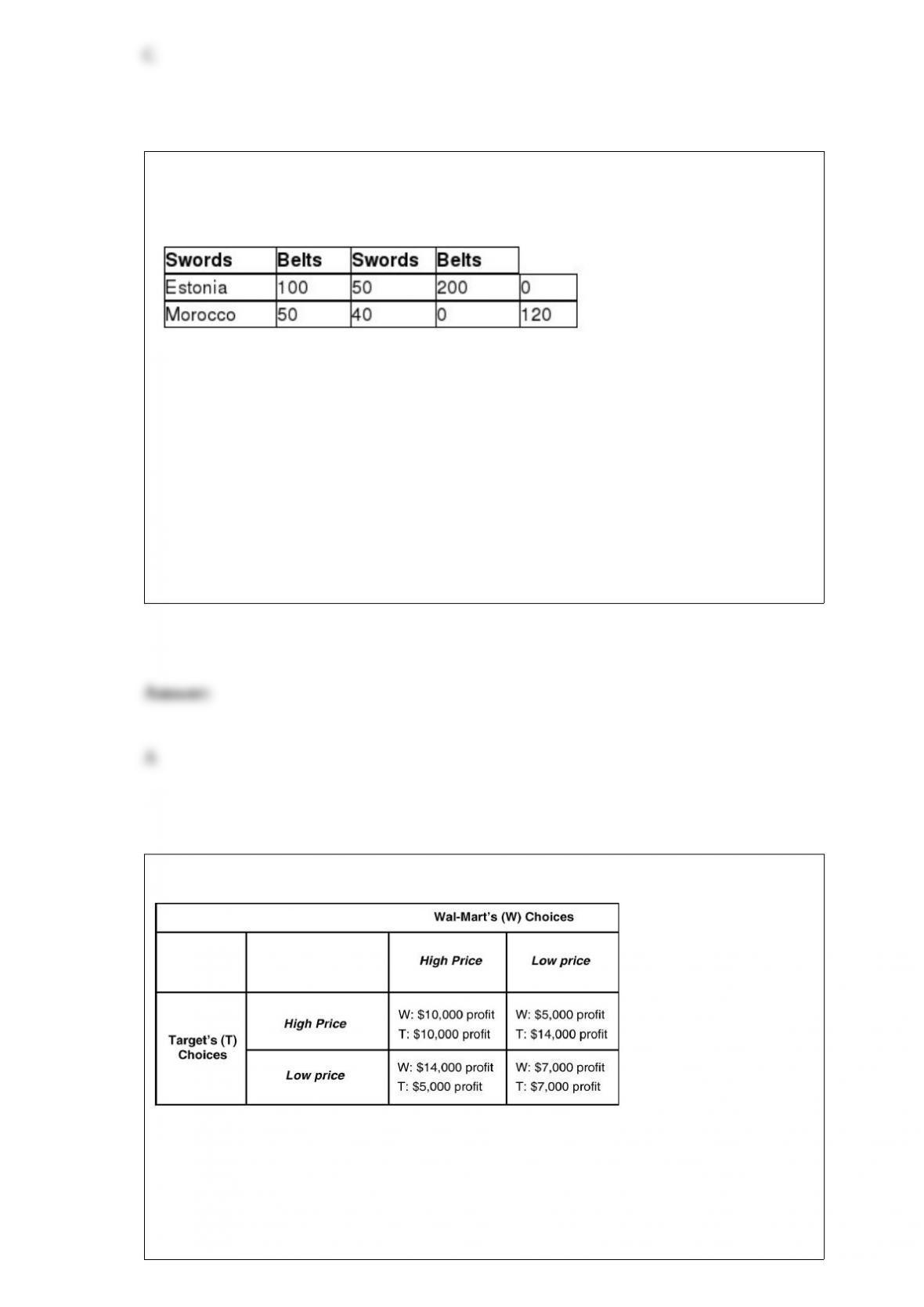
Table 7-6 Production and
Consumption Production
Without Trade With Trade
Estonia and Morocco can produce both swords and belts. Table 7-6 shows the
production and consumption quantities without trade, and the production numbers with
trade. With trade, what is the total gain in belt production?
A) 30
B) 80
C) 120
D) 210
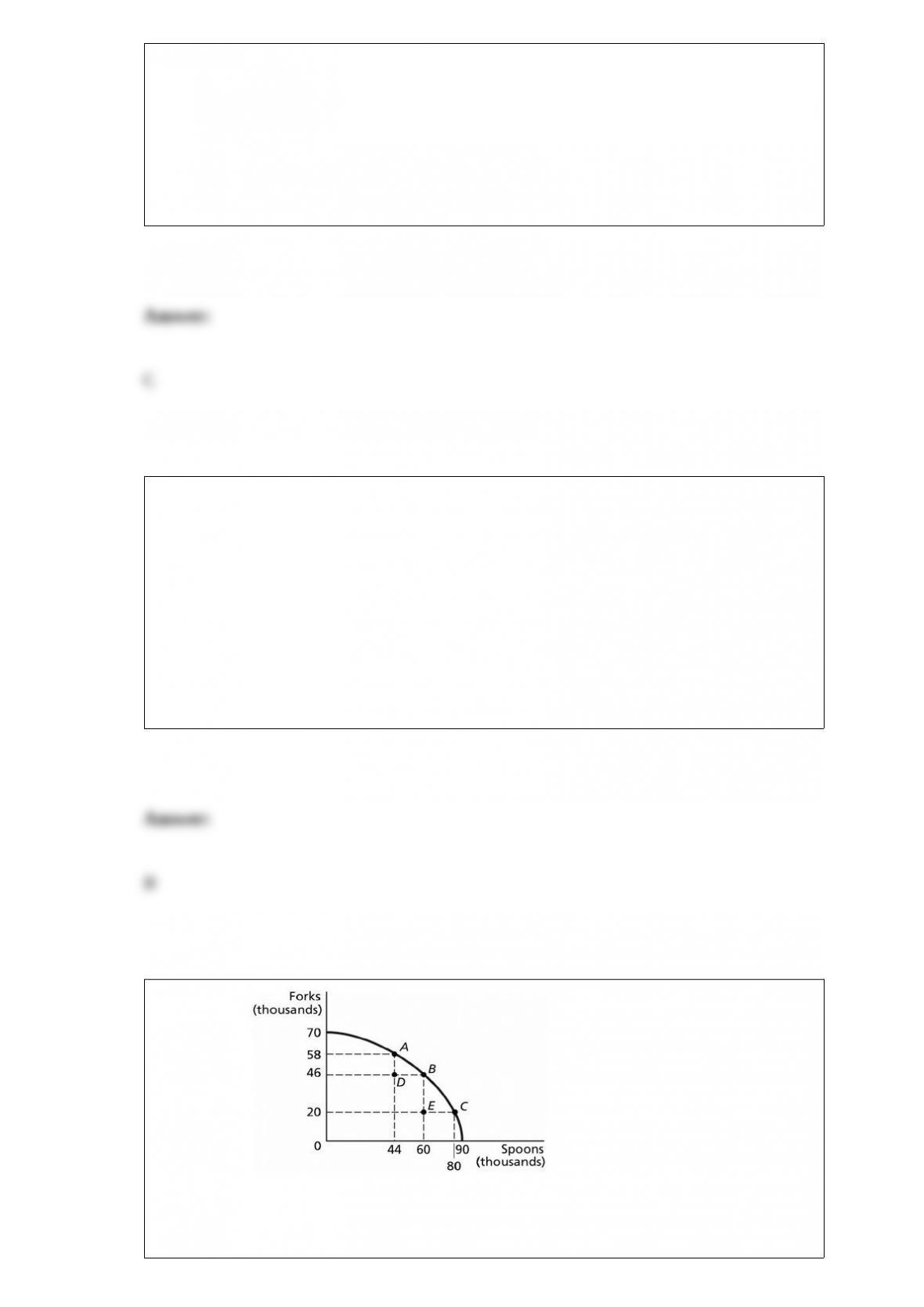
Table 14-2
Table 14-2 shows the
payoff matrix for Wal-Mart and Target from every combination of pricing strategies for
the popular PlayStation 3. At the start of the game each firm charges a low price and
each earns a profit of $7,000. Is the current strategy in which each firm charges the low
price and earns a profit of $7,000 a Nash equilibrium? If not, why and what is the Nash
equilibrium?

A) No, it is not a Nash equilibrium because each firm can do better by charging the high
price. The Nash equilibrium occurs when each firm charges the high price and earns a
profit of $10,000.
B) No, the current situation is not a Nash equilibrium; it is a dominant strategy
equilibrium. There is no Nash equilibrium in this game.
C) No, the current situation is not a Nash equilibrium. The Nash equilibrium for each
firm is to have the other charge a high price and for the firm in question charge a low
price.
D) Yes, the current situation is a Nash equilibrium.
Intel is the world’s largest semiconductor manufacturer and a major supplier of the
microprocessors and memory chips found in most personal computers. During the
recession of 2007-2009, Intel’s revenues ________ and it ________ the size of its
workforce.
A) fell; increased
B) fell; decreased
C) rose; increased
D) rose; decreased
If a nation changes its laws to more actively enforce intellectual property rights, all of
the following will most likely take place except
A) more software companies will choose to export their products to that country.
B) more film makers will choose to do business in that country.
C) the black market for intellectual property will become more prosperous in in that
country.
D) foreign investment in that country will increase.
U.S. net export spending rises when
A) the price level in the United States rises relative to the price level in other countries.
B) the growth rate of U.S. GDP is slower than the growth rate of GDP in other
countries.
C) the value of the U.S. dollar increases relative to other currencies.
D) the inflation rate is higher in the United States relative to other countries.
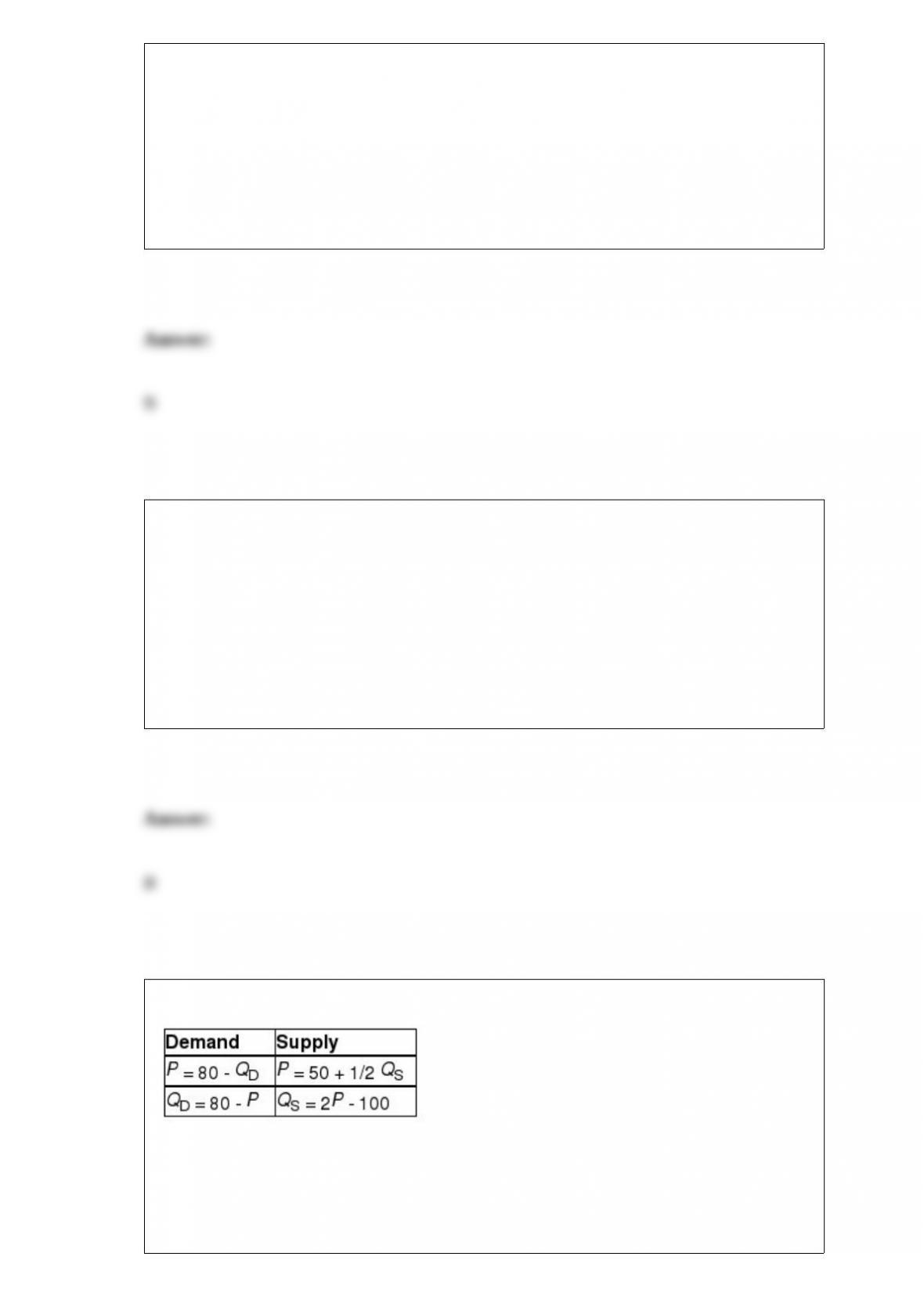
Figure 2-10
If the economy is currently producing at point A, what is the opportunity cost of moving
to point B?
A) 16 thousand spoons
B) 12 thousand forks
C) 60 thousand spoons
D) 46 thousand forks
If price exceeds average variable cost but is less than average total cost, a firm
A) should further differentiate its product.
B) should stay in business for a while longer until its fixed costs expire.
C) is making some profit but less than maximum profit.
D) should shut down.
Table 4-6
The equations above describe the demand and supply for Chef Ernie’s Sushi-on-a-Stick.
The equilibrium price and quantity for Chef Ernie’s sushi are $60 and 20 thousand units.
What is the value of consumer surplus?

A) $100 thousand
B) $200 thousand
C) $600 thousand
D) $800 thousand