Why does the short-run aggregate supply curve shift to the right in the long run,
following a decrease in aggregate demand?
A) Workers and firms adjust their expectations of wages and prices downward and they
accept lower wages and prices.
B) Workers and firms adjust their expectations of wages and prices downward and they
push for higher wages and prices.
C) Workers and firms adjust their expectations of wages and prices upward and they
push for higher wages and prices.
D) Workers and firms adjust their expectations of wages and prices upward and they
accept lower wages and prices.
a. Distinguish between a tariff and a quota.
b. In what ways are tariffs and quotas similar?
c. In what ways are tariffs and quotas different?
d. Why might a foreign producer prefer a quota rather than a tariff?

Suppose that domestic investment in Japan is 20.2% of GDP, and Japanese national
savings is 24% of GDP. What is Japan’s foreign investment as a percentage of GDP?
A) 1.19%
B) 3.8%
C) 27.8%
D) 44.2%
Which of the following will reduce consumer expenditures?
A) a decrease in interest rates
B) a general increase in housing prices
C) a decrease in expected future income
D) a decrease in the price level

Which of the following describes the substitution effect of a price change?
A) The change in demand that results from a change in price, making the good more or
less expensive relative to other goods, holding constant the effect of the price change on
consumer purchasing power.
B) The change in quantity demanded of a good that results from the effect of a change
in price on consumer purchasing power, holding everything else constant.
C) The change in quantity demanded of a good that results from the change in the price
of a substitute for the good.
D) The change in quantity demanded of a good that results from a change in price,
making the good more or less expensive relative to other goods, holding constant the
effect of the price change on consumer purchasing power.
Today, the United States charged an average tariff rate
A) that is more than its average tariff rate in 1930.
B) which is greater than any other high-income country.
C) of less than 2 percent.
D) that exceeds 50 percent.
The primary tool the Federal Reserve uses to increase the money supply is

A) printing more money.
B) lowering the required reserve ratio.
C) buying Treasury securities.
D) lowering the discount rate.
In an open economy, the current account balance equals ________. (Assume that the
capital account is zero and net transfers are zero.)
A) net foreign investment + domestic investment
B) net capital outflows
C) the financial account balance + net income on investments
D) net foreign investment
According to the quantity theory of money, deflation will occur if the
A) money supply is less than real GDP.
B) money supply is more than real GDP.
C) money supply grows at a slower rate than real GDP.
D) money supply grows at a faster rate than real GDP.

During the Great Depression, what appeared to be ________ fiscal policy was actually
not when the ________ budget deficit or surplus is examined.
A) expansionary; actual
B) expansionary; cyclically adjusted
C) contractionary; actual
D) contractionary; cyclically adjusted
All of the following are considered intellectual property except
A) books.
B) films.
C) software.
D) shares of stock.

Since lower-income people spend a larger proportion of their incomes on groceries than
do higher-income people, if grocery stores were required by law to charge a 10-cent fee
for disposable bags, this fee could be considered
A) a proportional tax.
B) a progressive tax.
C) a regressive tax.
D) an income tax.
When the marginal benefit equals the marginal cost of the last unit sold in a competitive
market,
A) the net benefit of consumers is equal to the net benefit of producers.
B) an economically efficient level of output is produced.
C) producer surplus is equal to consumer surplus.
D) total benefit is equal to total cost.
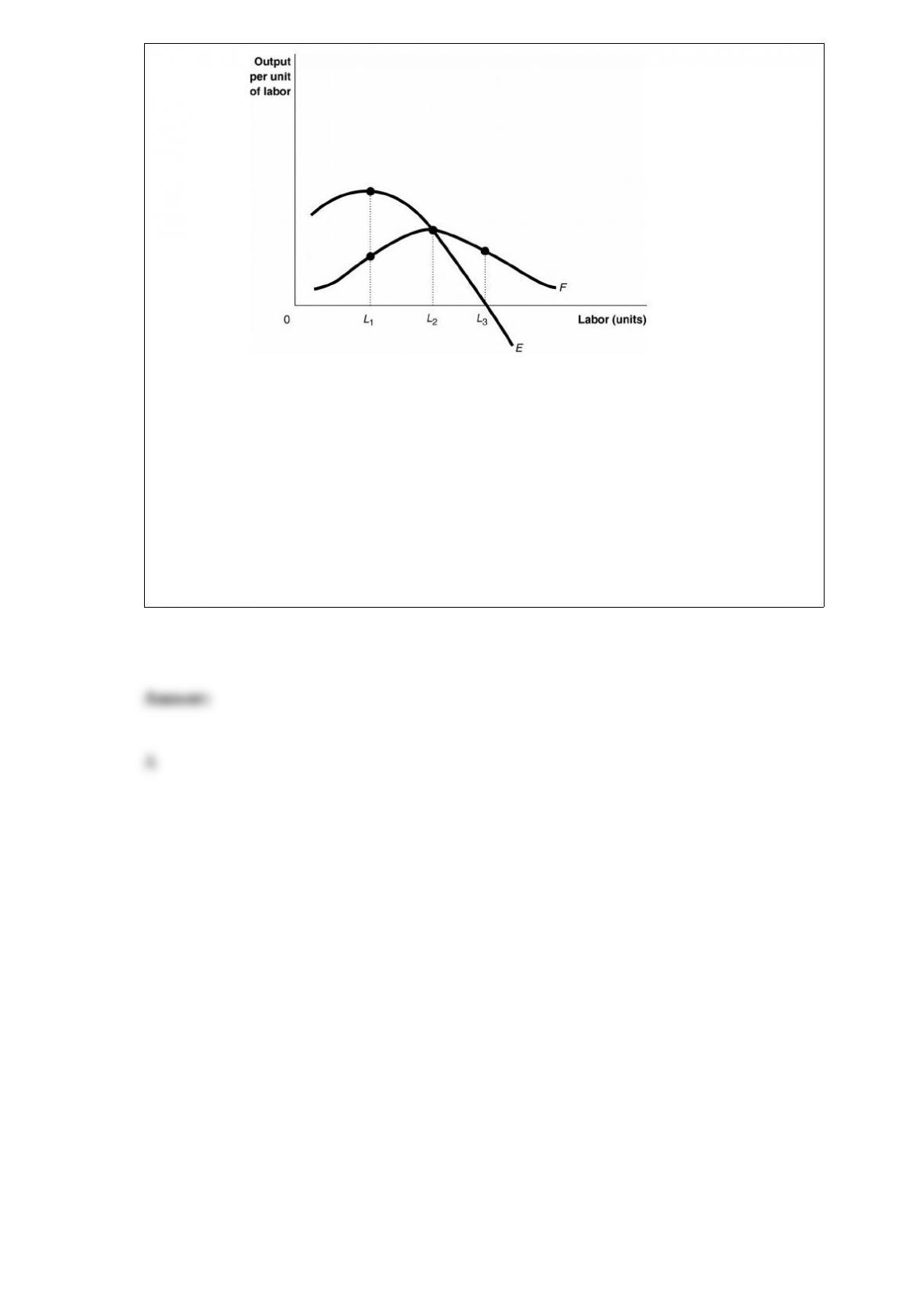
Figure 11-2
The average product of labor declines after L2 because
A) the marginal product of labor is below the average product of labor.
B) the marginal product of labor is falling.
C) the marginal product of labor is negative.
D) the marginal product of labor is positive.