
Given the labor force, either more capital or better technology will shift the production
function downward.
a. True
b. False
Assuming free trade between countries, exchange rates will change so that goods cost
the same in all countries. This concept is known as the
a. long-run equilibrium theory.
b. exchange rate equalization theory.
c. interest rate parity theory.
d. purchasing power parity theory.
If strong monetary policy stimulus is used to combat a recessionary gap, what will
happen?
a. a rapid movement toward lower unemployment and higher inflation
b. a rapid movement toward lower unemployment and lower inflation
c. a slow movement toward lower unemployment and higher inflation

d. a slow movement toward lower unemployment and lower inflation
Japan and China produce guns and rice. The country with the lowest opportunity cost of
guns (in terms of rice) will
a. import guns.
b. have a comparative advantage in guns.
c. have an absolute advantage in guns.
d. have a comparative advantage in rice.
A monopolist can earn a positive economic profit, even in the long run.
a. True
b. False

Figure 7-8
Of the graphs in Figure 7-8, which resembles marginal cost?
a. 1
b. 2
c. 3
d. 4
A shift outward of the aggregate supply curve could be caused by
a. higher import prices.
b. lower import prices.
c. energy shortages.
d. rising wage rates.

Recently, the financial crisis led to a bank run in
a. Brazil.
b. Germany and France.
c. Japan.
d. England.
By definition, an industry with high concentration also is highly competitive.
a. True
b. False
If oranges and grapefruit are close substitutes, an increase in the price of oranges will
shift the demand curve of
a. both products to the right.
b. both products to the left.
c. grapefruit to the right.
d. oranges to the left.
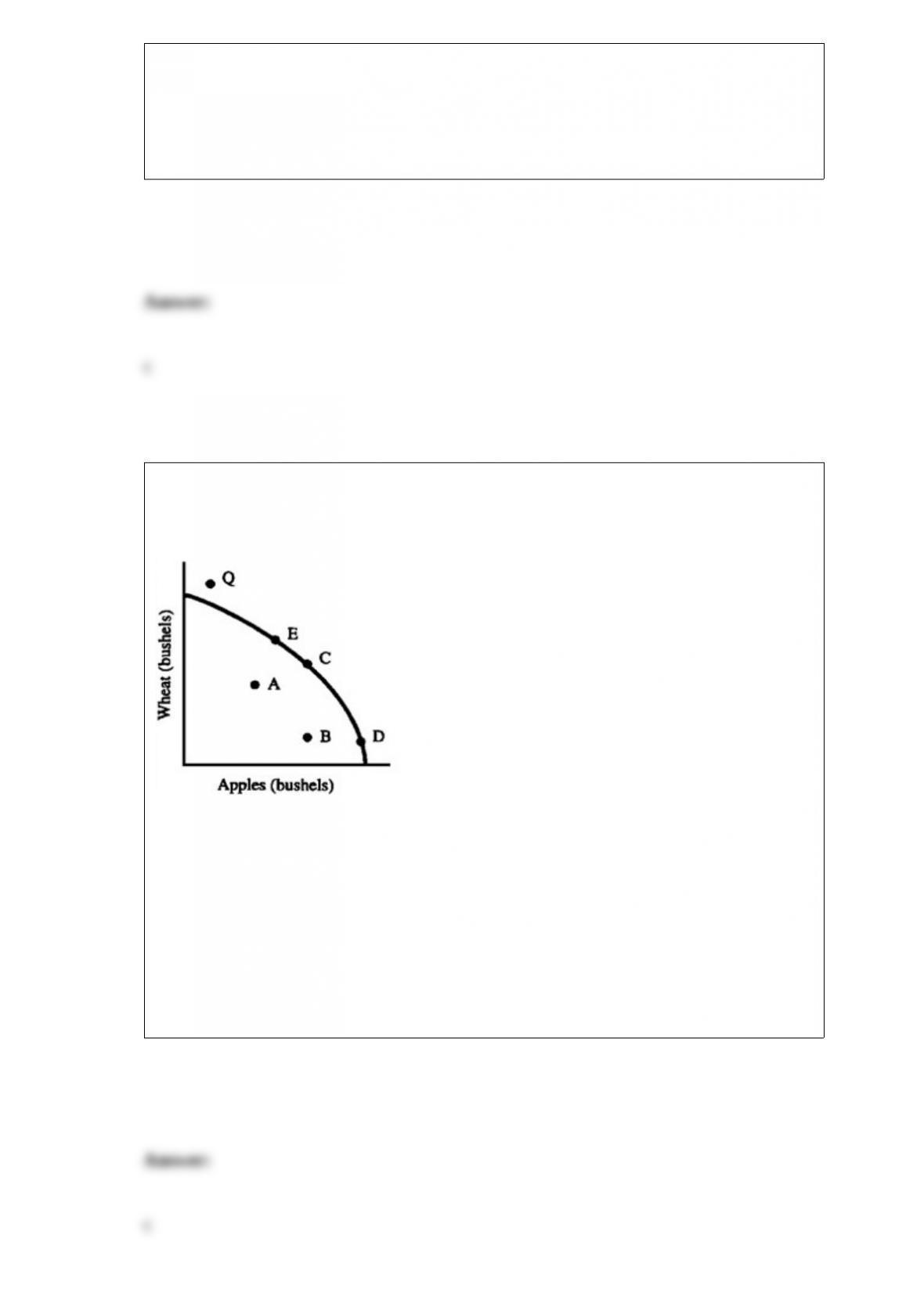
Figure 3-4
Which of the following would make point Q in Figure 3-4 attainable?
a. full-employment policies
b. a technological advance in the production of apples only
c. an increase in land available for agriculture
d. a transfer of available resources from apples to wheat

For more than a thousand years, the Catholic Church required its members to abstain
from meat on Fridays. Catholics customarily ate fish on Friday. After 1966 abstinence
from meat on Fridays was no longer required. Consequently, the
a. demand curve for fish shifted to the right.
b. demand curve for fish shifted to the left.
c. demand for meat decreased.
d. price of fish increased.
The incentive to lend increases as the real rate of interest decreases.
a. True
b. False
Business cycles are a persistent feature of the U.S. economy.
a. True
b. False

Mandated on-the-job training is seen in the United States mainly as a(n)
a. useful spur to economic growth.
b. proper use of legislative power.
c. unwarranted governmental interference.
d. necessary requirement for increased productivity.
What is the meaning of “a defective telescopic faculty,” as described by A.C. Pigou?
a. Persons are unable to plan rationally for consumption.
b. Persons zero in on something and cannot consider alternatives.
c. Persons seek long-term goals and ignore present problems.
d. Persons are unable to give adequate weight to the future.

The law of comparative advantage explains why
a. individuals choose specialized careers.
b. firms specialize in the production of certain goods.
c. nations develop strengths in certain industries.
d. All of the above are correct.
Suppose that with 1 unit of labor, Canada can produce 40 TVs or 20 computers. With 1
unit of labor, Taiwan can produce 30 TVs or 10 computers. Which of the following is
correct?
a. Taiwan has a comparative advantage in the production of computers.
b. Canada has an absolute advantage in the production of neither good.
c. Canada has a comparative advantage in the production of computers.
d. Taiwan has an absolute advantage in the production of computers.
e. Taiwan has an absolute advantage in the production of TVs.
Which person has the highest opportunity cost of obtaining a college degree (assuming
that attending college requires giving up his or her current position)?

a. Bill, who is unemployed.
b. Jane, who is an unwed mother and earns $15,000 a year.
c. Larry, who is a technician in the Navy earning $18,000 a year with free food and
housing.
d. Mary, who has a job earning $60,000 a year as a computer programmer.
e. Unable to determine from the data given.
If you believe that expectations react slowly, you are likely:
a. a believer in rational expectations
b. a Keynesian
c. a theoretical economist
d. None of these.
The largest portion of the M1 money supply consists of
a. coins in circulation.
b. paper currency in circulation.

c. savings deposits at credit unions.
d. checkable deposits.
If market forces change the exchange rate value of one dollar from 80 yen to 83.25 yen,
then the dollar has
a. appreciated.
b. depreciated.
c. been revalued.
d. been devalued.
When the Federal Reserve System was first established, its founders intended the Fed to
a. assist the Treasury in collecting taxes.
b. be primarily responsible for government regulations.
c. pursue an active monetary policy to stabilize the economy.
d. provide protection against financial panics by acting as the lender of last resort.

Being on the PPF implies that increasing the production of one good or service can only
be accomplished by decreasing the quantity produced of another good or service.
a. True
b. False
Monopolistic competition differs from perfect competition only in the number of firms
participating in the market.
a. True
b. False
Trade between nations usually means that
a. one country is richer than another.

b. one country becomes richer while the other becomes poorer.
c. both trading nations show some gains.
d. one trading country is trying to “beggar its neighbor.”
Minimum wage legislation
a. has little effect on university professors.
b. raises incomes of unskilled laborers who have jobs.
c. prevents some willing workers from getting jobs.
d. All of the above are true.
Ben quit his job as an economics professor to become a golf professional. He gave up
his salary ($40,000) and invested his retirement fund of $50,000 (which was earning 10
percent interest) in this venture. After all expenses, his net winnings (profit) were
$45,000. Ben’s economic profits were
a. $45,000.
b. $5,000.
c. $2,000.

d. zero.
Mortgage-backed securities became a significant issue because
I. housing prices fell across all regions.
II. these securities were not as widely distributed as previously thought.
a. I above only
b. II above only
c. both I and II above
d. neither I nor II above
An equilibrium point beyond a potential GDP is termed as
a. deflationary gap.
b. recessionary gap.
c. inflationary gap.
d. acceleration gap