
Which of the following are separate flows in the circular flow model?
A) the flow of goods and the flow of services
B) the flow of costs and the flow of revenue
C) the flow of income earned from the sale of resources and the flow of expenditures on
goods and services.
D) the flow of income received by households and the flow of tax revenues paid by
households
The coupon rate of a bond is equal to
A) the coupon payment.
B) the interest payment.
C) the interest rate.
D) the face value.
Adam spent $10,000 on new equipment for his small business, “Adam’s Fitness
Studio.” Membership at his fitness center is very low and at this rate, Adam needs an
additional $12,000 per year to keep his studio open. Which of the following is true?
A) The fixed cost of running the studio is $22,000.

B) The variable cost of running the studio is $22,000.
C) The $10,000 Adam spent on equipment is a fixed cost of business and the $12,000
he’ll need to continue operations is a variable cost.
D) The $10,000 Adam spent on equipment is the total cost of starting the business and
the $12,000 he’ll need to continue operations is a marginal cost.
Automobile manufacturers produce a range of automobiles such as sports utility
vehicles, luxury sedans, pickup trucks and compact cars. What fundamental economic
question are they addressing by making this range of products?
A) How to produce goods that consumers want?
B) Why produce a variety of automobiles?
C) What to produce?
D) Who to produce automobiles for?
A dominant strategy
A) is one that is the best for a firm, no matter what strategies other firms use.
B) is one that a firm is forced into following by government policy.

C) involves colluding with rivals to maximize joint profits.
D) involves deciding what to do after all rivals have chosen their own strategies.
Article Summary
According to the Department of Agriculture, net farm income will grow to a record high
of $120.6 billion in 2013, up from the previous high mark in 2011 and after adjusting
for inflation, its second highest level since 1973. Net cash income, however, is expected
to fall by 10 percent due to unsold inventories. Exports of chickens and milk are
expected to rise by 3 percent and 17 percent, respectively.
Source: Ros Krasny, “Farm income poised for record 2013: USDA,” Reuters, August
27, 2013.
Refer to the Article Summary. All else equal, the increase in demand for chicken and
milk exports will ________ the market prices for these exports and ________ economic
profit in these markets.
A) increase; decrease
B) decrease; increase
C) increase; increase
D) decrease; decrease
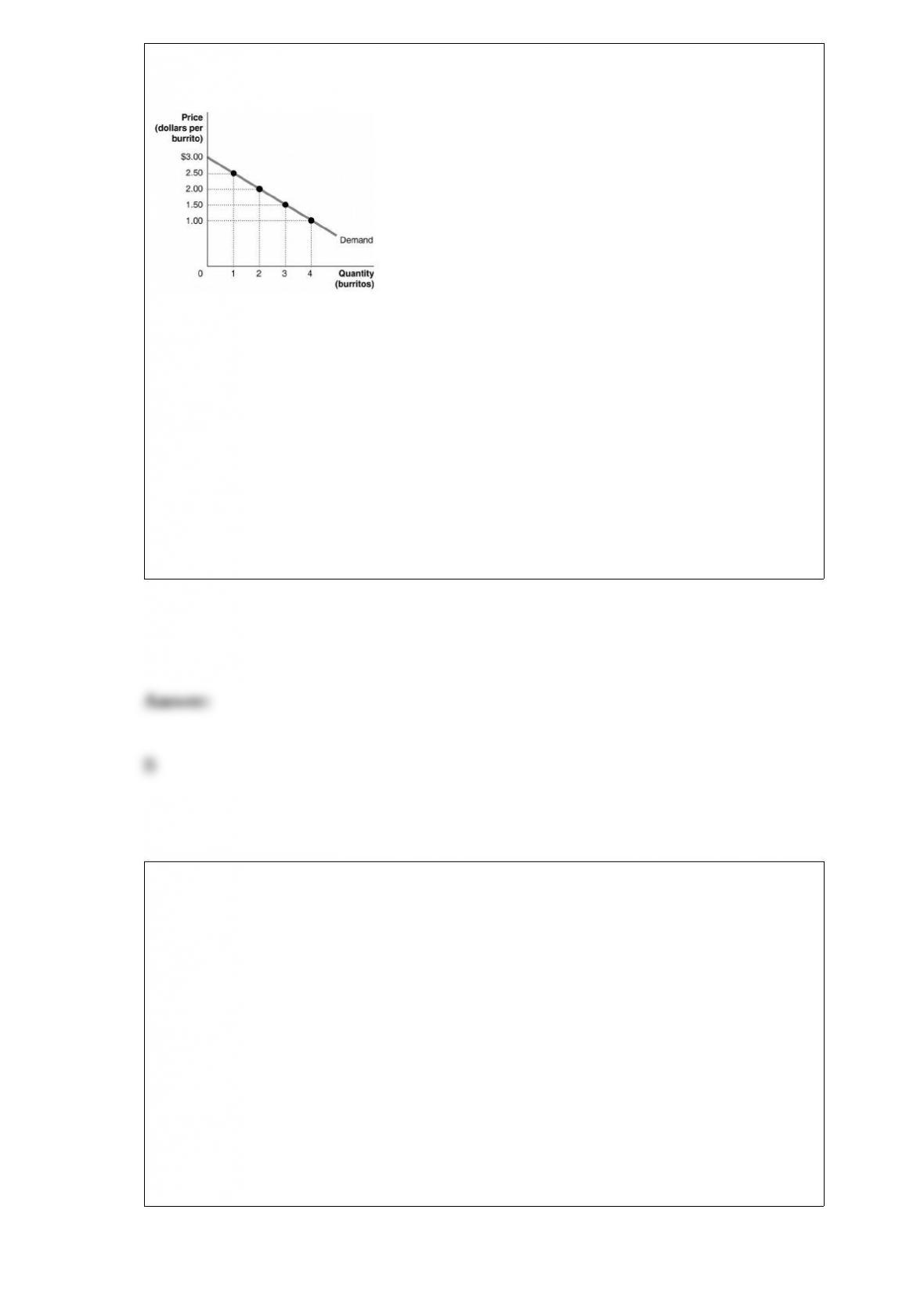
Figure 4-1
Figure 4-1 shows Arnold’s demand curve for burritos.
Refer to Figure 4-1. What is the total amount that Arnold is willing to pay for 3
burritos?
A) $1.50
B) $6.00
C) $7.00
D) $10.00
There is a difference between who is legally required to send a tax payment to the
government and who bears the burden of the tax. Which of the following would have
the most impact on who bears the burden of an excise tax?
A) whether the tax is imposed by the federal government or a state government
B) whether the tax is based on the ability-to-pay principle or the benefits-received
principle
C) The motive for the tax. If the tax is designed to raise revenue, more of the burden
will fall on firms. If the tax is designed to achieve a social objective (for example, to
discourage smoking) more of the burden will fall on consumers.
D) The elasticity of demand for the item that is taxed.
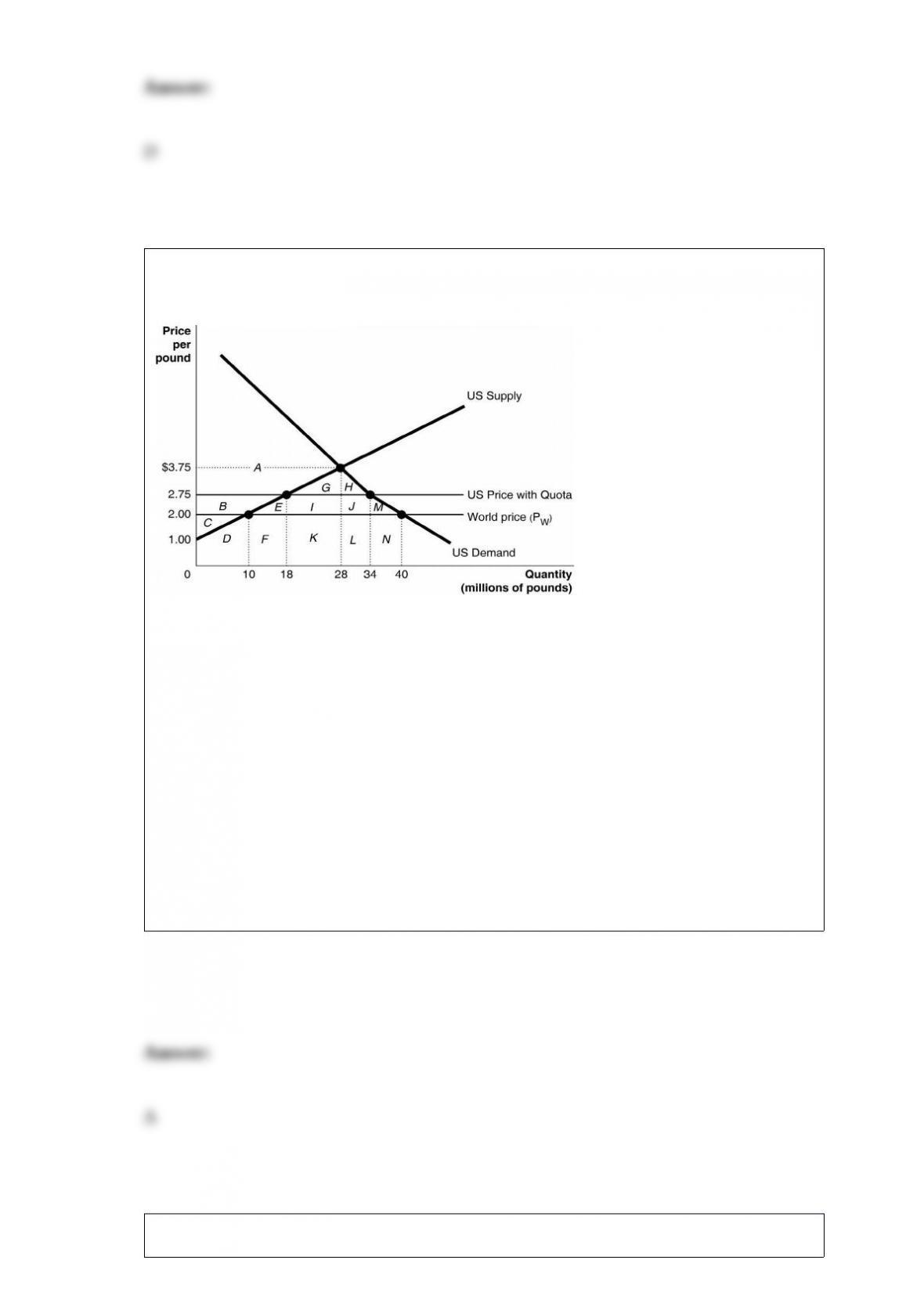
Figure 9-3
Since 1953 the United States has imposed a quota to limit the imports of peanuts.
Figure 9-3 illustrates the impact of the quota.
Refer to Figure 9-3. Without the quota, the domestic price of peanuts equals the world
price which is $2.00 per pound. What is the quantity of peanuts supplied by domestic
producers in the absence of a quota?
A) 10 million pounds
B) 28 million pounds
C) 30 million pounds
D) 40 million pounds
A stock’s dividend yield is determined by

A) dividing the dividend payment by the stock’s initial price.
B) dividing the dividend payment by the stock’s closing market price.
C) dividing the stock’s closing market price by the dividend payment.
D) subtracting the stock’s initial purchase price from the stocks’ closing market price on
a given day.
A corporation is owned by its
A) board of directors.
B) stockholders.
C) employees.
D) CEO.
For many years the Aluminum Company of America (Alcoa) controlled most of the
world’s supply of high quality bauxite, the ore needed to produce aluminum. What type
of entry barrier was responsible for Alcoa’s position in the aluminum industry?
A) ownership of a key input
B) a government-imposed barrier

C) a patent on the manufacture of aluminum
D) economies of scale
If opportunity costs are constant, the production possibilities frontier would be graphed
as
A) a ray from the origin.
B) a positively sloped straight line.
C) a negatively sloped curve bowed in toward the origin.
D) a negatively sloped straight line.
If Valerie purchases ankle socks at $5 and gets 25 units of marginal utility from the last
unit, and bandanas at $3 and gets 12 units of marginal utility from the last bandana
purchased, she
A) is maximizing total utility and does not want to change their consumption of ankle
socks or bandanas.
B) wants to consume more ankle socks and fewer bandanas.
C) wants to consume more of bandanas and fewer ankle socks.

D) wants to consume less of both ankle sock and bandanas.
By tying the salaries of top corporate managers to the price of the corporation’s stock,
corporations hope to avoid
A) corporate governance.
B) conflict between the CFO and the CEO.
C) the principal-agent problem.
D) paying high salaries to their managers.
An increase in the demand for green tea raises the price of apples from $16 a pound to
$20 a pound. As a result, quantity supplied increases by 30 percent. Using the midpoint
formula, calculate the value of the price elasticity of supply?
A) 1.35
B) 1.875
C) 2.22
D) 7.5
In 2013, Smileytown consumed 12,000 gallons of mouthwash. In 2014, mouthwash
consumption rose to 17,000 gallons. Calculate the percentage change in mouthwash
consumption.
A) 17.2%
B) 29.4%
C) 41.7%
D) 70.6%
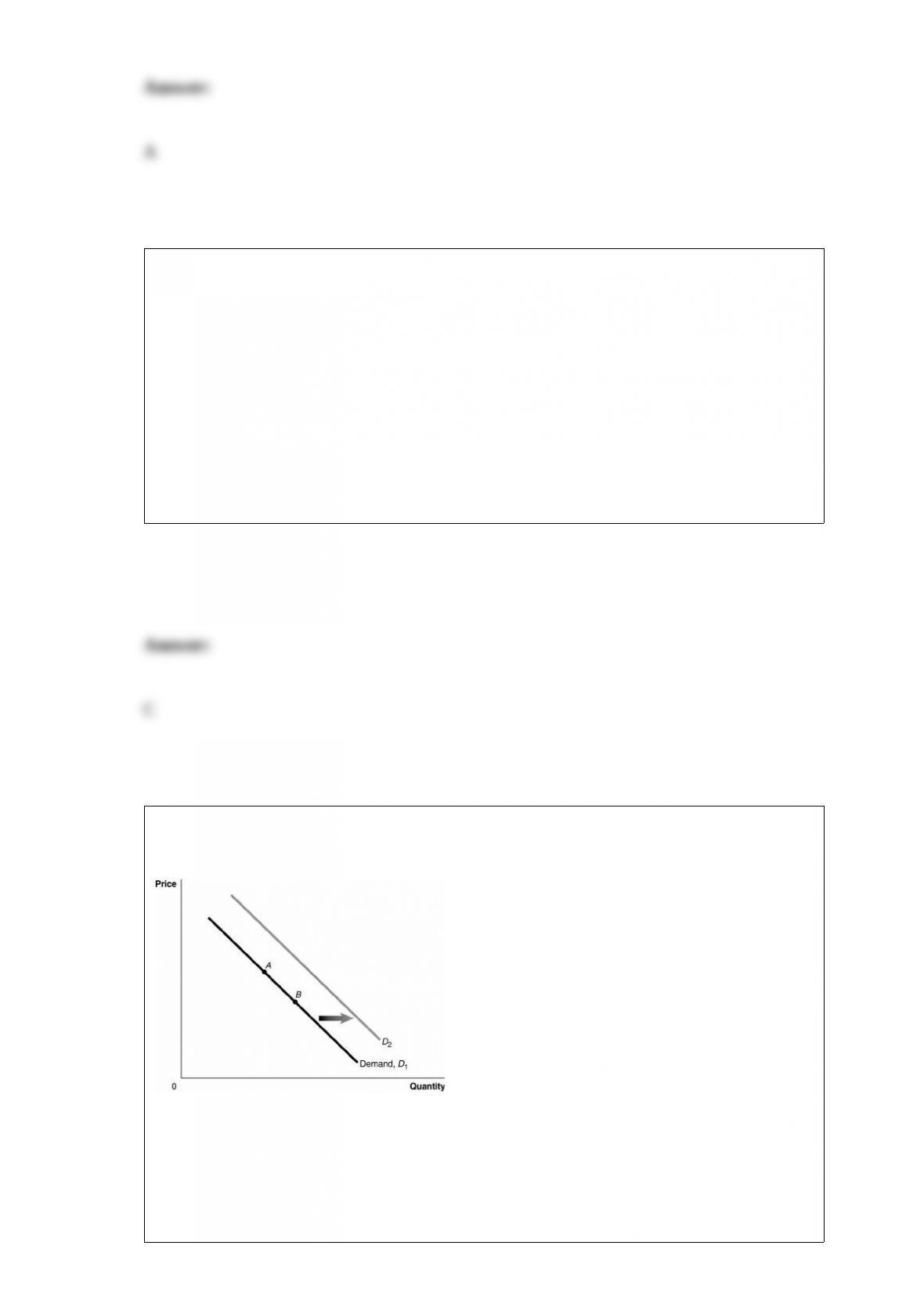
Figure 3-1
Refer to Figure 3-1. A decrease in the price of a complementary good would be
represented by a movement from
A) A to B.
B) B to A.

C) D1 to D2.
D) D2 to D1.
Vertical-equity is most closely associated with which of the following goals or
principles?
A) the horizontal-equity principle
B) the goal of economic efficiency
C) the goal of attaining social objectives
D) the ability-to-pay principle
Tony’s Italian Ice is a monopolistically competitive firm. If Tony’s earns a profit in the
short run, which of the following is most likely to occur?
A) New firms that sell Italian ice will enter the market and Tony’s cost curves will shift
to the left.
B) New firms that sell Italian ice will enter the market and Tony’s demand curve will
shift to the left.
C) New firms that sell Italian ice will enter the market and Tony’s demand curve will

shift to the right.
D) New firms that sell Italian ice will enter the market and Tony’s demand curve will
become more inelastic.
Which of the following is a reason why a firm would experience diseconomies of scale?
A) To finance an increase in the size of its plant a firm must borrow more money or sell
more shares of stock.
B) As the size of the firm increases, it becomes more difficult to find markets where it
doesn’t already have operations.
C) As the size of the firm increases it becomes more difficult to coordinate the
operations of its manufacturing plants.
D) As the size of the firm increases, it must operate in other countries where differences
in language, customs and laws increase its average costs.
Figure 9-2
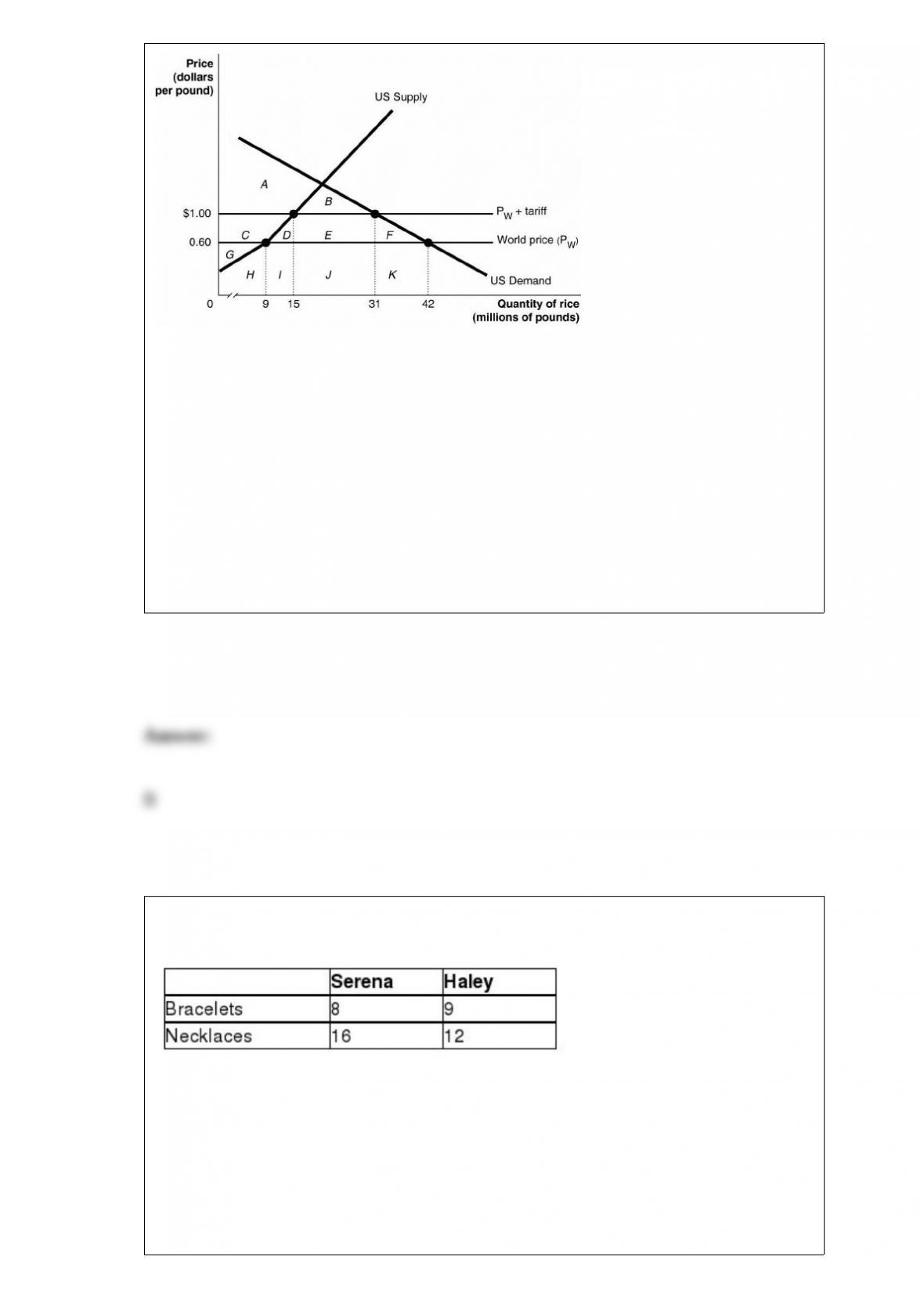
Suppose the U.S. government imposes a $0.40 per pound tariff on rice imports. Figure
9-2 shows the impact of this tariff.
Refer to Figure 9-2. The tariff causes domestic consumption of rice
A) to fall by 27 million pounds.
B) to fall by 11 million pounds.
C) to rise by 6 million pounds.
D) to rise by 16 million pounds.
Table 2-6
Table 2-6 shows the output per week of two jewelers, Serena and Haley. They can either
devote their time to making bracelets or making necklaces.
Refer to Table 2-6. Which of the following statements istrue?
A) Haley has a comparative advantage in making both products.
B) Serena has a comparative advantage in making both products.

C) Haley has a comparative advantage in making bracelets and Serena in making
necklaces.
D) Haley has a comparative advantage in making necklaces and Serena in making
bracelets.
Consider two single-malt whiskey distillers, Laphroaig and Knockando. If they
advertise, they can both sell more whiskey and increase their revenue. However, the
cost of advertising more than offsets the increased revenue so that each distiller ends up
with a lower profit than if they do not advertise. On the other hand, if only one
advertises, that distiller increases its market share and also its profit.
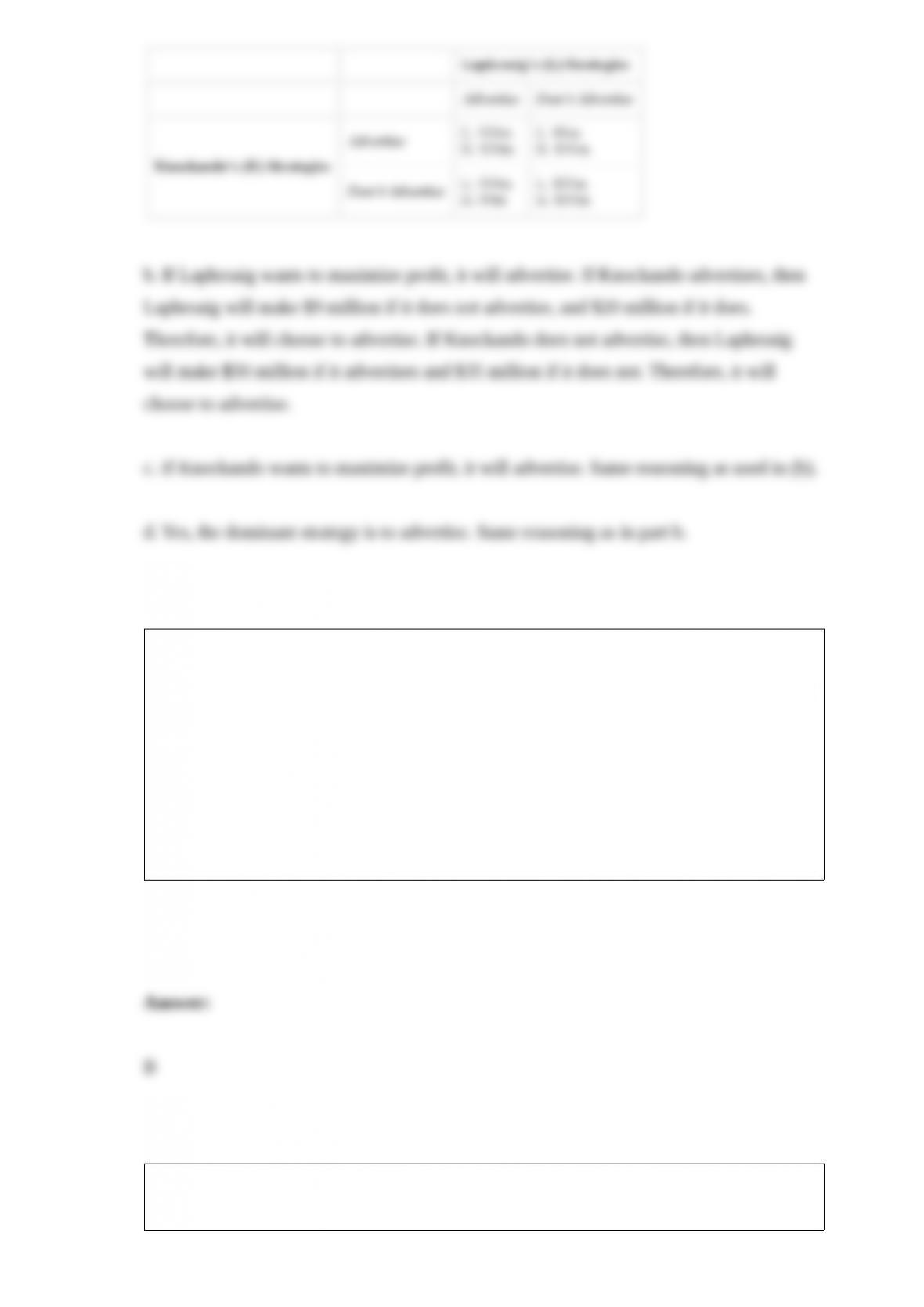
a. Construct a payoff matrix using the following hypothetical information: If neither
distiller advertises, each earns a profit of $35 million per year. If both advertise, each
earns a profit of $20 million per year. If one advertises and the other does not, the
distiller who advertises earns a profit of $50 million and the distiller who does not
advertise earns a profit of $9 million.
b. If Laphroaig wants to maximize profit, will it advertise? Briefly explain.
c. If Knockando wants to maximize profit, will it advertise? Briefly explain.
d. Is there a dominant strategy for each distiller? Briefly explain.
The prisoner’s dilemma illustrates
A) how oligopolists engage in implicit collusion under strategic situations.
B) why firms will not cooperate if they behave strategically.
C) why firms have an incentive to cheat on agreements.
D) how cooperation in strategic situations lead to the economically efficient market
outcome.
Figure 11-7
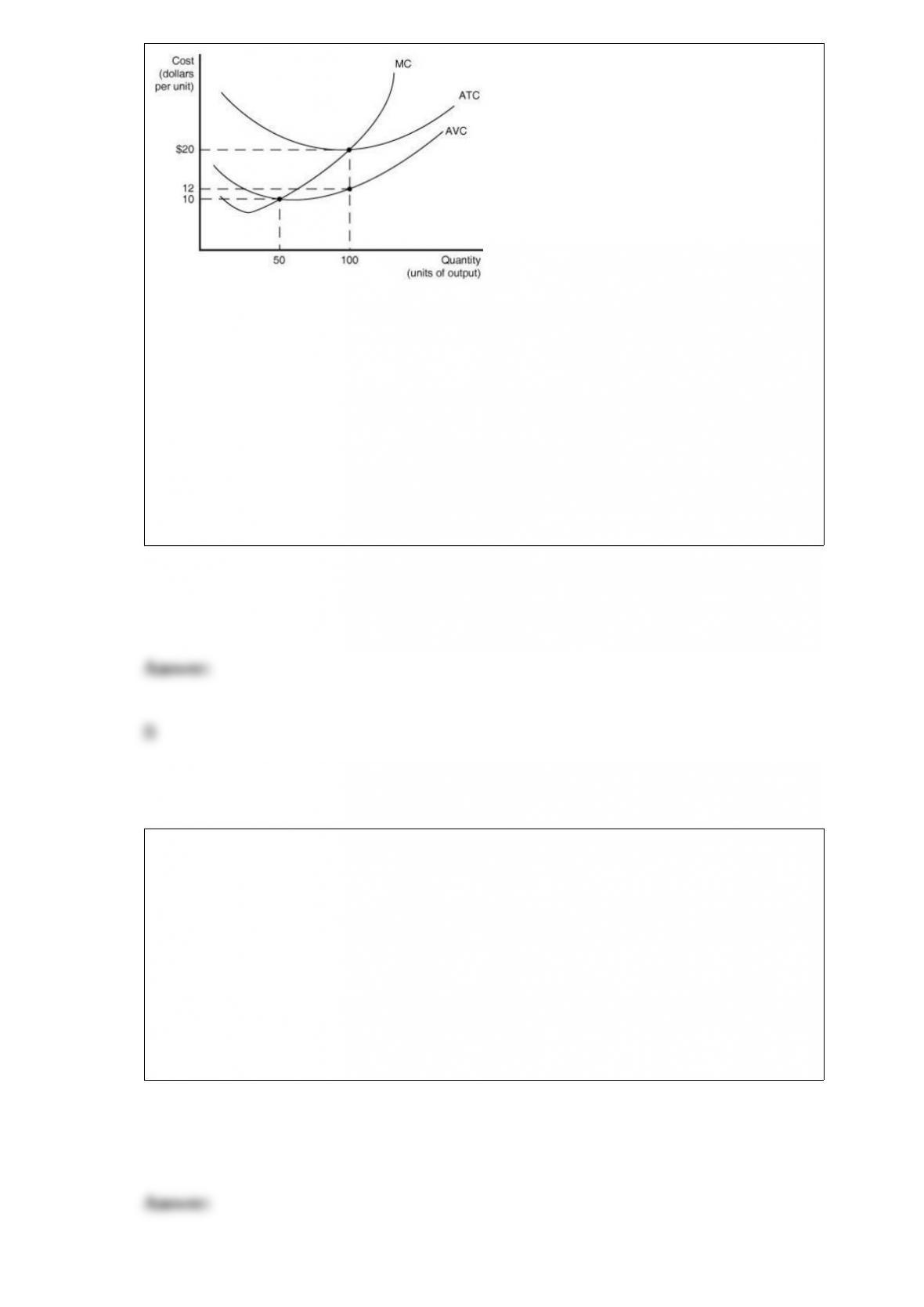
Figure 11-7 shows the cost structure for a firm.
Refer to Figure 11-7. When the output level is 100 units average fixed cost is
A) $10.
B) $8.
C) $5.
D) This cannot be determined from the diagram.
Private costs
A) are borne by producers of a good while social costs are borne by government.
B) are borne by consumers of a good while social costs are borne by government.
C) are borne by producers of a good while social costs are borne by society at large.
D) are borne by producers of a good while social costs are borne by those who cannot
afford to purchase the good.
Suppose Dublin Electronics charges regular customers $90 for a Blu-ray player but
allows senior citizens to purchase the same item for $75. Is this likely to be a successful
price discriminating strategy?
A) Yes, firms price discriminate to maximize profits.
B) No, price discrimination will not be effective because the store cannot prevent senior
citizens from buying large quantities of Blu-ray players and reselling them for a profit.
C) Yes, because senior citizens are likely to have a more elastic demand and therefore
will be willing to pay a lower price compared to regular customers.
D) No, because there are many different brands of Blu-ray players and consumers will
shop around.
Figure 13-19
Refer to Figure 13-19 to answer the following questions.
a. What is the productively efficient output?
b. What is the allocatively efficient output?
c. What is the amount of excess capacity?
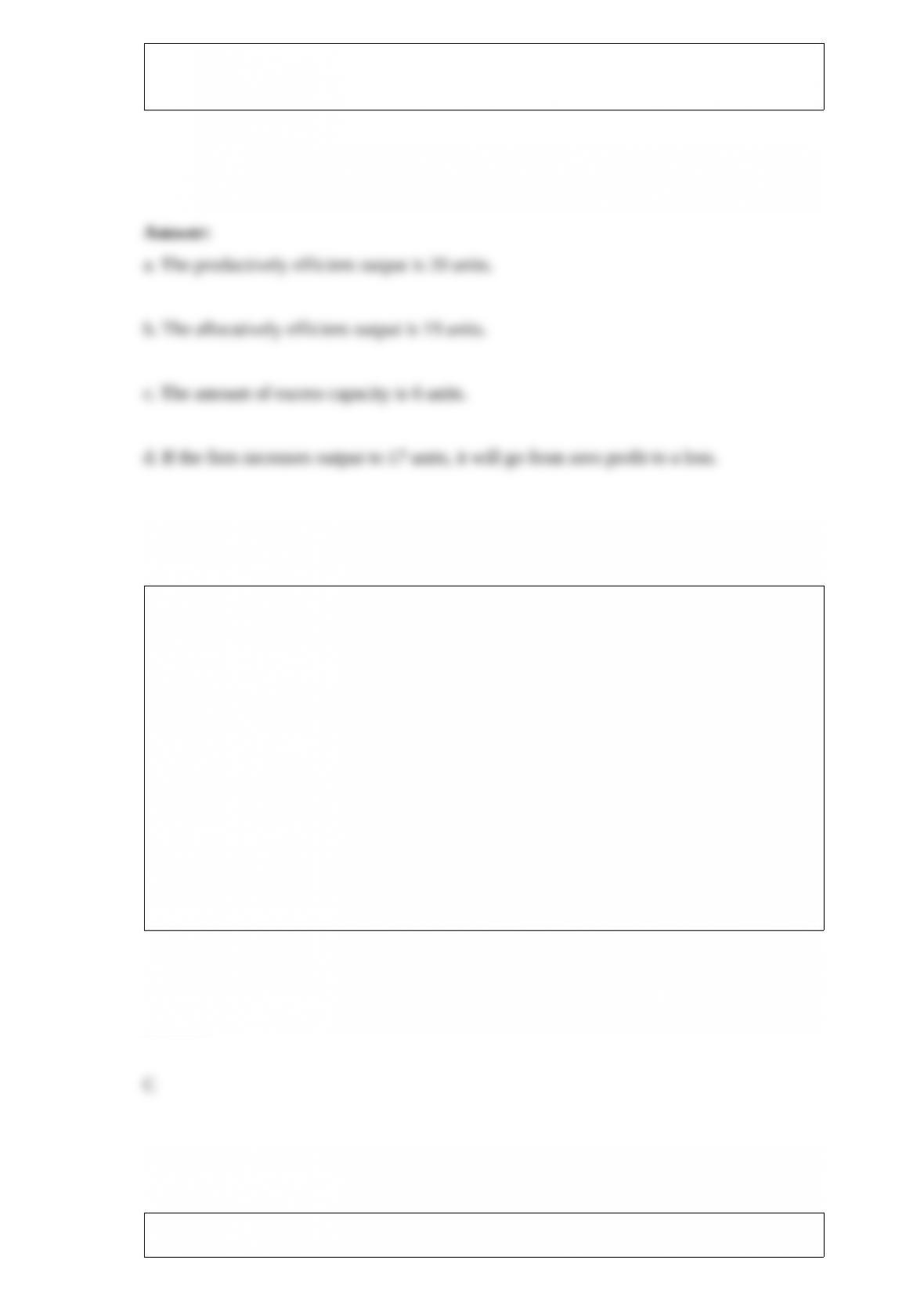
d. Suppose the firm is currently producing 14 units. What happens if it increases output
to 17 units?
Which of the following is not one of the concerns of some policymakers and
economists that the increase in the share of income earned by the 1 percent is damaging
to the country?
A) The higher incomes of the 1 percent may give them disproportionate political
influence through campaign contributions.
B) Countries with high levels of income inequality have lower growth rates than do
countries with more equal distributions of income.
C) further increases in marginal tax rates may reduce work, saving, and investment,
thereby reducing economic growth.
D) Rising income inequality can lead to political unrest.
Market power refers to
A) the ability of consumers to dictate what products should be produced.
B) the ability of a firm to advertise its product and succeed in selling more output.
C) the ability of a firm to sell at a lower price than rival sellers.
D) the ability of a firm to charge a price higher than the marginal cost of production.
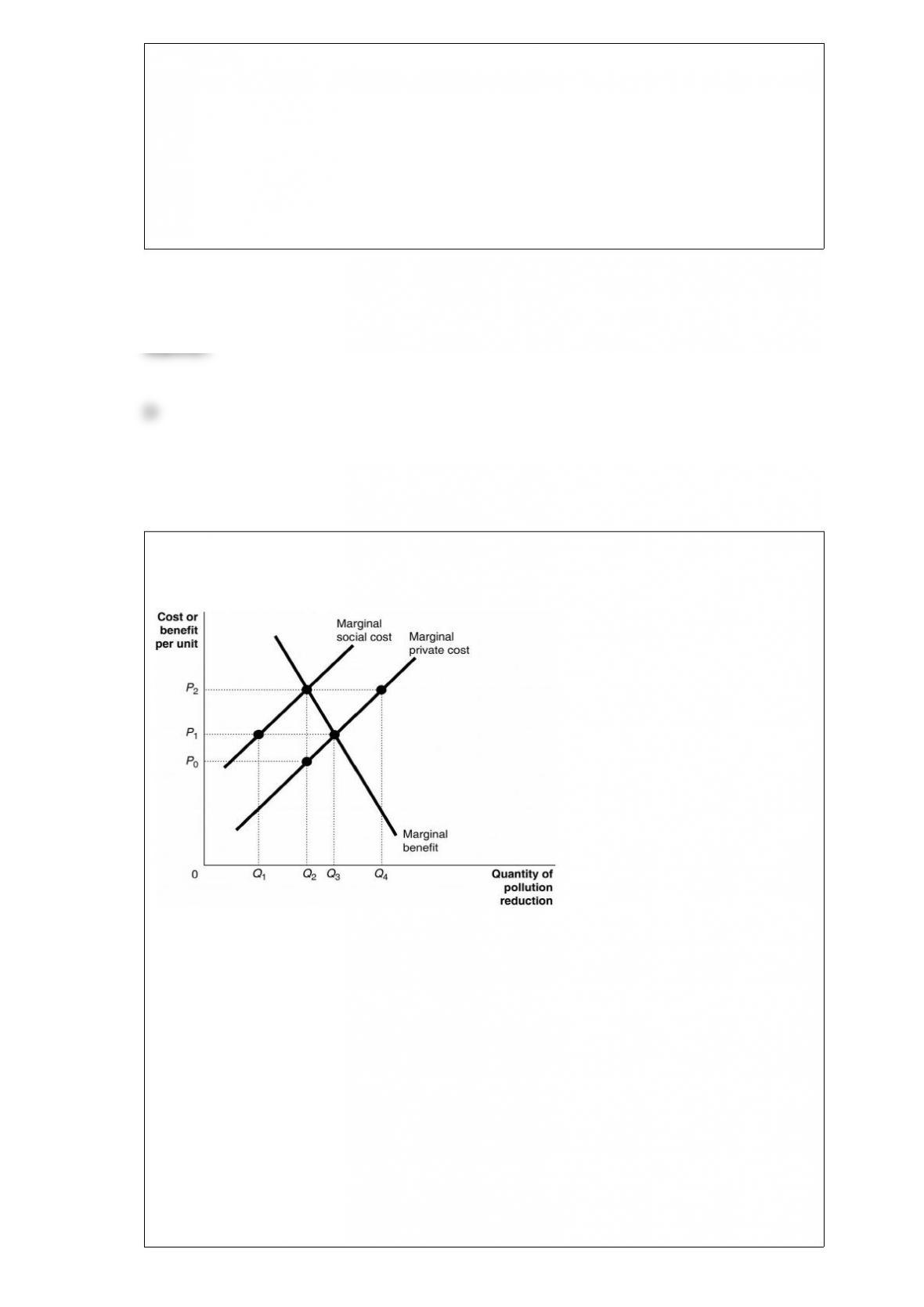
Figure 5-9
Companies producing toilet paper bleach the paper to make it white. The bleach is
discharged into rivers and lakes and causes substantial environmental damage. Figure
5-9 illustrates the situation in the toilet paper market.
Refer to Figure 5-9. The private profit-maximizing output level is
A) Q1.
B) Q2.
C) Q3.
D) Q4.