State whether the following statement is true or false AND explain why: “A decrease in
the discount rate will always cause a decrease in the federal reserve funds rate.”
State whether the following statement is true or false AND explain why: “An increase
in the interest rate paid on excess reserves will always cause an increase in the federal
reserve funds rate.”
Holding all else constant, when a bank receives the funds for a deposited check
A) cash items in the process of collection fall by the amount of the check.
B) bank assets increase by the amount of the check.
C) bank liabilities decrease by the amount of the check.
D) bank reserves increase by the amount of required reserves.

The ________ problem helps to explain why the private production and sale of
information cannot eliminate ________.
A) free-rider; adverse selection
B) free-rider; moral hazard
C) principal-agent; adverse selection
D) principal-agent; moral hazard
Potential weaknesses of nominal GDP targeting include
A) it requires accurate estimates of potential GDP growth, which are not easy to
achieve.
B) it implies that the central bank will respond to slowdowns in the real economy even
if inflation is not falling.
C) real GDP growth that is below potential or inflation that is below the inflation
objective will encourage more expansionary monetary policy.
D) it focuses not only on controlling inflation but also explicitly on stabilizing real
GDP.
Everything else held constant, an increase in the liquidity of bonds results in a
________ in demand for bonds and the demand curve shifts to the ________.
A) rise; right
B) rise; left
C) fall; right
D) fall; left

Secondary markets make financial instruments more
A) solid.
B) vapid.
C) liquid.
D) risky.
The present value of a fixed-payment loan is calculated as the ________ of the present
value of all cash flow payments.
A) sum
B) difference
C) multiple
D) log
Which of the following statements about the characteristics of debt and equity is
FALSE?
A) They can both be long-term financial instruments.
B) They can both be short-term financial instruments.
C) They both involve a claim on the issuer’s income.
D) They both enable a corporation to raise funds.
A monetary policy strategy that uses a fixed exchange rate regime that ties the value of
a currency to the currency of a large, low inflation country is called ________ targeting.
A) exchange-rate

B) currency
C) monetary
D) inflation
Under the Bretton Woods system, the United States was designated as the
A) reserve-currency country.
B) fixed-rate country.
C) par-standard country.
D) dollar-standard country.
Since the passage of the International Banking Act of 1978, the competitive advantage
enjoyed by foreign banks in the U.S. has been
A) reduced.
B) mildly expanded.
C) completely eliminated.
D) greatly expanded.
Which of the following statements is TRUE?
A) A liquid asset is one that can be quickly and cheaply converted into cash.
B) The demand for a bond declines when it becomes less liquid, decreasing the interest
rate spread between it and relatively more liquid bonds.
C) The differences in bond interest rates reflect differences in default risk only.
D) The corporate bond market is the most liquid bond market.

A bond that is bought at a price below its face value and the face value is repaid at a
maturity date is called a
A) simple loan.
B) fixed-payment loan.
C) coupon bond.
D) discount bond.
If the CPI in 2004 is 200, and in 2005 the CPI is 180, the rate of inflation from 2004 to
2005 is
A) 20%.
B) 10%.
C) 0%.
D) -10%.
________ are asymmetric information problems that act as a barrier to efficient
allocation of capital.
A) Asset prices
B) Credit imbalances
C) Financial frictions
D) Financial derivatives

If you expect the inflation rate to be 4 percent next year and a one year bond has a yield
to maturity of 7 percent, then the real interest rate on this bond is
A) -3 percent.
B) -2 percent.
C) 3 percent.
D) 7 percent.
Other things being equal, an increase in the default risk of corporate bonds shifts the
demand curve for corporate bonds to the ________ and the demand curve for Treasury
bonds to the ________.
A) right; right
B) right; left
C) left; right
D) left; left
An $8,000 coupon bond with a $400 coupon payment every year has a coupon rate of
A) 5 percent.
B) 8 percent.
C) 10 percent.
D) 40 percent.

Parties who have bought a futures contract and thereby agreed to ________ (take
delivery of) the bonds are said to have taken a ________ position.
A) sell; short
B) buy; short
C) sell; long
D) buy; long
Adverse selection is a problem associated with equity and debt contracts arising from
A) the lender’s relative lack of information about the borrower’s potential returns and
risks of his investment activities.
B) the lender’s inability to legally require sufficient collateral to cover a 100% loss if
the borrower defaults.
C) the borrower’s lack of incentive to seek a loan for highly risky investments.
D) the borrower’s lack of good options for obtaining funds.
If the required reserve ratio is 20 percent, the simple deposit multiplier is
A) 5.0.
B) 2.5.
C) 4.0.
D) 10.0.
The oldest central bank, having been founded in 1694, is the
A) Bank of England.

B) Deutsche Bundesbank.
C) Bank of Japan.
D) Federal Reserve System.
In order to reduce the ________ problem in loan markets, bankers collect information
from prospective borrowers to screen out the bad credit risks from the good ones.
A) moral hazard
B) adverse selection
C) moral suasion
D) adverse lending
The chartering process is especially designed to deal with the ________ problem, and
regular bank examinations help to reduce the ________ problem.
A) adverse selection; adverse selection
B) adverse selection; moral hazard
C) moral hazard; adverse selection
D) moral hazard; moral hazard
Elimination of riskless profit opportunities in the futures market is
A) hedging.
B) arbitrage.
C) speculation.
D) underwriting.

The problem of adverse selection helps to explain
A) why firms are more likely to obtain funds from banks and other financial
intermediaries, rather than from securities markets.
B) why collateral is an important feature of consumer, but not business, debt contracts.
C) why direct finance is more important than indirect finance as a source of business
finance.
D) why lenders refuse loans to individuals with high net worth.
If a bank has excess reserves of $7,000 and demand deposit liabilities of $100,000, and
if the reserve requirement is 15 percent, then the bank has actual reserves of
A) $17,000.
B) $22,000.
C) $27,000.
D) $29,000.
Solutions to the moral hazard problem include
A) low net worth.
B) monitoring and enforcement of restrictive covenants.
C) greater reliance on equity contracts and less on debt contracts.
D) greater reliance on debt contracts than financial intermediaries.

Defining money becomes ________ difficult as the pace of financial innovation
________.
A) less; quickens
B) more; quickens
C) more; slows
D) more; stops
The Federal Open Market Committee consists of the
A) five senior members of the seven-member Board of Governors.
B) seven members of the Board of Governors and seven presidents of the regional Fed
banks.
C) seven members of the Board of Governors and five presidents of the regional Fed
banks.
D) twelve regional Fed bank presidents and the chairman of the Board of Governors.
Before 1863
A) federally-chartered banks had regulatory advantages not granted to state-chartered
banks.
B) the number of federally-chartered banks grew at a much faster rate than at any other
time since the end of the Civil War.
C) banks acquired funds by issuing banknotes.
D) banks were required to maintain 100% of their deposits as reserves.

With the followings is NOT one of the reasons why quantitative easing in and of itself
will not necessarily be stimulative?
A) Most of the resulting increase in the monetary base just flows into holdings of
excess reserves.
B) Banks just add to their holdings of excess reserves instead of making loans.
C) The asset purchase program involves only the purchase of short-term government
securities.
D) The asset purchase program involves only the purchase of long-term government
securities.
Assume that the following are the predicted inflation rates in these countries for the
year: 2% for the United States, 3% for Canada; 4% for Mexico, and 5% for Brazil.
According to the purchasing power parity and everything else held constant, which of
the following would we expect to happen?
A) The Brazilian real will depreciate against the U.S. dollar.
B) The Mexican peso will depreciate against the Brazilian real.
C) The Canadian dollar will depreciate against the Mexican peso.
D) The U.S. dollar will depreciate against the Canadian dollar.
Why does the free-rider problem occur in the debt market?
Explain the 1992 crisis that led to the breakdown of the European Union’s Exchange
Rate Mechanism. What disadvantages of exchange-rate targeting were exhibited during
this crisis?
Explain why the Social Security system faces problems. Discuss the possible solutions
to these problems.
If the federal government where to raise the income tax rates, would this have any
impact on a state’s cost of borrowing funds? Explain.
Everything else held constant, would an increase in volatility of stock prices have any
impact on the demand for rare coins? Why or why not?
If the interest rate is 5%, what is the present value of a security that pays you $1, 050
next year and $1,102.50 two years from now? If this security sold for $2200, is the
yield to maturity greater or less than 5%? Why?
Assume that a fixed exchange rate is overvalued. Describe the situation of a speculative
crisis against this currency. What can the central bank do to defend the currency? Why
might the alternative of devaluation be preferable?
Explain the Keynesian theory of money demand. What motives did Keynes think
determined money demand? What are the two reasons why Keynes thought velocity
could NOT be treated as a constant?
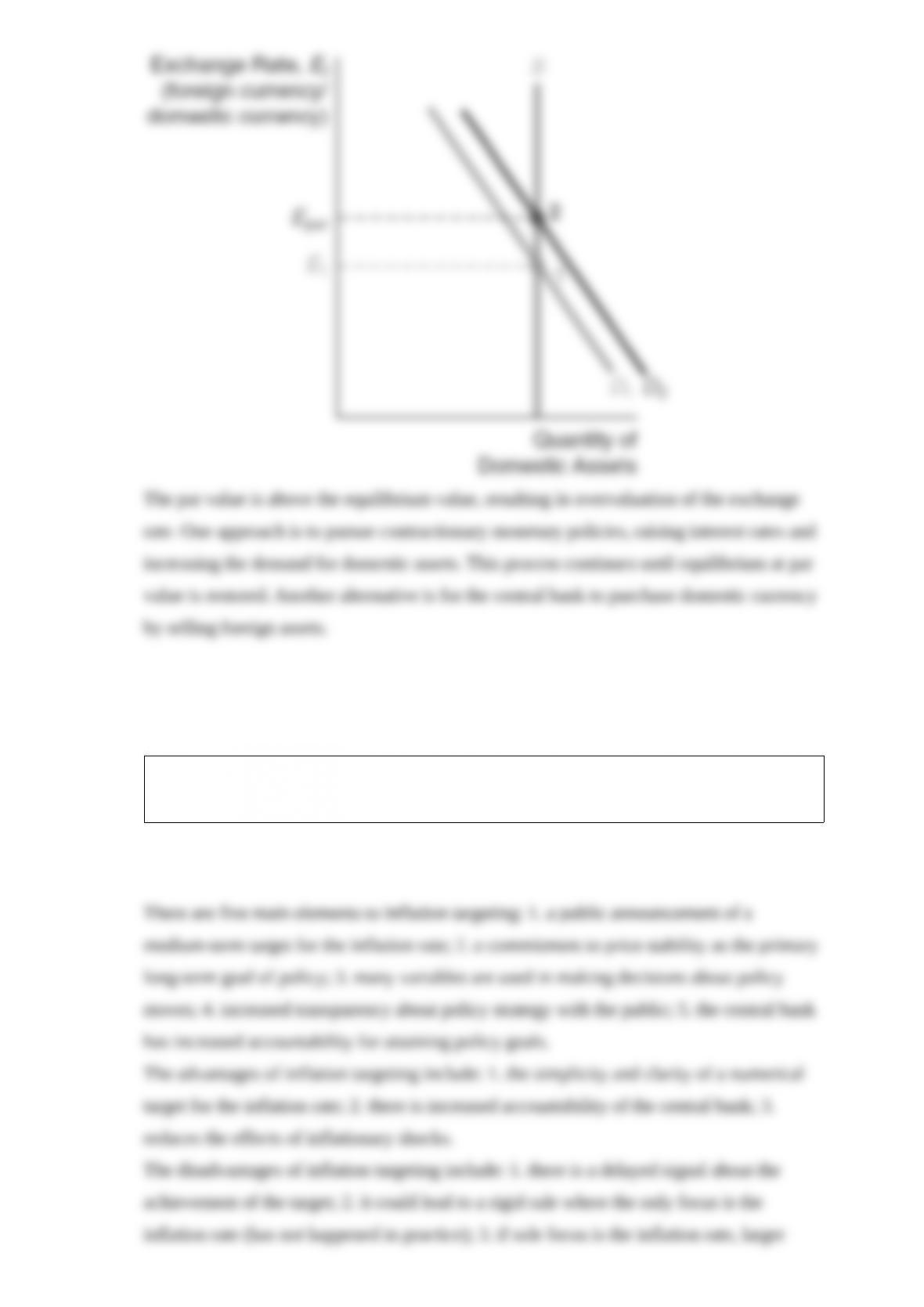
Explain and demonstrate graphically the situation of an overvalued exchange rate in a
fixed exchange rate system. What alternative policies are available to eliminate the
overvaluation of the exchange rate?
Explain what inflation targeting is. What are the advantages and disadvantages of this
type of monetary policy strategy?
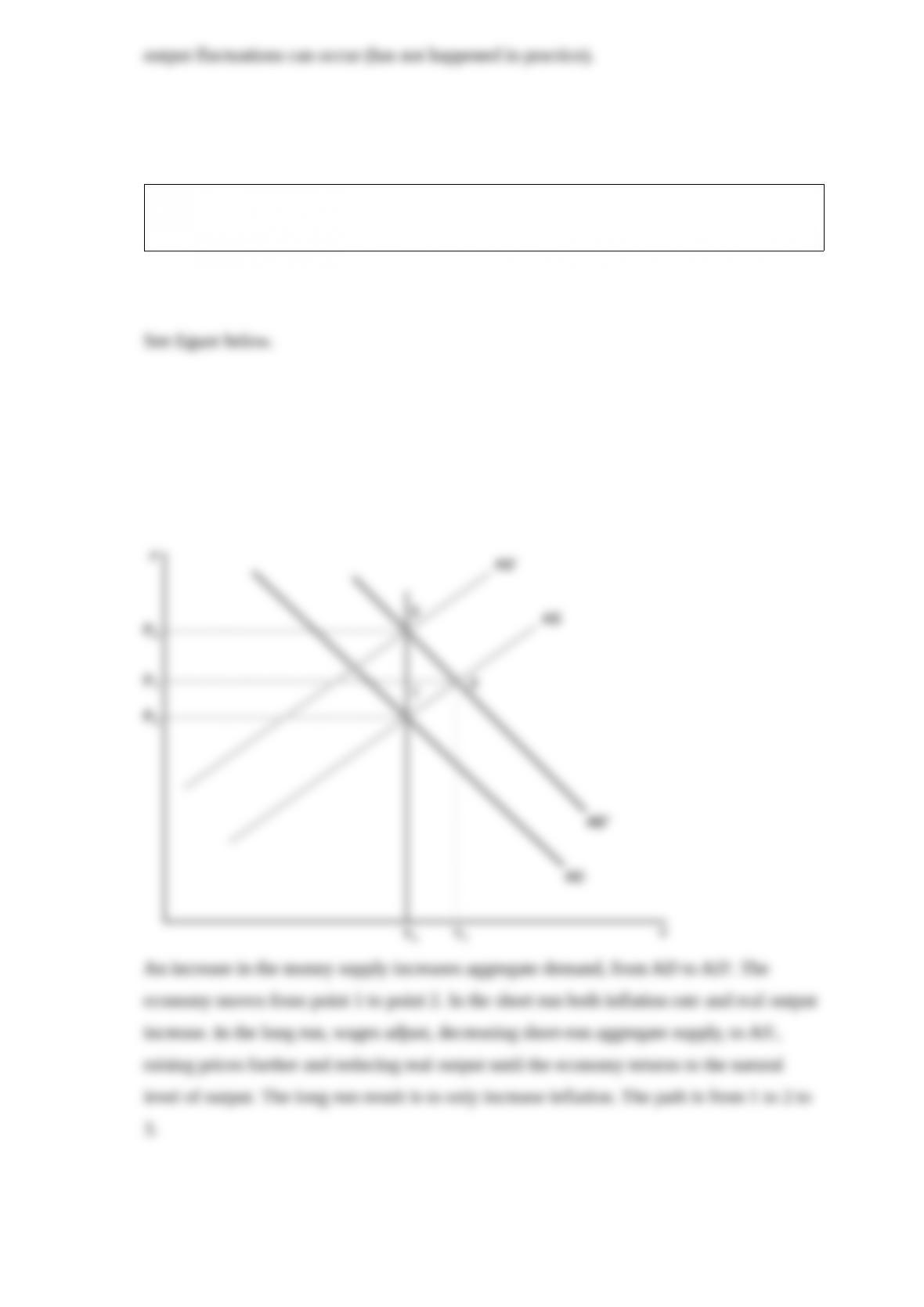
Using the aggregate demand-aggregate supply model, explain and demonstrate
graphically the short-run and long-run effects of an increase in the money supply.
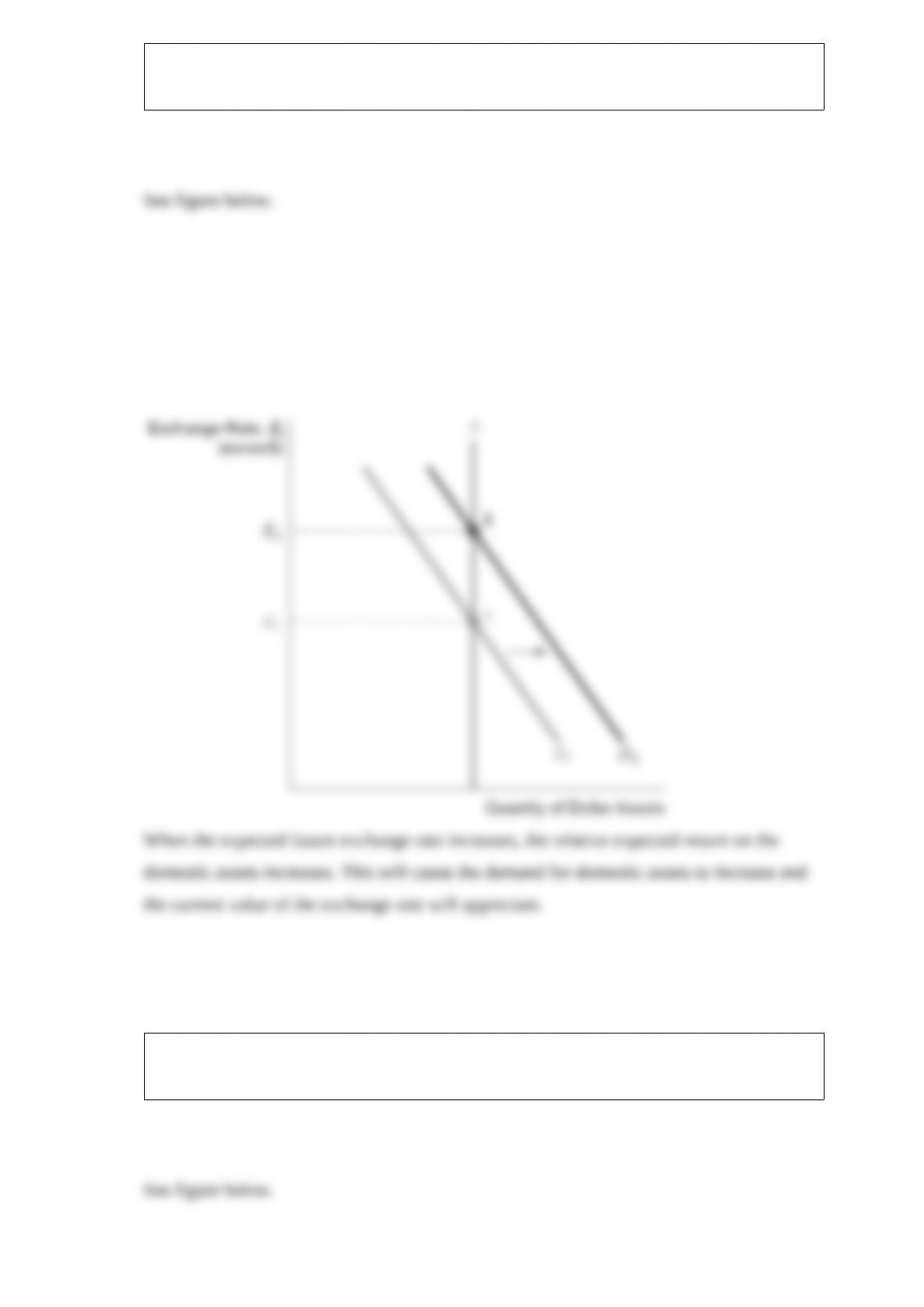
Explain and show graphically the effect of an increase in the expected future exchange
rate on the equilibrium exchange rate, everything else held constant.
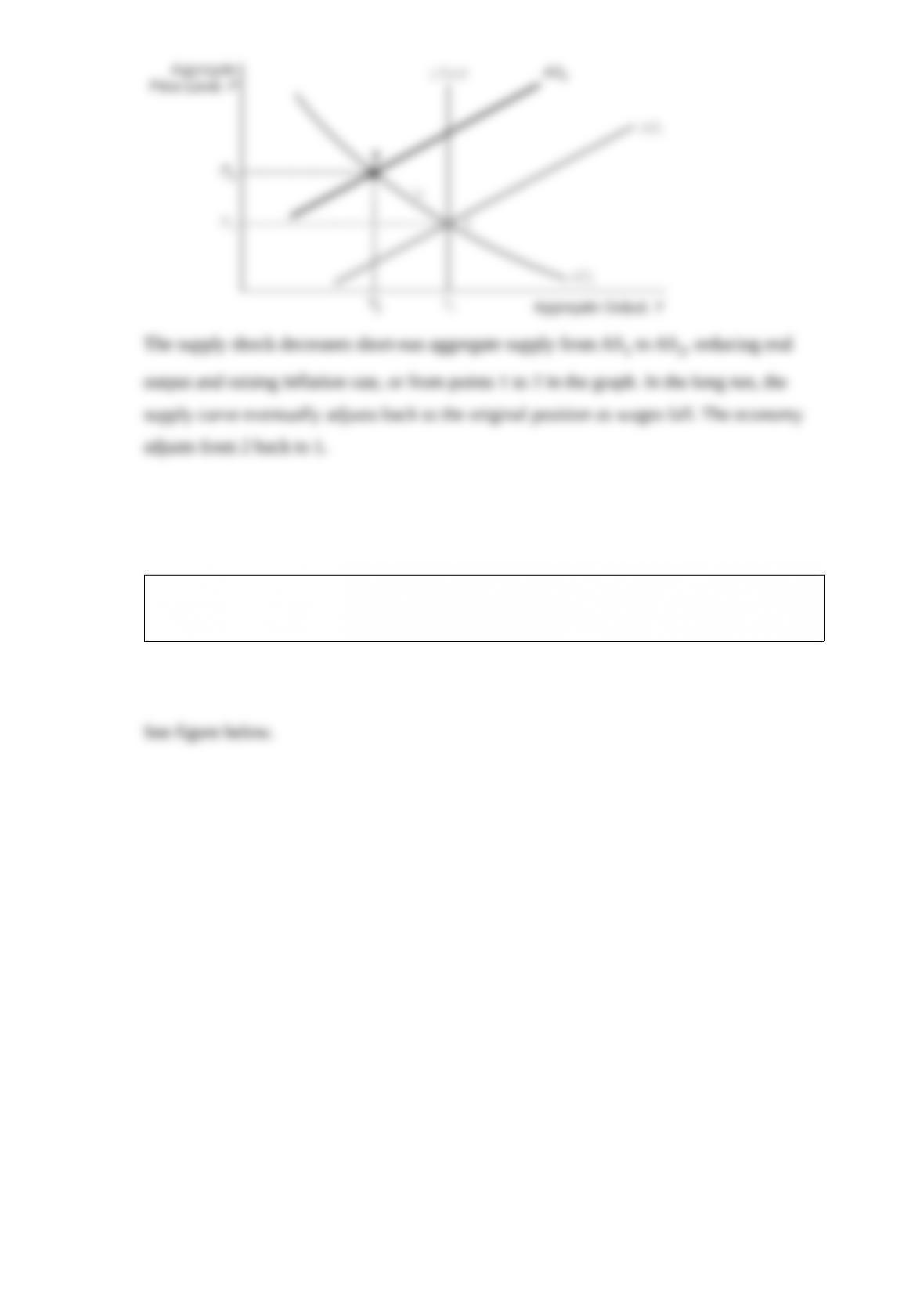
Explain and demonstrate graphically the effects of a negative supply shock in both the
short-run and long-run.
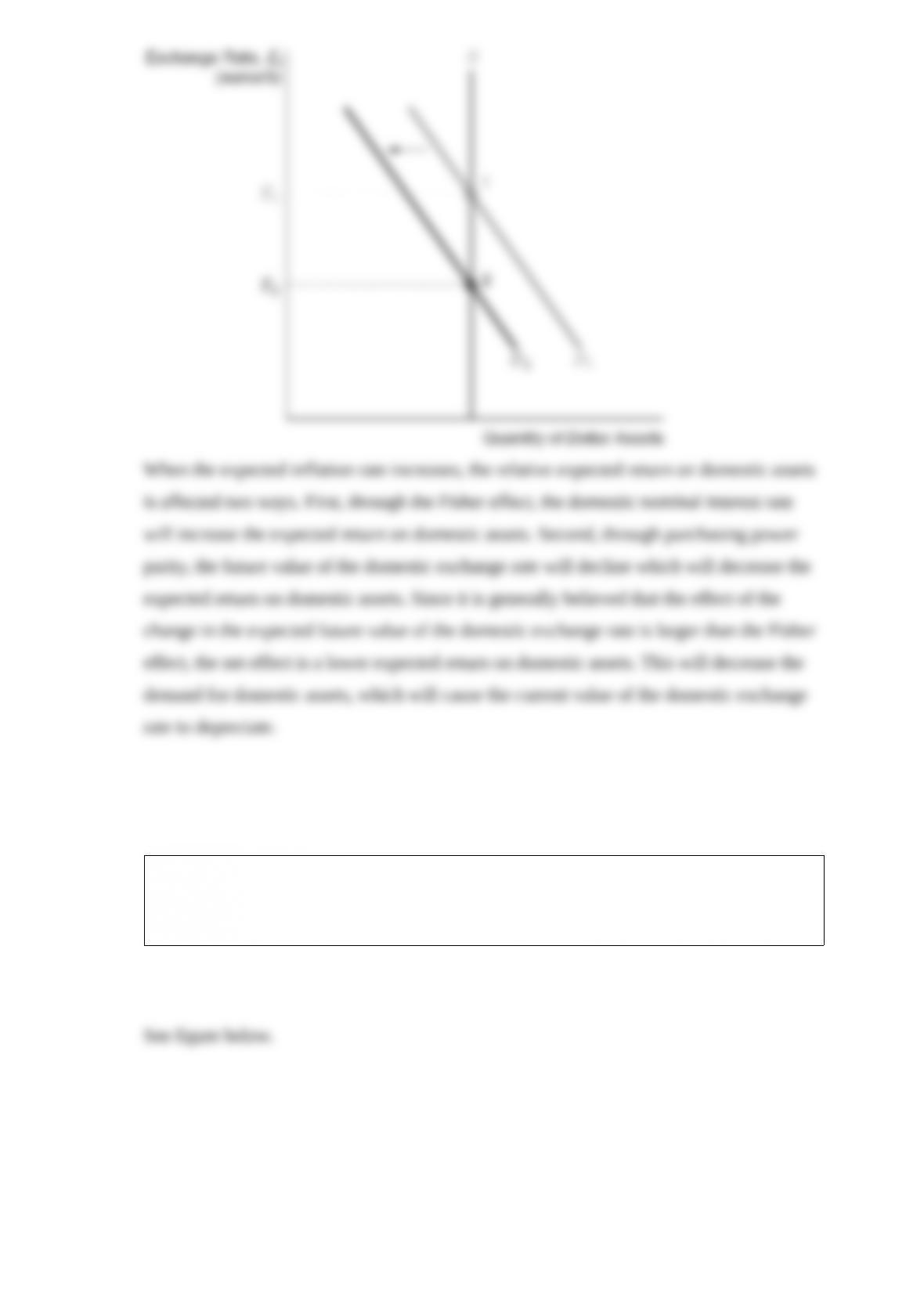
Explain and show graphically the effect of an increase in the expected inflation rate on
the equilibrium exchange rate, everything else held constant.
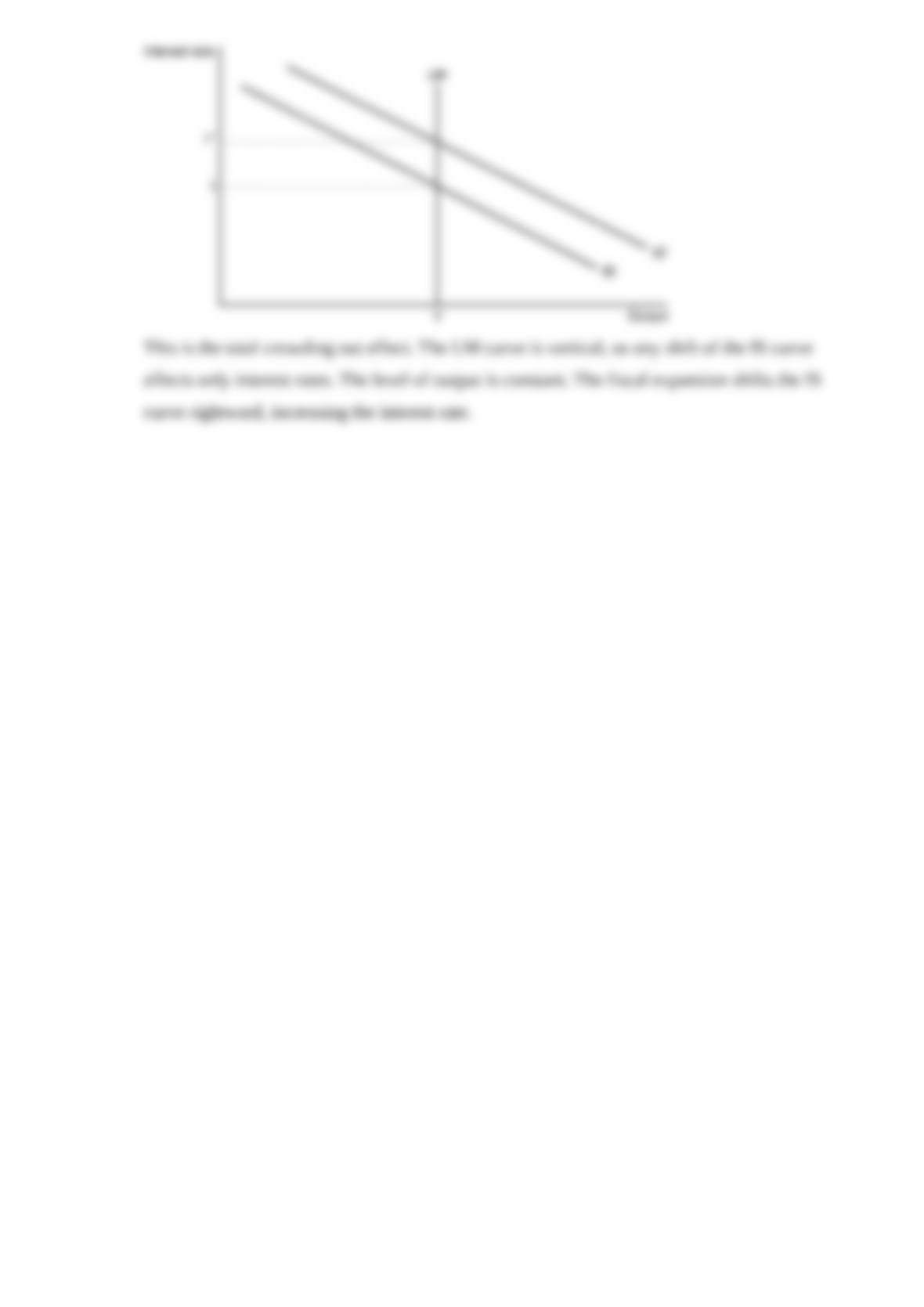
Using the ISLM model, explain and show graphically the effect of a fiscal expansion
when the demand for money is completely insensitive to changes in the interest rate.
What is this effect called?