
Inflation targeting refers to conducting ________ policy so as to commit the central
bank to achieving a ________.
A) fiscal; publicly announced level of inflation
B) fiscal; zero inflation rate
C) monetary; publicly announced level of inflation
D) monetary; zero inflation rate
Which of the following is a positive economic statement?
A) The standard of living in the United States is too low.
B) If the price of beef falls, a larger quantity of it will be bought.
C) The government should implement a national consumption tax.
D) The U.S. government should increase regulations on the banking industry.
What is regulatory capture?
A) It is a situation in which a policy maker seeks to improve his election prospects by
aligning himself with a powerful special interest group which will finance his political
campaign.
B) It is the exchange of political support between a regulatory agency and the regulated
firm resulting in both parties capturing economic rents.

C) It is a situation in which a firm being regulated successfully influences the
regulatory agency’s actions to benefit the interests of the firm, rather than the public
interest.
D) It is a situation in which a regulatory agency uses its authority to force actions that
are not favored by the regulated firms but are in the public’s interest.
An increase in the demand for American-made goods will
A) increase the supply of dollars on the foreign exchange market.
B) decrease the supply of dollars on the foreign exchange market.
C) increase the demand for dollars on the foreign exchange market.
D) decrease the demand for dollars on the foreign exchange market.
Which of the following would decrease net exports in the United States?
A) An American party planner purchases 350 pi±atas from Mexico.
B) The government of Mexico purchases 2,000 Dell laptop computers from the United
States.
C) A Mexican citizen purchases 100 shares of stock in IBM.
D) The U.S. government donates $25 million to Mexico to help victims of a hurricane
in Mexico.
Ethan Nicholas, who developed the iShoot application for the iPhone 3G, found that to
maintain sales in a profitable competitive market, the price of a product
A) will usually rise.
B) will usually fall.
C) will usually remain stable.
D) will eventually fall to zero.
Assume a firm is able to use an optimal two-part tariff.
a. Is the outcome economically efficient? Why or why not?
b. What happens to consumer surplus?
c. Does this represent perfect price discrimination? Why or why not?
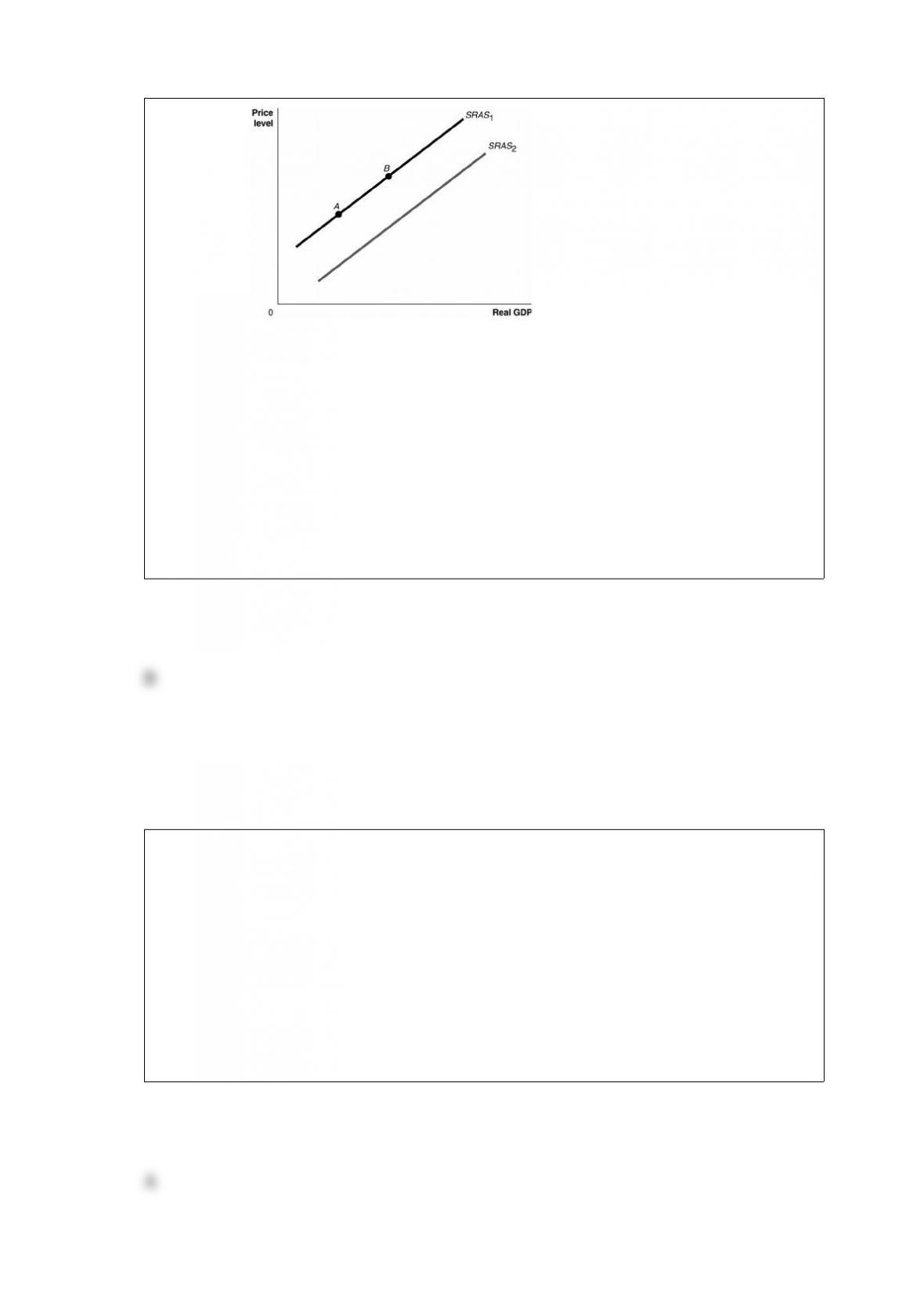
Figure 24-2
Ceteris paribus, a decrease in the labor force would be represented by a movement
from
A) SRAS1 to SRAS2.
B) SRAS2 to SRAS1.
C) point A to point B.
D) point B to point A.
Which of the following explains the ability of the U.S. economy to avoid diminishing
marginal returns and experience accelerating growth in the early to mid-20th century?
A) continuing technological change
B) immigration
C) additions of a greater amount of capital of the same quality
D) a decrease in the quality of labor
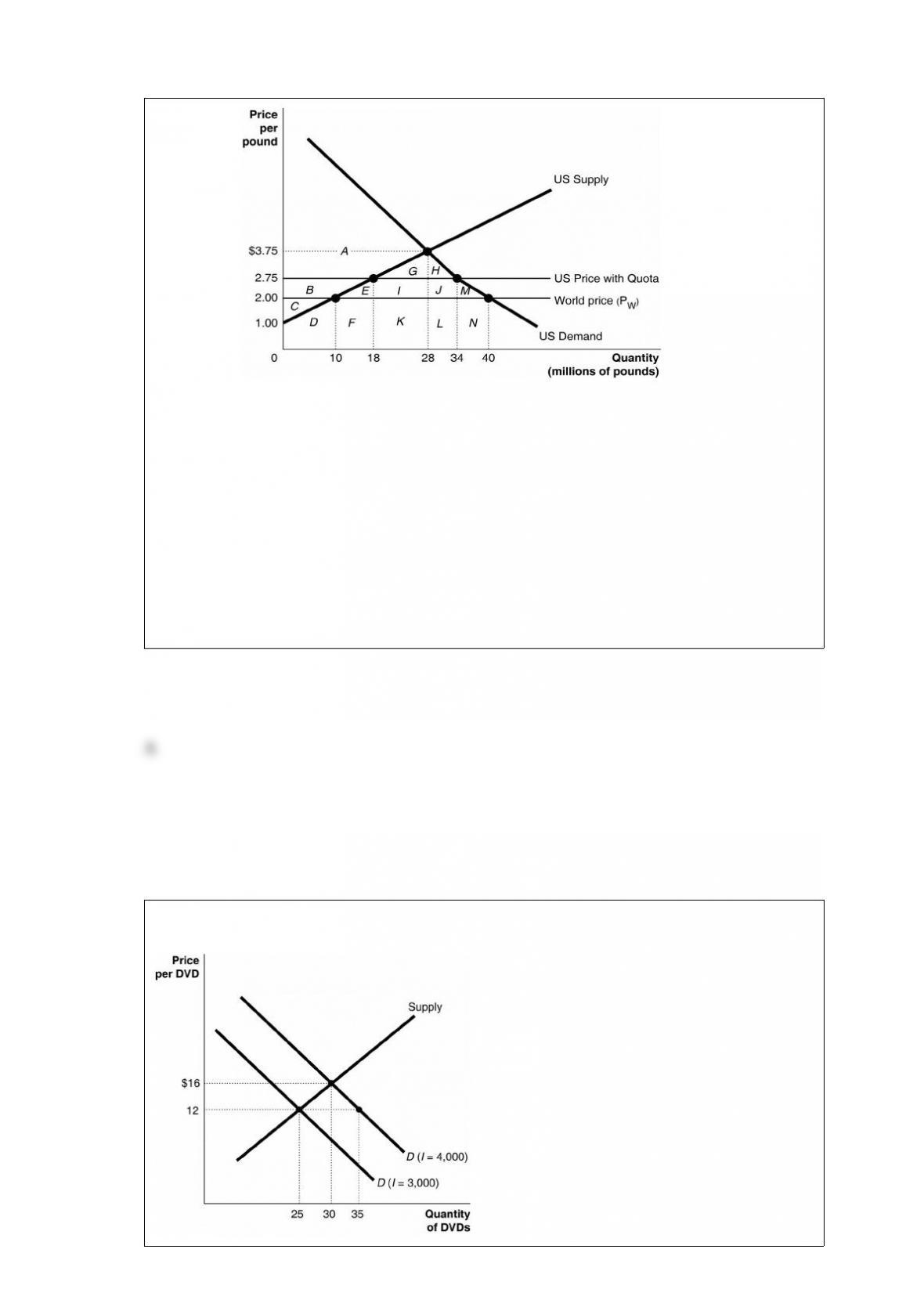
Figure 9-3 Since 1953 the
United States has imposed a quota to limit the imports of peanuts. Figure 9-3 illustrates
the impact of the quota. If there was no quota, how many pounds of peanuts would
domestic producers supply?
A) 10 million
B) 28 million
C) 30 million
D) 40 million
Figure 6-9

The data in the diagram indicates that DVDs are
A) luxury goods.
B) inelastic goods.
C) necessities.
D) both luxury goods and inelastic goods.
E) both necessities and inelastic goods.
Anything owed by a person or a firm is
A) an asset.
B) a liability.
C) a bond.
D) equity.
Merger guidelines developed by the U.S. Department of Justice and the Federal Trade
Commission use the Herfindahl-Hirschman Index as a measure of concentration. This
index measures concentration in an industry by
A) adding up the market shares of all firms in the industry, squaring this number and
then dividing by the number of firms in the industry.
B) squaring the market shares of each firm in an industry and then adding up the values
of the squares.
C) squaring the four-firm concentration ratio of the industry and dividing this number
by the total number of firms in the industry.
D) determining the market shares of the four largest firms in the industry, but unlike the
concentration ratio, the Index includes sales in the United States by foreign firms.
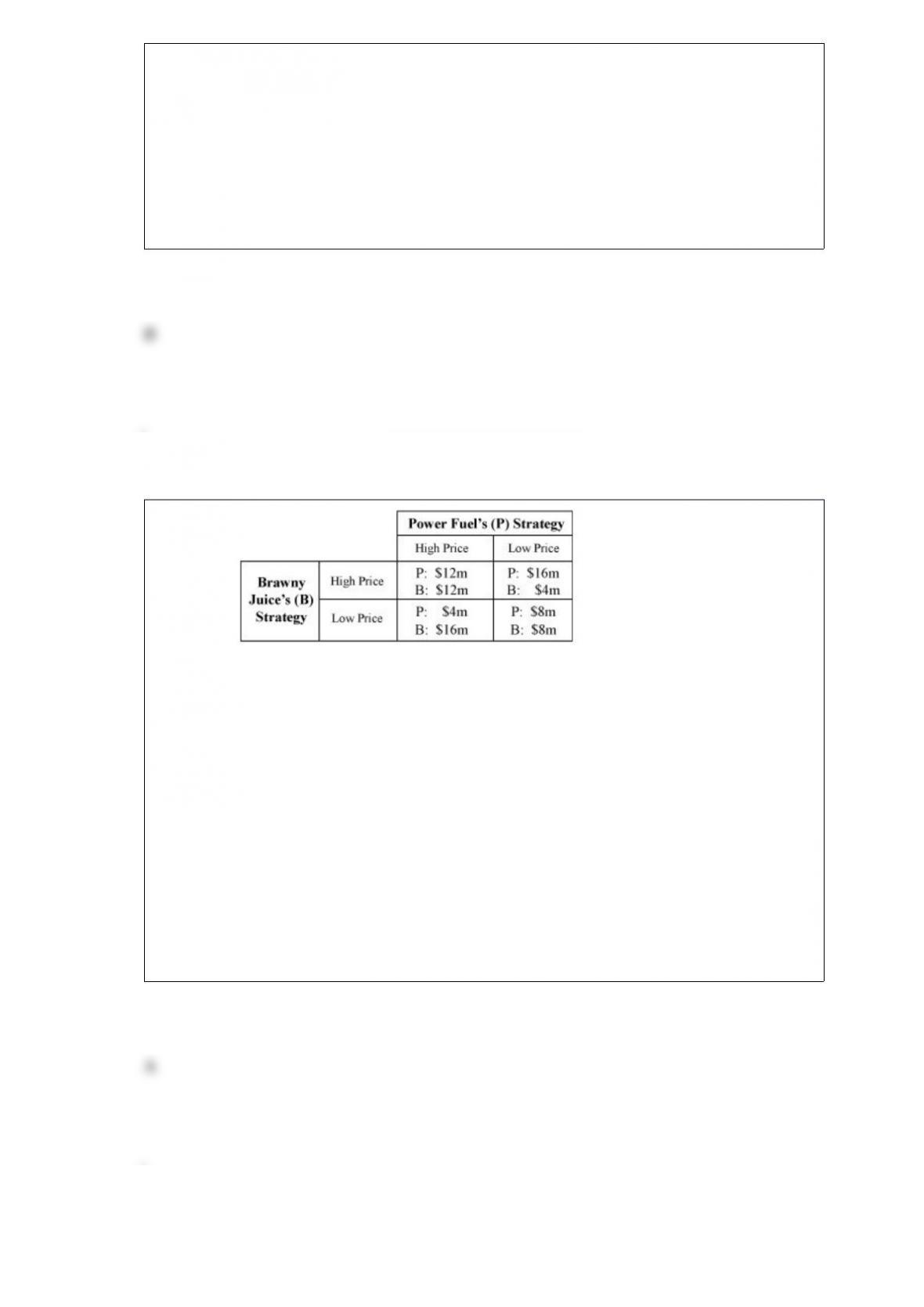
Table 14-8 Two rival oligopolists in the
athletic supplements industry, the Power Fuel Company and the Brawny Juice
Company, have to decide on their pricing strategy. Each can choose either a high price
or a low price. Table 14-8 shows the payoff matrix with the profits that each firm can
expect to earn depending on the pricing strategy it adopts.
Which of the following is true?
A) Power Fuel’s dominant strategy is to select a low price.
B) Brawny Juice’s dominant strategy is to select a high price.
C) Power Fuel does not have a dominant strategy.
D) Brawny Juice does not have a dominant strategy.

If a restaurant were a natural monopoly, its
A) marginal cost curve would still be declining when it crossed the demand curve.
B) average total cost curve would still be declining when it crossed the demand curve.
C) marginal revenue curve would be the same as its demand curve.
D) marginal revenue curve would be horizontal.
Jenna runs a small boutique in Capitola. She tells one of her suppliers that she is willing
to pay $6 for a pair of wool hand warmers and not a dime more. On the basis of this
information, what can you conclude about her price elasticity of demand for wool hand
warmers?
A) It is elastic.
B) It is perfectly elastic.
C) It is perfectly inelastic.
D) The price elasticity coefficient is 0.
Consider a situation in which a utility company emits high levels of sulfur dioxide and
the company is not liable for the damages its pollution causes. According to the Coase
theorem, government action is ________ to achieve an ________ amount of pollution.
A) necessary; equitable
B) necessary; efficient

C) not necessary; equitable
D) not necessary; efficient
If, as a person consumes more and more of a good, each additional unit adds less
satisfaction than the previous unit consumed, we are seeing the workings of
A) the law of demand.
B) the law of supply.
C) the law of increasing marginal opportunity cost.
D) the law of diminishing marginal utility.
When individuals use all available information about an economic variable to make a
decision, expectations are
A) underestimates of reality.
B) accurate.
C) rational.
D) overestimates of reality.