
The proportion of the tax burden that falls on consumers depends on:
A) the price elasticity of demand.
B) the size of the tax.
C) the price elasticity of supply.
D) both A and C
A study done about gender gaps identified some factors that could contribute to gender
gaps. Which of the following is NOT a factor?
A) difference in worker skills and productivity
B) difference in occupational preference
C) duration of unemployment
D) occupational discrimination
When deciding to implement a congestion tax, economists and the government would
use the elements of the economic way of thinking to primarily determine:
A) if the tax would be allocated equitably.
B) what tax amount should be charged.

C) who should be exempt from the tax.
D) how much revenue will the tax generate.
Under which conditions might economies of scale result?
A) hampered coordination brought about by bureaucracy
B) increasing costs of inputs
C) increasing output prices
D) workers having to spend less time switching back and forth between tasks.
A firm announces that in order to purchase a CD player, its customers must also
purchase 10 CDs. This is an example of:
A) a tie-in sale.
B) monopoly pricing.
C) price discrimination.
D) predatory pricing.
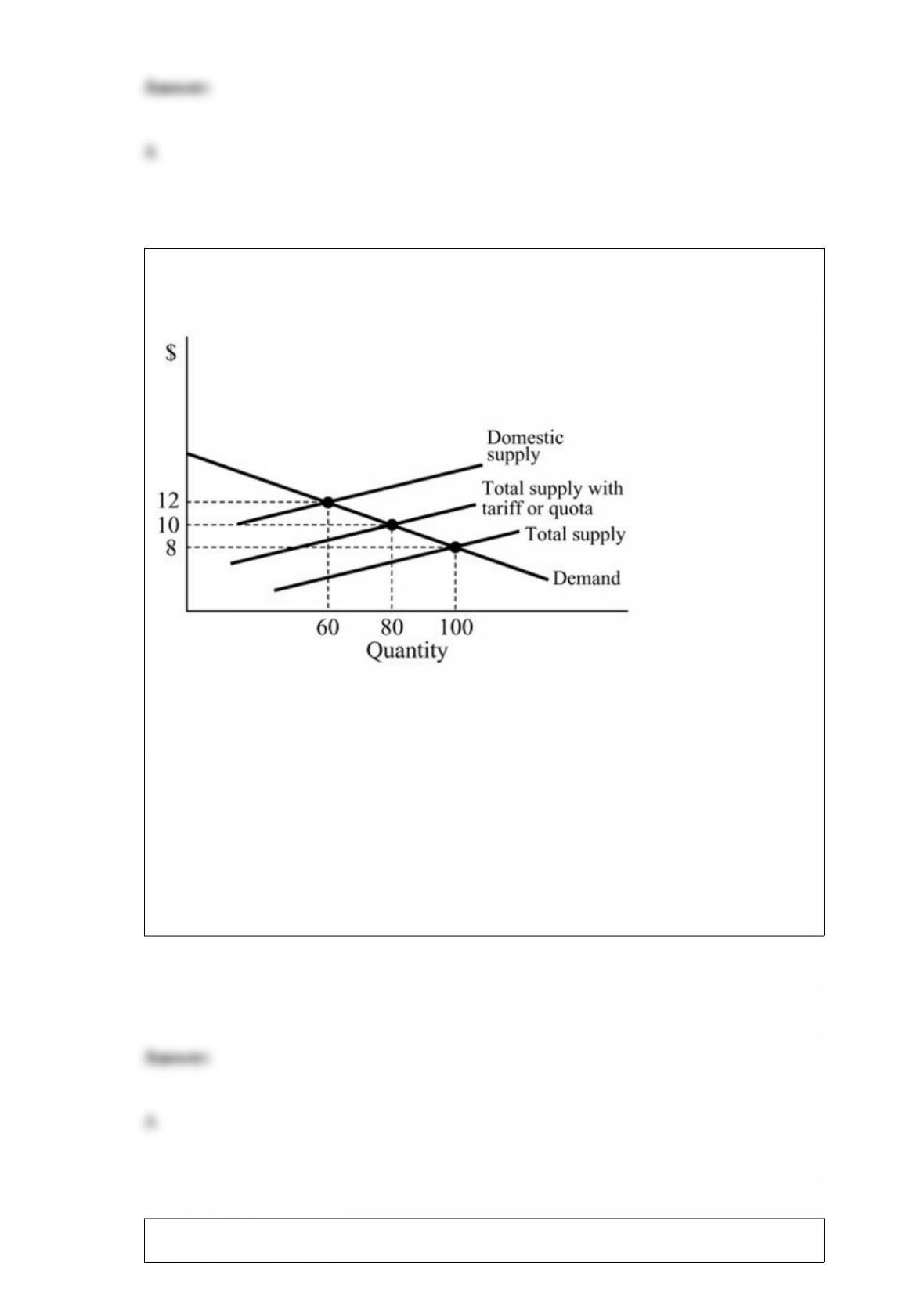
Figure 18.3
Refer to Figure 18.3. With a tariff or quota, the equilibrium quantity is:
A) 80.
B) 100.
C) 60.
D) 40.
Consider four types of markets: monopoly, perfect competition, oligopoly, and

monopolistic competition. If they were ranked from the lowest number of firms to the
largest number of firms the ranking would be:
A) monopoly, oligopoly, monopolistic competition, perfect competition.
B) oligopoly, monopoly, monopolistic competition, perfect competition.
C) monopoly, monopolistic competition, oligopoly, perfect competition.
D) perfect competition, oligopoly, monopoly, monopolistic competition.
Assume that the Indian restaurant industry is monopolistically competitive in London.
Garam Masala, an Indian restaurant near Piccadilly Circus, lowers its prices by 10%,
but all the other Indian restaurants in London keep their prices unchanged. Which of the
following is most likely to occur?
A) Garam Masala will not be able to sell any bagels since it was the only bakery to
raise its price.
B) Garam Masala will lose some of its customers.
C) Garam Masala’s profits will increase.
D) The number of customers served by Garam Masala will increase.
A monopoly may arise due to:
A) a patent.
B) net work externalities.
C) large economies of scale.
D) all of the above
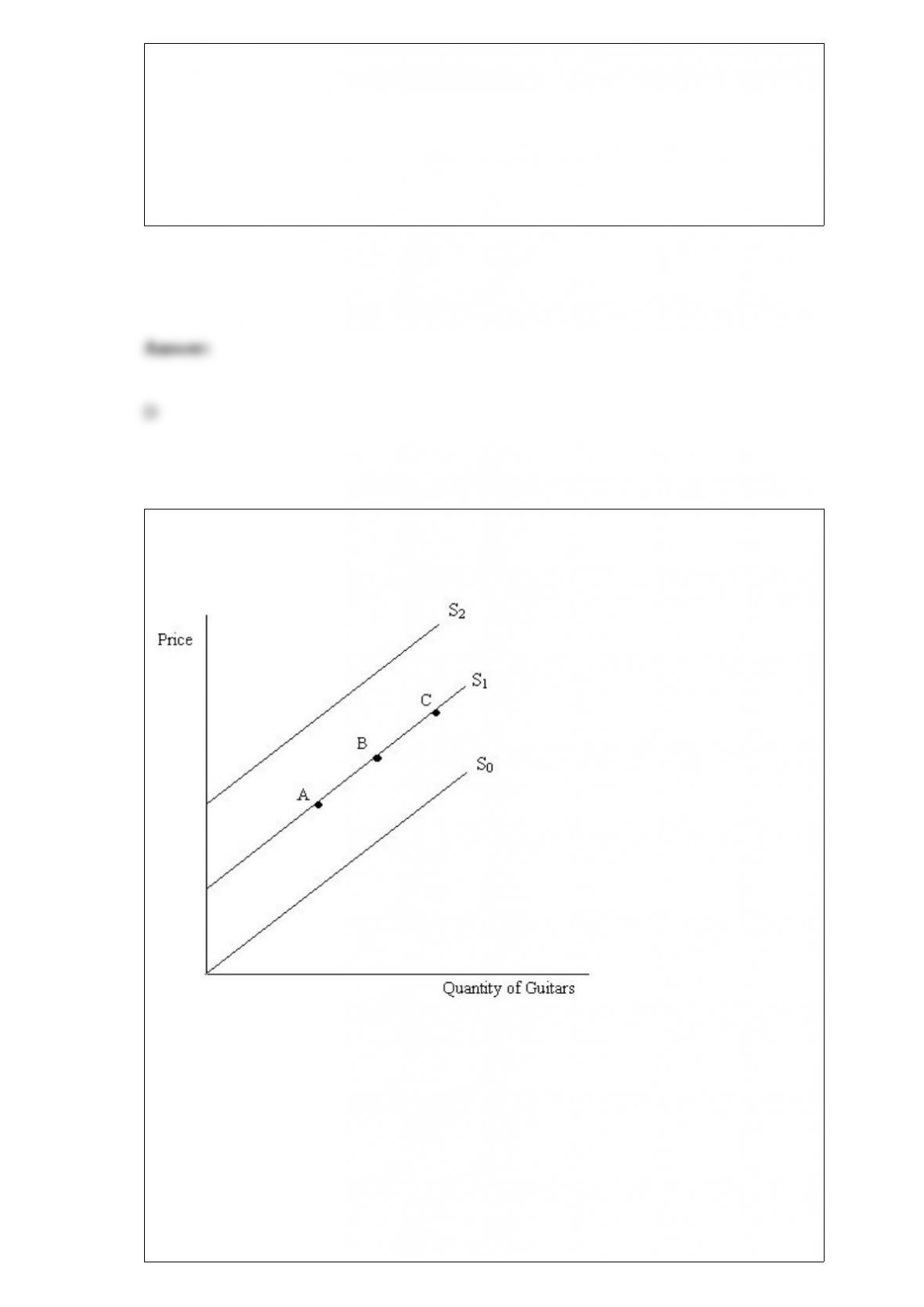
Figure 4.5 illustrates the supply of guitars. If firms expect the price of guitars to go up
after Christmas, then before Christmas this would most likely cause a movement from:
Figure 4.5
A) point B to point C.
B) point B to point A.
C) S1 to S0.
D) S1 to S2.

A firm can effectively practice price discrimination and increase profit if:
A) the marginal cost of production in each market is different.
B) the average cost of production in each market is different.
C) the price elasticity of demand in each market is different.
D) the product can be produced in two different factories.
Which of the following situations describes a short-run adjustment of a firm to
changing business conditions?
A) A doctor increases the size of his waiting room.
B) A manager calls in two part-time workers to prepare for the holiday rush.
C) A rancher sells some of his land.
D) A manufacturing firm expands its production facility.
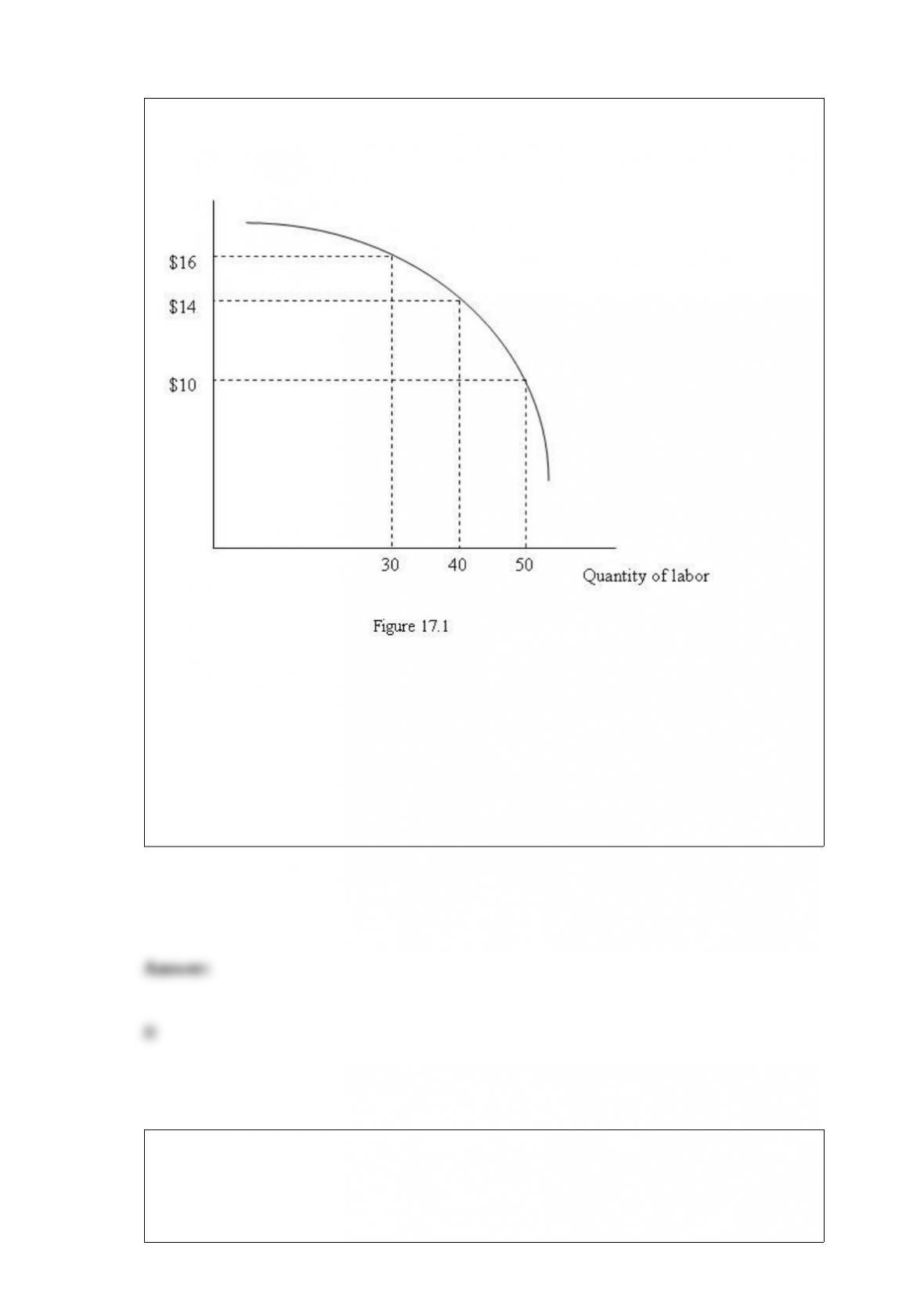
Figure 17.1 depicts a firm’s marginal revenue product curve. If the product price
increases, the marginal revenue product curve:
A) shifts downward.
B) shifts upward.
C) remains the same.
D) none of the above
The Act which outlawed asset-purchase mergers that would substantially reduce
competition was the:
A) Sherman Act.

B) Clayton Act.
C) Robinson-Patman Act.
D) Celler-Kefauver Act.
Suppose that the wage for musicians decreases relative to other occupations. We know
that ________ people will work in music, and the total number of hours worked will
________.
A) more; increase
B) more; decrease
C) fewer; increase
D) fewer; decrease
If the production possibilities curve is drawn as a straight line it means that:
A) the tradeoff between the two goods is increasing.
B) the tradeoff between the two goods is decreasing.
C) the tradeoff between the two goods is constant.

D) no tradeoff is possible between the two goods.
Among the external costs associated with automobiles is:
A) congestion costs.
B) pollution.
C) third party costs associated with automobile accidents.
D) all of the above.
If there are a large number of firms, each of which is so small it takes the market price
as given, then the market is characterized by:
A) informed buyers and sellers.
B) perfect competition.
C) no externalities.
D) efficiency.
Which of the following government agencies is responsible for initiating actions against
individuals or firms that are suspected of violating antitrust laws?
A) the Federal Trade Commission
B) the Consumer Protection Agency
C) the Department of Justice
D) both A and C
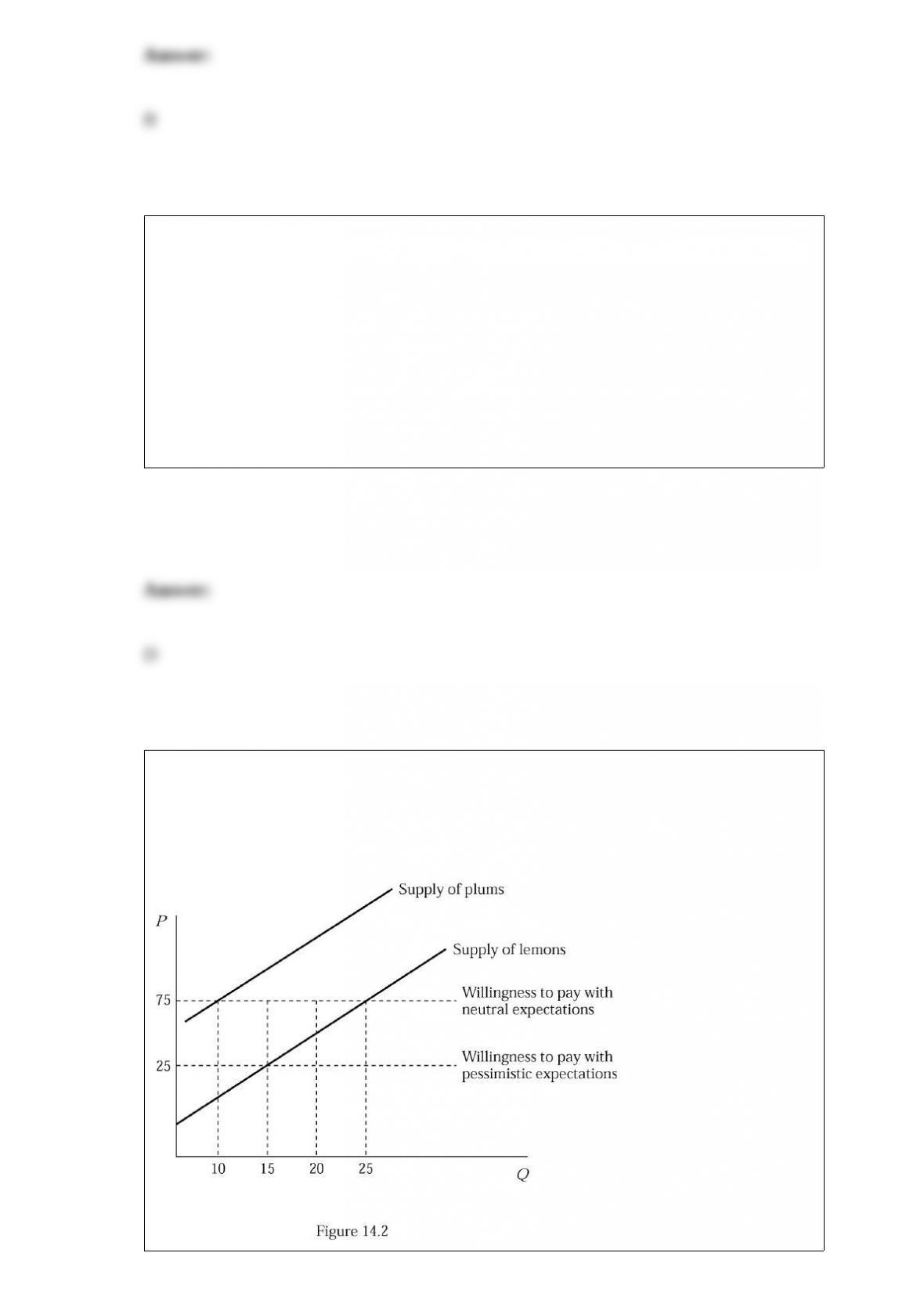
Figure 14.2 represents the market for used cameras. Suppose buyers are willing to pay
$125 for a plum (high-quality) used camera and $25 for a lemon (low-quality) used
camera. If buyers believe that 50% of used cameras in the market are lemons (low
quality), how many lemons (low quality) will be supplied by sellers?
A) 10
B) 15
C) 20
D) 25
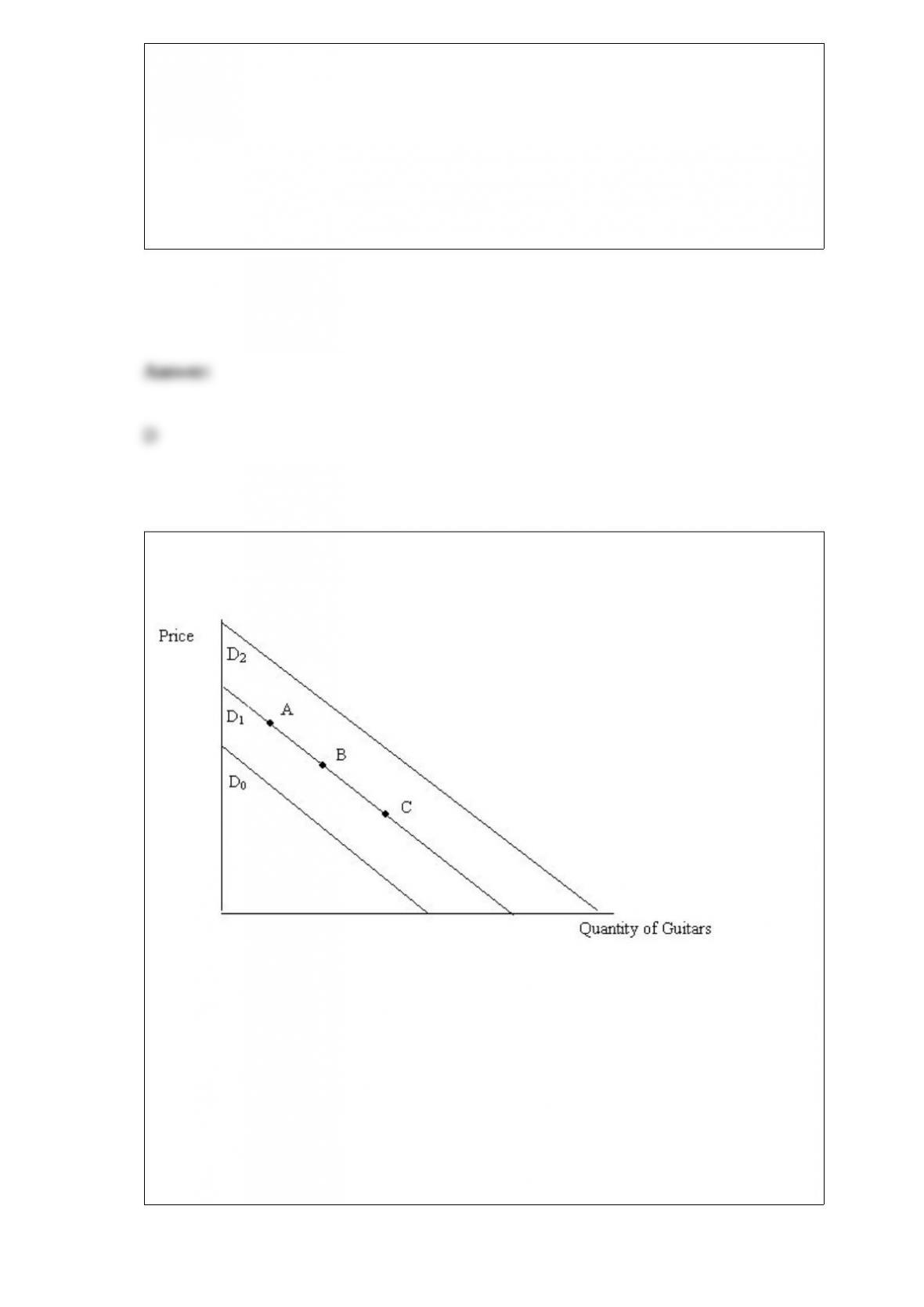
Figure 4.4 illustrates the demand for guitars. A decrease in the demand for guitars is
represented by the movement from:
Figure 4.4
A) point B to point C.
B) point B to point A.
C) D1 to D0.
D) D1 to D2.

If demand is perfectly inelastic, the price elasticity of demand is equal to:
A) 1.
B) 0.
C) infinity.
D) a negative number between 0 and infinity.
Under the Temporary Aid to Needy Families, work activities are defined to include:
A) vocational training.
B) community service.
C) on-the-job training.
D) all of the above

For country A, an import is a good produced in:
A) country B and purchased by residents of country B.
B) country B and purchased by residents of country A.
C) country A and purchased by residents of country B.
D) country A and purchased by residents of country A.
Specialization and trade exploit differences in productivity across workers and:
A) only benefit the exporter.
B) only benefit the importer.
C) make everyone better off.
D) make everyone worse off.
Lenny buys less oatmeal for breakfast when his income rises. This means that, for
Lenny:
A) oatmeal is an normal good.
B) the income elasticity of demand for oatmeal is positive.

C) the income elasticity of demand for oatmeal is negative.
D) A and C are correct.
The demand curve facing a monopolistically competitive firm is:
A) horizontal at the going market price.
B) downward sloping and less than the market demand curve.
C) downward sloping and greater than the market demand curve.
D) the same as the market demand curve.
Figure 8.2 presents a firm’s marginal, average total, average fixed, and average variable
cost curves. The firm minimizes average total costs by producing ________ units.
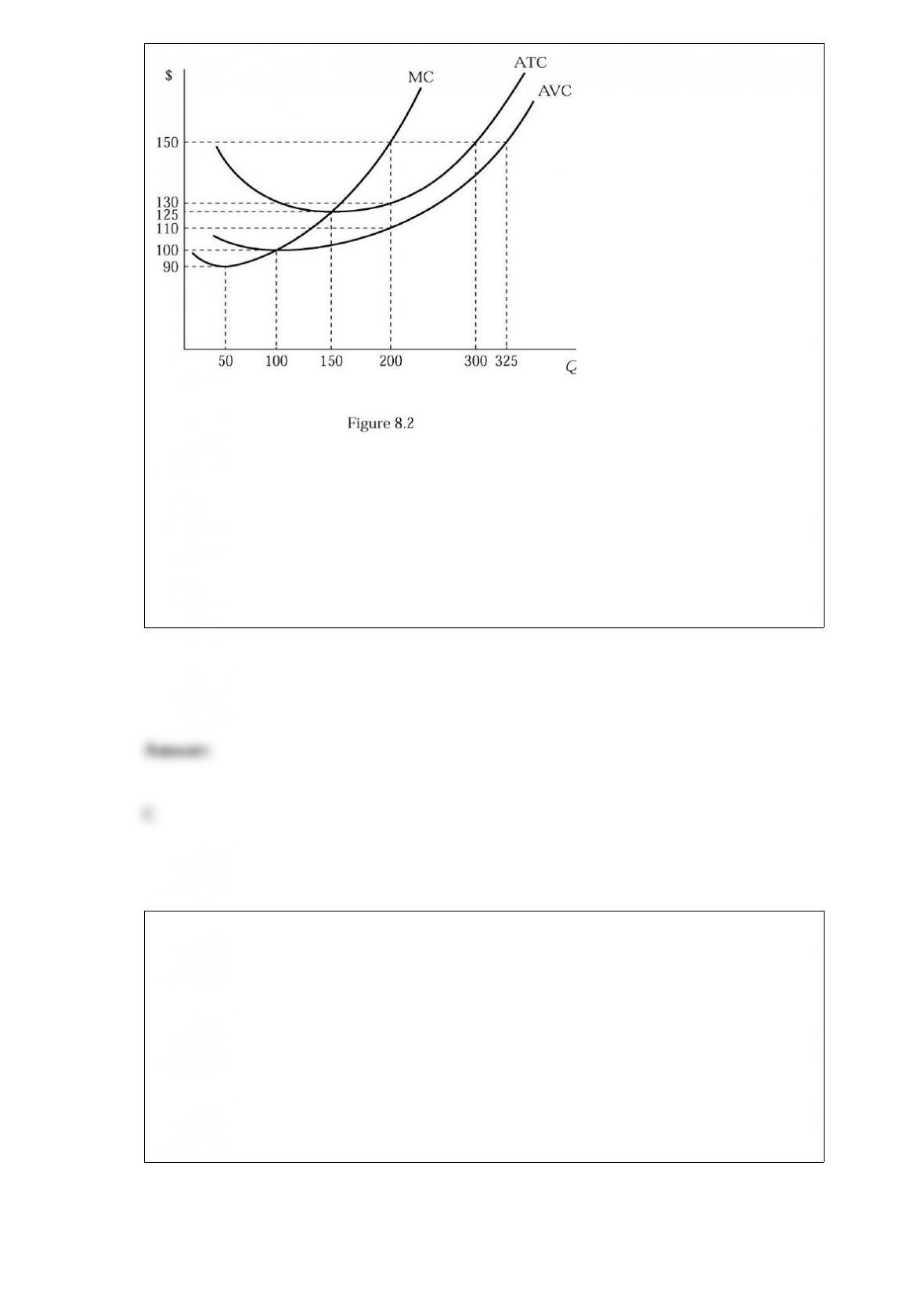
A) 50
B) 100
C) 150
D) 200
In most cases pollution taxes are more efficient than command-and-control policies at
achieving a desired reduction in the level of pollution because:
A) they can reduce the level of pollution at a lower cost to society.
B) the market price and quantity are not affected.
C) they make the firm pay for the pollution that they generate.
D) all of the above.
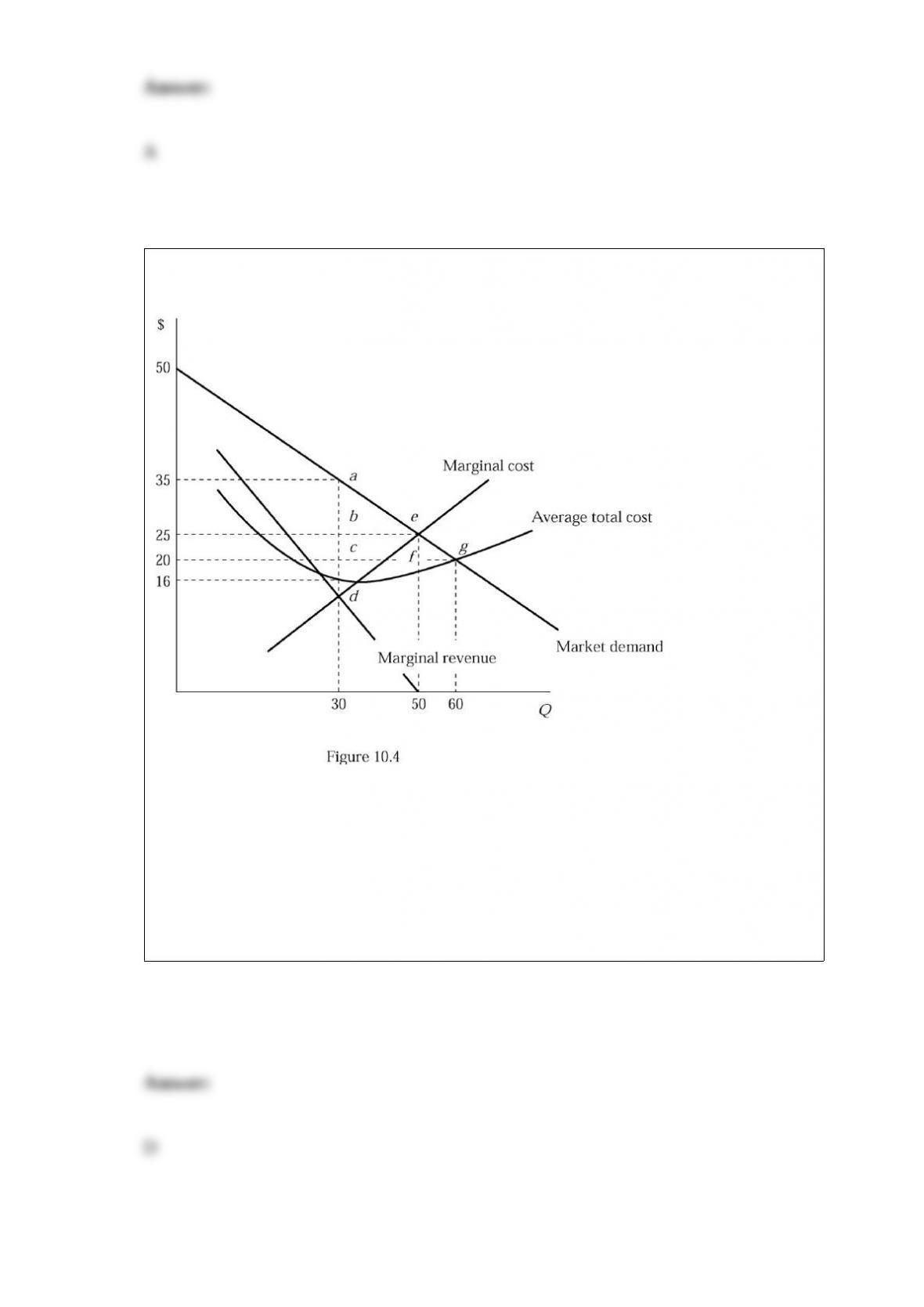
Refer to Figure 10.4. If the market was a monopoly, the consumer surplus would be:
A) $625.
B) $450.
C) $300
D) $225.
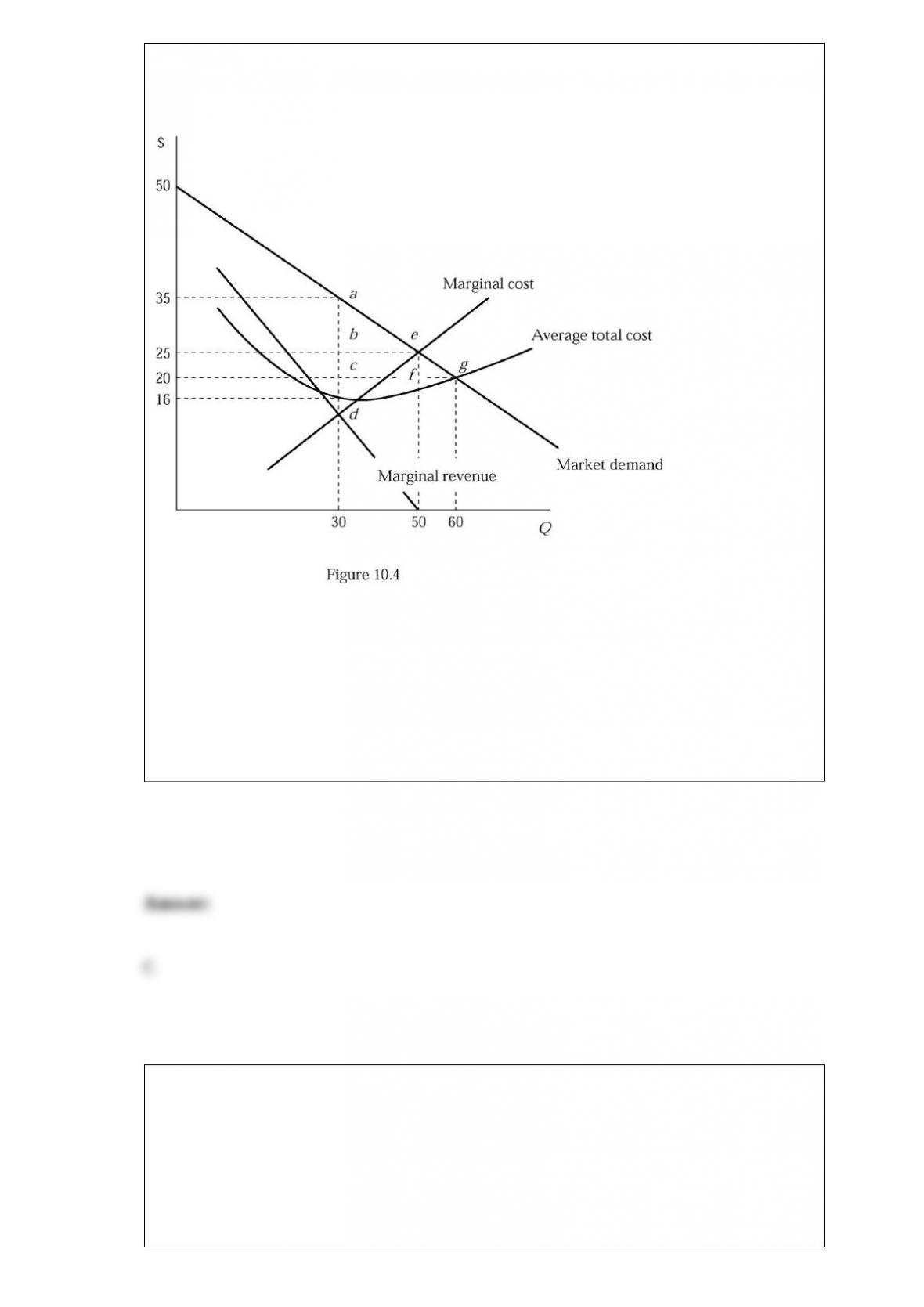
Refer to Figure 10.4. The deadweight loss associated with the monopoly would be
represented by the area:
A) △abe.
B) △ace.
C) △ade.
D) △efg.
When there is imperfect competition, the role of the government is to:
A) take over production.
B) tell the firms how much to produce.
C) foster competition.
D) all of the above
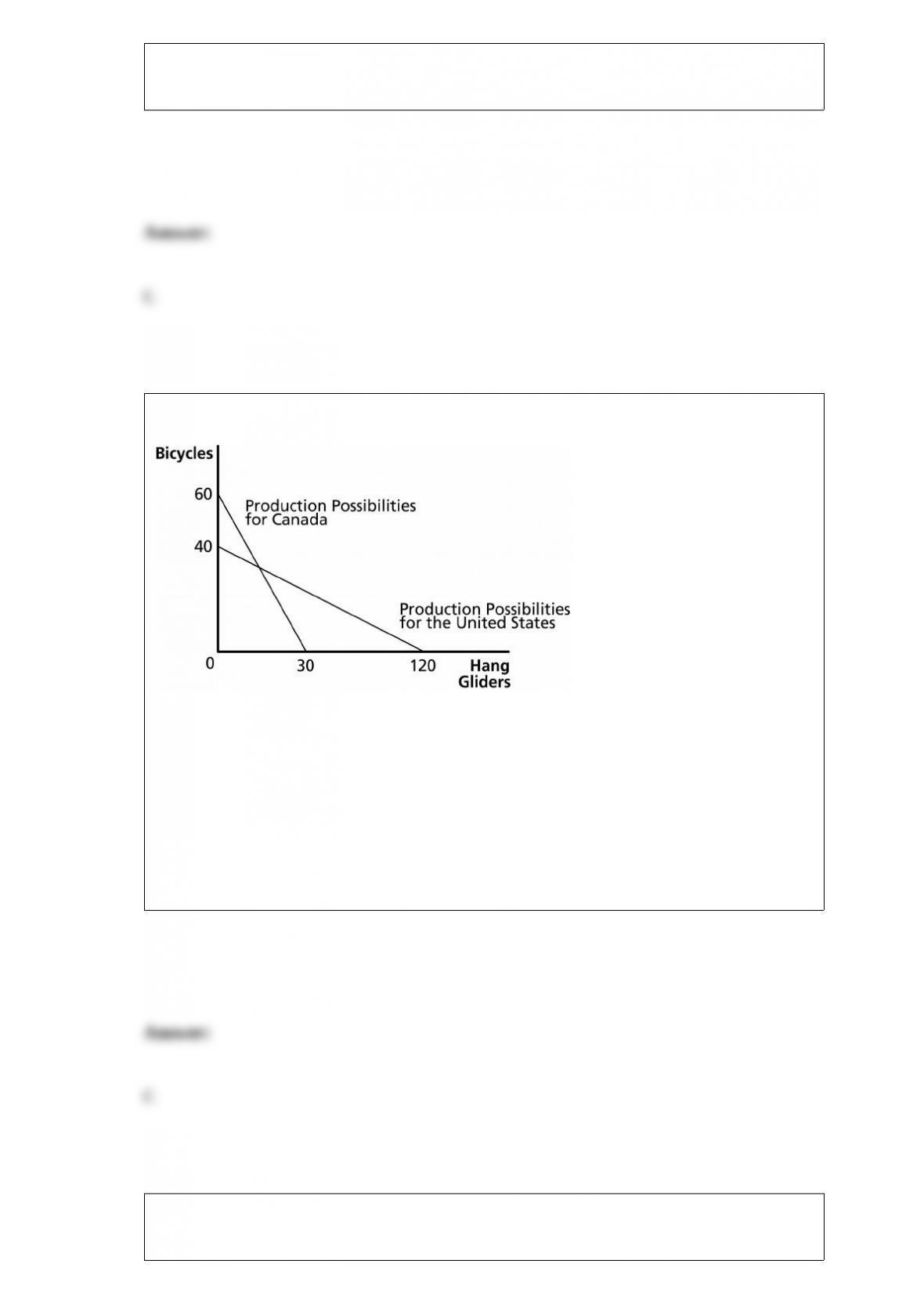
Refer to Figure 18.1. The opportunity cost of hang gliders in Canada is:
Figure 18.1
A) 1/4 of a bicycle.
B) 1/2 of a bicycle.
C) 2 bicycles.
D) 4 bicycles.
The additional cost resulting from a small increase in some activity is called the:

A) opportunity cost.
B) marginal benefit.
C) marginal cost.
D) diminishing returns of the activity.
Which of the following is NOT an example of the efforts to reduce the adverse selection
problem?
A) Sellers offer warranties.
B) Consumers invest in information.
C) Sellers offer money-back guarantees.
D) All of the above are examples of efforts to reduce adverse selection.