Identify the immediate effect of each of the following events on U.S. GDP and its
components.
a. James receives a Social Security check.
b. John buys an Italian sports car.
c. Henry buys domestically produced tools for his construction company.
National income is defined as
a. the total income of a nation’s permanent residents minus losses from depreciation.
b. the income that households and noncorporate businesses receive.
c. the total income earned by a nation’s permanent residents in the production of goods
and services.
d. the income that households and noncorporate businesses have left after satisfying all
their obligations to the government.

Other things the same, an increase in wages above their equilibrium level
a. increases frictional unemployment but leaves the natural rate of unemployment
unchanged.
b. increases frictional unemployment and increases the natural rate of unemployment.
c. increases structural unemployment but leaves the natural rate of unemployment
unchanged.
d. increases structural unemployment and increases the natural rate of unemployment.
Which of the following should be held constant when calculating an income elasticity
of demand?
a. the quantity of the good demanded
b. the price of the good
c. income
d. All of the above should be held constant.
The real exchange rate is the nominal exchange rate, defined as foreign currency per
dollar, times
a. U.S. prices minus foreign prices.

b. prices in the United States divided by foreign prices.
c. foreign prices divided by U.S. prices.
d. None of the above is correct.
Suppose the United States unexpectedly decided to pay off its debt by printing new
money. Which of the following would happen?
a. People who held money would feel poorer.
b. Prices would rise.
c. People who had lent money at a fixed interest rate would feel poorer.
d. All of the above are correct.
Suppose the economy is in long-run equilibrium. If there is a tax cut at the same time
that major new sources of oil are discovered in the country, then in the short-run
a. real GDP will rise and the price level might rise, fall, or stay the same.
b. real GDP will fall and the price level might rise, fall, or stay the same.
c. the price level will rise, and real GDP might rise, fall, or stay the same.
d. the price level will fall, and real GDP might rise, fall, or stay the same.
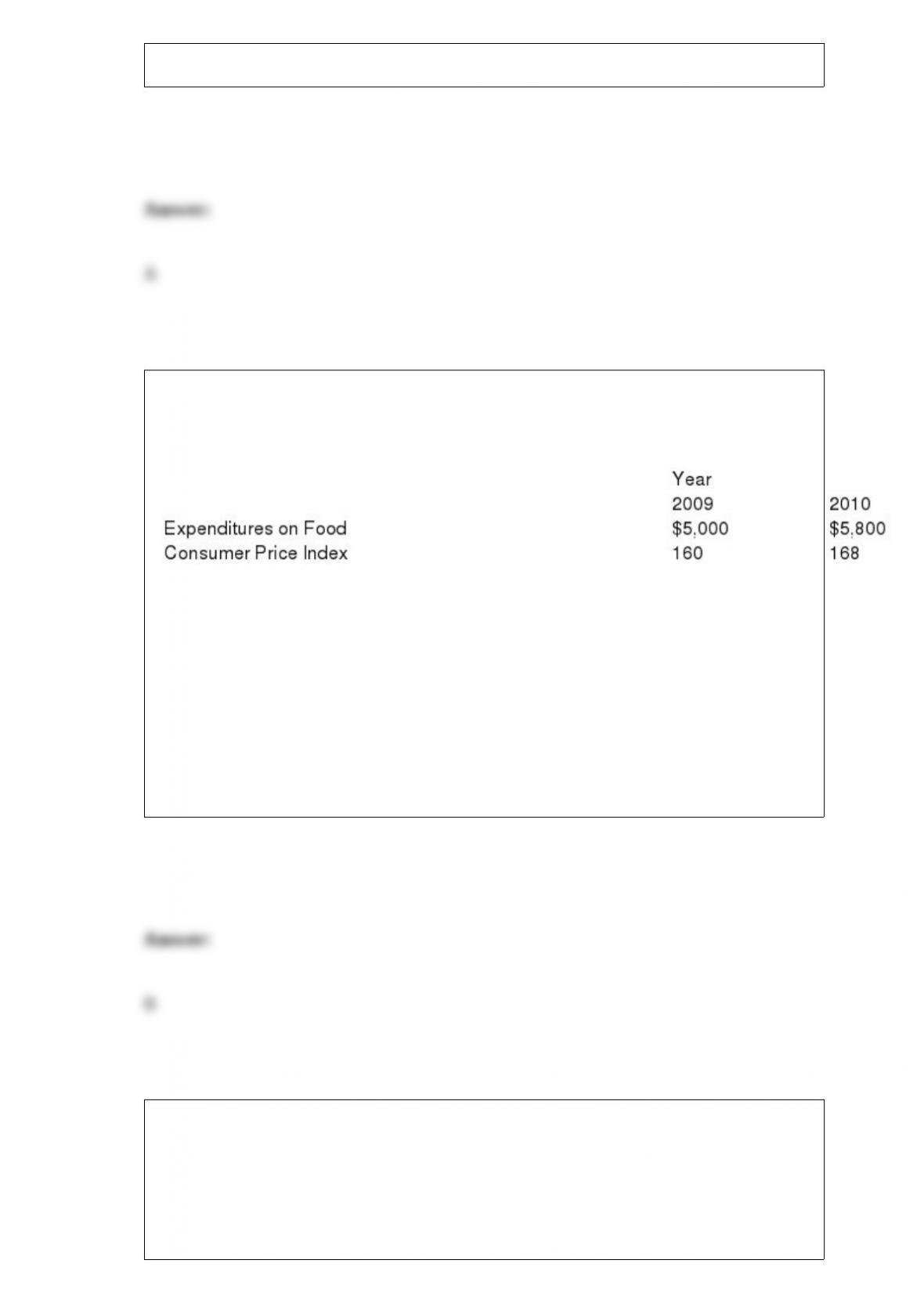
Table 11-12. Will’s expenditures on food for three consecutive years, along with other
values, are presented in the table below.
Refer to Table 11-12. Suppose Will’s 2009 food expenditures in 2011 dollars amount to
$5,670. Then
a. the consumer price index was 11.8 percent higher in 2011 than it was in 2009.
b. the inflation rate in 2011 was 8 percent.
c. Will’s 2011 food expenditures in 2009 dollars amount to $5,740.
d. Will’s 2010 food expenditures in 2011 dollars amount to $6,210.
A downward-sloping demand curve illustrates
a. that demand decreases over time.
b. that prices fall over time.

c. the relationship between income and quantity demanded.
d. the law of demand.
Domestic producers of a good become worse off, and domestic consumers of a good
become better off, when a country begins allowing international trade in that good and
a. the country becomes an importer of the good as a result.
b. the world price exceeds the domestic price of the good that prevailed before
international trade was allowed.
c. the country in question has a comparative advantage, relative to other countries, in
producing the good.
d. total surplus does not change as a result.
In 2002 mortgage rates fell and mortgage lending increased. Which of the following
could explain both of these changes?
a. The demand for loanable funds shifted rightward.
b. The demand for loanable funds shifted leftward.
c. The supply of loanable funds shifted rightward.
d. The supply of loanable funds shifted leftward.

When her income increased from $10,000 to $20,000, Heather’s consumption of
macaroni decreased from 10 pounds to 5 pounds and her consumption of soy-burgers
increased from 2 pounds to 4 pounds. We can conclude that for Heather, macaroni
a. and soy-burgers are both normal goods with income elasticities equal to 1.
b. is an inferior good and soy-burgers are normal goods; both have income elasticities
of 1.
c. is an inferior good with an income elasticity of -1 and soy-burgers are normal goods
with an income elasticity of 1.
d. and soy-burgers are both inferior goods with income elasticities equal to -1.
Suppose inflation is higher in the United States over the next six months than in foreign
countries. If exchange rates are given in terms of how much foreign currency a dollar
buys or how many foreign goods U.S. goods buy, then according to purchasing-power
parity we should expect to see
a. only the nominal exchange rate depreciate.
b. both the real and nominal exchange rate appreciate.
c. both the real and nominal exchange rate depreciate.
d. only the real exchange rate appreciate.
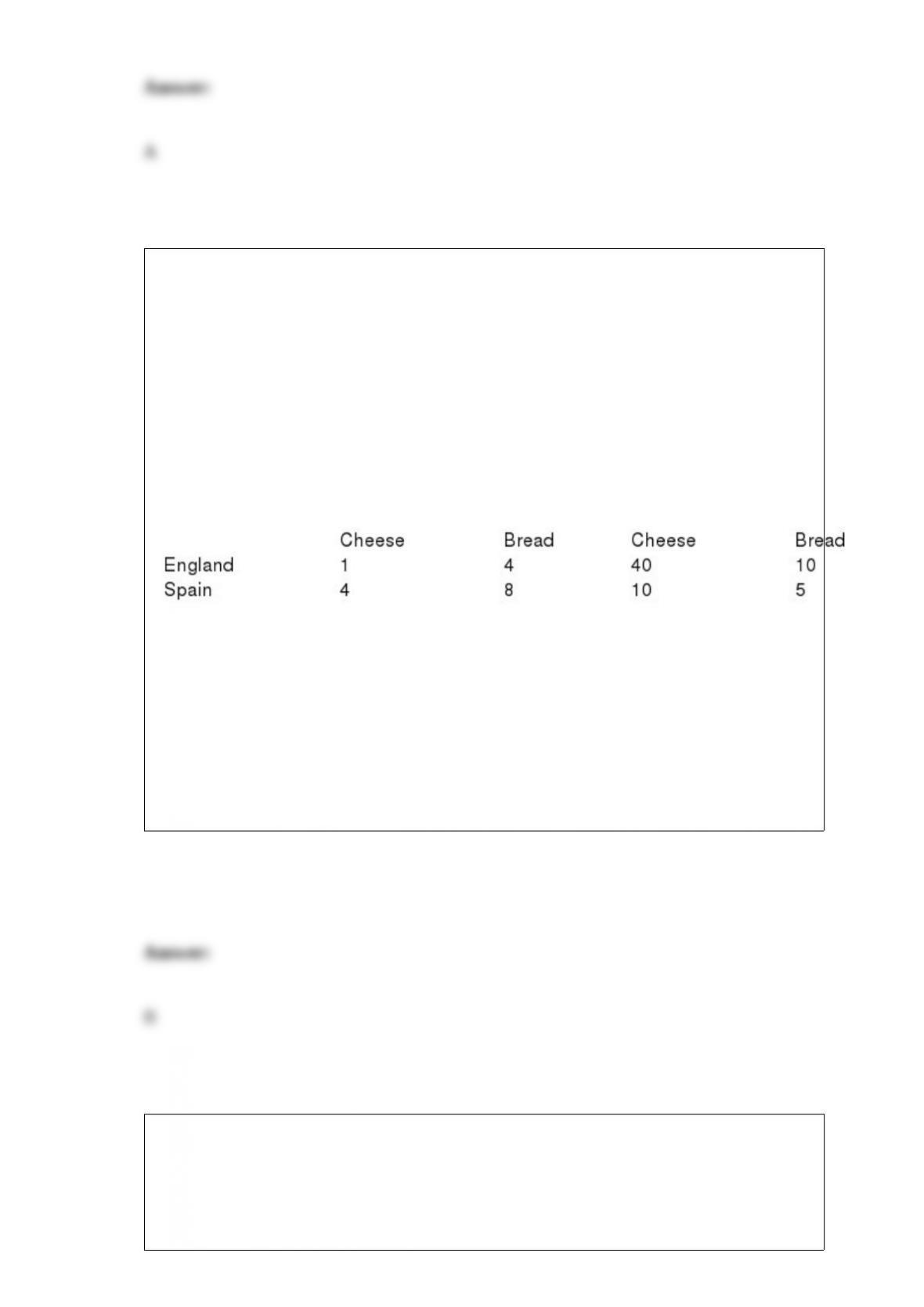
Table 3-5
Assume that England and Spain can switch between producing cheese and producing
bread at a constant rate.
Labor Hours Needed
to Make 1 Unit of Number of Units
Produced in 40 Hours
Refer to Table 3-5. Spain should export
a. cheese and import bread.
b. bread and import cheese.
c. both goods and import neither good.
d. neither good and import both goods.
If countries that imported goods and services from the United States went into
recession, we would expect that U.S. net exports would
a. rise, making aggregate demand shift right.

b. rise, making aggregate demand shift left.
c. fall, making aggregate demand shift right.
d. fall, making aggregate demand shift left.
In the economy of Ukzten in 2010, consumption was $1000, GDP was $1950,
government purchases were $500, and investment was $700. What were Ukzten’s net
exports in 2010?
a. -$250
b. $250
c. $2200
d. Net exports cannot be calculated from the information given.
Adam Smith’s book The Wealth of Nations was published in
a. 1692.
b. 1776.
c. 1816.
d. 1936.
As the price level rises
a. people will want to buy more bonds, so the interest rate rises.
b. people will want to buy fewer bonds, so the interest rate falls.
c. people will want to buy more bonds, so the interest rate falls.
d. people will want to buy fewer bonds, so the interest rate rises.
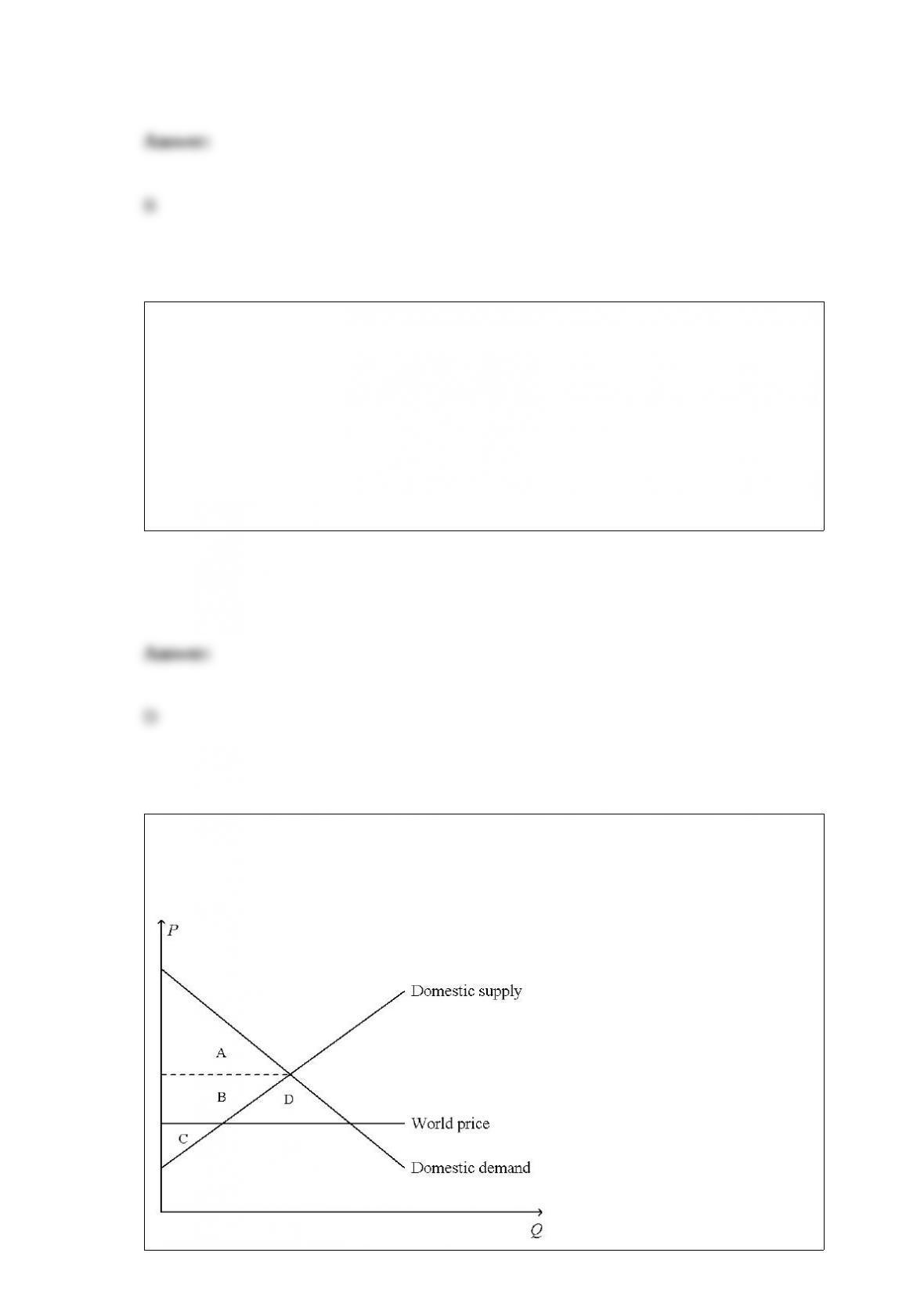
Figure 9-8. On the diagram below, Q represents the quantity of cars and P represents
the price of cars.

Refer to Figure 9-8. The country for which the figure is drawn
a. has a comparative advantage relative to other countries in the production of cars and
it will export cars.
b. has a comparative advantage relative to other countries in the production of cars and
it will import cars.
c. has a comparative disadvantage relative to other countries in the production of cars
and it will export cars.
d. has a comparative disadvantage relative to other countries in the production of cars
and it will import cars.
Nominal GDP measures
a. the total quantity of final goods and services produced.
b. the dollar value of the economy’s output of final goods and services.
c. the total income received from producing final goods and services measured in
constant dollars.
d. None of the above is correct.
Which of the following is correct?
a. Countries with the highest growth rates over the last 100 years are the ones that had
the highest level of real GDP 100 years ago.
b. Most countries have had little fluctuation around their average growth rates during
the past 100 years.
c. The ranking of countries by income changes substantially over time.
d. Over the last 100 years, Japan had the highest real GDP growth rate, and now has the
highest real GDP per person.
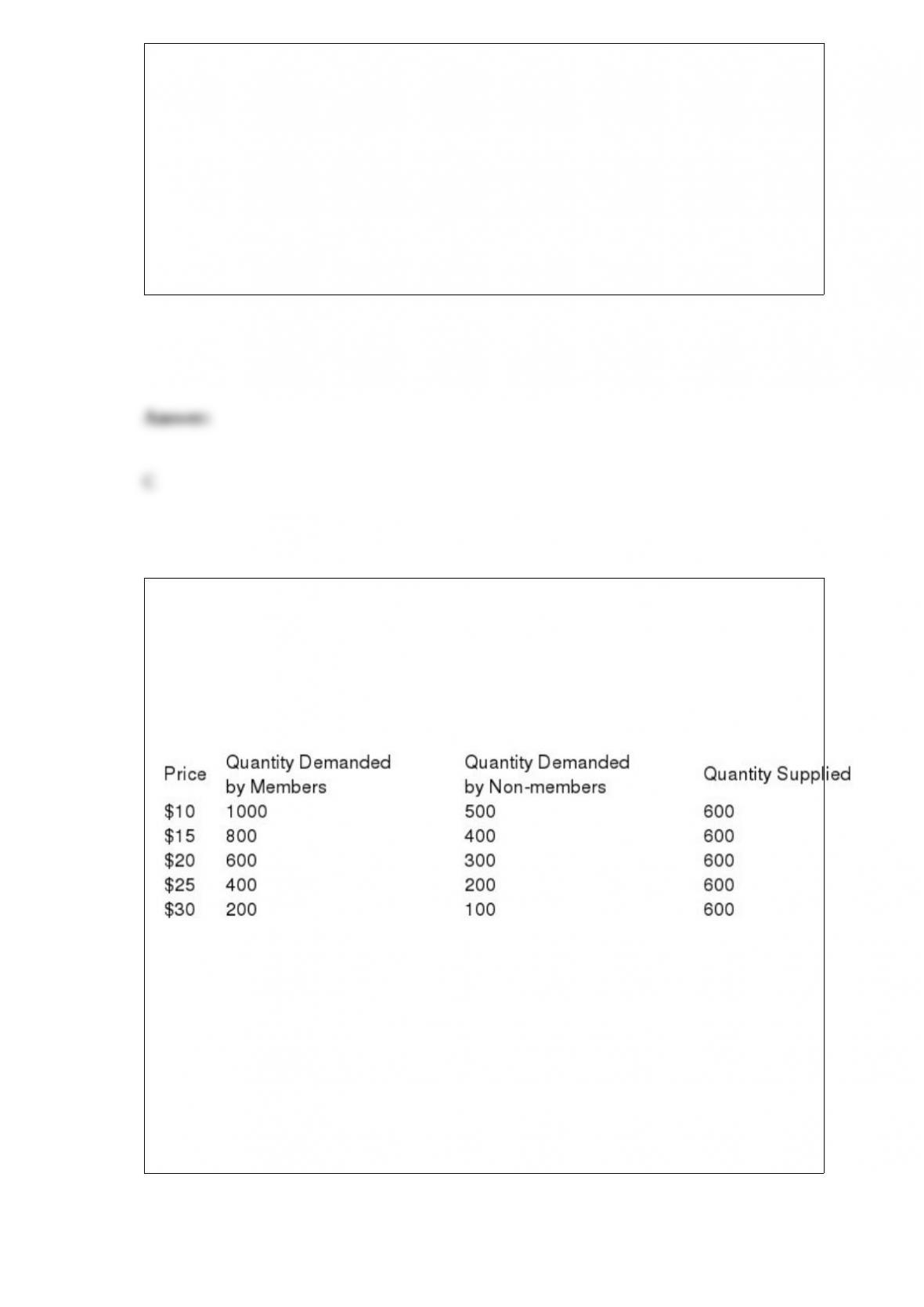
Table 4-8
A country club usually only allows members to purchase tickets for its celebrity golf
tournament, but the club is considering allowing non-members to purchase tickets this
year. The demand and supply schedules are as follows:
Refer to Table 4-8. If only members are allowed to purchase tickets to this year’s
celebrity golf tournament, then what will be the equilibrium price?
a. $10
b. $15
c. $20
d. $25

The aggregate demand and aggregate supply graph has
a. the price level on the horizontal axis. The price level can be measured by the GDP
deflator.
b. the price level on the horizontal axis. The price level can be measured by real GDP.
c. the price level on the vertical axis. The price level can be measured by the GDP
deflator.
d. the price level on the vertical axis. The price level can be measured by GDP.
In general, if a consumer good is produced domestically and consumed domestically, a
decrease in its price will have which of the following effects?
a. The consumer price index will decrease relatively more than will the GDP deflator.
b. The consumer price index and the GDP deflator will decrease by the same amount.
c. The consumer price index will decrease relatively less than will the GDP deflator.
d. One cannot generalize about the decrease in the consumer price index relative to the
decrease in the GDP deflator.
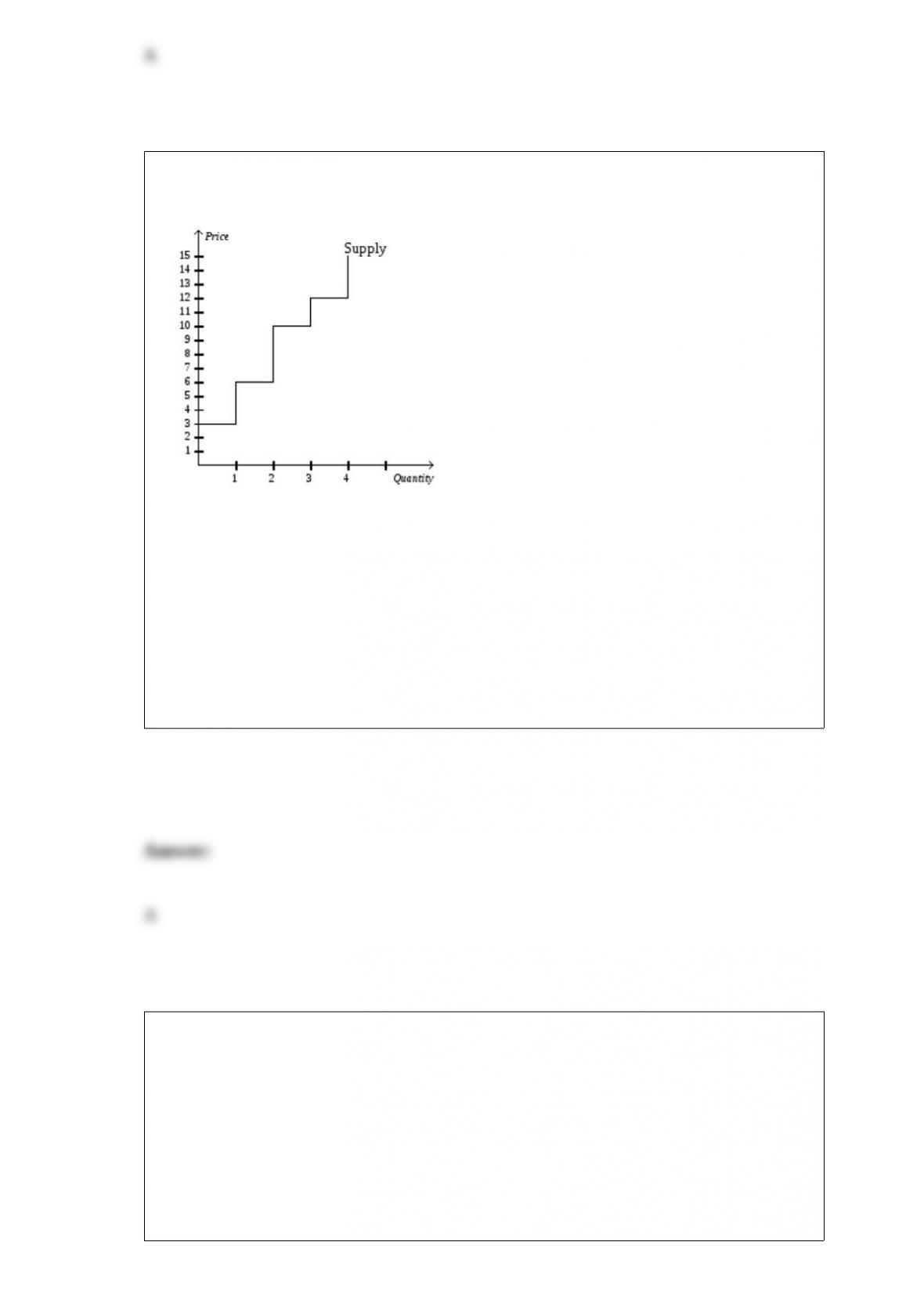
Figure 7-7
Refer to Figure 7-7. If producer surplus is $14, then the price of the good is
a. $11.00.
b. $12.00.
c. $13.50.
d. $14.75.
As opposed to a payments system based on barter, a payments system based on money
a. requires a double coincidence of wants.
b. leads to less specialization.
c. makes trades less costly.
d. None of the above is correct.

When an American household purchases a bottle of Italian wine for $100,
a. U.S. consumption does not change, U.S. net exports decrease by $100, and U.S. GDP
decreases by $100.
b. U.S. consumption does not change, U.S. net exports increase by $100, and U.S. GDP
increases by $100.
c. U.S. consumption increases by $100, U.S. net exports decrease by $100, and U.S.
GDP does not change.
d. U.S. consumption increases by $100, U.S. net exports do not change, and U.S. GDP
increases by $100.
Figure 9-5
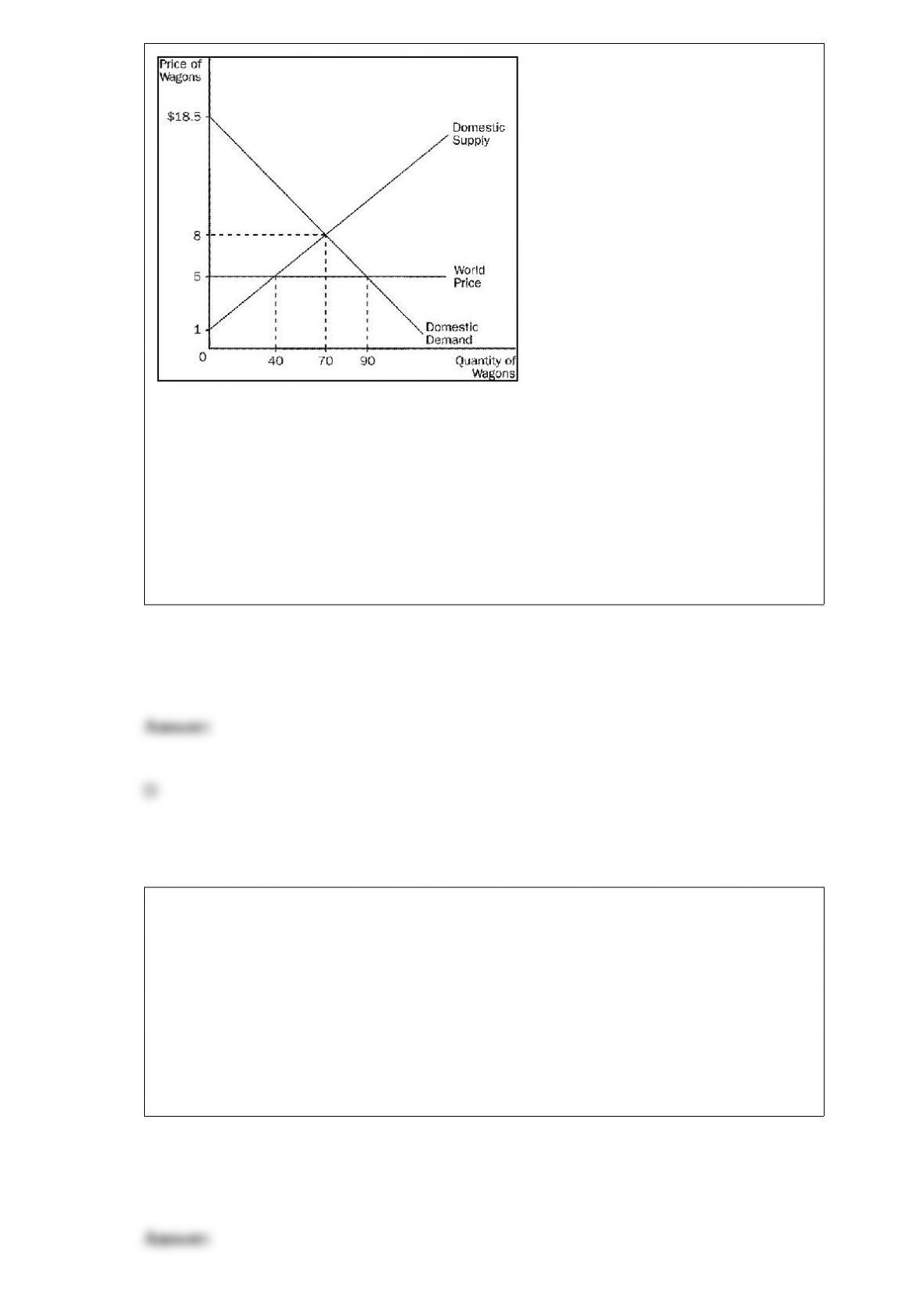
Refer to Figure 9-5. With trade, this country
a. exports 20 wagons.
b. exports 50 wagons.
c. imports 30 wagons.
d. imports 50 wagons.
The value of Peru’s exports minus the value of Peru’s imports is called
a. Peru’s foreign portfolio investment.
b. Peru’s foreign direct investment.
c. Peru’s net exports.
d. Peru’s net imports.

During periods of expansion, automatic stabilizers cause government expenditures
a. and taxes to fall.
b. and taxes to rise.
c. to rise and taxes to fall.
d. to fall and taxes to rise.
Some people who are employed or who are not making serious effort to find
employment will report themselves as unemployed. Some people who want to find
work will be counted as out of the labor force.
a. Both the first and the second fact tend to make the reported unemployment rate lower
than otherwise.
b. Both the first and the second fact tend to make the reported unemployment rate
higher than otherwise.
c. The first fact tends to make the reported unemployment rate higher than otherwise,
while the second fact tends to make the reported unemployment rate lower than
otherwise.
d. The first fact tends to make the reported unemployment rate lower than otherwise,
while the second fact tends to make the reported unemployment rate higher than
otherwise.

Suppose banks desire to hold no excess reserves and that the Fed has set a reserve
requirement of 10 percent. If you deposit $9,000 into First Jayhawk Bank,
a. First Jayhawk’s required reserves increase by $900.
b. First Jayhawk will be able to lend out $8,100.
c. First Jayhawk’s assets and liabilities both will increase by $9,000.
d. All of the above are correct.
In 1979, Fed chair Paul Volcker decided to pursue a policy
a. that would lead to disinflation.
b. that would create falling prices.
c. to accommodate continuing adverse supply shocks.
d. that maintained money growth at its current level.
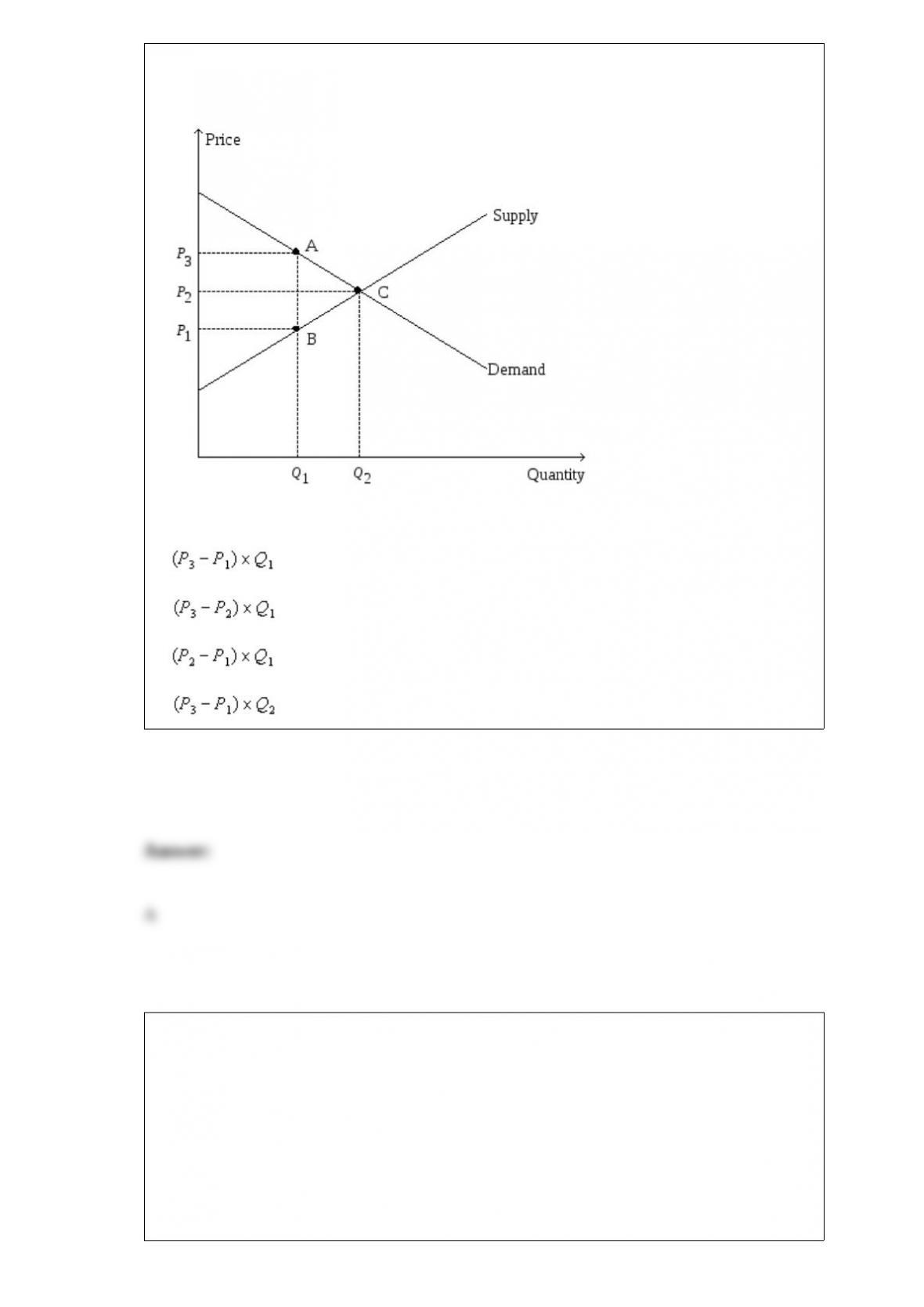
Figure 8-11
Refer to Figure 8-11. The tax revenue that the government collects equals
a. .
b. .
c. .
d. .
Over the last ten years productivity grew more slowly in Upland than in Lowland and
the population and total hours worked remained the same in both countries. It follows
that
a. real GDP per person must be lower in Upland than in Lowland.
b. real GDP per person grew more slowly in Upland than in Lowland.
c. the standard of living must be higher in Upland than in Lowland.

d. All of the above are correct.