
Suppose the market price for wheat changes, and we move from point A to point B on
the wheat demand curve. If the price elasticity of wheat demand was -0.3 at point A and
-0.4 at point B, what is a plausible value for the arc elasticity of demand for wheat
between points A and B?
A) -0.25
B) -0.35
C) -0.45
D) -0.70
Scenario 14.4:
John’s firm is a competitor in your product market and a monopsonist in the labor
market. The current market price of the product that your firm produces is $2. The total
product and marginal product of labor are given as:
TP = 100L – 0.125L2 MP = 100 – 0.25L
where L is the amount of labor employed. The supply curve for labor and the marginal
expenditure curve for labor are given as follows:
L = PL -5 MEL = 2L + 5
Refer to Scenario 14.4. Suppose that a tax is imposed on each unit of the product that
John produces. Which curve will shift?
A) Marginal product of labor
B) Marginal revenue product of labor
C) The supply of labor
D) All of the above will shift due to the tax on output.

To protect the cod fishery off the northeast coast of the U.S., the federal government
may limit the amount of fish that each boat can catch in the fishery. The result of this
public policy is to:
A) shift the cod demand curve to the left.
B) shift the cod demand curve to the right.
C) shift the cod supply curve to the right.
D) shift the cod supply curve to the left.
Consider the following information about job opportunities for new college graduates in
Megalopolis:
Table 5.1
Refer to Table 5.1. Expected income for the first year is
A) highest in accounting.

B) highest in mathematics.
C) higher in English than in mathematics.
D) higher in political science than in economics.
E) highest in economics.
In the ________, one firm sets its output first, and then a second firm, after observing
the first firm’s output, makes its output decision.
A) Cournot model
B) model of monopolistic competition
C) Bertrand model
D) kinked-demand model
E) none of the above
The demand curve for a particular stock at any point in time is
A) very inelastic but not infinitely so.
B) almost infinitely inelastic.

C) infinitely elastic.
D) fairly elastic but not infinitely elastic.
When the interest rate is R, the formula for finding the value of a current amount $M
one year from now is
A) M (1 + R/100).
B) M (1 + R).
C) M / (1 + R).
D) M / R.
E) M / (100R).
Suppose that the market demand for mountain spring water is given as follows:
P = 1200 – Q
Mountain spring water can be produced at no cost.
a. What is the profit maximizing level of output and price of a monopolist?
b. What level of output would be produced by each firm in a Cournot duopoly
in the long run? What will the price be?
c. What will be the level of output and price in the long run if this industry were
perfectly competitive?
As we move downward along a demand curve for apples,
A) consumer well-being decreases.
B) the marginal utility of apples decreases.
C) the marginal utility of apples increases.
D) Both A and B are true.
E) Both A and C are true.

The Catawba River City Park has a low demand D1 during work days, but on Saturday
and Sunday demand increases to D2 on Saturday and Sunday. The demand and marginal
revenue functions are:
D1 = P1 = 2 – 0.001Q1
MR1 = 2 – 0.002Q1
D2 = P2 = 20 – 0.01Q2
MR2 = 20 – 0.01Q2
where Q = number of cars entering the park each day. The marginal cost of operating
the park is the same on weekdays and weekends:
MC = 1 + 0.004Q.
a. In order to control crowds, the park’s management uses peak-load pricing. This
scheme controls crowds and makes sure the park is self-supporting. Calculate the
appropriate prices to charge, and determine the number of cars entering the park, Q1
and Q2.
b. Explain how switching from a uniform pricing scheme to a peak load pricing scheme
affects the market.
An electric power company uses block pricing for electricity sales. Block pricing is an
example of
A) first-degree price discrimination.
B) second-degree price discrimination.
C) third-degree price discrimination.
D) Block pricing is not a type of price discrimination.

Transferable permits allow emission reduction to be achieved
A) without any impact on the industrial sector, just as a standard would.
B) without any impact on the industrial sector, just as fees would.
C) at the lowest possible cost.
D) with firms monitoring each other, rather than having the government do the
monitoring.
E) Both C and D are true.
If the initial distribution of two goods between two people is Pareto optimal, which of
the following statements is TRUE?
A) It is possible to reallocate the goods between the two people so as to increase the
utility of both people.
B) It is possible to reallocate the goods between the two people so as to increase the
utility of one person without decreasing the utility of the other.
C) It is possible to reallocate the goods between the two people so as to increase the
utility of one person, but only at the expense of the other person.
D) It is impossible to reallocate the goods between the two people so as to increase
either person’s utility.
E) none of the above
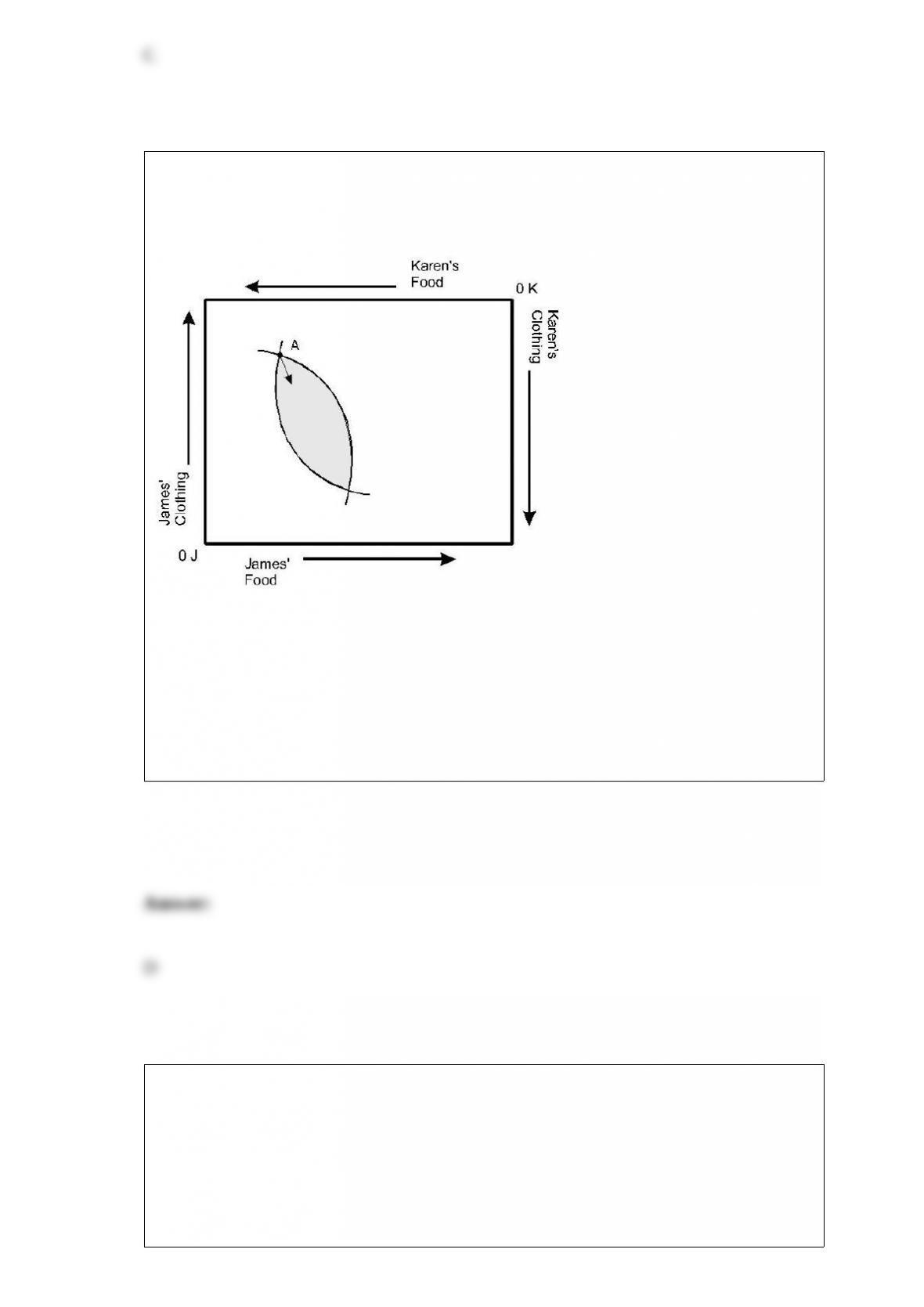
The Edgeworth box illustrates possibilities for Karen and James to increase their
satisfaction by trading goods. If point A gives the initial allocation of food and clothing,
a movement into the shaded area:
A) leaves Karen better off, but James worse off.
B) leaves James better off, but Karen worse off.
C) leaves James and Karen worse off.
D) leaves James and Karen better off.
Which of the following is NOT a factor that has contributed to declining private-sector
differential between union and nonunion wages in the U.S. since 1980?
A) Globalization of the production process
B) Improved ability of firms to substitute capital for labor in production

C) Adoption of two-tiered wage and benefit structures by unionized firms
D) Declines in the unemployment and health insurance premiums paid by union
workers
Scenario 4.3:
The demand for erasers (Q) is given as follows:
Q = 240 – 4Pe + 2I + Pb + A
where Pe is the price of erasers
I is the level of income
Pb is the price of another good
A is the level of advertising
Suppose that Q = 240, Pe = 10, Pb = 10, and A = 2.Given the information in Scenario
4.3, determine I.
A) 0
B) 14
C) 24
D) 36
E) 48

The principal-agent problem of ownership vs. control of the corporation tends to get
worse when
A) stock in a corporation is held exclusively by a small number of people who control
the company’s day-to-day operations.
B) stock in the company is tightly held, but there are some “outsider” stockholders.
C) stock in the company is very diffusely held, with no individual or group having
control over a large block of stock.
D) managers have profit-sharing schemes as part of their incentive package.
E) managers focus on maximizing the firm’s profits, rather than the firm’s market share.
Which of the following assets is almost riskless?
A) Common stocks
B) Long-term corporate bonds
C) U.S. Treasury bills
D) Long-term government bonds
E) Apartment buildings

Why doesn’t the marginal worker hired earn economic rent in a competitive labor
market?
A) His reservation wage is less than the wage.
B) His reservation wage is greater than the wage.
C) His reservation wage is equal to the wage.
D) He is paid a wage that is lower than the others.
Suppose Congress passes a law that states the price of gasoline may not exceed $6 per
gallon (but may be lower). If the current price of gasoline is less than $6, what impact
does this law have on the current price and quantity of gasoline in the US market?
A) There is a shortage of gasoline
B) There is a surplus of gasoline
C) Quantity supplied currently equals quantity demanded, but a surplus is possible at
prices above $6
D) The law currently has no impact, and the market clears at the equilibrium price
Rather than charging a single price to all customers, a firm charges a higher price to

men and a lower price to women. By engaging in this practice, the firm:
A) is trying to reduce its costs and therefore increase its profit.
B) is engaging in an illegal activity that is prohibited by the Sherman Antitrust Act.
C) is attempting to convert producer surplus into consumer surplus.
D) is attempting to convert consumer surplus into producer surplus.
E) Both A and C are correct.
Which of the following statements is true?
A) The expected return and standard deviation of return are greater for common stock
than for U.S. Treasury bills.
B) The expected return on common stocks is greater than the expected return on U.S
Treasury bills, but the standard deviation of return for common stocks is less than the
standard deviation of return for U.S. Treasury bills
C) The expected return on common stocks is less than the expected return on U.S
Treasury bills, but the standard deviation of return for common stocks is greater than
the standard deviation of return for U.S. Treasury bills.
D) The expected return and standard deviation of return are less for common stocks
than for U.S. Treasury bills.

What happens to the marginal revenue product curve of a factor as more of a
complementary factor is hired?
A) It shifts to the left, because its marginal product decreases.
B) It shifts to the left, because its marginal product increases.
C) It shifts to the right, because its marginal product decreases.
D) It shifts to the right, because its marginal product increases.
Another commonly used algebraic form for a demand function is the semi-logarithmic
functional form, log(Q) = a – bP + cI, where Q is quantity demanded, P is the product
price, and I is income. Here, -100b represents the percentage change in quantity
demanded given a one unit increase in price. By the Law of Demand, we should expect
the value of b to be:
A) positive.
B) negative.
C) positive or negative.
D) We do not have enough information to answer this question.
Which of the following is NOT a condition for third degree price discrimination?
A) Monopoly power
B) Different own price elasticities of demand
C) Economies of scale
D) Separate markets
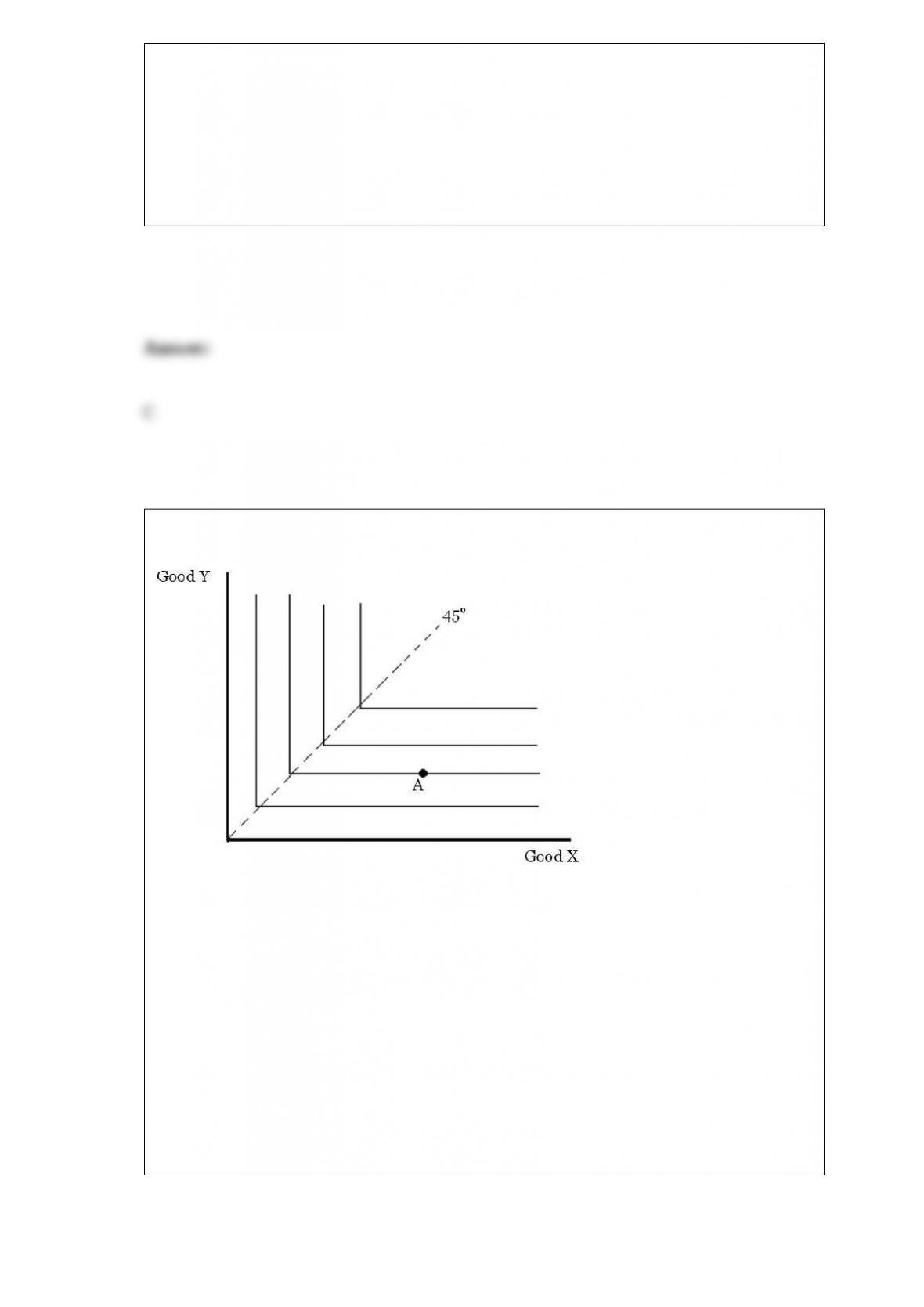
Alvin’s preferences for good X and good Y are shown in the diagram below.
Figure 3.2
Based on Figure 3.2, it can be inferred that:
A) Alvin does not consider good X as “good.”
B) Alvin will never purchase any of good Y.
C) Alvin regards good X and good Y as perfect substitutes.
D) Alvin regards good X and good Y as perfect complements.
E) none of the above

The demand for books is: Qd = 120 – P
The supply of books is: Qs = 5P
What is the equilibrium quantity of books sold?
A) 25
B) 50
C) 75
D) 100
E) none of the above
Scenario 4.4:
The demand curve for the new computer game, Rock and Roll Trivia, is given as
follows:
Q = 200 – 5P – .1Pc – .5Pd + .2A – I
where P is the price of the game
Pc is the price of a computer
Pd is the price of a diskette
A is the level of advertising
Q is the level of incomeSee the information in Scenario 4.4. Does the demand curve for
Rock and Roll Trivia slope downward?
A) Yes it does.
B) No it does not.
C) More information is needed to answer this question.
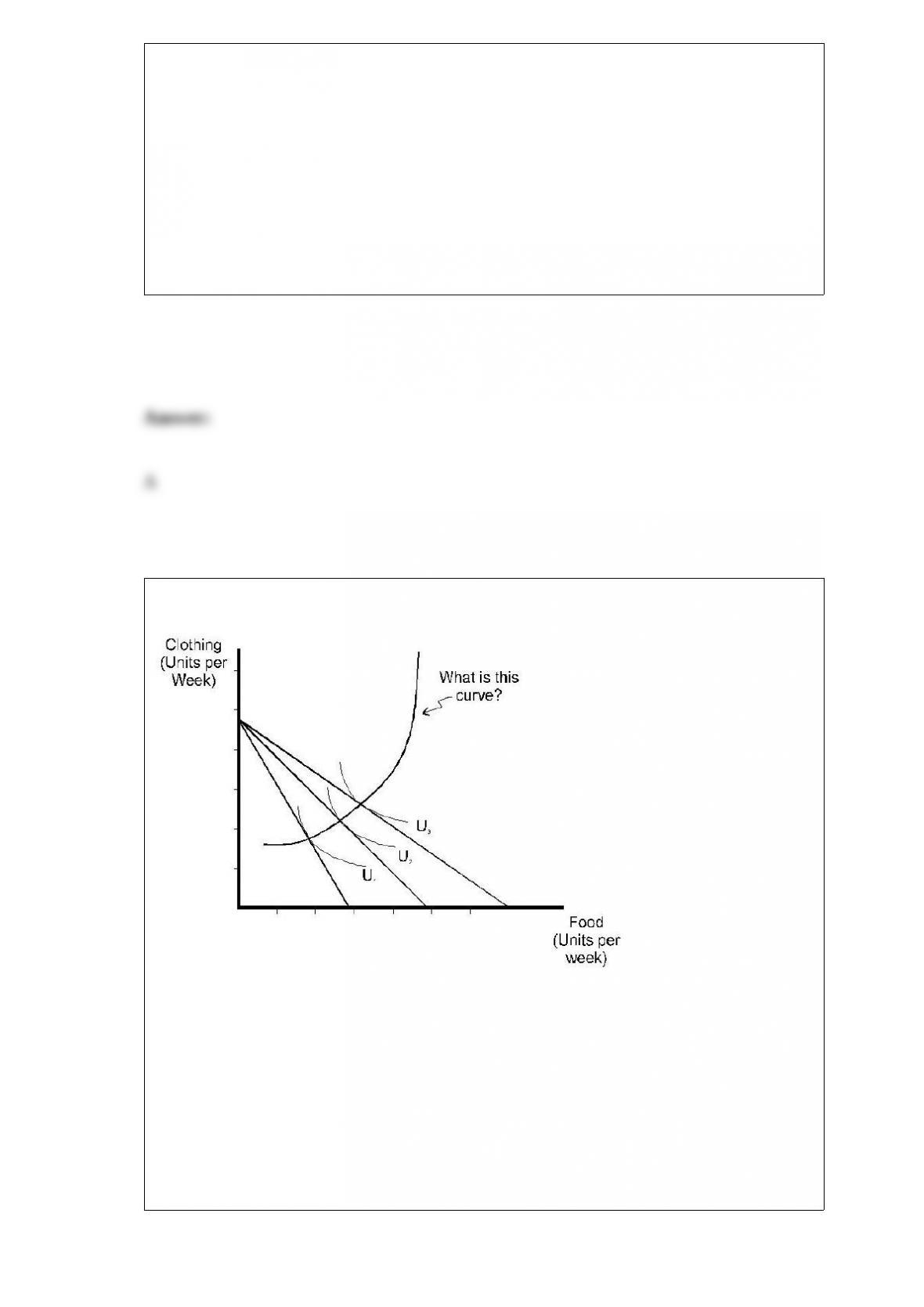
The curve in the diagram below is called
A) the price-consumption curve.
B) the demand curve.
C) the income-consumption curve.
D) the Engel curve.
E) none of the above

Loud music from a neighbor’s party is
A) a negative externality whether or not you like it.
B) a positive externality whether or not you like it.
C) a positive externality if you like the music, and a negative externality if you don’t.
D) a negative externality if you like the music, and a positive externality if you don’t.
E) not an externality.
American Mining Company is interested in obtaining quick estimates of the supply and
demand curves for coal. The firm’s research department informs you that the elasticity
of supply is approximately 7, the elasticity of demand is approximately -0.85, and the
current price and quantity are $41 and 1,206, respectively. Price is measured in dollars
per ton, quantity the number of tons per week.
a. Estimate linear supply and demand curves at the current price and quantity.
b. What impact would a 10% increase in demand have on the equilibrium price and
quantity?
c. If the government refused to let American raise the price when demand increased in
(b) above, what shortage is created?


Which of the following is true? Partial equilibrium analysis will
A) overstate the impact of a tax for both substitutes and complements.
B) understate the impact of a tax for both substitutes and complements.
C) understate the impact of a tax for complements and overstate the impact for
substitutes.
D) understate the impact of a tax for substitutes and overstate the impact for
complements.

The Slutsky equation is a mathematical representation of:
A) a utility function.
B) the marginal utility of income.
C) a demand curve.
D) the income expansion path.
E) the substitution and income effects.
Suppose there are 10 apples and 10 oranges in the economy. Joe is currently consuming
4 apples and 5 oranges, and Jane is consuming 6 apples and 5 oranges. At this
allocation, Joe’s marginal utility of apples is 3, and his marginal utility of oranges is 5.
Jane’s marginal utility of apples is 9. The current allocation is necessarily efficient if:
A) the price of apples is 60% of the orange price.
B) Jane’s marginal utility of oranges is 6 at this point.
C) Joe’s MRS equal the MRT.
D) Jane’s marginal utility of oranges is 15 at this point.
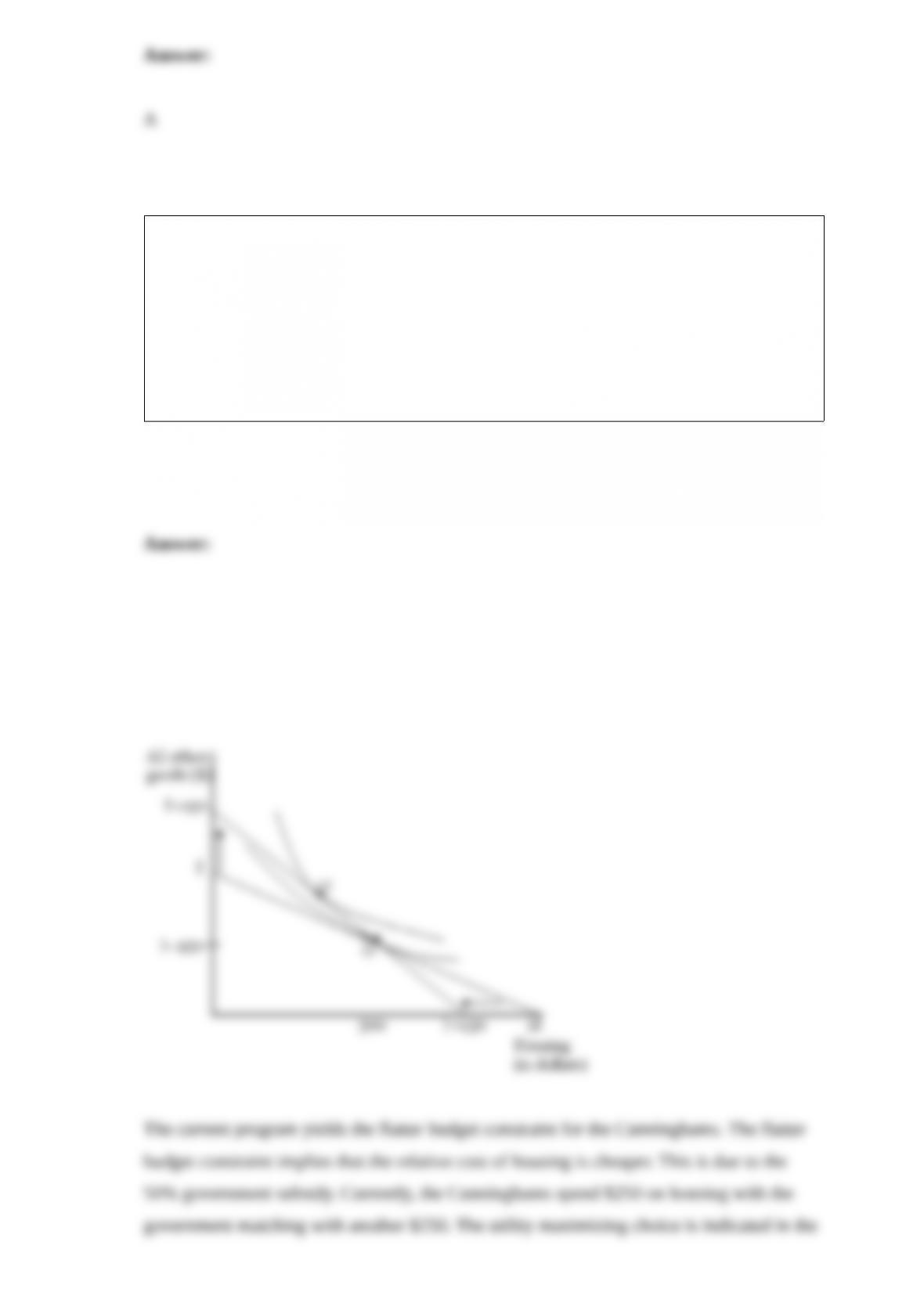
Suppose that the government subsidizes housing expenditures of low-income families
by providing a dollar-for-dollar subsidy to a family’s housing expenditure. The
Cunninghams qualify for this subsidy and spend a total of $500 per month on housing:
they spend $250 of their own and receive a government subsidy of $250. Recently, a
new policy has been proposed that would provide each low income family with a lump
sum transfer of $250 which can be used for housing or other goods. Using a graph,
demonstrate whether the Cunninghams would prefer the current program, the proposed
program, or would be indifferent between the two.

The city of Econoville has 100 residents who each have the identical demand function
for roads: P = 100 – 1.99Q. The marginal cost of providing road area is: MC(Q) = 2,500
+ Q. Road area is a public good. That is, if the city of Econoville provides public access
to roads, all of the residents can enjoy the roads. If the city of Econoville does not offer
public roads, how much area of roads will each individual resident maintain on their
own? What is the optimal area of public roads in Econoville? What flat road tax should
Econoville implement on residents for units of roads the city provides? With this flat
tax, what is the total contribution of each resident for the roads?

Each of the following consumers exhibit behavior that violates one of the basic
assumptions of consumer preferences. Identify the assumption that is violated for each
individual.
∙ Art says that he can watch 2 movies a week but couldn’t be paid to watch another
movie after that.
∙ Alex says that he prefers going to a movie over hiking. He also indicates that he
prefers hiking to swimming. Alex then states that he would rather go swimming than go
to a movie.
∙ Alicia says that she prefers hiking to watching a movie but can’t determine her
preferences for swimming.
Two large diversified consumer products firms are about to enter the market for a new
pain reliever. The two firms are very similar in terms of their costs, strategic approach,
and market outlook. Moreover, the firms have very similar individual demand curves so
that each firm expects to sell one-half of the total market output at any given price. The
market demand curve for the pain reliever is given as:
Q = 2600 – 400P.
Both firms have constant long-run average costs of $2.00 per bottle. Patent protection
insures that the two firms will operate as a duopoly for the foreseeable future. Price and
quantity values are stated in per-bottle terms. If the firms act as Cournot duopolists,
solve for the firm and market outputs and equilibrium prices.

The demand and supply functions for basic cable TV in the local market are given as:
QD= 200,000 – 4,000P and QS = 20,000 + 2,000P. Calculate the consumer and producer
surplus in this market. If the government implements a price ceiling of $15 on the price
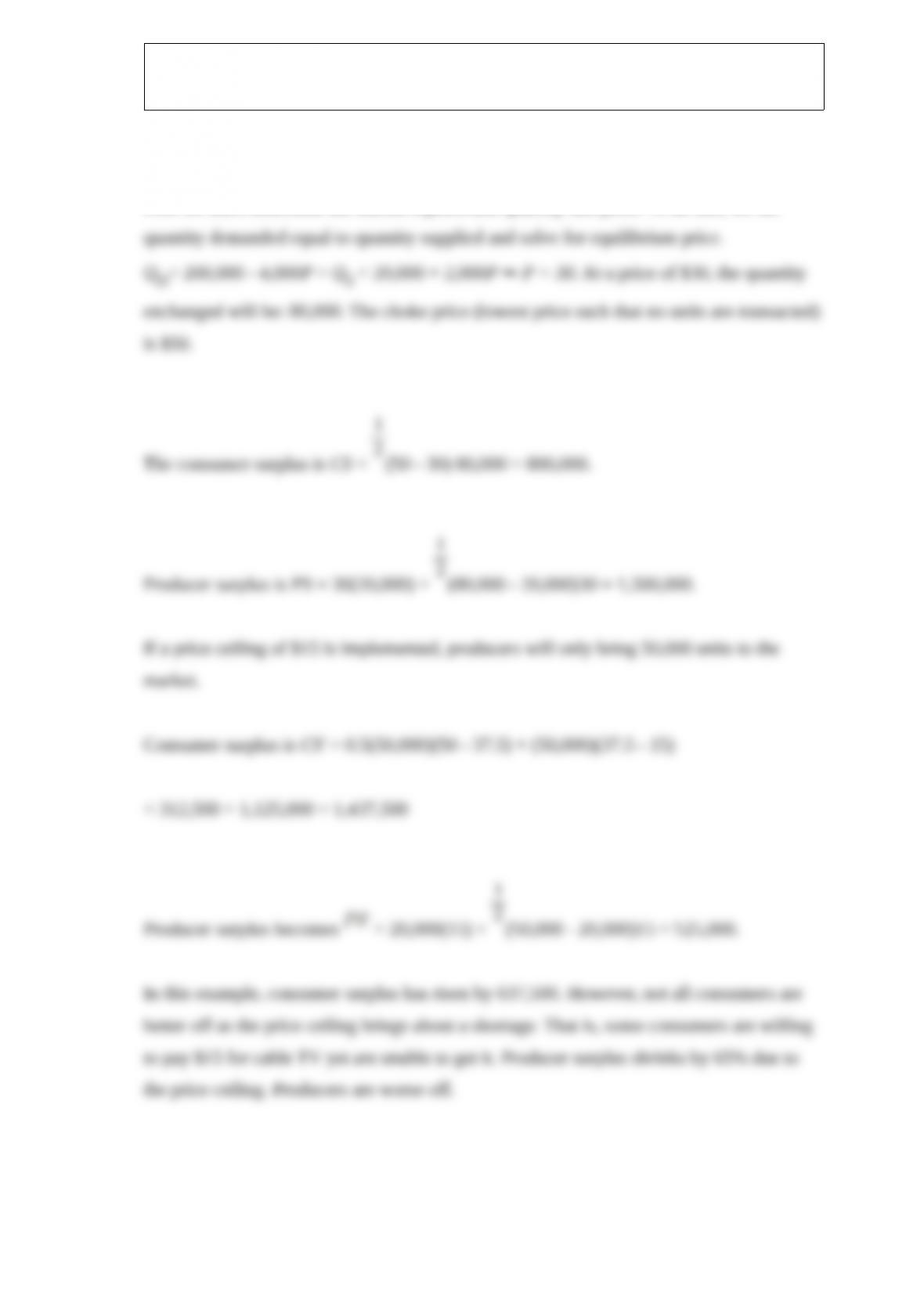
of basic cable service, calculate the new levels of consumer and producer surplus. Are
all consumers better off? Are producers better off?

Ronald’s monthly demand for Cap Rock Chardonnay is given by Q = 6 + ( ) (I – T)
– P, where I is Ronald’s monthly income, T is his tax expense and P is the price of
Cap Rock Chardonnay. Suppose the Price of Cap Rock Chardonnay is $10, Ronald’s
monthly income is $15,000, and his tax expense is $5,000. Calculate how much Ronald
changes his Chardonnay consumption if his taxes are increased by 20%. Also, calculate
Ronald’s Consumer Surplus from consuming Cap Rock Chardonnay before and after
the increase in taxes.
The price to attend a NBA basketball game in Chicago is $55 while the CPI in Chicago
is 153. The CPI in Charlotte is 108 while the price to attend a NBA basketball game is
$52. Which city offers a smaller real cost of attending a NBA basketball game?

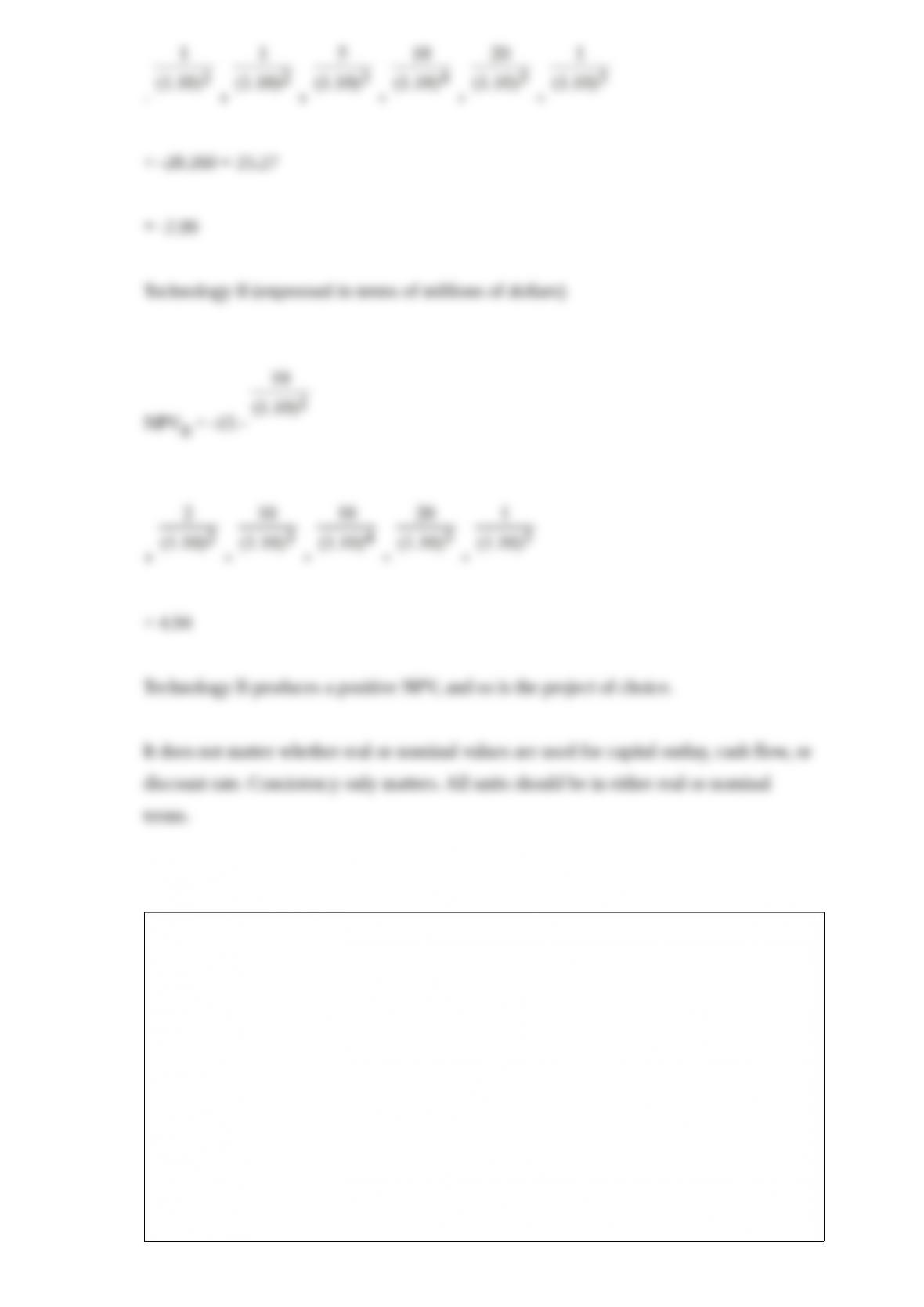
The Clemson Manufacturing Corp. engineers have estimated that a new factory can be
constructed for the manufacture of hydraulic valves and fittings. Two different
technologies, A and B, have been considered in the manufacturing process. The costs of
the factory and annual earnings are given below for both technologies.
Capital Costs Earnings
(in $millions) (in $millions)
End of the Year A B A B
0 $10 $15 $0 $0
1 10 10 -1 0
2 10 0 1 2
3 0 0 5 10
4 0 0 10 10
5 0 0 20 10
At the end of five years, technology A will have a scrap value of one million dollars,
and technology B will have a scrap value of 5 million dollars. Assume that these two
projects are equally risky and the appropriate discount rate is 10 percent per year.
Calculate the net present value of each of these factories. Determine if either or both
would be feasible. Does it matter whether or not real or nominal terms are used for
capital costs, cash flows, and discount rate? Explain.
Trisha’s Fashion Boutique is considering a profit sharing arrangement with her
employees. Currently, the employees receive an annual bonus. In a “Boom” market,
Trisha can sell all the output she produces for $225 per unit. In a “Bust” market, Trisha
can sell all the output she produces for $125 per unit. The probability of a “Boom”
market is 75% and the probability of a bust market is 25%. Trisha’s total cost function
(including bonus payments to employees) is: TC(Q) = 75Q + 2.5Q2. The marginal cost
function is: MC(Q) = 75 + 5Q. The profit sharing plan would pay employees 30% of
profits. However, due to greater cost saving initiatives from employees, Trisha’s total
cost function becomes: TC(Q) = 50Q + 2Q2. The relevant marginal cost function
becomes: MC(Q) = 50 + 4Q. Which plan offers Trisha the greatest expected profits for
herself? Suppose the employees will only approve a profit sharing plan if they are
guaranteed their portion of profits will be at least $400. Will the employees approve of
the profit sharing program?

Larry’s Carpet Cleaners can influence demand by advertising. Larry charges $50 per
carpet, and he cleans 150 carpets per month. The price elasticity of demand is -4, and
Larry spends $500 per month on advertising. If Larry is maximizing profits, calculate
the advertising elasticity of demand.
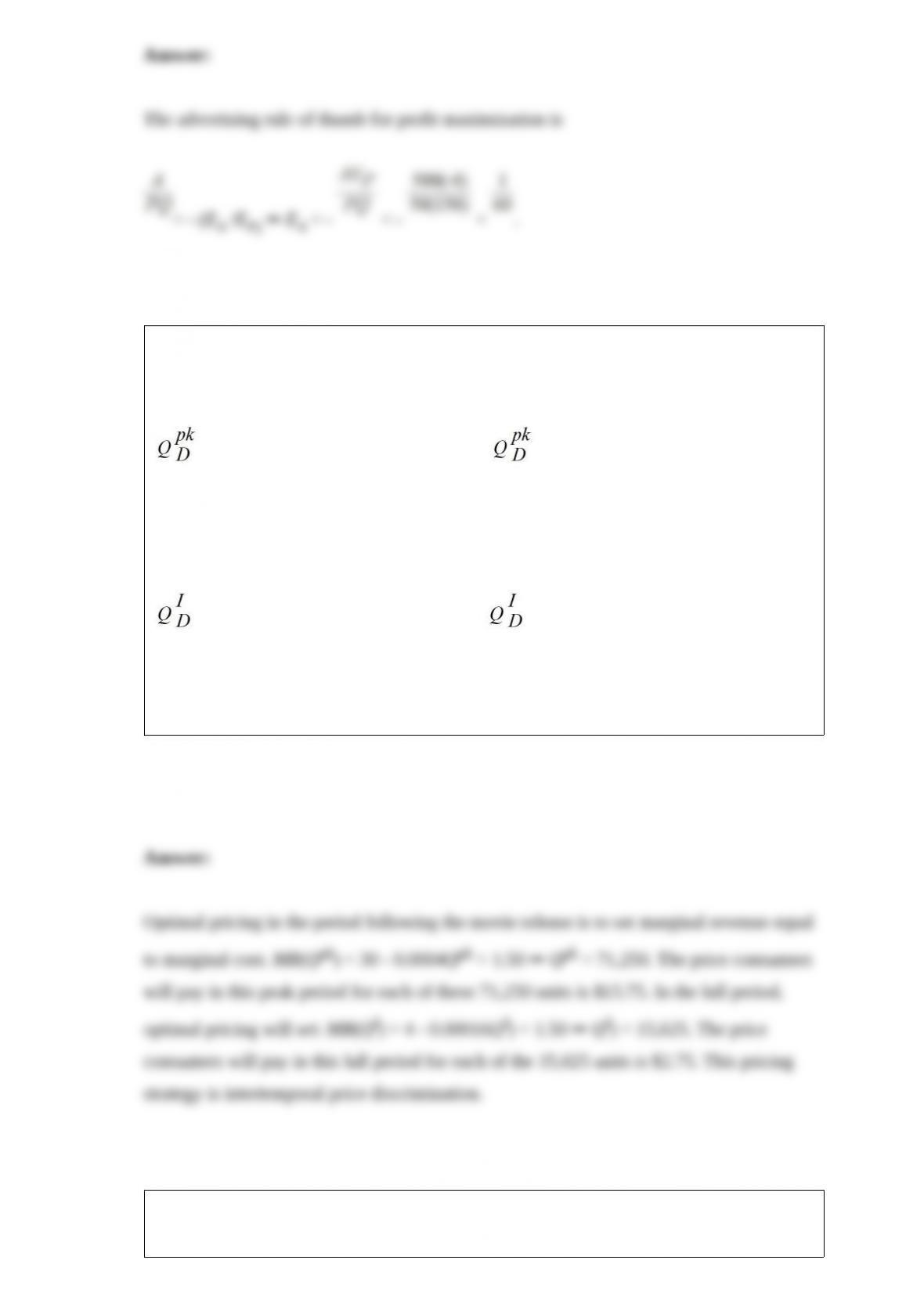
The demand for action figures based on characters from children’s movies is extremely
high around the time the movie is released. In this peak period, demand for action
figures is
= 300,000 – 10,000P ⇔P = 30 – 0.0002 .
The resulting marginal revenue curve is MR(Qpk) = 30 – 0.0004Qpk. Some time after the
movie release, interest in the action figures wanes. In this lull period, demand for the
action figures becomes
= 100,000 – 25,000P ⇔P = 4 – 0.00008 . The resulting lull period marginal
revenue curve is MR(QI) = 4 – 0.00016QI. Suppose the marginal costs of producing the
action figures are constant at $1.50. What is the optimal pricing strategy in the two
different periods?
Ron owns an automotive repair center. Ron provides high quality automotive repair.
The market price for high quality service is $225 while the market price for standard

service is $150. Currently, Ron only has a reputation for providing standard service.
Ron’s marginal cost function of providing high quality service is: MCH(Q) = 0.25Q.
Ron’s marginal cost function of providing standard service is: MCS(Q) = 0.0625Q.
Butch’s Marketing has told Ron that if he hires Butch’s firm to advertise and market
Ron’s high quality services, consumers will pay him the high quality service market
price providing he delivers that quality. What is the most amount of money Ron is
willing to pay for Butch’s services?
Determine the “rule-of-thumb” price when the monopolist has a marginal cost of $25
and the price elasticity of demand of -3.0.
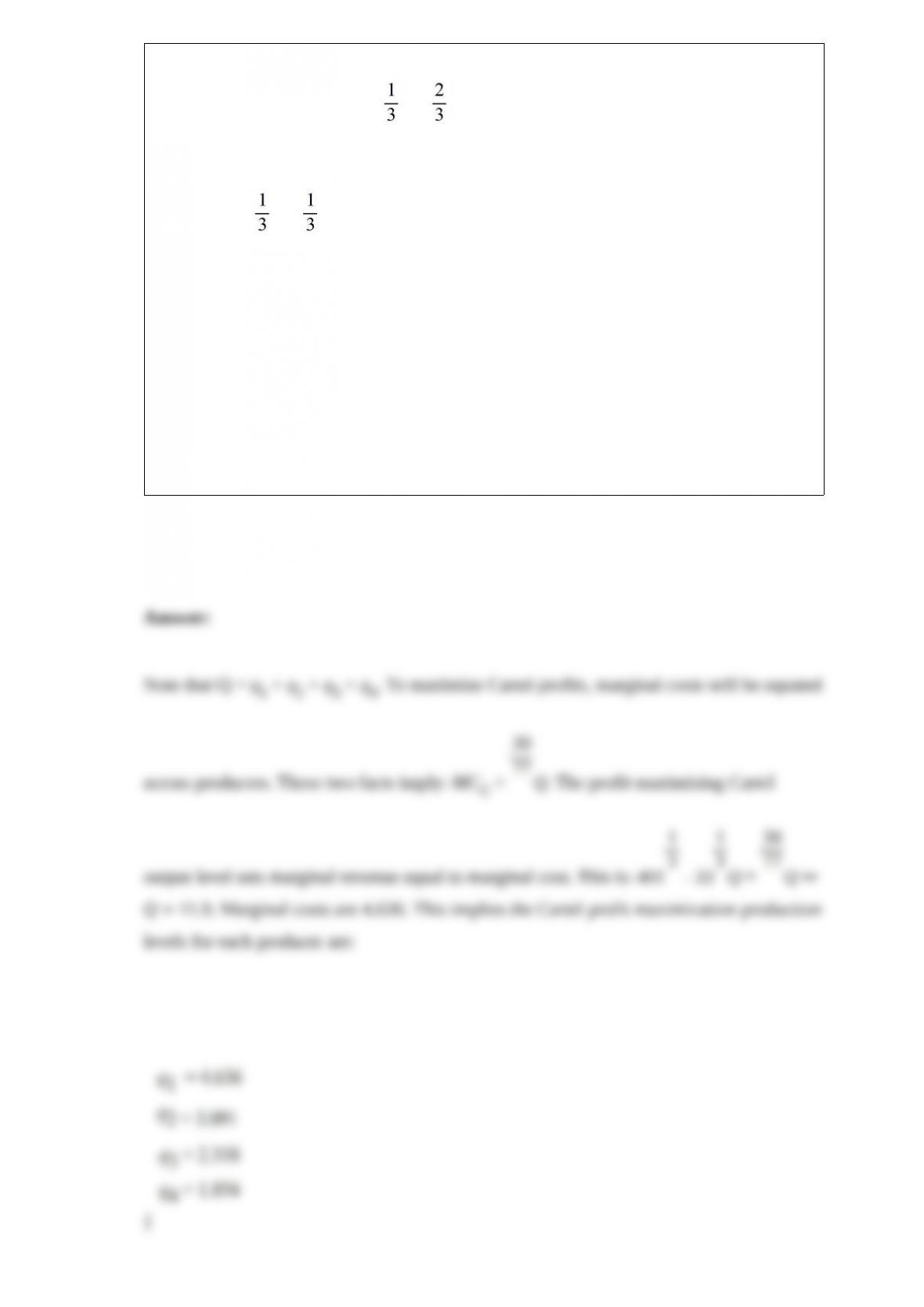
On the planet Economus, the demand for Kryptonite is:
QD = 24.08 – 0.06P ⇔P = 401 – 16 QD. There are four producers of Kryptonite on
the planet who have formed a Kryptonite Cartel. The resulting marginal revenue
function for the cartel is:
MR(Q) = 401 – 33 Q. The marginal costs for producing Kryptonite for the 4 different
producers are:
MC1 (q1) = q1,
MC2 (q2) = 1.5q2,
MC3 (q3) = 2q3,
MC4 (q4) = 2.5q4.
Determine the Cartel profit maximization output levels of each producer. If producer #2
cheats and produces 50% more than their collusive output level, determine their new
revenue level.