
Which one of the following is NOT a retaliation strategy that firms would apply to one
that cheated on a price-fixing scheme by selling at a price below the agreed-upon fixed
price?
A) All other firms sell at the same low price as the cheating firm.
B) All other firms sell at a price that ensures zero economic profit for all firms.
C) Each period, all other firms sell at the price picked by the cheater in the previous
period.
D) All other firms would reduce their output.
A(n) ________ is a tax on an imported good.
A) tariff
B) import quota
C) voluntary export restraint
D) export quota
If the government sets a minimum price above the equilibrium price for soybeans.
which of the following statements will be correct?
A) There will be an efficient level of output produced.
B) There will be excess supply.
C) There will be excess demand.
D) all of the above
Which of the following products has the most elastic demand?
A) Raspberry Mocha Kona coffee blend at Starbuck’s
B) Starbuck’s coffee
C) coffee
D) all beverages
The cross-price elasticity of demand between spaghetti and spaghetti sauce is most
likely:
A) positive.
B) negative.
C) zero.
D) More information is needed to determine.
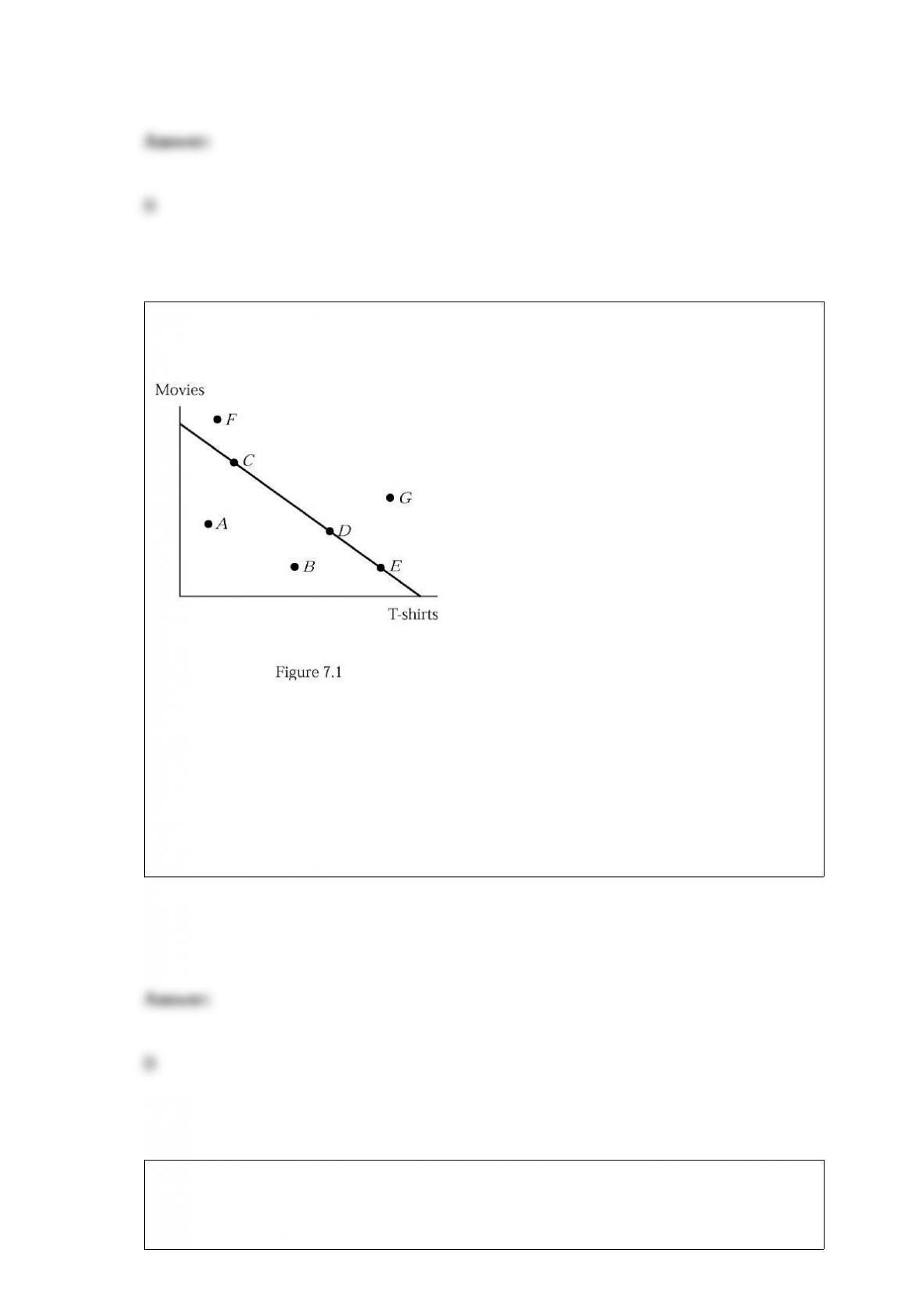
Refer to Figure 7.1. Which of the following are the combinations of movies and T-shirts
that would exhaust the budget?
A) A and C
B) C and E
C) B and G
D) A and B
When Luna Hair Salon raised its hair cut prices by 10% because of an increase in rent
cost, it lost a quarter of its customers. The price elasticity of demand for its hair cut is:

A) 4.
B) 0.25.
C) 0.4.
D) 2.5.
The difference between the maximum amount that a consumer is willing to pay for a
product and the price that is paid for the product describes:
A) consumer surplus.
B) the cost of producing a unit of the product.
C) marginal utility.
D) producer surplus.
An example of a public good is:
A) a levee.
B) national defense.
C) space exploration.

D) All of the above are examples of public goods.
Jody’s bakery makes cakes and would be willing to sell each cake for $12.50. If Jody’s
bakery sells 10 cakes for $13 each, the total producer surplus for Jody’s bakery would
be equal to:
A) $5.00.
B) $12.50.
C) $125.
D) $130.
Suppose two firms operate under a system of marketable pollution permits. If it costs
Firm A $25 to reduce pollution by 1,000 units per day, and Firm B can reduce costs by
$35 by increasing pollution by 1,000 units per day:
A) the firms cannot gain by trading the right to pollute.
B) both firms can benefit if Firm A trades the right to pollute 1,000 units to Firm B for
$30.
C) both firms can benefit if Firm A trades the right to pollute 1,000 units to Firm B for
$40.
D) both firms can benefit if Firm B trades the right to pollute 1,000 units to Firm A for

$30.
Suppose there are only two manufacturers of in an area that and generate the same
amount of carbon emission pollution per hour. The only difference is that firm 1 is a
low cost firm and firm 2 is a high cost one. What would we expect if the government
were to use a uniform abatement policy?
A) the demand for tires to increase
B) the quantity of tires produced to increase
C) The uniform abatement policy is likely to be inefficient.
D) The uniform abatement policy is likely to be efficient.
A contestable market is one where:
A) there is a threat of entry.
B) there are no firms that threaten to enter the market.
C) firms already in the market cannot leave the market.
D) only one firm at a time can serve the market.

Suppose coffee is sold in a monopolistically competitive market, where coffee is
differentiated by coffee shop location. As firms enter in the long run and the price of
coffee falls:
A) the market quantity of coffee demanded will increase, but the quantity of coffee
supplied by any individual coffee shop declines.
B) the market quantity of coffee demanded will decrease as does the quantity supplied
from any individual coffee shop.
C) the average costs of production decline.
D) the profits of individual coffee shops increase.
Recall the Application about allegations that the makers of branded drugs made
deals with generic drug makers once the patents expired on branded drugs to
answer the following question(s).
Recall the Application. When a patent ends and generic drugs are introduced, there is:
A) downward pressure on the price of the patent version of the drug.
B) upward pressure on the price of the patent version of the drug.
C) no pressure on the price of the patent version of the drug.
D) no demand for the patent version of the drug.

When a U.S. company shifts some of its production to Mexico, it is engaging in:
A) outsourcing.
B) insourcing.
C) self-sufficiency.
D) involuntary exchange.
Recall the application on state lotteries and distribution of Income, how do government
policies affect the distribution of income?
A) Higher-income household contributes a larger percent of its income and more than
the lower-income households.
B) Lower-income household contributes a larger percent of its income.
C) A low-income household spends about the same per yer on lotteries as a medium and
high income households.
D) B and C are correct.

When economists assume that people are rational and respond to incentives, they mean:
A) people act with kindness.
B) people are altruistic.
C) people act in their own self-interest.
D) none of the above.
Marginal product in the short run:
A) increases at all levels of production.
B) diminishes at all levels of production.
C) may initially increase, then eventually decrease.
D) may initially decrease, then eventually increase.
Economists employ economic models:
A) because reality is complex.
B) to make the field more scientific.

C) to make reality more complex.
D) because economic theory is too easy without them.
The single largest source of smog is:
A) automobiles.
B) power plants.
C) industrial manufacturing.
D) fireplaces.
Marginal costs typically:
A) increase as output increases.
B) decrease as output increases.
C) first increase then decrease as output increases.
D) first decrease then increase as output increases.

Which of the following is a microeconomic question?
A) Should we have a constitutional amendment to balance the federal budget?
B) Why do some countries grow faster than others?
C) Should the government prevent the merger of two large firms?
D) All of the above are microeconomic questions.
If the marginal cost of producing the next unit of output is less than the average total
cost, then:
A) the average total cost curve is increasing.
B) the marginal cost curve is at its minimum.
C) the average total cost curve is decreasing.
D) the average total cost curve is at its minimum.

The toothpaste industry with 5 firms is a monopolistic competition, if a sixth firm
decides to entry the market, what will happen to firms’ specific demand curve?
A) shifts to the right
B) shifts to the left
C) stays the same
D) none of the above
Additional Application
For the first seven months of 2006 Stockholm, Sweden has been testing a possible
solution to the city’s traffic congestion. It is called “congestion pricing” and their system
includes ‘small transponder boxes, laser detectors and a network of cameras to track the
path of every car” They want to reduce problems associated with smog and gridlock
and, in turn, improve the quality of life.
The experiment recorded each car’s registration, the date and time of day, as it passed
through specific electronic tolls and calculated a fee that was charged to the car’s owner.
During the rush hour the fee could be as high as $2.75. But in the evenings the toll
would be zero. The expectation is that people will respond to these varying tolls, change
their driving habits to be more efficient, and take more public transportation.
The next step is to put a referendum to the voters to decide whether this system will
become a permanent feature in the life of Stockholm drivers.
Leila Abboud and Jenny Clevstrom, “Stockholm’s Syndrome: Hostages to Traffic,
Swedes Will Vote on High-Tech Plan To Untangle Snarls With Tolls,” Wall Street
Journal, August 29, 2006, http://infoweb.newsbank.com, accessed 11/22/06.
The gridlock and smog that are associated with the traffic in Stockholm, Sweden are
known as:
A) direct costs.
B) business costs.

C) external costs.
D) equilibrium costs.
The demand for labor is called a “derived demand” because it is:
A) derived from the demand for the products it is used to produce.
B) affected by the demand for consumer products workers produce.
C) affected by the price of consumer products workers produce.
D) all of the above.
Recall the Application. The change in demand for cigarettes resulting from the decrease
in taxes would normally create, ceteris paribus:
A) an increase in their supply.
B) a decrease in their supply.
C) an increase in their quantity supplied.
D) a decrease in their quantity supplied.

When consumers are willing to buy more than producers are willing to sell:
A) there is excess supply of the product in the market.
B) there is excess demand for the product in the market.
C) the market is in equilibrium.
D) the demand curve will shift until the quantity supplied equals the quantity
demanded.
One method firms can use to solve the duopolists’ dilemma is to engage in:
A) predatory pricing.
B) tying contracting.
C) marginal cost pricing.
D) guaranteed price matching.
Suppose that at Jones & Smith Shoe Factory, the marginal cost of making a pair of
shoes is $15 and average variable cost is $15. For the next pair of shoes produced
marginal cost will be ________ $15 and average variable cost will be ________ $15.
A) greater than; less than
B) less than; greater than
C) less than; less than
D) greater than; greater than
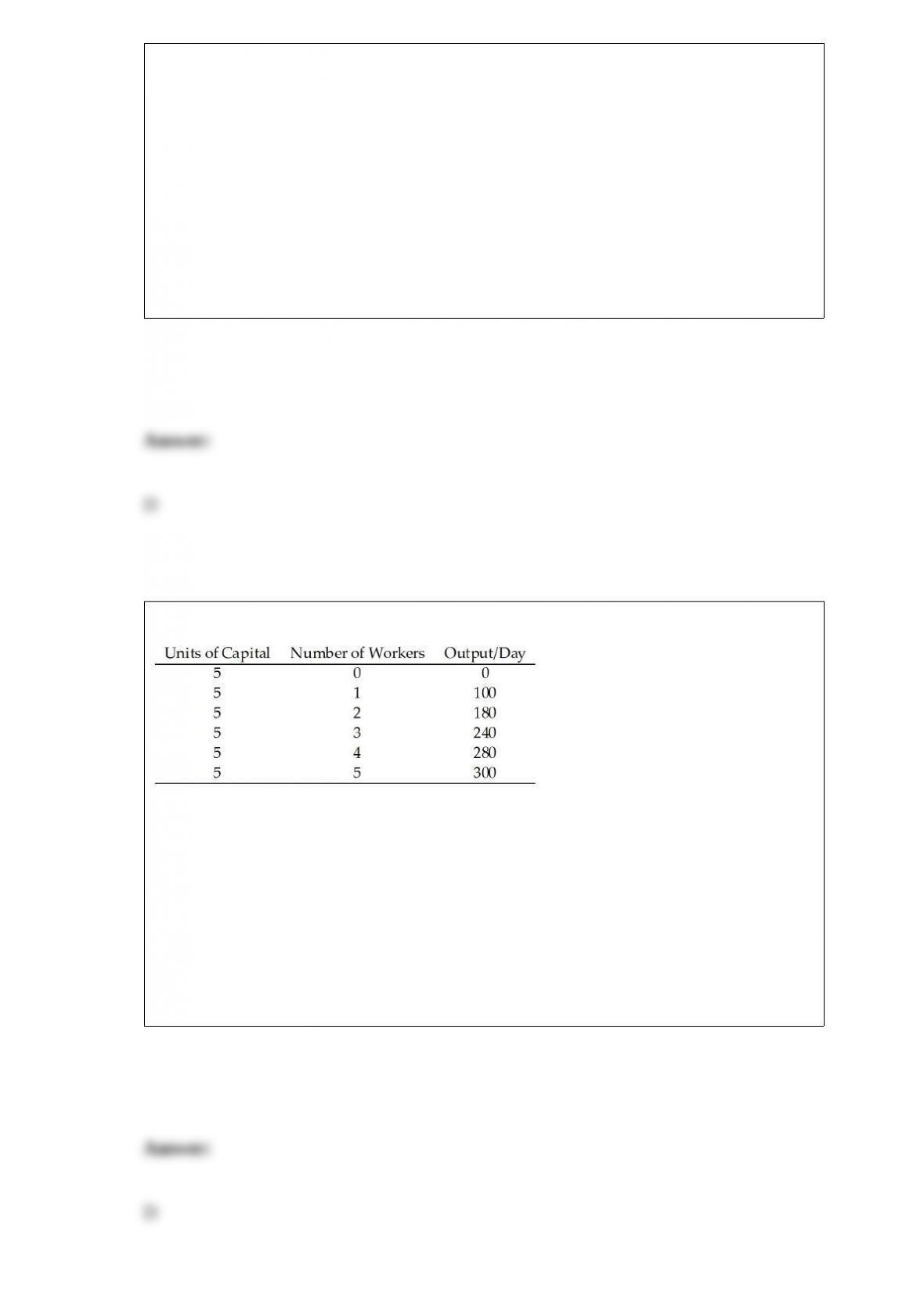
Refer to Table 2.3. The marginal product of the 4th worker is:
Table 2.3
A) 100 units of output.
B) 80 units of output.
C) 60 units of output.
D) 40 units of output.