
The balance of trade is defined as
A) the difference between the balance of the current account and the balance of the
capital account.
B) the difference between the value of the goods and services a country exports and the
value of the goods and services a country imports.
C) the difference between the value of the goods a country exports and the value of the
goods a country imports.
D) the difference between the balance of the current account and the balance of the
financial account.
A firm’s accounting profit is also its
A) economic profit.
B) income statement.
C) net income.
D) statement of liabilities.
Currency traders expect the dollar to appreciate. What impact will this have on
equilibrium in the foreign exchange market?
A) The dollar will appreciate, and the equilibrium quantity of dollars will decrease.
B) The dollar will depreciate, and the equilibrium quantity of dollars exchanged will

decrease.
C) The dollar will appreciate, and the equilibrium quantity of dollars will increase.
D) The dollar will appreciate, and the change in the equilibrium quantity of dollars
exchanged cannot be determined.
The United States has ________ social insurance programs, and generally has a
________ unemployment rate, as compared to Canada and Western Europe.
A) less generous; lower
B) less generous; greater
C) more generous; lower
D) more generous; greater
Which of the following are represented by the same flow in the circular flow model?
A) the flow of goods and the flow of factors of production
B) the flow of costs and the flow of revenue
C) the flow of income earned from the sale of resources and the flow of expenditures on
goods and services
D) the flow of income received by households and the flow of tax revenues paid by
firms
Higher personal income taxes
A) increase aggregate demand.
B) increase disposable income.
C) decrease aggregate demand.
D) both B and C
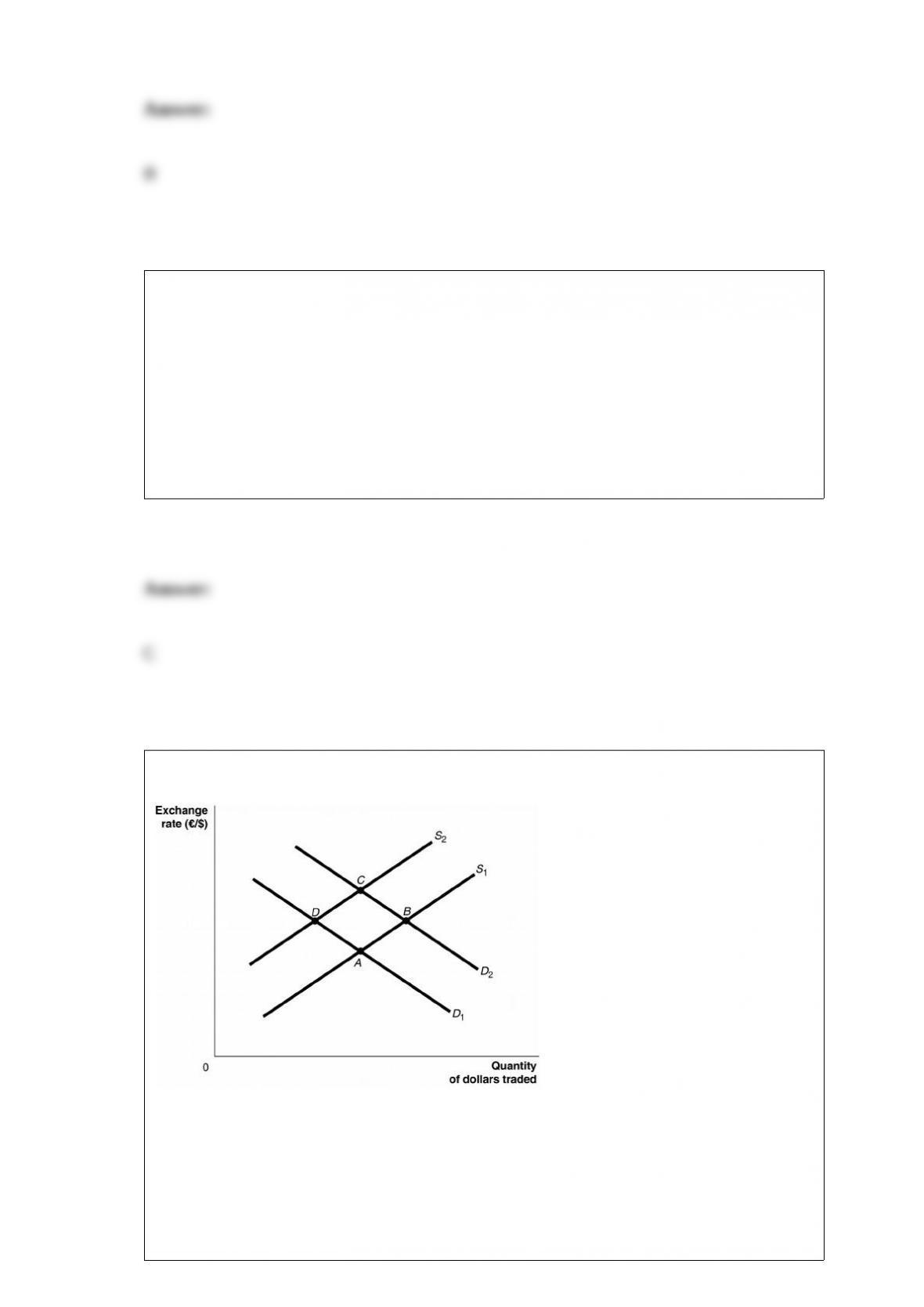
Figure 18-1
Refer to Figure 18-1. The depreciation of the dollar is represented as a movement from
A) B to A.
B) D to C.
C) B to C.

D) A to C.
E) A to B.
When an economy faces diminishing returns,
A) the slope of the per-worker production function becomes steeper as capital per hour
worked increases.
B) the slope of the per-worker production function becomes flatter as capital per hour
worked increases.
C) the per-worker production function shifts to the left.
D) the per-worker production function shifts to the right.
The labor force is the sum of
A) employed workers and discouraged workers.
B) employed workers and unemployed workers.
C) employed workers and individuals not looking for work.
D) employed workers and the working age population.
E) unemployed workers and the working age population.

A government tax rebate of $1,000 would ________ your disposable income by
________.
A) increase; less than $1,000
B) increase; $1,000
C) decrease; less than $1,000
D) decrease; $1,000
If, in a closed economy, real GDP is $30 billion, consumption is $20 billion, and
government purchases are $5 billion, what is total saving in the economy?
A) $5 billion
B) $15 billion
C) $45 billion
D) $55 billion

Monique buys a new television for $795. She receives consumer surplus of $355 from
the purchase. How much does Monique value her television?
A) $355
B) $440
C) $795
D) $1150
Gross domestic product is generally ________ national income.
A) greater than
B) less than
C) equal to
D) unrelated to
Purchasing power parity is the theory that, in the long run, exchange rates should be at a
level such that equivalent amounts of any country’s currency
A) will equalize nominal interest rates across countries.
B) are valued inversely relative to the size of its GDP.
C) should earn the same real rate of return.

D) allow one to buy the same amount of goods and services.
The quantity of goods and services that can be produced by one worker or by one hour
of work is referred to as
A) technology.
B) labor productivity.
C) real GDP.
D) human capital.
If, during a deposit expansion, not all money gets redeposited into the banking system
and some leaks out as currency, then the real world multiplier is
A) smaller than 1/RR.
B) larger than 1/RR.
C) equal to 1/RR.
D) not related to 1/RR.