
Your loss from an increase in interest rates is ________, and your gain from a decrease
in interest rates is ________, if you hold a two-year bond compared to holding a
one-year bond.
A) greater; greater
B) greater; less
C) less; greater
D) less; less
Suppose that the production function for the economy is Y = AK0.5L0.5. If the capital
stock = 40,000, the quantity of labor = 10,000, and the efficiency index = 3, the
equilibrium real wage is
A) $3.
B) $4.50.
C) $9.
D) $16.67.
In 1886, the price of a 6.5-ounce glass bottle of Coca Cola was priced at 5 cents. In the
case of this size bottle of Coca Cola, the price could be considered

A) as remaining sticky in the short run but flexible in the long run.
B) as remaining sticky in both the short run and the long run.
C) as being flexible in the short run, but returning to price stickiness in the long run.
D) as being flexible in both the short run and the long run.
Using AK growth models and assuming that the labor force is fixed at the value of 1,
A) real GDP per worker is greater than real GDP per capita.
B) real GDP per capita is less than real GDP.
C) real GDP is greater than real GDP per worker and real GDP per capita.
D) there is essentially no difference in real GDP, real GDP per worker, and real GDP
per capita.
Economists who are concerned with the effect of fiscal policy on the ability of
households and firms to borrow to finance consumption will focus on ________, and
economists who want to know whether the government’s fiscal policy is sustainable will
focus on ________.
A) yearly budget deficits; the federal debt
B) the federal debt; yearly budget deficits
C) yearly budget deficits; both the federal debt and yearly budget deficits
D) the federal debt; both the federal debt and yearly budget deficits
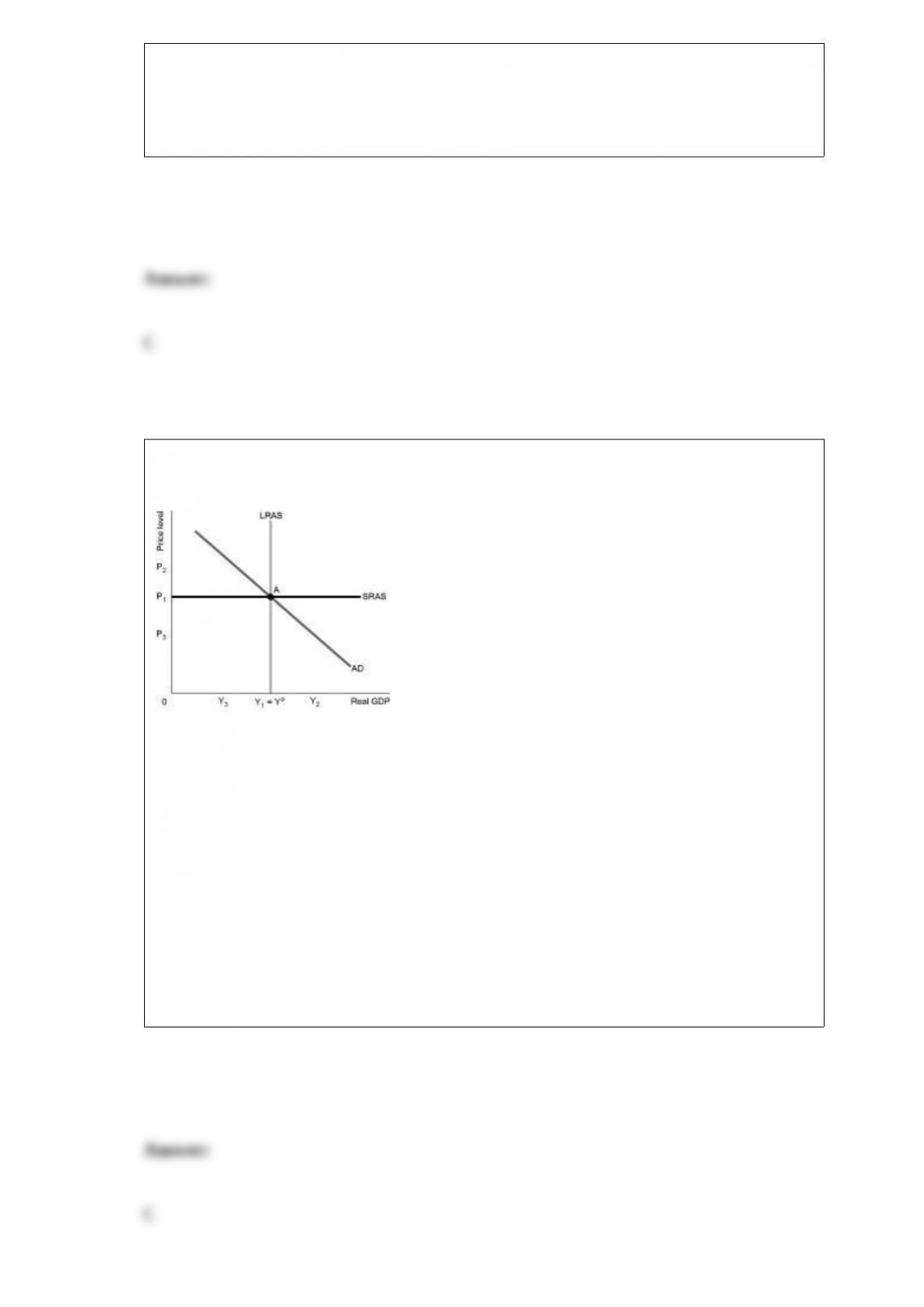
Figure 9.1
Refer to Figure 9.1. Assume the economy is initially at point A. The initial change
resulting from a recession caused by an increase in oil prices is best represented by
which short-run equilibrium combination of price level and real GDP?
A) P2; Y2
B) P3; Y3
C) P2; Y3
D) P3; Y2

Of the three primary tax sources of revenue for the U.S. federal government, which of
the following has decreased the most as a percentage of GDP since 1962?
A) corporate income taxes
B) social insurance taxes
C) sales and excise taxes
D) individual income taxes
If the MPC = 0.80, the tax multiplier is
A) -2.
B) -4.
C) -5.
D) -8.
By announcing a higher inflation target, a central bank can
A) permanently increase real GDP and permanently decrease the unemployment rate.

B) temporarily increase real GDP and permanently decrease the unemployment rate.
C) permanently increase real GDP and temporarily decrease the unemployment rate.
D) temporarily increase real GDP and temporarily decrease the unemployment rate.
During the housing market and financial crises of 2007 and 2008, the Fed increased the
volume of discount loans in an attempt to
A) reassure financial markets and promote financial market stability.
B) stabilize prices and reduce the growing inflation rate.
C) eliminate structural unemployment to lower the unemployment rate.
D) attract foreign investment and stabilize interest rates.
In which of the following situations are wages the least likely to be sticky?
A) Unionized workers are in the second year of a three-year labor contract.
B) A firm that pays efficiency wages to its employees is experiencing an economic
recession.
C) A firm has an implicit contract with its employees regarding wages during recessions
and expansions.
D) A firm hires hourly workers based on changes in the supply and demand for its
products.
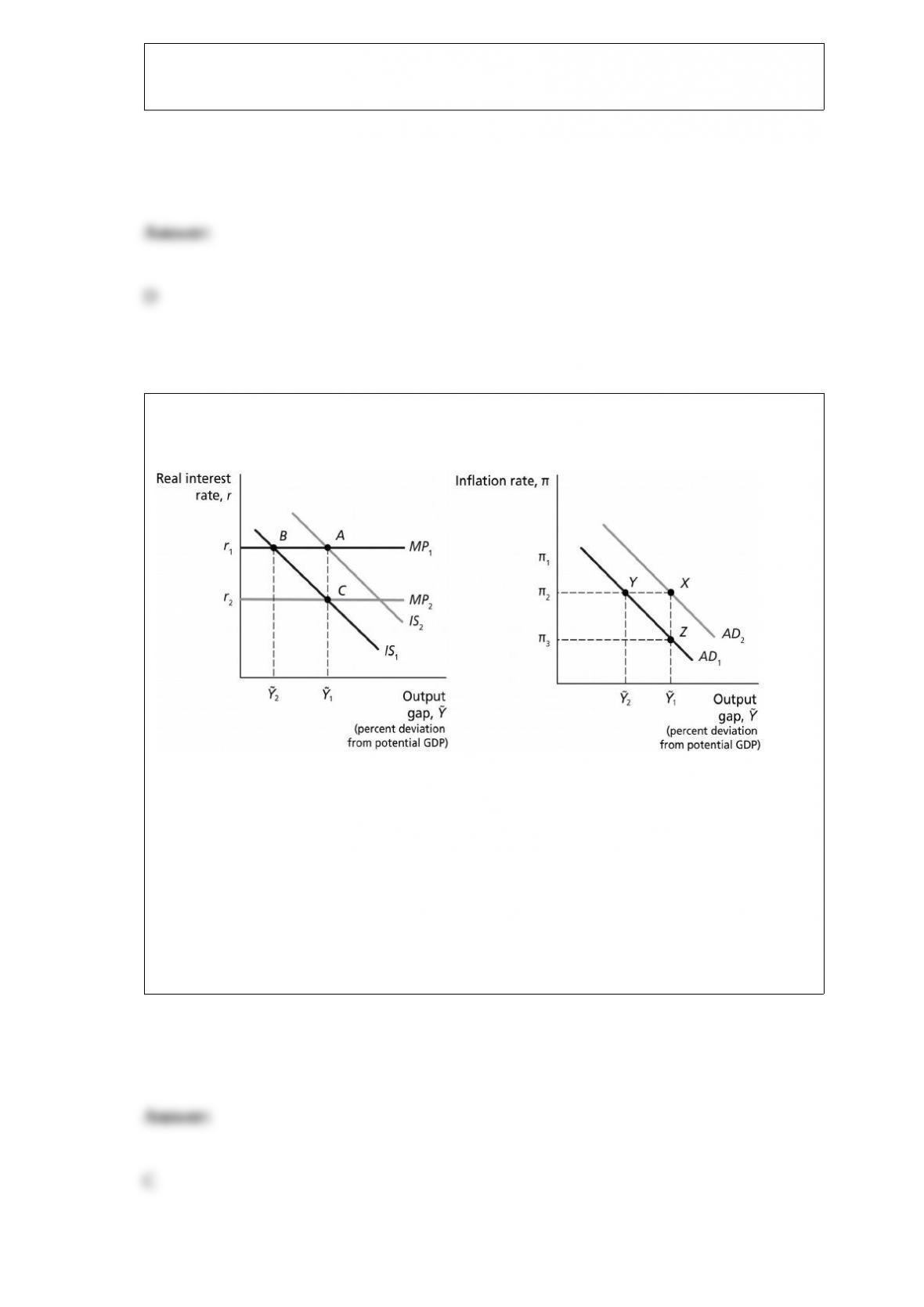
Figure 14.1
Refer to Figure 14.1. Other things equal, an increase in the inflation rate is best
represented as a movement from
A) point A to point B.
B) point C to point A.
C) point C to point B.
D) point B to point C.

Assume the long-term real interest rate is 4% and the expected inflation rate is 5%. If
the Fed decreases the money supply and as a result, the expected inflation rate
decreases to 2%, then based on the Fisher effect, the long-term real interest rate will
________ and the long-term nominal interest rate will ________.
A) fall to 4%; rise to 7%
B) remain at 4%; fall to 6%
C) fall to 1%; fall to 6%
D) fall to 6%; remain at -1%
Suppose the government cuts taxes by $300 million dollars this year and must pay off
its debt next year by increasing taxes by $300 million. According to Ricardian
equivalence, consumption spending will ________ this year and ________ next year,
all else equal.
A) increase by $300 million; decrease by $300 million
B) increase by $150 million; decrease by $150 million
C) increase by $300 million; not change
D) not change; not change
Which expression best represents the break-even level of investment when

incorporating labor-augmenting technological change into the Solow growth model?
A) (d + n + g)k
B) (d + n)k
C) (d + n ) / (k + g)
D) (d + n + k) / (gk)
Other things equal, if foreign holdings of U.S. dollars decrease,
A) the balance on the U.S. current account will decrease.
B) the balance on the U.S. financial account will decrease.
C) the balance on the U.S. capital account will decrease.
D) the U.S. balance of payments will decrease.
When economists address the concept of price and wage stickiness in relation to the
business cycle, they are referring to
A) nominal prices and nominal wages.
B) real prices and real wages.
C) both nominal and real prices and wages.
D) both nominal and real prices, but only real wages.
Which of the following represents a positive supply shock, a negative supply shock, a
positive demand shock, or a negative demand shock?
a. The government unexpectedly doubles all personal income tax rates.
b. A newly discovered infectious disease shuts down all international ports indefinitely.
c. Major technological progress occurs in the market for green energy.
d. An earthquake wipes out 60% of the manufacturing capacity of an economy.
e. The government unexpectedly eliminates the inheritance tax and the capital gains tax
on sales of stocks and bonds.

The per worker production function shows the relationship between
A) the labor force and the capital stock.
B) the supply of labor and the population.
C) the hours worked and the number of workers.
D) real GDP per worker and capital per worker.
The housing shock which occurred during the recession of 2007-2009 reduced wealth
and residential construction, causing the
A) IS curve to shift to the right.
B) IS curve to shift to the left.
C) MP curve to shift up.
D) MP curve to shift down.
The most important source of revenue for the federal government is
A) tax revenue.
B) investment income from the Federal Reserve.

C) seigniorage.
D) import tariffs.
Suppose that the demand for labor decreases due to an economic downturn, and union
workers are in the first year of a 3-year labor contract. With respect to these union
laborers, the economic downturn will most likely ________ the nominal wage and
________ the quantity of labor hired.
A) decrease; not change
B) decrease; decrease
C) not change; decrease
D) not change; not change
A key reason that Congress established the Fed to act as a lender of last resort was to
prevent ________, the process by which a run on one bank spreads to other banks,
resulting in a bank panic.
A) contagion
B) asset inflation
C) moral hazard

D) bailouts
Assume the capital-labor ratio remains constant. If investment increases at a constant
rate, real GDP per worker will increase ________, and if total factor productivity
increases at a constant rate, real GDP per worker will increase ________.
A) at an increasing rate; at an increasing rate
B) at a constant rate; at an increasing rate
C) at a constant rate; at a decreasing rate
D) at a decreasing rate; at a constant rate
The increase in the amount that the government collects in taxes when the economy
expands and the decrease in the amount that the government collects in taxes when the
economy goes into a recession is an example of
A) discretionary monetary policy.
B) the discretionary multiplier effect.
C) discretionary fiscal policy.
D) automatic stabilizers.

Forward-looking households may reduce consumption expenditures today if they
believe that the government is currently
A) borrowing to run a budget deficit, and to pay back these loans in the future may
require higher taxes.
B) running a budget surplus, and the increase in the government’s supply of money will
generate inflation in the future.
C) experiencing a balanced budget, and will therefore not be implementing any fiscal
policy to stabilize the economy.
D) cutting federal spending to decrease the budget deficit, which will raise the real
interest rate, the inflation rate , and the unemployment rate.
Table 9.1
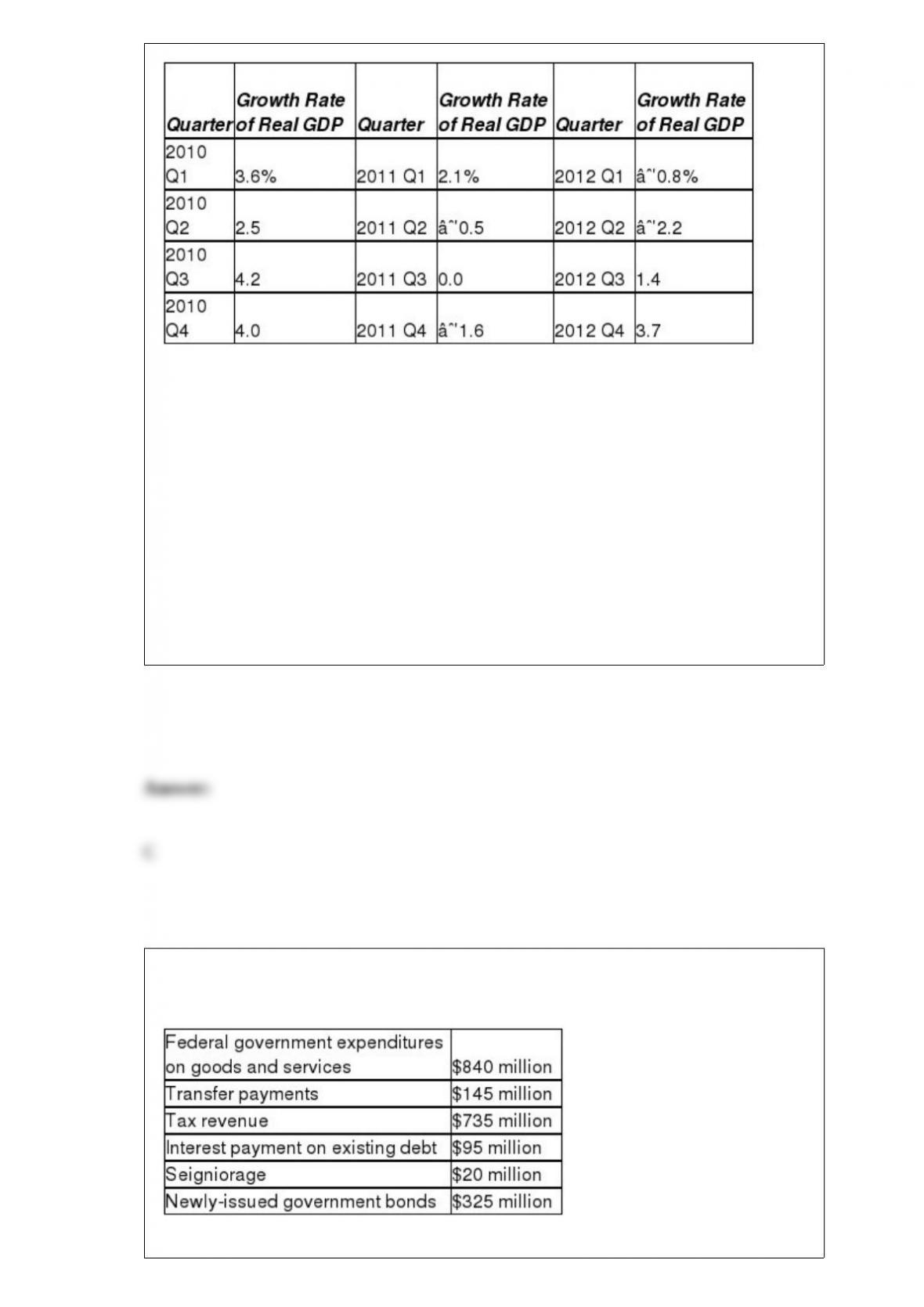
The table shows the growth rate of real GDP for the nation of Gigantica for the years
2010-2012.
Refer to Table 9.1. Use the rule of thumb to determine in which quarter Gigantica first
entered a recession during the years 2010-2012.
A) 2010 Q4.
B) 2011 Q2.
C) 2011 Q4
D) Gigantica did not enter a recession from the years 2010-2012.
Table 15.2
The data in the table represents budget figures for the nation of Harmonia for 2012.
Refer to Table 15.2. From the information presented in the table, calculate the
following values for the nation of Harmonia in 2012:
a. the budget deficit
b. the primary budget deficit
c. the uses of government funds
d. the sources of government funds
Suppose the required reserve ratio is 5%. If banks are conservative and choose not to
loan all of their excess reserves, the actual money multiplier is
A) less than 20.
B) greater than 20.
C) equal to 20
D) equal to 5.

From 1950 to 2007, the United States experienced ________ business cycle expansions,
followed by ________ recessions.
A) long; long
B) long; brief
C) brief; long
D) brief; brief
Assume that for the second quarter of 2012, actual real GDP was $125.5 billion and
potential real GDP was $142.7 billion. According to Okun’s law, the cyclical
unemployment rate during the second quarter of 2012 was
A) 5.7%.
B) 6%.
C) 6.9%.
D) 7.4%.

Suppose that the labor movement has a revival in the United States and the majority of
workers join labor unions. As a result we would expect
A) the unemployment rate to fall.
B) the unemployment rate to rise.
C) no change in the unemployment rate, but a decrease in the natural rate of
unemployment.
D) an increase in the unemployment rate, but a decrease in the natural rate of
unemployment.