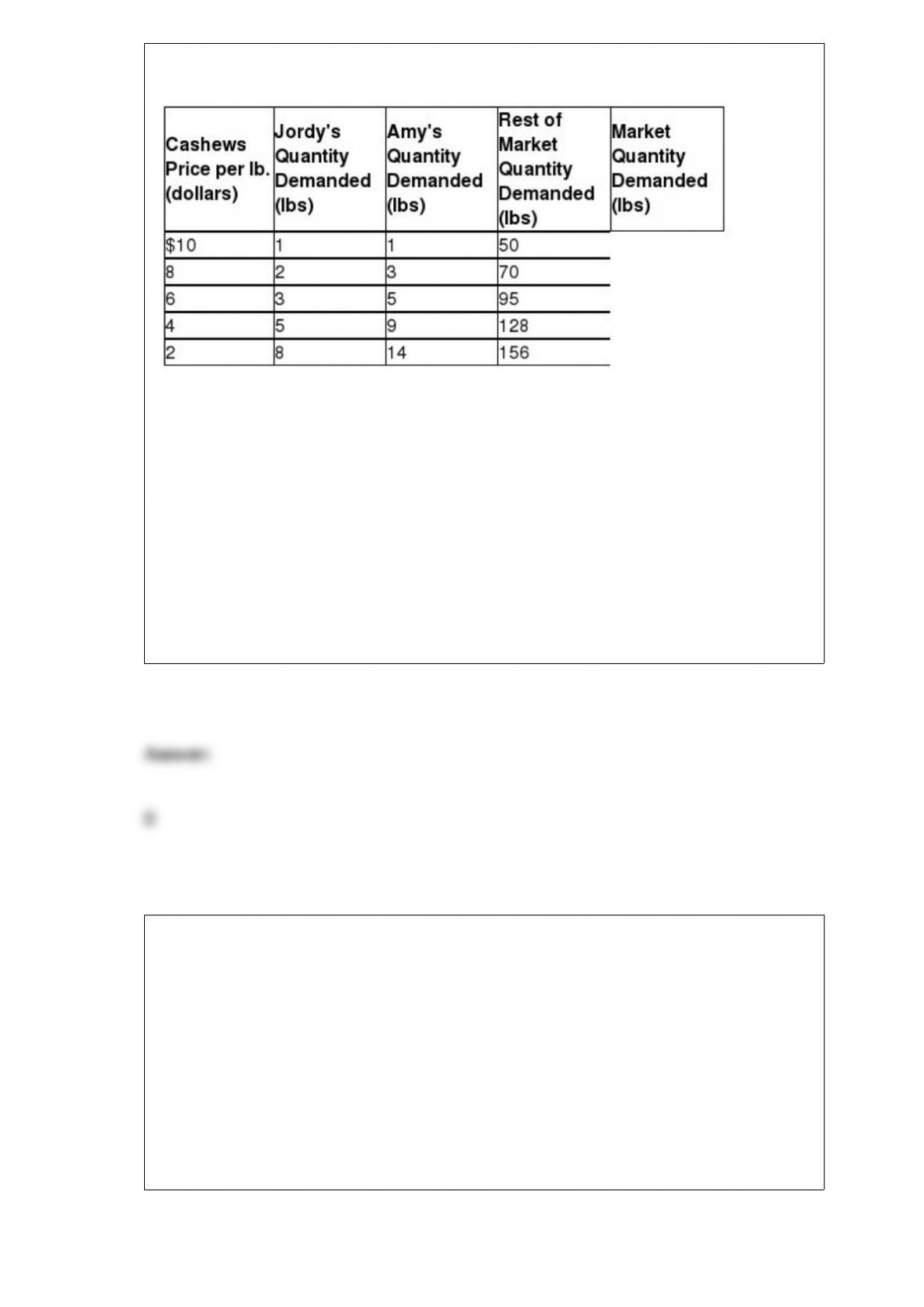
Table 3-2
The table above shows the demand schedules for cashews of two individuals (Jordy and
Amy) and the rest of the market. If the price of cashews falls from $4 to $2, the market
quantity demanded would
A) decrease by 28 lbs.
B) increase by 36 lbs.
C) increase by 28 lbs.
D) decrease by 36 lbs.
From an initial long-run macroeconomic equilibrium, if the Federal Reserve anticipated
that next year aggregate demand would grow significantly faster than long-run
aggregate supply, then the Federal Reserve would most likely
A) increase income tax rates.
B) decrease income tax rates.
C) increase interest rates.
D) decrease interest rates.

Potential GDP refers to the level of
A) real GDP in the long run.
B) nominal GDP in the long run.
C) real GDP in the short run.
D) nominal GDP in the short run.
The Google search engine has a market share of ________ in the United States and
________ in Europe.
A) 90 percent; 25 percent
B) 50 percent; 50 percent
C) 70 percent; 90 percent
D) 45 percent; 15 percent
The shape of the average total cost curve is determined by the shape of

A) the marginal cost curve.
B) the average fixed cost curve.
C) the average product curve.
D) the firm’s production function.
Active changes in tax and spending by government intended to smooth out the business
cycle are called ________, and changes in taxes and spending that occur passively over
the business cycle are called ________.
A) automatic stabilizers; discretionary fiscal policy
B) discretionary fiscal policy; automatic stabilizers
C) automatic stabilizers; monetary policy
D) discretionary fiscal policy; conscious fiscal policy
Suppose that American firms claim that protectionism in Canada is on the rise as the
Canadian government attempts to protect its infant industries with a “Buy Canadian”
provision. This policy, similar to the original “Buy American” provision in the 2009
U.S. stimulus bill, is likely to cause
A) exporting countries to retaliate by placing trade barriers on Canadian imports.
B) Canadian manufacturers to become more efficient.
C) Canadian companies to pay lower prices for protected products.
D) most countries to reduce their own trade barriers to be able to better compete with
Canadian imports at home.
If consumers purchase fewer of those products that increase most in price and more of
those products that decrease in price as compared to the CPI basket, then
A) changes in the CPI accurately reflect the true rate of inflation.
B) changes in the CPI understate the true rate of inflation.
C) changes in the CPI overstate the true rate of inflation.
D) changes in the CPI are unrelated to the true rate of inflation.
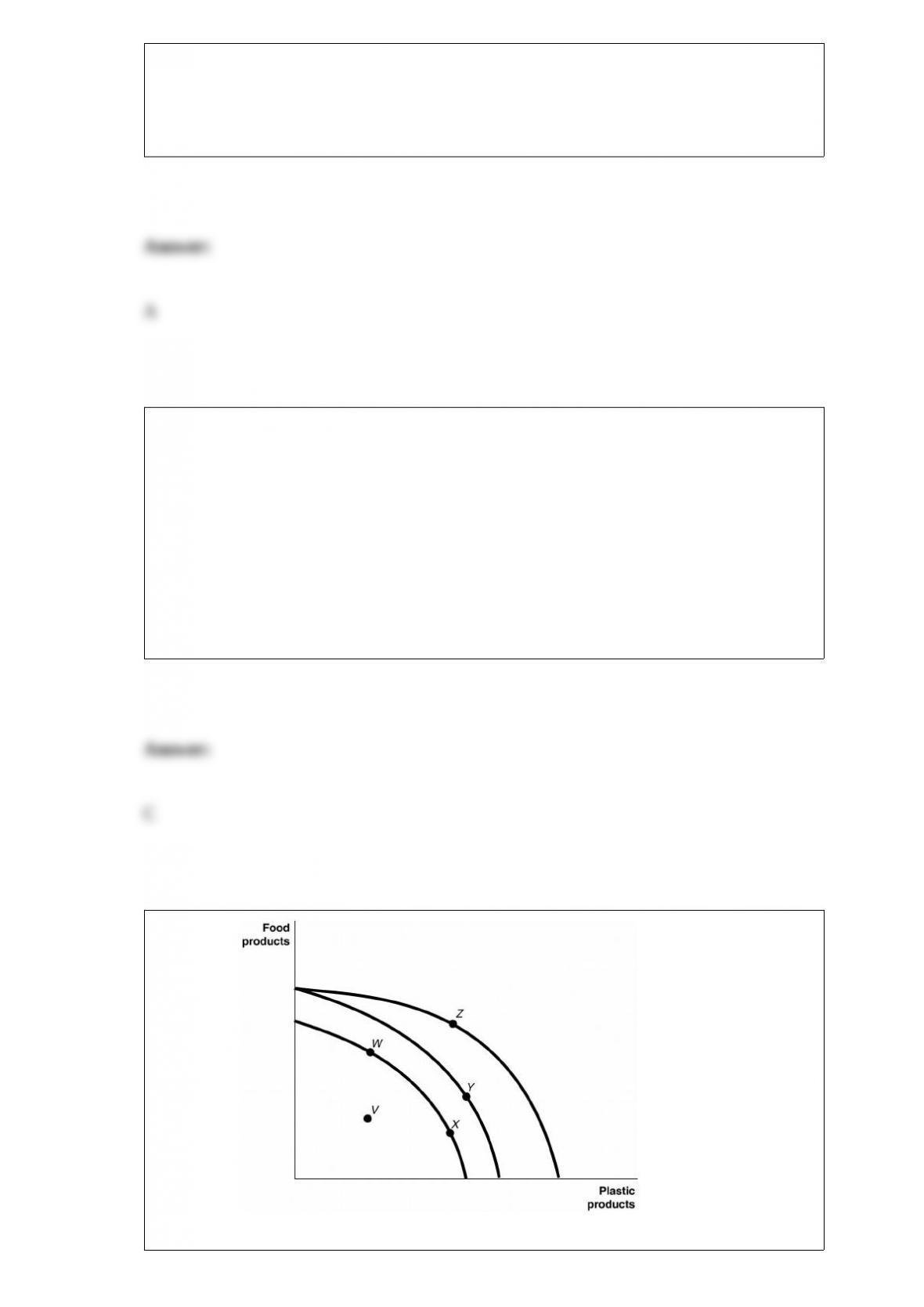
Figure 2-4

Figure 2-4 shows various points on three Different production possibilities frontiers for
a nation.
Consider the following movements:
a. from point V to point W
b. from point W to point Y
c. from point Y to point Z Which of the movements listed above represents
advancements in technology with respect to only plastic production?
A) a, b, and c
B) b and c only
C) b only
D) c only
Which of the following describes actual trends in the U.S. labor force participation rate?
A) The labor force participation rate of adult men has risen since 1950.
B) The labor force participation rate of adult women has fallen since 1950.
C) The labor force participation rate of adult men not in school, but too young to retire
has risen since 1950.
D) The labor force participation rate of adult women has risen since 1950.
E) The labor force participation rate of all adults has fallen since 1950.

What is an isoquant? What is the slope of an isoquant?
What effect does the entry of new firms in a monopolistically competitive market have
on the economic profits of existing firms in the market? How might existing firms
attempt to counteract this effect?
Compare the distribution of income in the United States with the distribution of income
in other high-income countries.