
1) “Pork-barrel” legislation that contains funding for hundreds of earmarks throughout
numerous states often reflects:
A.the paradox of voting.
B.logrolling.
C.the benefits-received principle.
D.the Coase theorem.
2) The equation underlying the mainstream view of macroeconomics is:
A.MV = PQ.
B.Ca + Ig + Xn + G = GDP.
C.S = a – bY.
D.GDP = P x Q.
3) Which of the following countries has the highest Gini ratio?
A.Italy
B.United States
C.Japan
D.Mexico
4) between 1950 and 2007, u.s. real gdp grew at an average annual rate of about:
a.2.3 percent.
b.3.5 percent.
c.5.1 percent.
d.8.6 percent.
5) “under central planning, some group has to decide how to get the necessary inputs
produced in the right amounts and delivered to the right places at the right time. this is a
nearly impossible task without markets and profits.” this quotation best identifies the:
a.incentive problem under central planning.
b.coordination problem under central planning.
c.self-sufficiency dilemma under communism.
d.resource overcommitment problem under communism.

6) in national income accounting, consumption expenditures include:
a.purchases of both new and used consumer goods.
b.consumer durable goods and consumer nondurable goods, but not services.
c.consumer durable goods, consumer nondurable goods, and services.
d.changes in business inventories.
7) In the aggregate expenditures model, an increase in government spending may:
A.decrease real GDP.
B.increase output and employment.
C.shift the aggregate expenditures schedule downward.
D. reduce the size of the inflationary gap.
8) Other things equal, a restrictive monetary policy during a period of demand-pull
inflation will:
A.lower the interest rate, increase investment, and reduce net exports.
B.lower the price level, increase investment, and increase aggregate demand.
C.increase productivity, aggregate supply, and real output.
D.increase the interest rate, reduce investment, and reduce aggregate demand.
9) allocative efficiency is achieved when the production of a good occurs where:
a.p = minimum atc.
b.p = mc.
c.p = minimum avc.
d.total revenue is equal to tfc.
10) in 1933 net private domestic investment was a minus $6.0 billion. this means that:
a.gross private domestic investment exceeded depreciation by $6.0 billion.
b.the economy was expanding in that year.
c.the production of 1933’s gdp used up more capital goods than were produced in that
year.
d.the economy produced no capital goods at all in 1933.
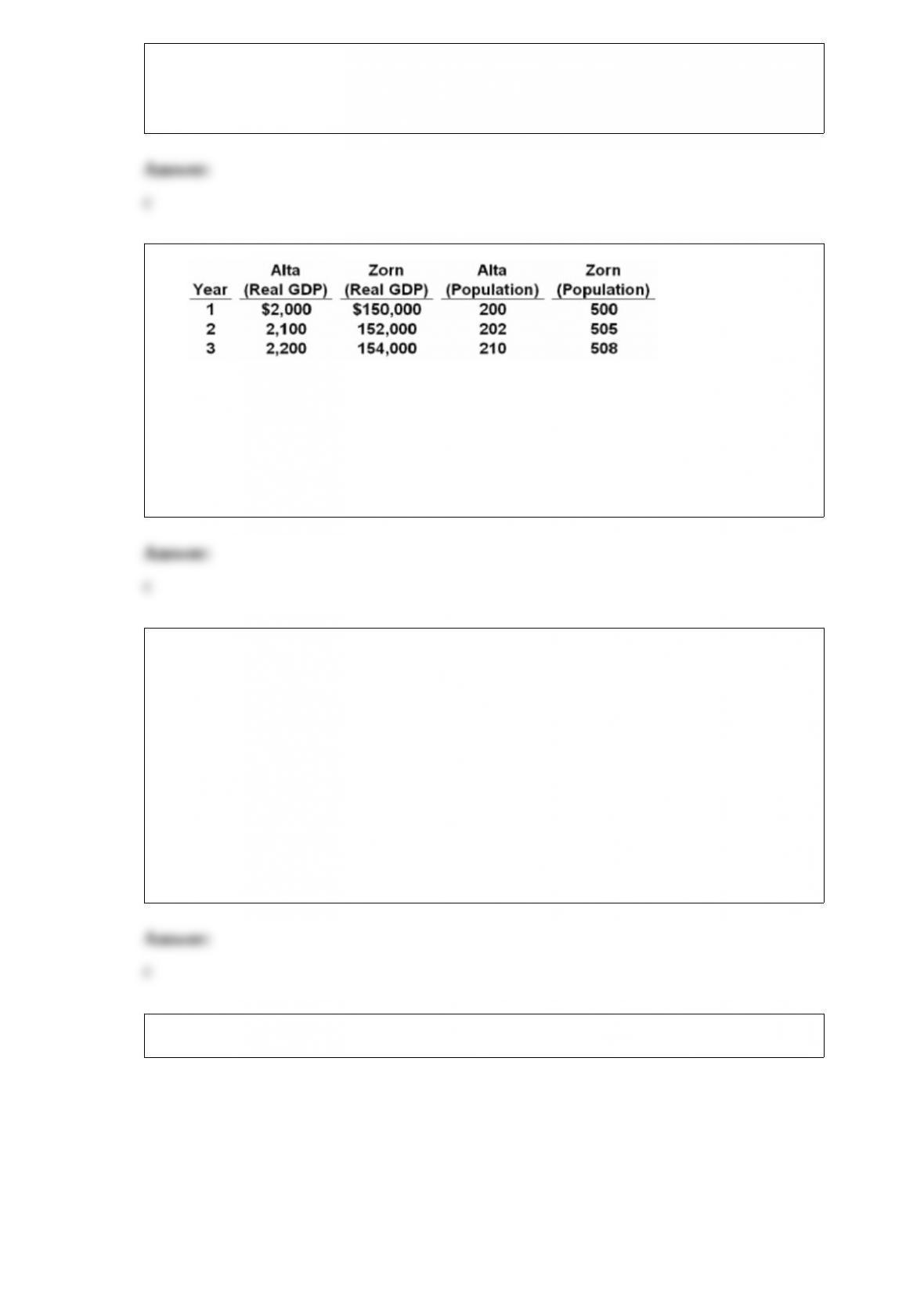
11)
refer to the above table. between years 1 and 2, real gdp grew by __________ percent
in alta:
a.3
b.4
c.5
d.10
12) the illinois central railroad once asked the illinois commerce commission for
permission to increase its commuter rates by 20 percent. the railroad argued that
declining revenues made this rate increase essential. opponents of the rate increase
contended that the railroad’s revenues would fall because of the rate hike. it can be
concluded that:
a.both groups felt that the demand was elastic but for different reasons.
b.both groups felt that the demand was inelastic but for different reasons.
c.the railroad felt that the demand for passenger service was inelastic and opponents of
the rate increase felt it was elastic.
d.the railroad felt that the demand for passenger service was elastic and opponents of
the rate increase felt it was inelastic.
13) Consumer’s income = $12
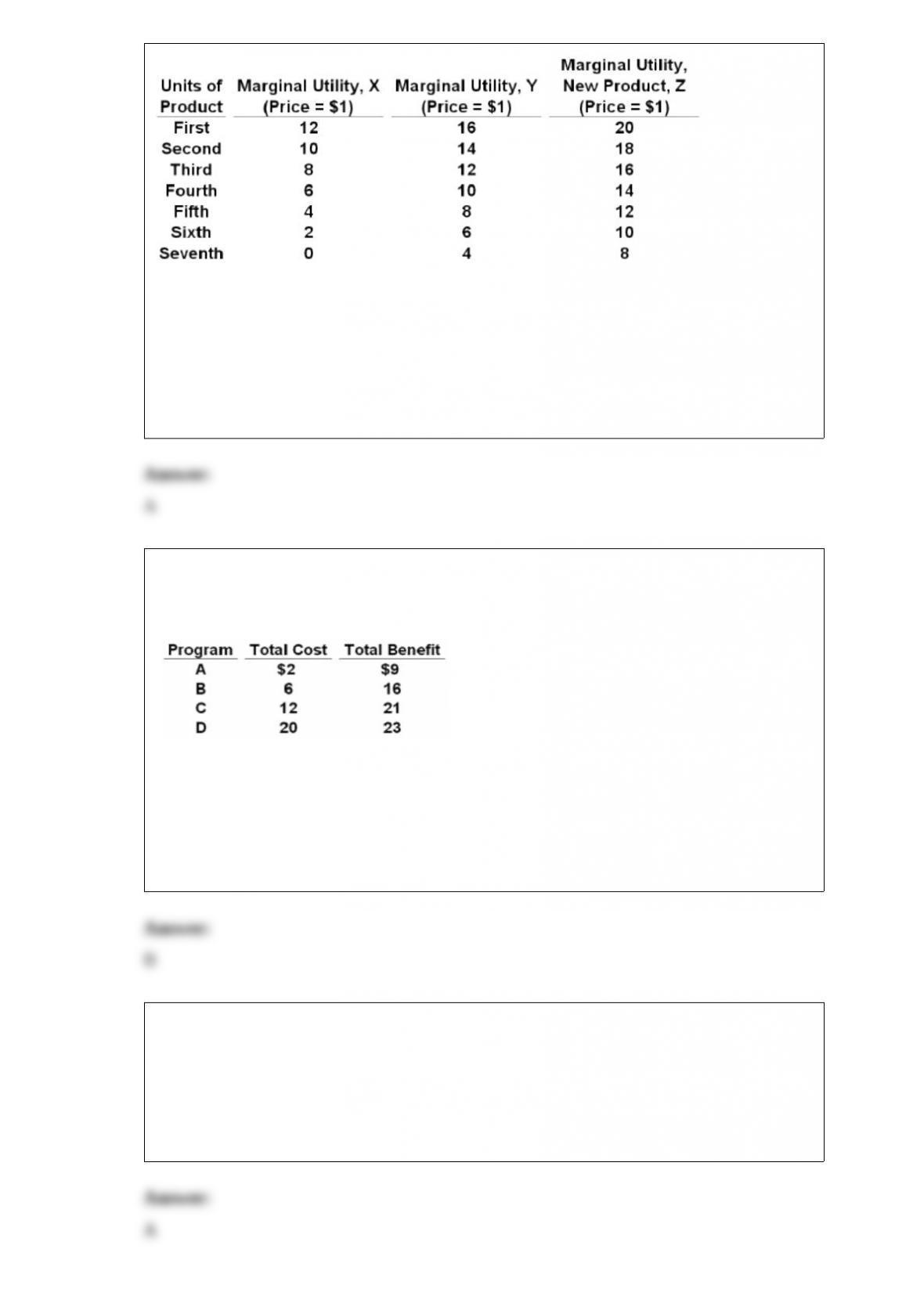
Refer to the above data for a utility-maximizing consumer. Assume that new product Z
doesn’t exist. How many units of X and Y will this consumer buy, given his or her $12
budget?
A.5 of X and 7 of Y.
B.7 of X and 5 of Y.
C.6 of X and 6 of Y.
D.5 of X and 6 of Y.
14) The following information is for four highway programs of increasing scope. All
figures are in millions of dollars.
The above data indicate that:
A.there is no highway program that is economically justifiable on the basis of
cost-benefit analysis.
B.the marginal cost and marginal benefit of Program A are $2 and $9 respectively.
C.the marginal cost and marginal benefit of Program C are $12 and $21 respectively.
D.the marginal cost and marginal benefit of Program A cannot be determined.
15) What percentage of the U.S. public debt is held by Federal agencies and the Federal
Reserve?
A.53 percent
B.58 percent
C.47 percent
D.26 percent