
Suppose that television show A is much more popular than television show B.The
equilibrium price for a ticket to view the taping of show A is $40 and the equilibrium
price for a ticket to view the taping of show B is -$30.If free tickets are offered for the
taping of both shows, it is likely that
a. there will be a shortage of tickets for show A and a surplus of tickets for show B.
b. there will be a surplus of tickets for show A and a shortage of tickets for show B.
c. there will be a surplus of tickets for both shows.
d. there will be a shortage of tickets for both shows.
Which of these goods may be considered rivalrous in consumption and nonexcludable?
a. wilderness areas
b. national defense
c. broadcast television reception
d. fire insurance
The open lands in the early West were overgrazed largely because no one owned the
land being used for grazing.
a. True

b. False
Three persons, A, B, and C, will use a simple majority vote to determine whether some
good will be purchased. Each person’s “tax share” of the purchase price of the good will
be $25. Person A receives $30 worth of benefits from the good, person B receives $26
worth of benefits from the good, and person C receives $2 worth of benefits from the
good. It follows that __________ person(s) will vote for the good, __________
person(s) will vote against it, and that the outcome is __________.
a. one; two; inefficient
b. two; one; efficient
c. one; two; efficient
d. two; one; inefficient
Which of the following is false?
a. It is impossible for a person to be uninformed on who is running for president, what
the candidates stand for, and on everything else connected with presidential politics and
still be rational.

b. Failure to vote in an election is not necessarily a sign of apathy.
c. Informed voters necessarily have a larger impact on elections than uninformed voters.
d. a and c
The profit-maximizing monopolistic competitor produces at the level of output where
a. price equals marginal cost and marginal revenue.
b. marginal cost equals marginal revenue, but not price.
c. price equals marginal revenue, but not marginal cost.
d. price equals marginal cost, but not marginal revenue.
As a result of a quota, both consumers’ surplus and producers’ surplus fall.
a. True
b. False
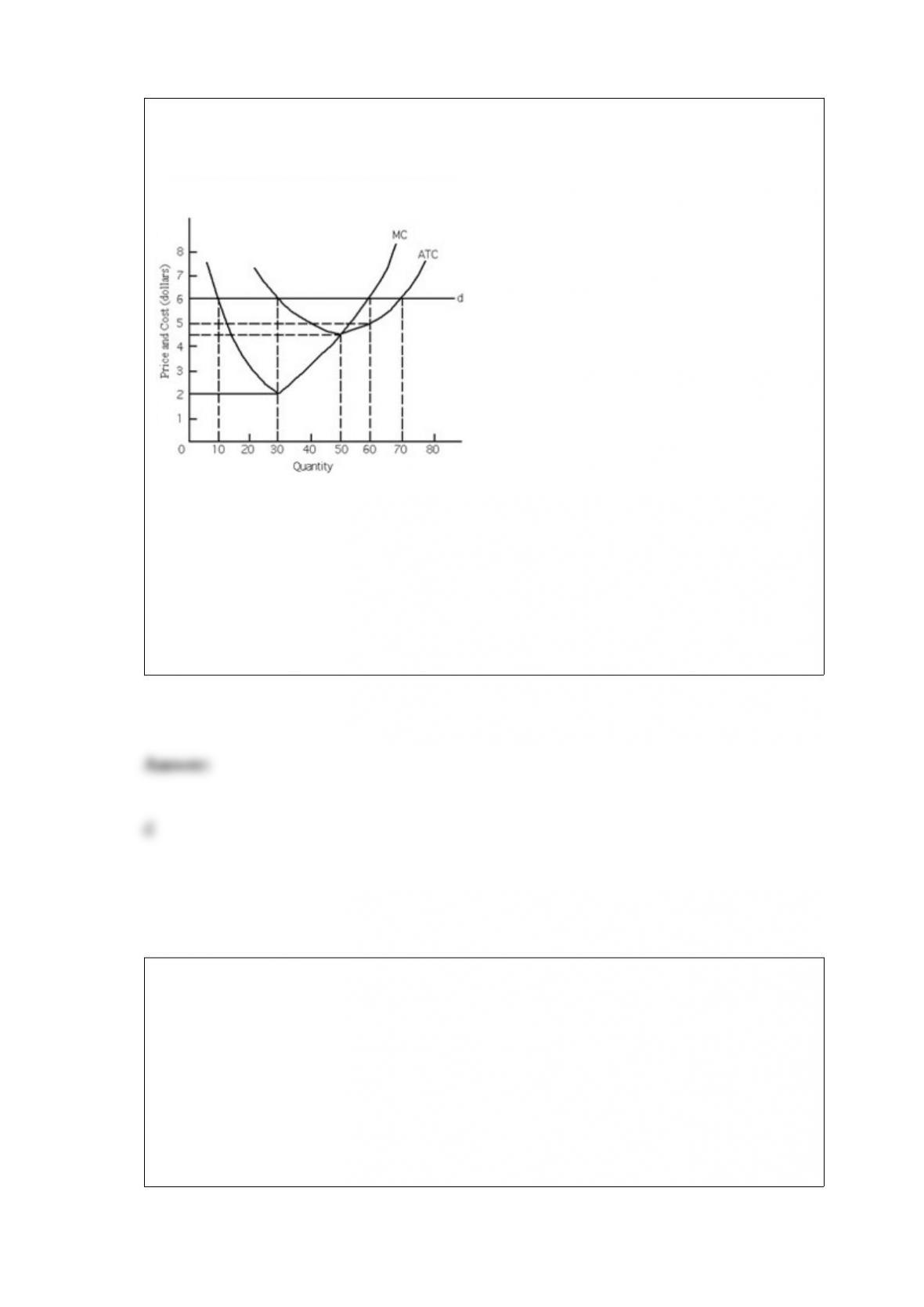
Refer to Exhibit 23-7. At the profit-maximizing output level, the firm’s total revenue is
Exhibit 23-7
a. $60.00.
b. $225.00.
c. $300.00.
d. $360.00.
e. $420.00.
A perfectly competitive firm should increase its level of production as long as
a. total revenue is less than total cost.
b. the total revenue curve is rising.
c. marginal revenue is greater than marginal cost.
d. the marginal revenue curve is rising.

A monopolist can sell 26,000 units at a price of $30 per unit. Lowering price by $1
raises the quantity demanded by 1,000 units. What is the change in total revenue
resulting from this price change?
a. $1,500
b. $3,000
c. $5,500
d. -$2,800
Interest can be regarded as the
a. payment to entrepreneurs for incurring risk in the production of new goods.
b. rate that a lender receives for the use of the lender’s loanable funds.
c. return earned by capital as an input in the production process.
d. dollar amount of loanable funds that a person borrows to invest in a capital good.

The market shares (in percentage terms) for the 12 firms that comprise an industry are
15, 12, 11, 10, 8, 7, 7, 6, 6, 6, 6, and 6. The Herfindahl index is __________ and the
four-firm concentration ratio is __________.
a. 932; 48 percent
b. 1,032; 27 percent
c. 1,000; 48 percent
d. 950; 24 percent
e. none of the above
What is the Herfindahl index of an industry made up of four equal-sized firms?
a. 1,667
b. 2,500
c. 2,250
d. 125
e. This cannot be determined without further information.

The question of how a tax change might impact U.S. economic output is most closely
associated with the study of
a. microeconomics.
b. managerial economics.
c. macroeconomics.
d. consumer economics.
In the case of a nonexcludable public good, the market will fail to produce the good
because of the free rider problem.
a. True
b. False
Marginal utility is
a. the extra satisfaction derived from consuming an additional unit of a good.
b. the total satisfaction derived from consuming an additional unit of a good.
c. the total satisfaction derived from consuming a good.
d. the change in total satisfaction as an additional unit of a good is consumed.
e. a and d

Suppose that your school pays one rate for the first one million kilowatts of electricity
and a lower rate for any power it uses over one million kilowatts. What economic
concept is occurring here?
a. perfect price discrimination
b. second-degree price discrimination
c. third-degree price discrimination
d. economies of scale
If the top four firms account for $85 billion in sales and total industry sales are $250
billion, it follows that the four-firm concentration ratio is
a. 0.34.
b. 0.66.
c. 1.34.
d. 1.66.

When a decision is made based on a simple majority vote it is possible for the total
benefits to the community of this decision to be less than the total costs to the
community of this decision.
a. True
b. False
“Logrolling” is
a. the exchange of votes to gain support for legislation.
b. pressure that special interest groups place on politicians.
c. when politicians refuse to go into detail and speak only in generalities.
d. the process by which government agencies make sure they spend their allotted annual
budget.
If an economist says “the higher the price of oranges, the fewer oranges individuals will
buy, ceteris paribus,” this means that
a. individuals don’t like high-priced oranges.

b. as the price of oranges rises, individuals’ preferences change and they no longer like
oranges as much as they once did.
c. as the price of oranges rises, individuals’ preferences do not change, nor does
anything else, but individuals buy fewer oranges in response to the higher price of
oranges.
d. the higher the price of oranges, the fewer oranges individuals will buy, assuming that
people have economic motives.
The theory of consumer choice assumes that consumers attempt to maximize
a. the difference between total utility and marginal utility.
b. average utility.
c. total utility.
d. marginal utility.