
Driving around and observing competition is called “windshield” research.
In a recent survey, 92 percent of consumers say that given the opportunity, they would
buy products with a social and/or environmental benefit.
The most effective technique by which small companies can gain a competitive edge
over their larger rivals is to charge lower prices for the goods and services they sell.
By collecting a wealth of data on possible locations, entrepreneurs will find that the
location decision is made for them.

The difference between the total sources of funds and the total uses of funds represents
the increase or decrease in a firm’s working capital.
Perceived value is the price customers would be willing to pay if they perfectly
understood the benefits offered, while objective value is what determines the price they
are willing to pay.
Mini-Case 12-3: Rent-A-Nerd Computer Consultants
The owners of Rent-A-Nerd Computer Consultants have prepared the partial cash
budget for the upcoming quarter:
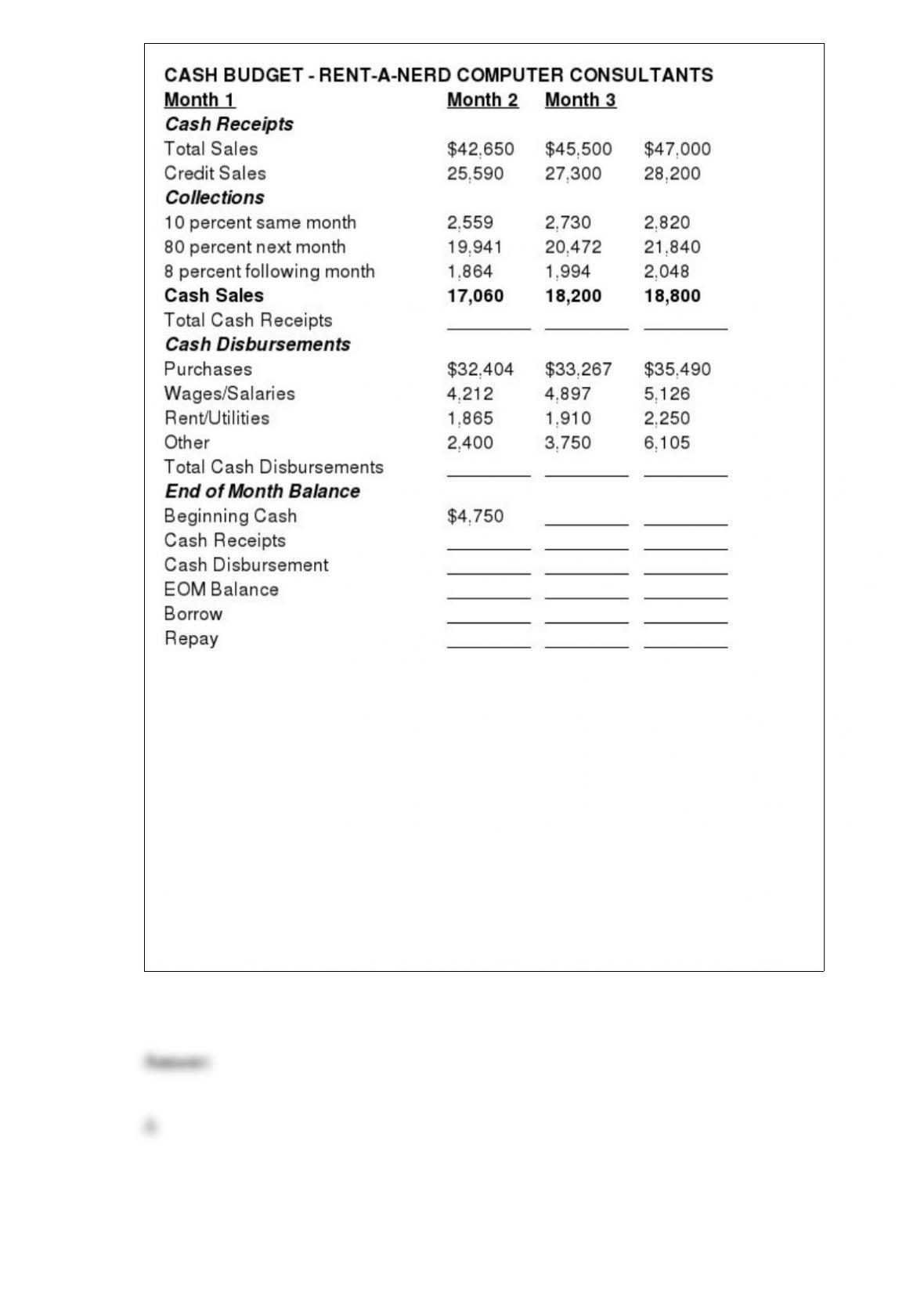
Calculate the final end-of-month balance for months 1-3 and answer the following
question.
The end-of-the-month balances for months 1, 2, and 3, respectively are ________.
A) $5,293, $4,865, and $1,402
B) $6,519, $8,195, and $6,224
C) -$10,541, -$12,524, and -$16,771
D) $32,109, $61,085, and $87,314

A cash budget ________.
A) is based on the cash method of accounting
B) is a “cash map,” showing the amount and the timing of cash flowing into and out of
the business over a given period of time
C) will never be completely accurate since it is based on forecasts
D) All of the above
Which of the following is not true regarding the limitations of professional
corporations?
A) Seventy-five percent of the shares of stock must be owned and held by individuals
licensed in the profession of the corporation.
B) At least one of the incorporators, one director, and one officer must be licensed in
the profession.
C) The Articles of Incorporation, in addition to all other requirements, must designate
the professional services to be provided by the corporation.
D) The professional corporation must obtain from the appropriate licensing board a
certification that declares the shares of stock are owned by individuals who are duly
licensed in the profession.
The nation’s small businesses ________.
A) employ more than 49 percent of the nation’s private sector workforce

B) create more jobs than do big businesses
C) account for 47 percent of business sales
D) All of the above
“Stick to what you are good at and ________ everything else” is an approach to reduce
overhead costs.
A) make
B) sell
C) leverage
D) outsource
A(n) ________ trial involves sending researchers into customers’ homes to observe
them as they use the company’s product or service.
A) in-home
B) prototype
C) windshield
D) focus group

An effective search engine optimization (SEO) strategy can be maintained through
________.
A) natural, or organic, listings
B) paid or sponsored listings
C) paid inclusions
D) All of the above
The primary cause of small business failures is ________.
A) the lack of capital
B) management mistakes
C) poor location
D) improper inventory control
Which of the following is/are disadvantage(s) of locating in a central business district?

A) Intense competition
B) High rental rates
C) Traffic congestion and inadequate parking facilities
D) All of the above
The right brain is guided by ________.
A) kaleidoscopic, lateral thinking
B) linear, vertical thinking
C) asymmetrical thinking
D) logical thinking
A technique that allows the small business owner to perform financial analysis by
understanding the relationship between two accounting elements is called ________.
A) creating the pro forma
B) budgeting
C) break-even analysis
D) ratio analysis

Which of the following is not a liquidity ratio?
A) Current ratio
B) Total asset turnover ratio
C) Quick ratio
D) None of the above
It is recommended that new business owners estimate cash disbursements as best they
can and then add on another ________ percent.
A) 3-4
B) 5-10
C) 10-25
D) 25-35

Mini-Case 2-1: Doing “good” but not doing the “right” thing
Ed and Marci Buchanan are spouses and partners in a business called “Flags
Unlimited.” They made and sold a variety of national flags in various shapes. About 40
percent of their total revenues came from a single chain retailer, MegaMart USA that
owned 798 stores throughout the United States. When Ed and Daisy started their
company, their son’s classmate’s father was a senior buyer at MegaMart USA. The
buyer, Arturo Higuain, encouraged Ed and Daisy to submit a bid to MegaMart USA and
he helped the couple establish the relationship that led to subsequent recurring sales at
the retailer. Higuain’s wife, Lupe was the head of the school’s PTA and in charge for
fund raising. Without Arturo’s asking, the Buchanans started contributing significant
sums of money to the PTA. Arturo never discouraged them from contributing. In a cost
cutting move, Arturo was laid off from MegaMart USA and in his place, Cindy
Carmichael became the buyer who interacted with the Buchanans. Cindy hinted to the
Buchanans that there were other vendors willing to supply flags at a lower price than
the Buchanans but that if they would contribute to the rebuilding of her (Cindy’s)
community’s softball park, they would continue to sell their product at MegaMart USA.
Did the Buchanans act ethically in contributing to the school’s PTA?
Which of the following would be most likely to benefit from choosing S corporation
status?
A) Startup companies anticipating net losses.
B) Corporations where net profits before any compensation to shareholders is less than
$100,000 per year.
C) Highly profitable firms with substantial dividends to pay out to shareholders.
D) A and C only

Small companies are incubators of new sales ideas, products and services and create
________ times more patents per employee than large companies.
A) 3
B) 5
C) 10
D) 16
Generally, an industry is more attractive when ________.
A) the number of competitors is large
B) competitors are similar in size
C) the industry is growing at a fast pace
D) the opportunity to sell a differentiated product or service is present

Which of the following statements about women-owned businesses is false?
A) The businesses women start tend to be smaller than those men start.
B) Women own about 28 percent of all privately-held businesses in the U.S.
C) The number of women-owned businesses is growing slower than the national
average.
D) Women-owned companies are far less likely to attract equity capital investments as
those that men start.
Mini-Case 16-2: Passing the Baton
Carol Wingard started a small jewelry manufacturing company when she was in her late
20s, and has worked hard to build it into a highly successful family business. Now, 40
years later, she was “ready to sit down and enjoy life.” Seven family members,
including her two sons, Ralph and Cooper, work in the business. Ralph, with 30 years
of experience, and Cooper, with 22 years of experience, are both vice presidents of the
company.
Carol has always intended to pass the business on to her sons, who together own 20
percent of the company’s stock. However, she has always been too busy running the
business to put together a formal management succession plan. For the past decade,
many of the employees have whispered among themselves about who would be named
president if Mrs. Wingard stepped down and exactly what would happen to the
business.
Now that she has decided to retire, Carol wants to begin developing a management
succession plan.
What tools would you suggest to Carol to minimize the estate taxes involved in passing
the business on to Ralph and Cooper? Explain the advantages and disadvantages of at
least three choices and explain why you make the final recommendation that you do.
What is an S corporation? Explain the advantages and the disadvantages of an S
corporation.

Explain the difference between equity and debt capital. What advantages and
disadvantages characterize each?
What are some indicators that a potential franchisee might be dealing with a dishonest
franchise? What steps can a potential franchisee take to avoid becoming a victim of a
dishonest franchise?

Calculate Harry’s break-even point.