
Consumers receive more consumers’ surplus when __________.
a. tariffs exist.
b. tariffs and quotas do not exist.
c. quotas exist.
d. a and c
If demand for a given good is elastic, then a given percentage change in price will bring
about a(n) __________ percentage change in quantity __________.
a. larger; demanded
b. smaller; demanded
c. equal; supplied
d. smaller; supplied
e. equal; demanded
For a perfectly competitive firm,
a. the marginal revenue curve and the demand curve are the same.
b. the marginal revenue curve and the marginal cost curve are the same.
c. the supply curve and the marginal revenue curve are the same.

d. the demand curve and the marginal cost curve are the same.
e. none of the above
The Townsend Acts, passed by the British Parliament in 1767, imposed taxes on various
products imported into the American colonies.
a. True
b. False
Cartels often dissolve because
a. their members often set a time limit as to how long the cartel should exist.
b. their members often cheat on the cartel agreements because they have incentive to.
c. their members often find that they do not earn as high profits from the cartel as they
had hoped to.
d. firms in a cartel face different costs than firms outside a cartel.
e. none of the above
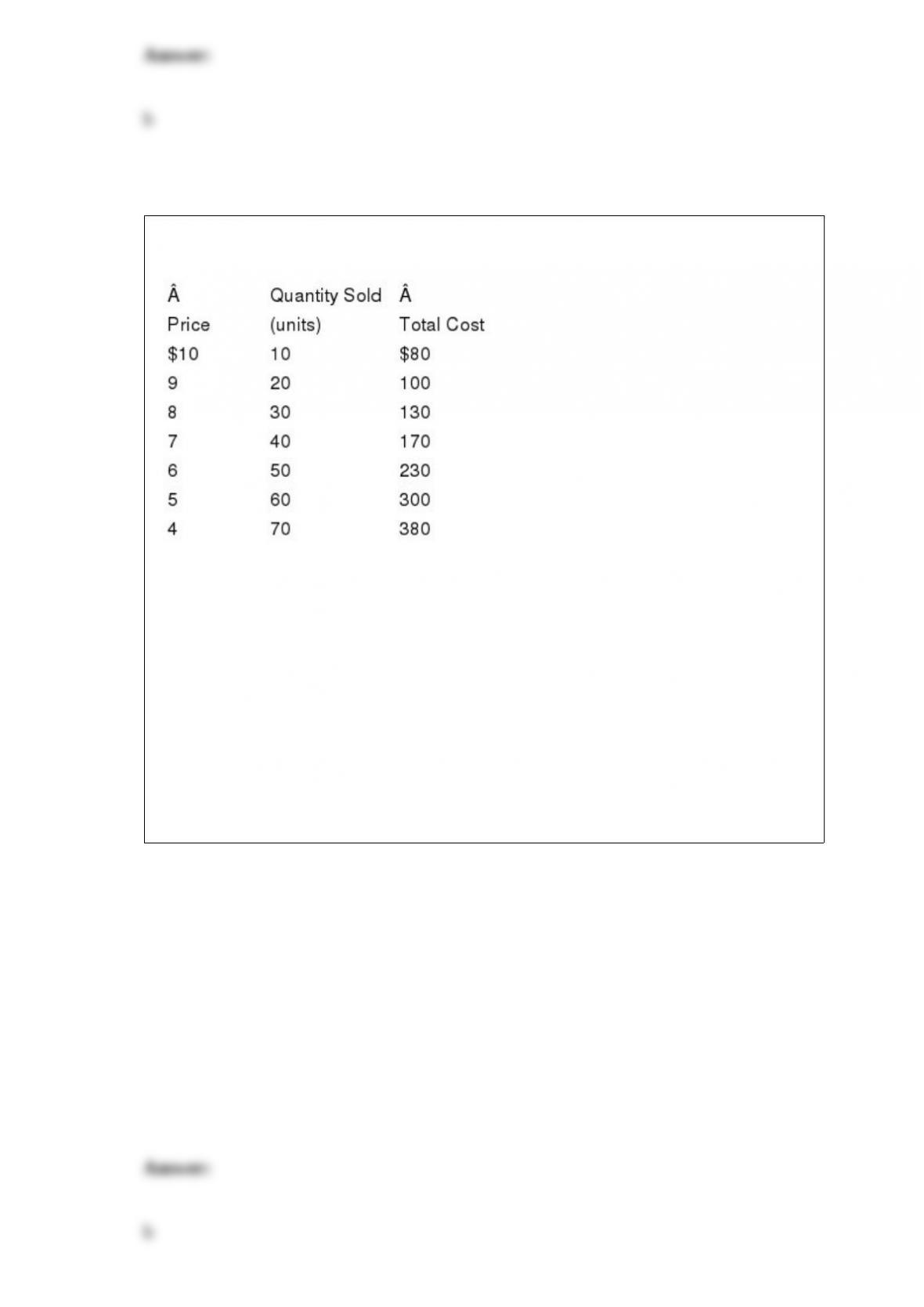
Exhibit 24-9
A single-price monopolist earns a total profit of __________ when it produces the profit
maximizing level of output.
a. $120
b. $110
c. $180
d. $80
e. $49

Some economists contend that a monopolistic competitor tends to produce too
__________ output, charges a price that is too __________ and __________ its present
plant size.
a. little; low; underutilizes
b. little; high; underutilizes
c. much; low; overutilizes
d. much; high; overutilizes
e. much; low; underutilizes
The three major components of a bond are the bond price, maturity date, and coupon
rate.
a. True
b. False
Suppose Congress passes a law that states that the federal government will pay $100 to
any American citizen who can pass a (reasonably simple) current political events test. It
follows that
a. this raises the benefits of being rationally ignorant.
b. this raises the benefits of becoming informed and therefore will lower the degree of
rational ignorance in society.
c. this raises the costs of being rationally ignorant.
d. b and c

e. none of the above
Evidence pertaining to the airline industry suggests that
a. since the airlines have become deregulated, airline fares have increased steadily.
b. under regulation the airlines’ fares were low, which indicates that the regulators were
doing a good job setting prices.
c. airline fares are no higher and no lower than they were when the industry was
regulated.
d. deregulation of the airline industry has brought significant price reductions.
If variable X goes down as a result of variable Y going down, then X and Y are
a. directly related.
b. negatively related.
c. inversely related.
d. independent.
The __________ the opportunity cost of doing something, the __________ likely a
person will do that something.
a. lower; less

b. lower; more
c. higher; more
d. higher; less
e. b and d