
A sole proprietorship is
A) the easiest type of business to set up.
B) the most difficult type of business to set up.
C) the most expensive type of business to set up.
D) the least profitable type of business to set up.
If the United States has a net export surplus, which of the following must be true?
A) The balance on the financial account must equal the balance on the current account.
B) Net foreign investment must be positive as well.
C) Domestic private saving must be greater than net foreign investment.
D) Domestic public saving must be greater than net foreign investment.
The CPI is also referred to as
A) the GDP deflator.
B) the inflation-consumption index.
C) the cost-of-living index.
D) the producer price index.

Growth in real GDP per hour worked in the United States was slowest during what
period of time?
A) 1900-1949
B) 1950-1973
C) 1974-1995
D) 1996-2012
Suppose that the economy is producing below potential GDP and the Fed implements
the correct change in monetary policy, but not until after the economy has passed the
trough of the recession. Then
A) the Fed’s contractionary policy will result in too large of a decrease in GDP.
B) the Fed’s contractionary policy will result in too small of a decrease in GDP.
C) the Fed’s expansionary policy will result in too small of a decrease in GDP.
D) the Fed’s expansionary policy will result in too large of an increase in GDP.

The period of time from 1,000,000 B.C. to 1300 A.D. was a period of
A) no sustained economic growth.
B) slow and steady economic growth.
C) moderate economic growth.
D) rapid and sustained economic growth.
Increasing marginal opportunity cost implies that
A) the more resources already devoted to any activity, the payoff from allocating yet
more resources to that activity increases by progressively smaller amounts.
B) the more resources already devoted to any activity, the benefits from allocating yet
more resources to that activity decreases by progressively larger amounts.
C) that rising opportunity costs makes it inefficient to produce beyond a certain
quantity.
D) the law of scarcity.
There is often a trade-off between
A) productive efficiency and allocative efficiency.

B) limited and unlimited resources.
C) voluntary and involuntary exchanges.
D) economic efficiency and economic equity.
The provision of the Patient Protection and Affordable Care Act (ACA) which states
that, with limited exceptions, every resident of the United States must have health
insurance that meets certain basic requirements is the ________ provision.
A) employer mandate
B) state health exchanges
C) individual mandate
D) regulation of health insurance
A farm worker gets paid today in money, but plans to spend the money next week. This
illustrates which function of money?
A) medium of exchange
B) unit of account
C) store of value
D) standard of deferred payment

Under the Soviet system of communism,
A) managerial pay was determined by the extent to which managers could lower the
per-unit costs of production.
B) technological progress was slow because managers had little incentive to develop
new technologies.
C) competitive pressures in the Soviet Union allowed the country’s technological
progress to keep pace with the rest of the world.
D) the per-worker production function in the Soviet Union shifted up more rapidly than
production functions in other countries.
Expansionary fiscal policy will
A) shift the aggregate demand curve to the left.
B) shift the aggregate demand curve to the right.
C) not shift the aggregate demand curve.
D) shift the short-run aggregate supply curve to the left.
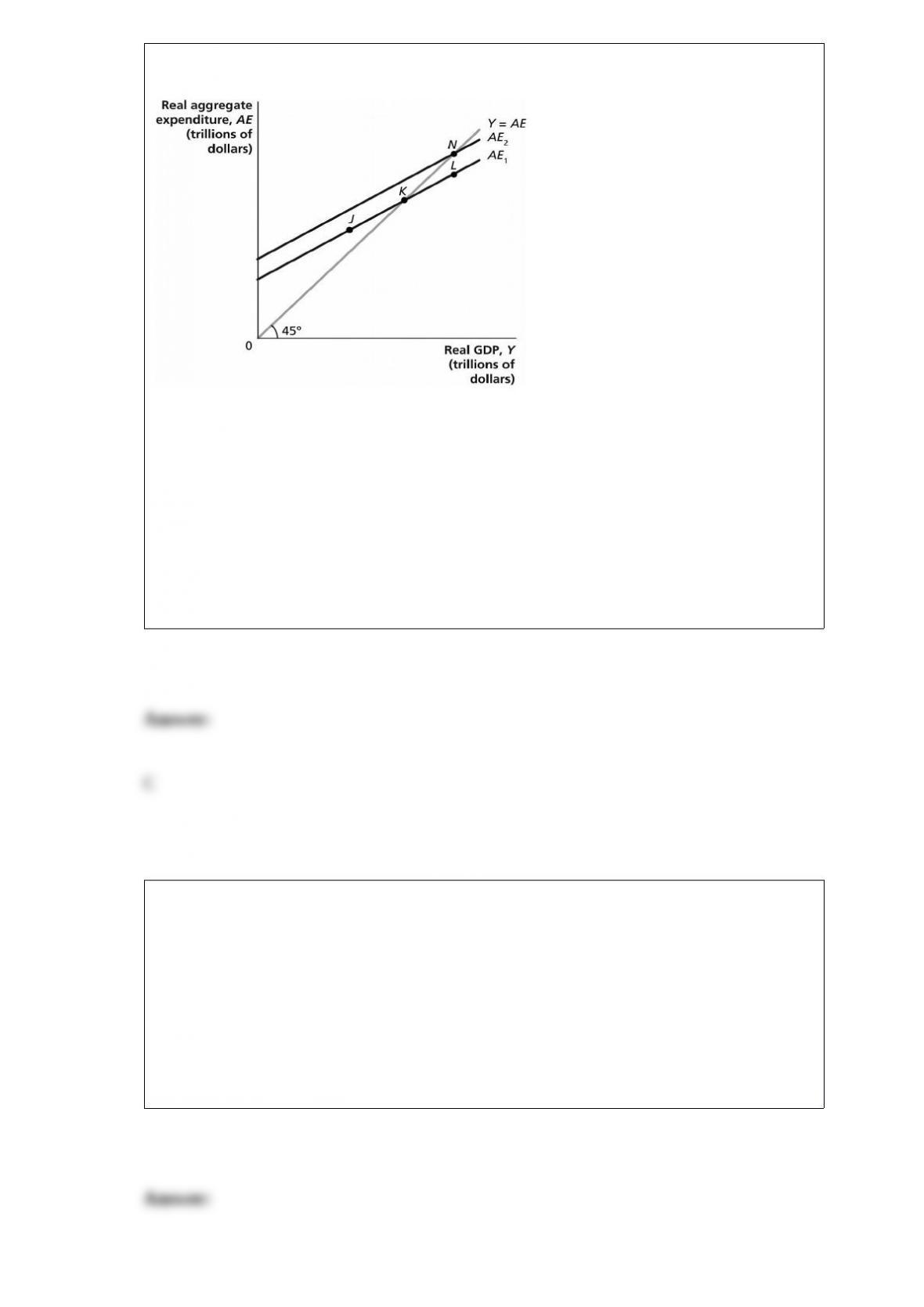
Figure 12-2
Refer to Figure 12-2. Suppose that the level of GDP associated with point K is
potential GDP. If the U.S. economy is currently at point N,
A) firms are operating below capacity.
B) the economy is at full employment.
C) the economy is in an expansion.
D) the level of unemployment is above the natural rate.
Which of the following is most liquid?
A) a mutual fund share
B) a government bond
C) a corporate bond
D) a dollar bill

Which of the following would encourage economic growth through increases in the
capital stock?
A) a change from an income tax to a consumption tax
B) an increase in household saving
C) a decrease in the government deficit
D) all of the above
Which of the following is not one of the three sources of technological change?
A) additional amounts of existing capital
B) better machinery and equipment
C) increases in human capital
D) better means of organizing and managing production
What impact does expansionary monetary policy have on the short-run Phillips curve if
consumers and firms expect the expansionary monetary policy to increase inflation?
A) The short-run Phillips curve shifts down.

B) The short-run Phillips curve shifts up.
C) The short-run Phillips curve becomes the long-run Phillips curve.
D) The short-run Phillips curve is not affected by expansionary monetary policy.
Which of the following cause the unemployment rate as measured by the Bureau of
Labor Statistics to understatethe true extent of joblessness?
A) inflation
B) discouraged workers
C) people employed in the underground economy
D) unemployed persons falsely report themselves to be actively looking for a job
From the 1960s to 2012, transfer payments
A) have risen from about 25 percent to 46 percent of federal government expenditures.
B) remained the same percentage of total federal government expenditures.
C) have declined by half as a percentage of total federal government expenditures.
D) have grown very slowly as a percentage of total federal government expenditures.