
If workers and firms ignore inflation or form their inflation expectations adaptively,
expansionary monetary policy will lower unemployment permanently.
According to Nobel laureate Douglass North, one reason why the Industrial Revolution
occurred in England before many other countries was because the king in England
consistently maintained control over the court system and the government.
When colleges use yield management techniques, they increase financial aid offers to
students likely to be more price sensitive and they reduce financial aid offers to students
likely to be less price sensitive.
The three most important financial centers in the world today are New York, London,
and Tokyo.

Economists believe that cost-plus pricing may be the best way for a firm to determine
its optimal product price when the firm’s marginal cost and average cost are about the
same and when it is difficult to estimate the product’s demand curve.
The sum of consumer surplus and producer surplus is called economic surplus.
If additional units of a good could be produced at a constant opportunity cost, the
production
possibility frontier would be bowed outward (concave).
One of the main sources of comparative advantage is internal economies.

The act of buying a product at a low price in one market and reselling the product at a
higher price in another market is called arbitrage.
In the United States, corporate profits are taxed at the corporate level and then are taxed
again as personal income in the form of dividend payments.
A college must decide if it wants to offer more Internet-based classes. This decision
involves answering the economic question of “what to produce.”
The relative price of a country’s goods and services in terms of foreign goods and
services is the real exchange rate.

If in the long run a firm makes zero profit, it should exit the industry.
If the opportunity cost of producing more of one good increases as more of that good is
produced, then the production method is inefficient.
Occupational licensing is an example of an entry barrier that improves a country’s
standard of living.
Article Summary. For only the second time in the previous 10 quarters, China’s

GDP grew at a faster rate than from the same period a year earlier. From July
through September 2013, China’s GDP increased 7.8 percent, but a decline in
exports, growing inflation, and slowing growth in factory production all suggest
that growth will be slowing down. China has recently been attempting to
restructure its economy by moving toward increasing consumption and relying
less on exports and investments as a means to achieving more sustainable
economic growth. In the first nine months of 2013, 46 percent of growth was due to
consumption, 56 percent was due to investment, and exports accounted for
negative 1.7 percent. Source: Aileen Wang and Kevin Yao, “China’s third-quarter
GDP growth fastest this year, but outlook dim,” Reuters, October 18, 2013.
The decline in export growth will hurt China’s GDP because
A) a decrease in exports will decrease net exports, assuming no change in imports.
B) a decline in export growth indicates an increase in import growth.
C) exports are added to imports when calculating GDP.
D) exports are subtracted from imports when calculating GDP.
If the price of grapefruit rises, the substitution effect due to the price change will cause
A) a decrease in the demand for grapefruit.
B) a decrease in the demand for oranges, a substitute for grapefruit.
C) a decrease in the quantity demanded of grapefruit.
D) a decrease in the quantity supplied of grapefruit.
Economic rent is defined as
A) what you pay to rent your apartment or house.
B) the revenue received by a factor of production with an upward sloping supply curve.
C) the price of a factor of production that is fixed in supply.
D) the surplus received by employing a factor of production in its highest valued use.
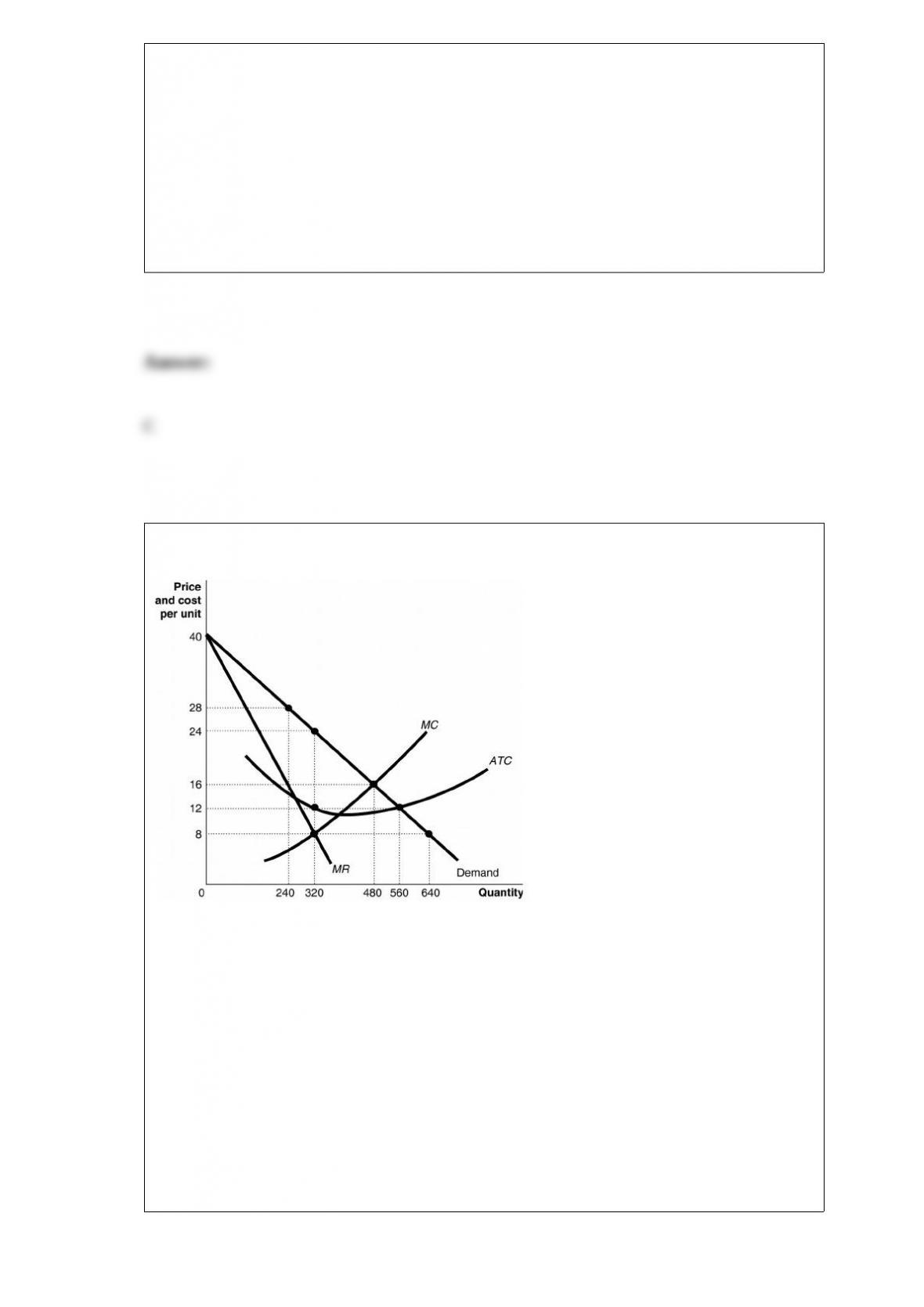
Figure 16-5
Suppose the firm represented in the diagram decides to use a two-part pricing strategy
such that such that it charges a fixed fee and a per-unit price equal to the competitive
price. (This is also called an optimal two-part tariff.) What is the quantity it should
produce?
A) 240 units
B) 320 units
C) 480 units
D) 560 units
All but one of the following statements is used to justify protectionism. Which
statement is not used to justify protectionism?
A) Free trade leads to higher prices for imported goods.
B) Free trade reduces employment by driving domestic firms out of business.
C) A country should not rely on other countries for goods that are critical to its national
defense.
D) Trade restrictions are necessary to protect new firms until they can gain experience
and become more productive.
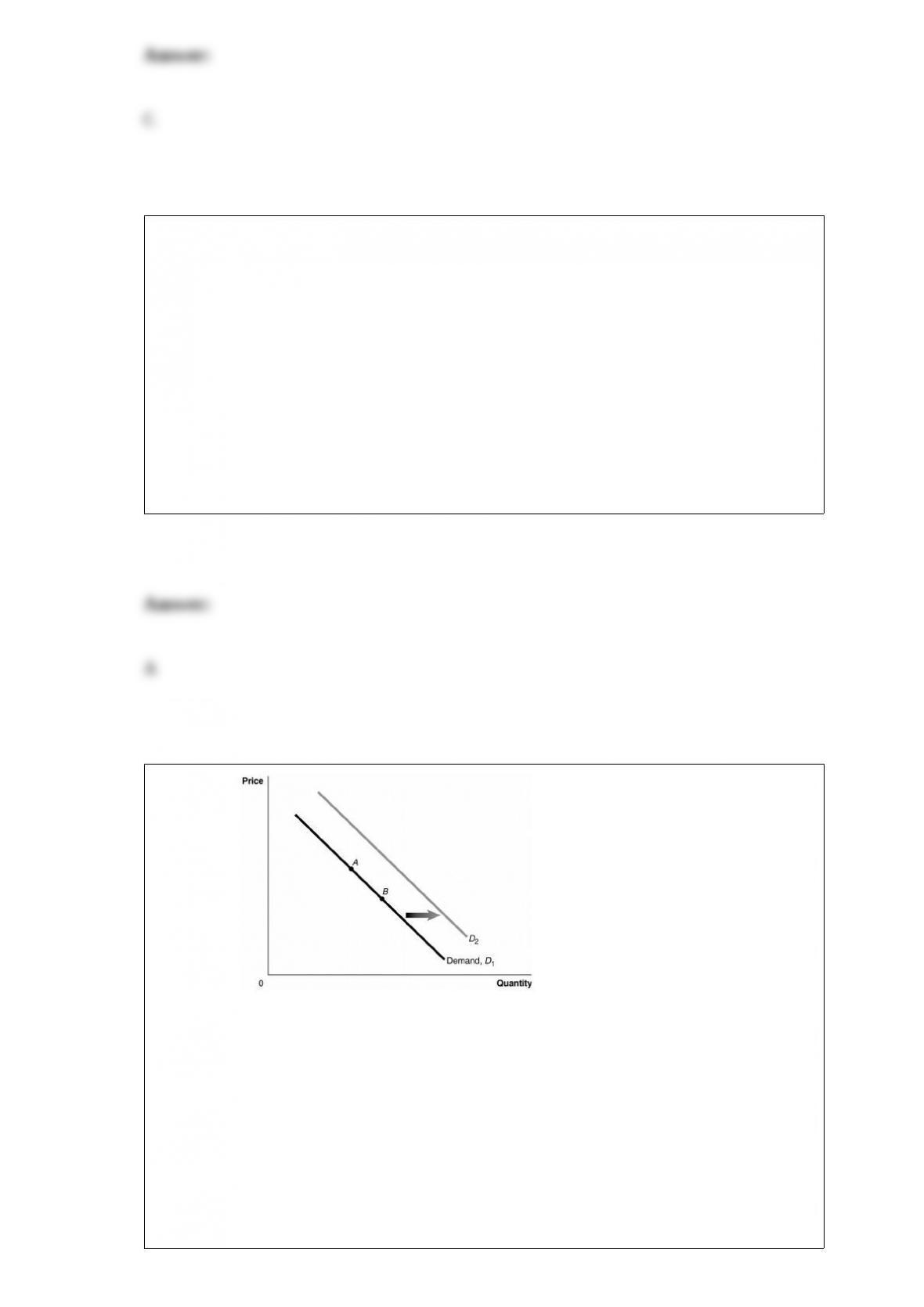
Figure 3-1
An increase in the price of a complement would be represented by a movement from
A) A to B.
B) B to A.
C) D1 to D2.
D) D2 to D1.

The price of domestic goods in terms of foreign goods is referred to as
A) the nominal exchange rate.
B) the relative inflation rate.
C) the current account balance.
D) the real exchange rate.
A perfectly competitive firm has to charge the same price as every other firm in the
market. Therefore, the firm
A) faces a perfectly inelastic demand curve.
B) is not able to make a profit in the short run.
C) is a price taker.
D) faces a perfectly elastic supply curve.

If, for a perfectly competitive firm, price exceeds the marginal cost of production, the
firm should
A) increase its output.
B) reduce its output.
C) keep output constant and enjoy the above normal profit.
D) lower the price.
If a monopolist practices perfect price discrimination,
A) the firm will break even in the long run.
B) consumers surplus will be equal to the deadweight loss.
C) producer surplus will equal consumer surplus.
D) consumer surplus will be zero.
Suppose Warren Buffet withdraws $1 million from his checking account at Chase
Manhattan Bank. If the required reserve ratio is 20 percent, what is the maximum
change in deposits in the banking system?
A) -$5 million
B) -$4 million
C) -$200,000

D) $1 million
E) $5 million
Article Summary. In 2012, Colorado and Washington legalized marijuana for
recreational use, and one of the major selling points in each state’s pro-marijuana
campaign was the possibility of generating millions of dollars in tax revenue from
sales which could be used for funding general education. The Colorado legislature
was weighing a proposal to tax marijuana at 30 percent, of which 15 percent would
be a sales tax on consumers and 15 percent an excise tax on growers. Washington
has set a tax rate of 44 percent on consumers and 25 percent each for growers and
retailers. Since the legalization of marijuana is relatively new, projecting the
economic impact of its sale is difficult, leading to many questions as to the
quantities that will be produced and sold and what actual tax revenues will be
generated.
Source: Elizabeth Dwoskin, “Colorado and Washington Try to Figure Out How to
Tax Marijuana,” Bloomberg Businessweek, April 26, 2013.
Colorado is weighing a proposal to tax marijuana at 30 percent, of which 15 percent
would be a sales tax on consumers and 15 percent would be an excise tax on growers.
Suppose the actual burden of the tax falls 80 percent on consumers and 20 percent on
producers. In this case, consumers will actually bear the tax burden of ________
percent of the selling price and producers will actually bear the tax burden of ________
percent of the selling price.
A) 24; 6
B) 50; 50
C) 15; 15
D) 80; 20
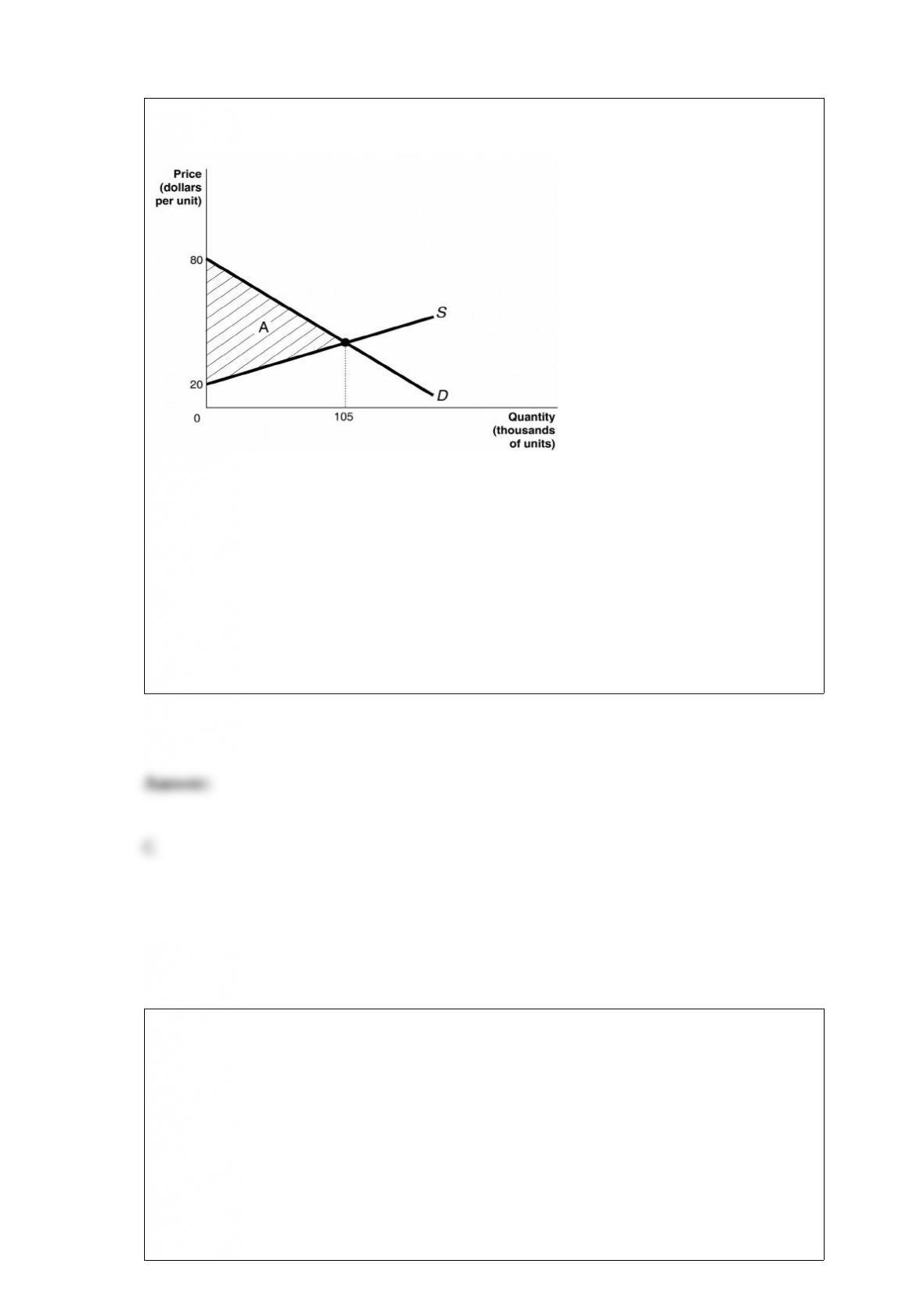
Figure 1-2
Calculate the area of the triangle A.
A) $8.4 million
B) $6.3 million
C) $3.15 million
D) $2.1 million
What are liabilities?
A) anything of value owned by a person or a business
B) anything a person or a business owes to entities outside the business
C) the total cost of labor for a firm
D) only those unpaid expenses for which a business or person is making interest
payments

A curve showing the lowest cost at which a firm is able to produce a given level of
output in the long run is
A) a long-run production function.
B) a long-run marginal cost curve.
C) a minimum efficient scale curve.
D) a long-run average total cost curve.
How will the exchange rate (foreign currency per dollar) respond to an increase in the
relative rate of productivity growth in the United States in the long run?
A) Exchange rates will rise.
B) Exchange rates will fall.
C) Exchange rates will be unaffected by changes in the relative rate of productivity
growth in the United States, both in the short run and in the long run.
D) The exchange rate will be affected in the short run, but not in the long run.

If economists forecast an increase in aggregate expenditure, which of the following is
likely to occur?
A) GDP will rise.
B) GDP will fall.
C) Wages will fall.
D) Inventories will rise.
The additional benefit to a consumer from consuming one more unit of a good or
service
A) is equal to consumer surplus.
B) is equal to the opportunity cost of consuming the good or service.
C) is equal to marginal benefit.
D) is equal to economic surplus.
Which of the following statements is used to justify protectionism?
A) Free trade leads to higher prices for imported goods.
B) Free trade increases employment by protecting domestic firms.

C) A country should not rely on other countries for goods that are critical to its national
defense.
D) Trade restrictions are not necessary to protect new firms since they can gain
experience and become more productive without protection.
Gross domestic product understates the total production of final goods and services
because of the omission of
A) the underground economy.
B) intermediate goods.
C) inflation.
D) exports.
In 2003, Congress passed a tax cut that included a reduction in the marginal tax rate on
stock dividends. This essentially increased the after-tax rate of return on stocks that
offer dividends. Using the loanable funds market, describe what will happen to saving,
investment, economic growth, the real interest rate, and the quantity of loanable funds
exchanged.
Why would an organization as large as the National Football League (NFL) incur large
legal expenses to try to prevent bars and restaurants from using their trademarked term
“Super Bowl” in their advertising?
If Congress and the president pursue an expansionary fiscal policy at the same time as
the Federal Reserve pursues an expansionary monetary policy, how might the
expansionary monetary policy affect the extent of crowding out in the short run?
What are the advantages of setting up a proprietorship or partnership as opposed to a
corporation?
How is the impact of expansionary fiscal policy different in an open economy than in a
closed economy?