
The Federal Funds rate is the interest rate
a. banks charge each other for short-term loans.
b. the Fed charges depository institutions for short-term loans.
c. the Fed pays on deposits.
d. interest rate on 3 month Treasury bills.
According to liquidity preference theory,
a. an increase in the interest rate reduces the quantity of money demanded. This is
shown as a movement along the money-demand curve. An increase in the price level
shifts money demand to the right.
b. an increase in the interest rate increases the quantity of money demanded. This is
shown as a movement along the money-demand curve. An increase in the price level
shifts money demand leftward.
c. an increase in the price level reduces the quantity of money demanded. This is shown
as a movement along the money-demand curve. An increase in the interest rate shifts
money demand rightward.
d. an increase in the price level increases the quantity of money demanded. This is
shown as a movement along the money-demand curve. An increase in the interest rate
shifts money demand leftward.

The most important automatic stabilizer is
a. open-market operations.
b. the tax system.
c. unemployment compensation.
d. welfare benefits.
A Ukrainian firm sells diesel locomotives to a U.S. railroad. Other things the same,
these sales
a. increase U.S. net exports and decrease Ukrainian net exports.
b. decrease U.S. net exports and increase Ukrainian net exports.
c. increase U.S. and Ukrainian net exports.
d. decrease U.S. and Ukrainian net exports.
What basket of goods and services is used to construct the CPI?
a. a random sample of all goods and services produced in the economy
b. the goods and services that are typically bought by consumers as determined by
government surveys

c. only food, clothing, transportation, entertainment, and education
d. the least expensive and the most expensive goods and services in each major
category of consumer expenditures
Other things the same, the aggregate quantity of output supplied will decrease if the
price level
a. is lower than expected so that firms believe the relative price of their output has
increased.
b. is lower than expected so that firms believe the relative price of their output has
decreased.
c. is higher than expected so that firms believe the relative price of their output has
increased.
d. is higher than expected so that firms believe the relative price of their output has
decreased.
Accumulating capital
a. requires that society sacrifice consumption goods in the present.
b. allows society to consume more in the present.

c. decreases saving rates.
d. involves no tradeoffs.
Other things the same, if the price level rises, people
a. increase foreign bond purchases, so the dollar appreciates.
b. increase foreign bond purchases, so the dollar depreciates.
c. increase domestic bond purchases, so the dollar appreciates.
d. increase domestic bond purchases, so the dollar depreciates.
Brock is willing to pay $400 for a new suit, but he is able to buy the suit for $350. His
consumer surplus is
a. $50.
b. $150.
c. $350.
d. $400.

Which of the following shifts long-run aggregate supply right?
a. an increase in either the physical or human capital stock
b. an increase in the human but not the physical capital stock
c. an increase in the physical capital stock, but no the human capital stock
d. neither an increase in the physical capital stock or the human capital stock
Which of the following would shift the demand for dollars in the market for foreign
currency exchange to the right?
a. foreign citizens want to buy more U.S. goods and services at a given exchange rate
b. foreign citizens want to buy fewer U.S. goods and services at a given exchange rate
c. foreign citizens want to buy more U.S. bonds
d. foreign citizens want to by fewer U.S. bonds

In 1961, President John F. Kennedy, acting upon advice from his economists, proposed
tax cuts. The advice he received
a. was opposed to the teaching of Keynes, who had taught that tax cuts were
counterproductive.
b. was opposed to the teaching of Keynes, who had taught that all attempts to stabilize
the economy were futile.
c. came from economists who had studied Keynes’s ideas when those ideas were only a
few years old.
d. came from economists who were unaware of Keynes’s ideas because those ideas had
not yet been widely disseminated at that time.
The graph that represents the amount of deadweight loss (measured on the vertical axis)
as a function of the size of the tax (measured on the horizontal axis) looks like
a. a U.
b. an upside-down U.
c. a horizontal straight line.
d. an upward-sloping curve.
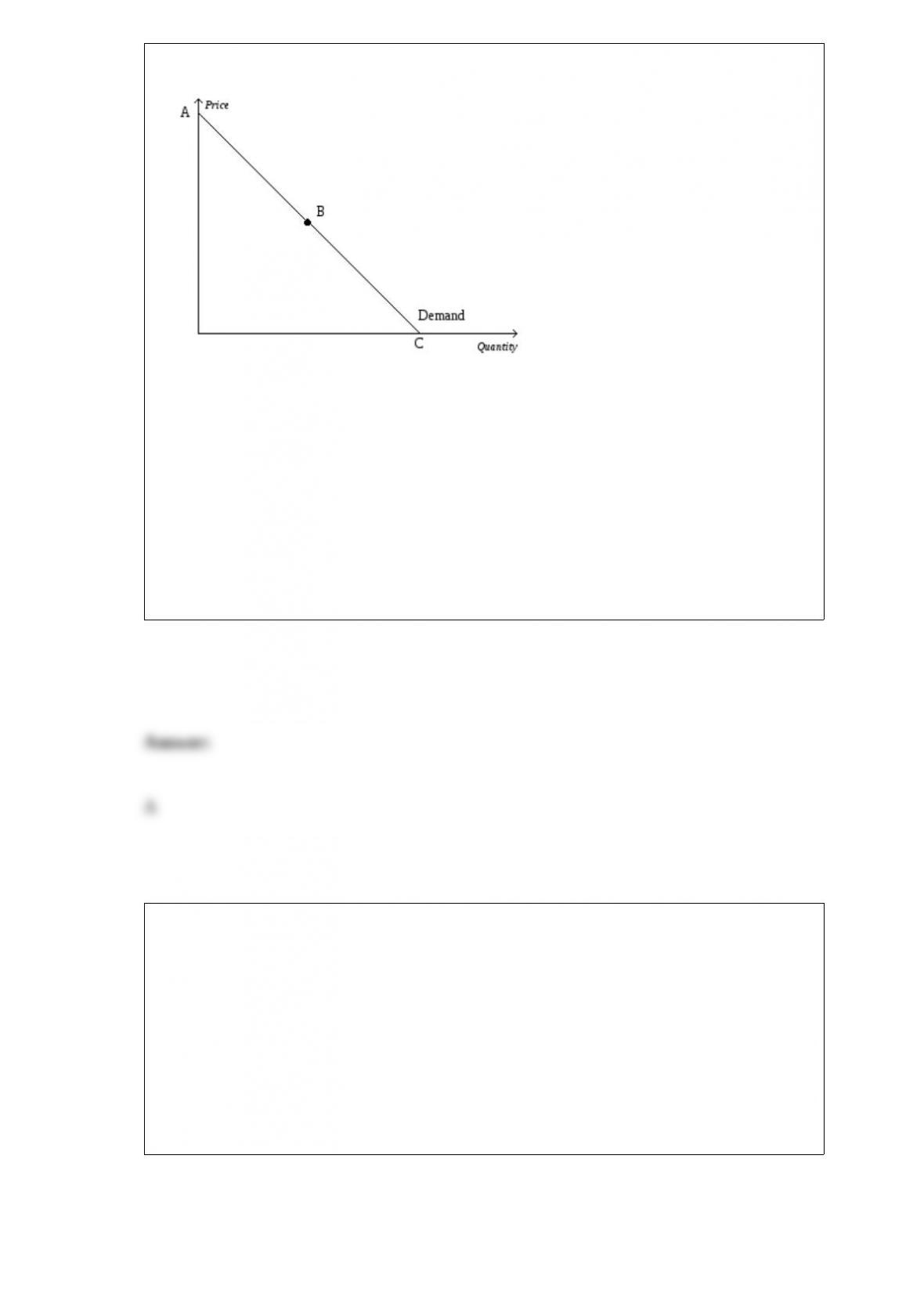
Figure 5-4
Refer to Figure 5-4. If the price increases in the region of the demand curve between
points B and C, we can expect total revenue to
a. increase.
b. stay the same.
c. decrease.
d. first decrease, then increase until total revenue is maximized.
Suppose Susan can wash three windows per hour or she can iron six shirts per hour.
Paul can wash two windows per hour or he can iron five shirts per hour.
a. Susan has an absolute advantage over Paul in washing windows.
b. Susan has a comparative advantage over Paul in washing windows.
c. Paul has a comparative advantage over Susan in ironing shirts.
d. All of the above are correct.

Which of the following events would shift money demand to the left?
a. an increase in the interest rate or an increase in the price level
b. an increase in the interest rate, but not an increase in the price level
c. an increase in the price level, but not an increase in the interest rate
d. neither an increase in the interest rate nor an increase in the price level
When a tax is placed on the sellers of a product, the
a. size of the market decreases.
b. effective price received by sellers decreases, and the price paid by buyers increases.
c. supply of the product decreases.
d. All of the above are correct.

To increase the money supply, the Fed could
a. sell government bonds.
b. auction more loans to banks.
c. increase the reserve requirement.
d. None of the above is correct.
When the U.S. real interest rate falls
a. U.S. purchases of foreign assets and foreign purchases of U.S. assets rise
b. U.S. purchases of foreign assets rise and foreign purchases of U.S. assets fall
c. U.S. purchases of foreign assets fall and foreign purchases of U.S. assets rise
d. U.S. purchases of foreign assets and foreign purchases of U.S. assets fall
On its web site, your bank posts the interest rates it is paying on savings accounts.
Those posted rates
a. and a price index are both real variables.
b. and a price index are both nominal variables.
c. are real variables, and a price index is a nominal variable.
d. are nominal variables, and a price index is a real variable
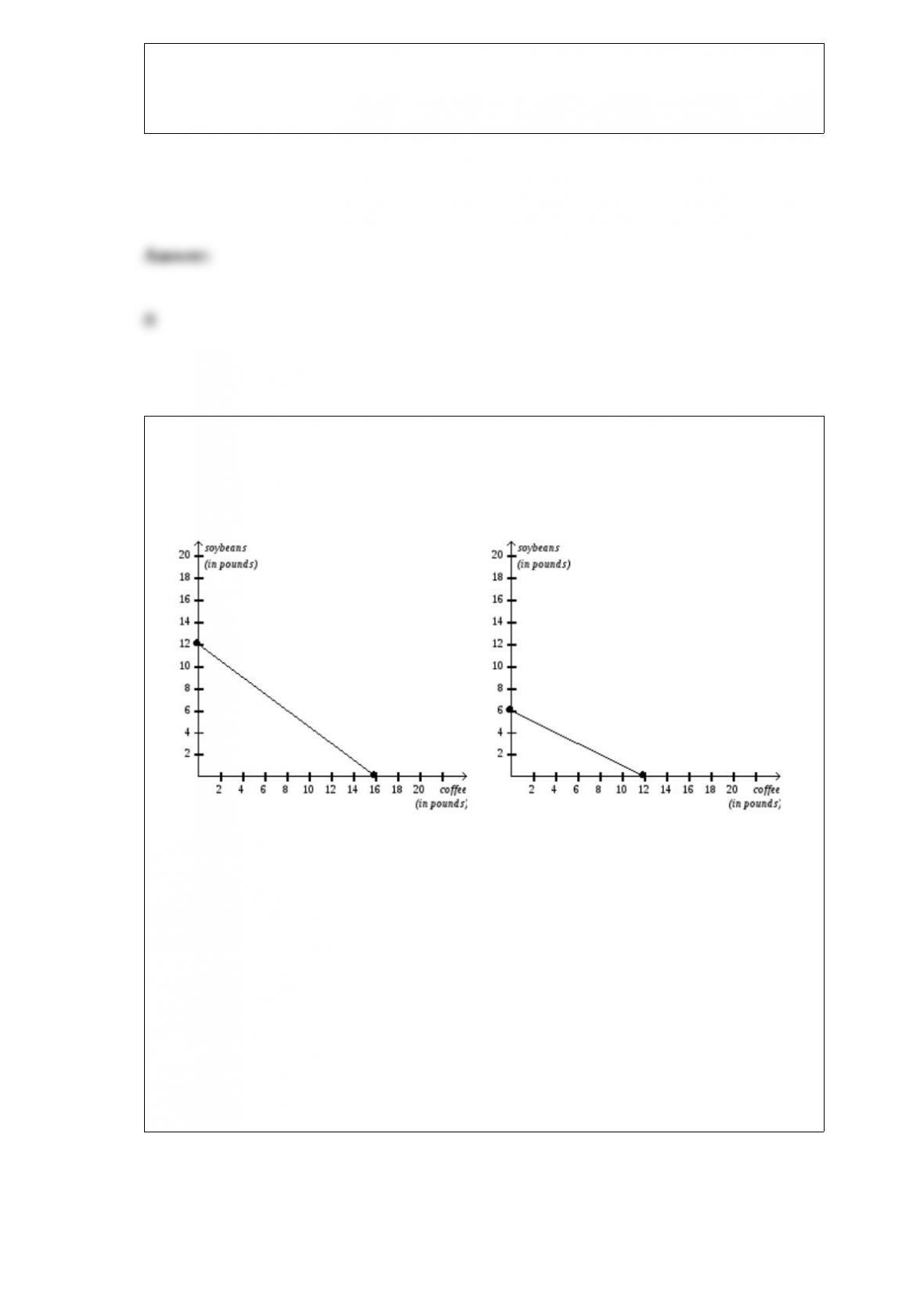
Figure 3-8
Chile’s Production Possibilities Frontier Colombia’s Production Possibilities
Frontier
Refer to Figure 3-8. Chile’s opportunity cost of one pound of coffee is
a. 3/4 pound of soybeans and Colombia’s opportunity cost of one pound of coffee is 1/2
pound of soybeans.
b. 3/4 pound of soybeans and Colombia’s opportunity cost of one pound of coffee is 2
pounds of soybeans.
c. 4/3 pounds of soybeans and Colombia’s opportunity cost of one pound of coffee is
1/2 pound of soybeans.
d. 4/3 pounds of soybeans and Colombia’s opportunity cost of one pound of coffee is 2
pounds of soybeans.

Between the 1940s and today, union membership in the U.S.
a. rose from about one-eighth to one-third of the labor force.
b. rose from about one-third to one-half of the labor force.
c. fell from about one-half to one-third of the labor force.
d. fell from about one-third to one-eighth of the labor force.
When supply and demand both increase, equilibrium
a. price will increase.
b. price will decrease.
c. quantity may increase, decrease, or remain unchanged.
d. price may increase, decrease, or remain unchanged.

According to liquidity preference theory, an increase in money demand for some reason
other than a change in the price level causes
a. the interest rate to fall, so aggregate demand shifts right.
b. the interest rate to fall, so aggregate demand shifts left.
c. the interest rate to rise, so aggregate demand shifts right.
d. the interest rate to rise, so aggregate demand shifts left.
If a firm is a price taker, it operates in a
a. competitive market.
b. monopoly market.
c. oligopoly market.
d. monopolistically competitive market.
Honduras is an importer of goose-down pillows. The world price of these pillows is
$50. Honduras imposes a $7 tariff on pillows. Honduras is a price-taker in the pillow
market. As a result of the tariff, the price of goose-down pillows in Honduras
a. remains at $50 and the quantity of goose-down pillows purchased in Honduras
decreases.
b. increases to $57 and the quantity of goose-down pillows purchased in Honduras
decreases.
c. increases to a new price between $50 and $57 and the quantity of goose-down
pillows purchased in Honduras decreases.
d. increases to a new price above $57 and the quantity of goose-down pillows
purchased in Honduras remains the same.
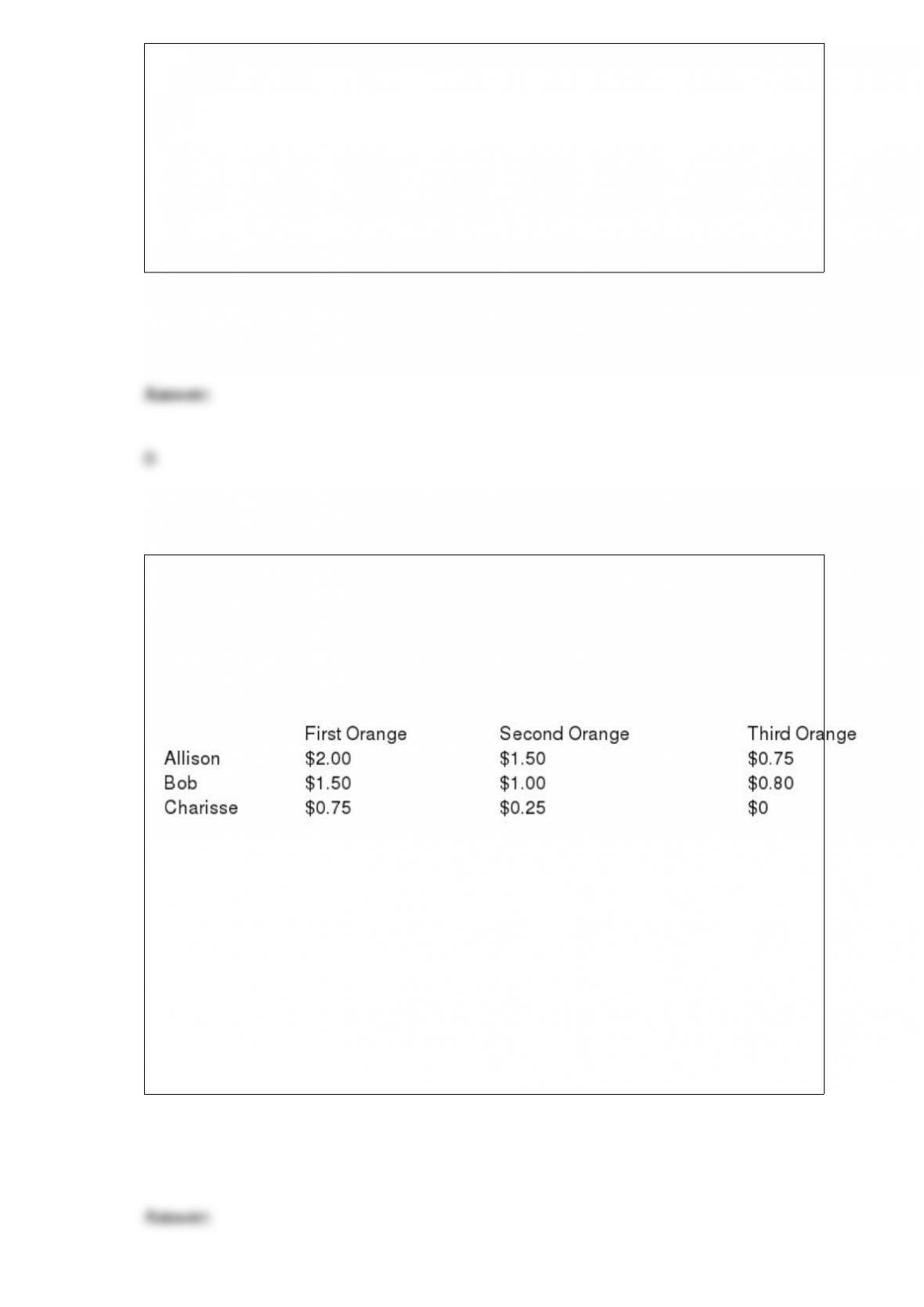
Table 7-5
For each of three potential buyers of oranges, the table displays the willingness to pay
for the first three oranges of the day. Assume Alex, Barb, and Carlos are the only three
buyers of oranges, and only three oranges can be supplied per day.
Refer to Table 7-5. Who experiences the largest gain in consumer surplus when the
price of an orange decreases from $1.05 to $0.75?
a. Allison
b. Bob
c. Charisse
d. Allison and Bob experience the same gain in consumer surplus, and Charisse’s gain is
zero.
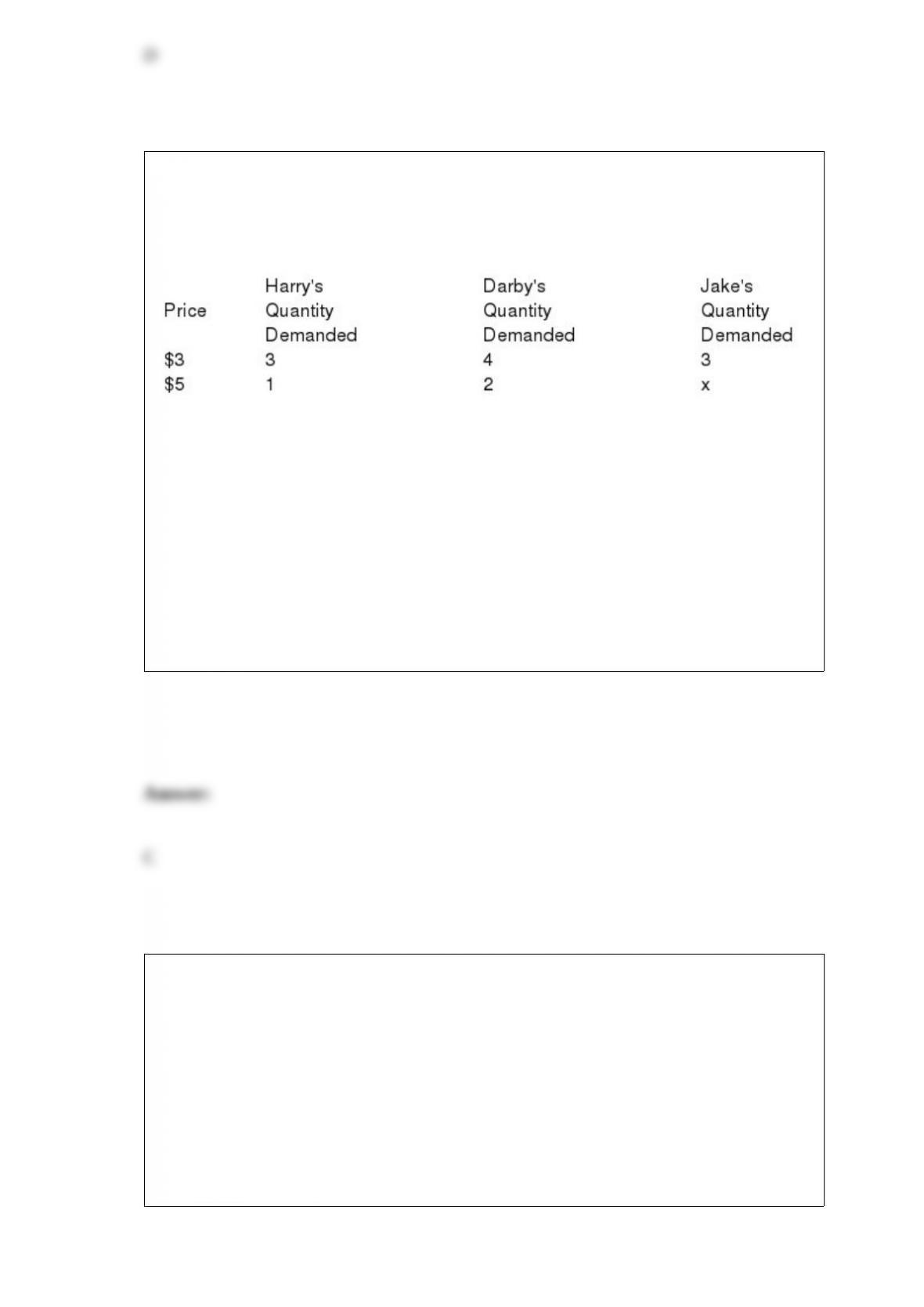
Table 4-9
The demand schedule below pertains to sandwiches demanded per week.
Refer to Table 4-9. Suppose Harry, Darby, and Jake are the only demanders of
sandwiches and that the market demand violates the law of demand. Then, in the table,
the value of x must be
a. less than or equal to 5.
b. greater than or equal to 5.
c. greater than or equal to 7.
d. greater than or equal to 10.
At which interest rate is the present value of $183.60 two years from today equal to
about $173.06 today?
a. 2 percent
b. 3 percent
c. 4 percent
d. 5 percent

Most economists believe that in the short run
a. real and nominal variables are determined independently and that money cannot
move real GDP away from its long-run trend.
b. real and nominal variables are determined independently but that money can
temporarily move real GDP away from its long-run trend.
c. real and nominal variables are highly intertwined but that money cannot move real
GDP away from its long-run trend.
d. real and nominal variables are highly intertwined and that money can temporarily
move real GDP away from its long-run trend.
Which of the following is correct?
a. Efficiency deals with the size of the economic pie, and equality deals with how fairly
the pie is sliced.
b. Equality can be judged on positive grounds whereas efficiency requires normative
judgments.
c. Efficiency is more difficult to evaluate than equality.
d. Equality and efficiency are both maximized in a society when total surplus is
maximized.

If the federal funds rate were above the level the Federal Reserve had targeted, the Fed
could move the rate back towards its target by
a. buying bonds. This buying would increase the money supply.
b. buying bonds. This buying would reduce the money supply.
c. selling bonds. This selling would increase the money supply.
d. selling bonds. This selling would reduce the money supply.
In a closed economy, what does (Y – T – C) represent?
a. national saving
b. government tax revenue
c. public saving
d. private saving

Which of the following is an example of depreciation?
a. falling stock prices
b. the retirement of several employees
c. computers becoming obsolete
d. All of the above are examples of depreciation.
Donald produces nails at a cost of $350 per ton. If he sells the nails for $500 per ton, his
producer surplus is
a. $150.
b. $350.
c. $500.
d. $850.