
The short-run demand curve for labor for a firm in any type of market for its output
coincides with
a. the upward sloping portion of the marginal revenue product curve.
b. the downward sloping portion of the marginal revenue product curve.
c. the downward sloping portion of the marginal product curve.
d. the marginal labor cost curve.
A firm would find it profitable to increase its production when
a. its marginal revenue exceeds its marginal cost.
b. its fixed costs fall.
c. higher resource costs raise its marginal costs.
d. new competitors reduce the demand for the firm’s product.
At a fast food restaurant, a large drink is twice as big as a small drink, but the restaurant
charges 79¢ for the small drink and only 99¢ for the large drink. This situation is
probably not a case of price discrimination because
a. the restaurant cannot easily prevent resale.

b. people who buy large drinks order more food than people who buy small drinks.
c. the cost of serving a large drink is not twice the cost of serving a small drink.
d. the fast food restaurant has no monopoly power.
Your company is considering a project that generates a revenue stream of $250 a year
for four years. If the market interest rate is 10%, then the present value of this project is
approximately
a. $-209.54
b. $790.46
c. $886.48
d. $-113.52
The price of a bond with a maturity date one time period into the future is equal to its
face value
a. multiplier by 1 – r.
b. multiplied by 1 + r.
c. divided by 1 + r.

d. divided by 1 – r.
The price of a California orange is $2.00 and the price of a Florida orange is $1.00. If
the price of California oranges goes down by one cent and the quantity demanded of
Florida oranges goes up by one thousand, then
a. the cross elasticity is 0.4.
b. these goods are substitutes.
c. the price elasticity of demand for California oranges is 0.4.
d. these goods are complements.
In a case where there are two possible work activities and two workers, which of the
following is true regarding to comparative advantage?
a. One person can have a comparative advantage in both activities.
b. Both people can have a comparative advantage in both activities.
c. No one can have a comparative advantage in either activity.
d. Each person must have a comparative advantage in one activity, but not both.
When a supplier imposes resale price maintenance on its dealers, social gain will
increase as long as
a. the supplier chooses to charge a competitive price for its product.
b. the value consumers receive from dealer services outweighs their cost.
c. dealers are allowed to charge consumers less than the supplier’s recommended retail
price.
d. dealers are able to enter and exit the industry costlessly.
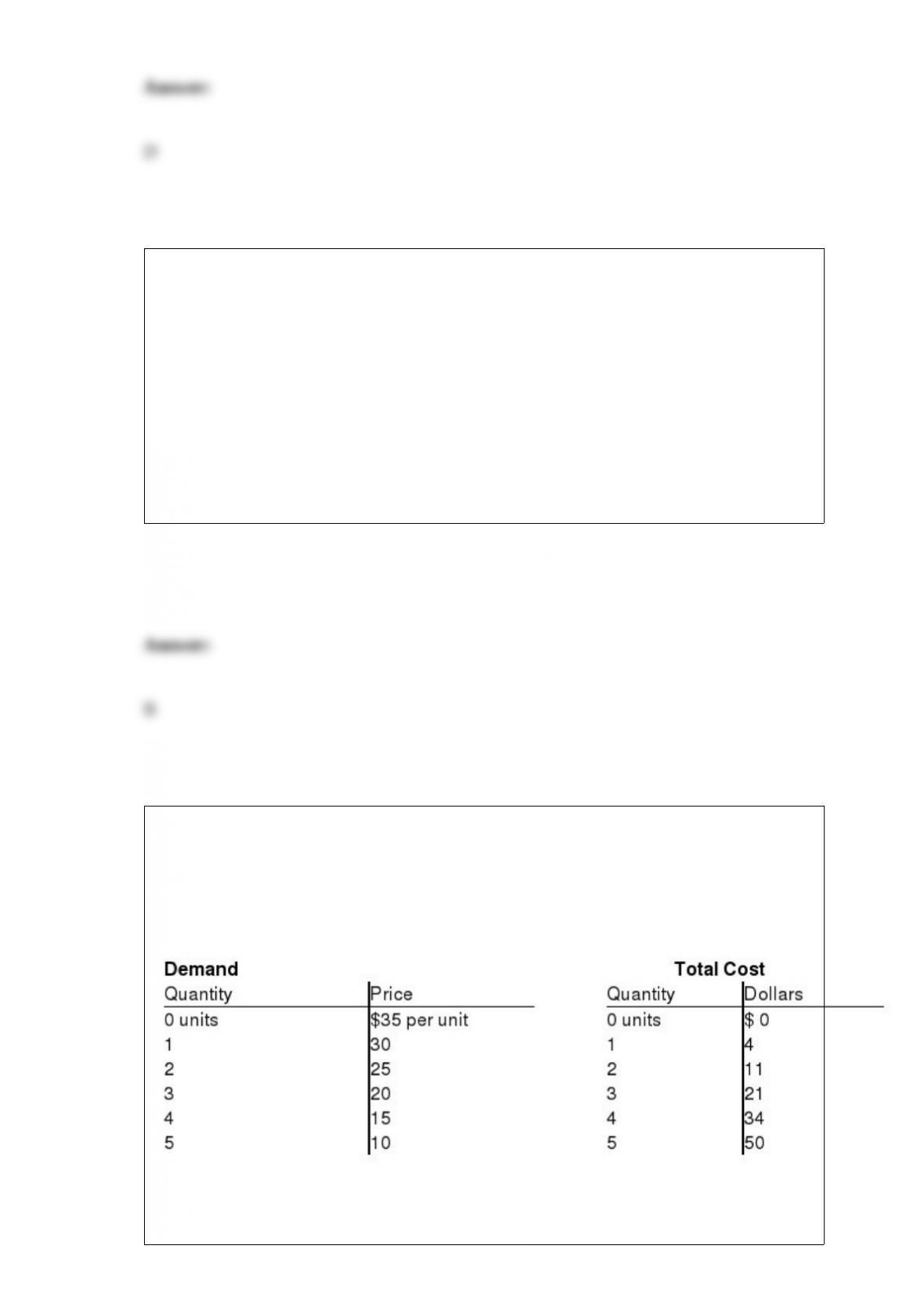
Demand and Total Cost of Production
The following questions refer to the following tables which show the demand for a
firm’s product and the firm’s total cost of production.
The profit from selling two units would be
a. $50.
b. $39.
c. $14.
d. $11.
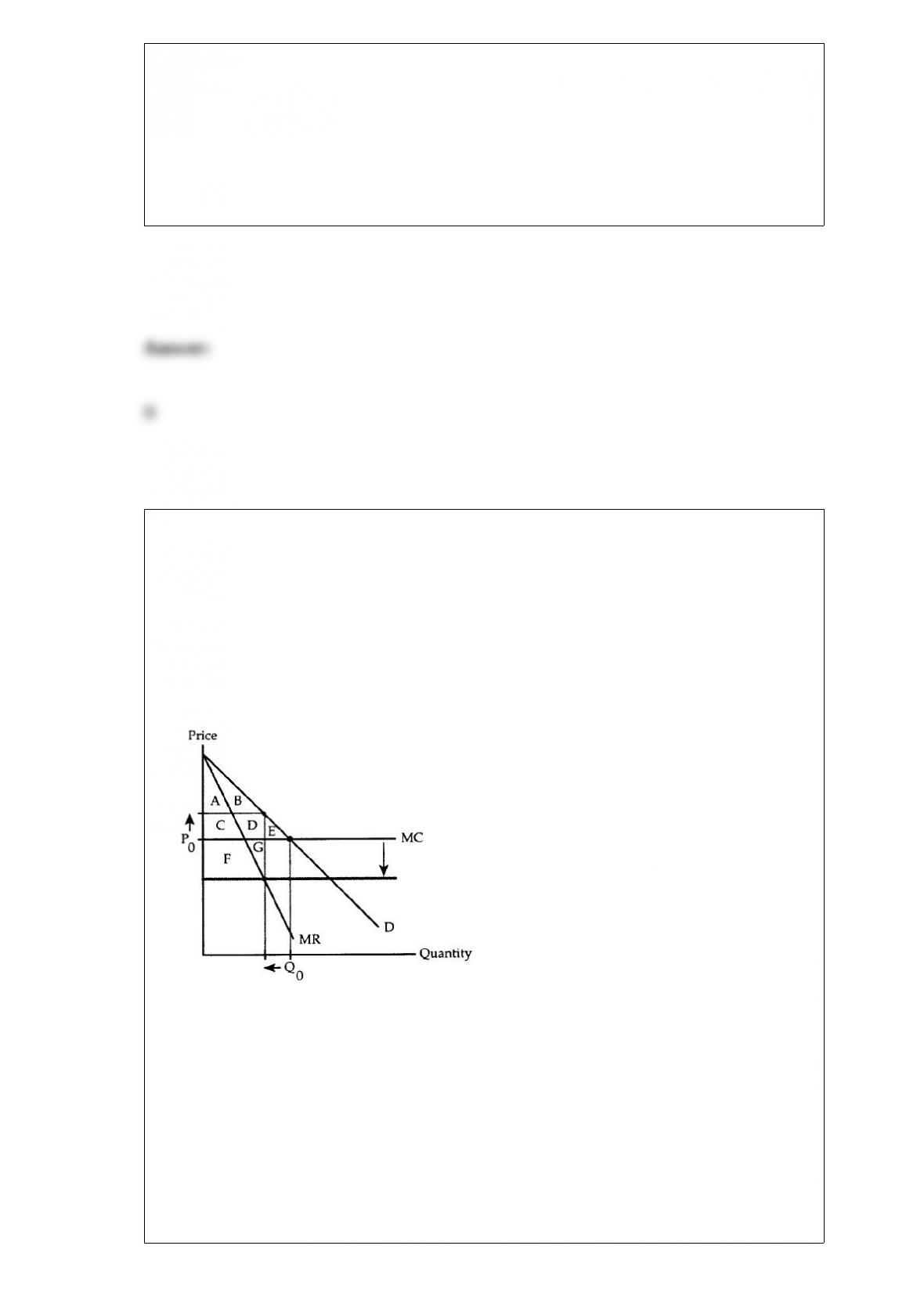
Horizontal Merger
The following questions refer to the accompanying diagram, which shows the effects of
a horizontal merger. Before the merger, the firm behaves competitively producing Q0
and charging P0. The merger lowers the firm’s marginal cost and gives the firm enough
market power to switch to the monopoly equilibrium.
The result of the merger is
a. a decrease in marginal costs.
b. an increase in the quantity supplied.
c. a decrease in the price.
d. an increase in consumer surplus.

If the marginal value of 1 bottle of shampoo is 4 soap bars, then
a. the absolute price of shampoo is 4 times the absolute price of a soap bar.
b. trading away 1 bottle of shampoo for 4 bars of soap will not affect the consumer’s
level of satisfaction.
c. the consumer’s optimum contains 4 times as many bars of soap as bottles of shampoo.
d. shampoo provides 4 times as much satisfaction to the consumer as does soap.
A competitive firm’s supply curve is determined by
a. its marginal costs.
b. the market price.
c. the zero-profit condition.
d. its fixed inputs.
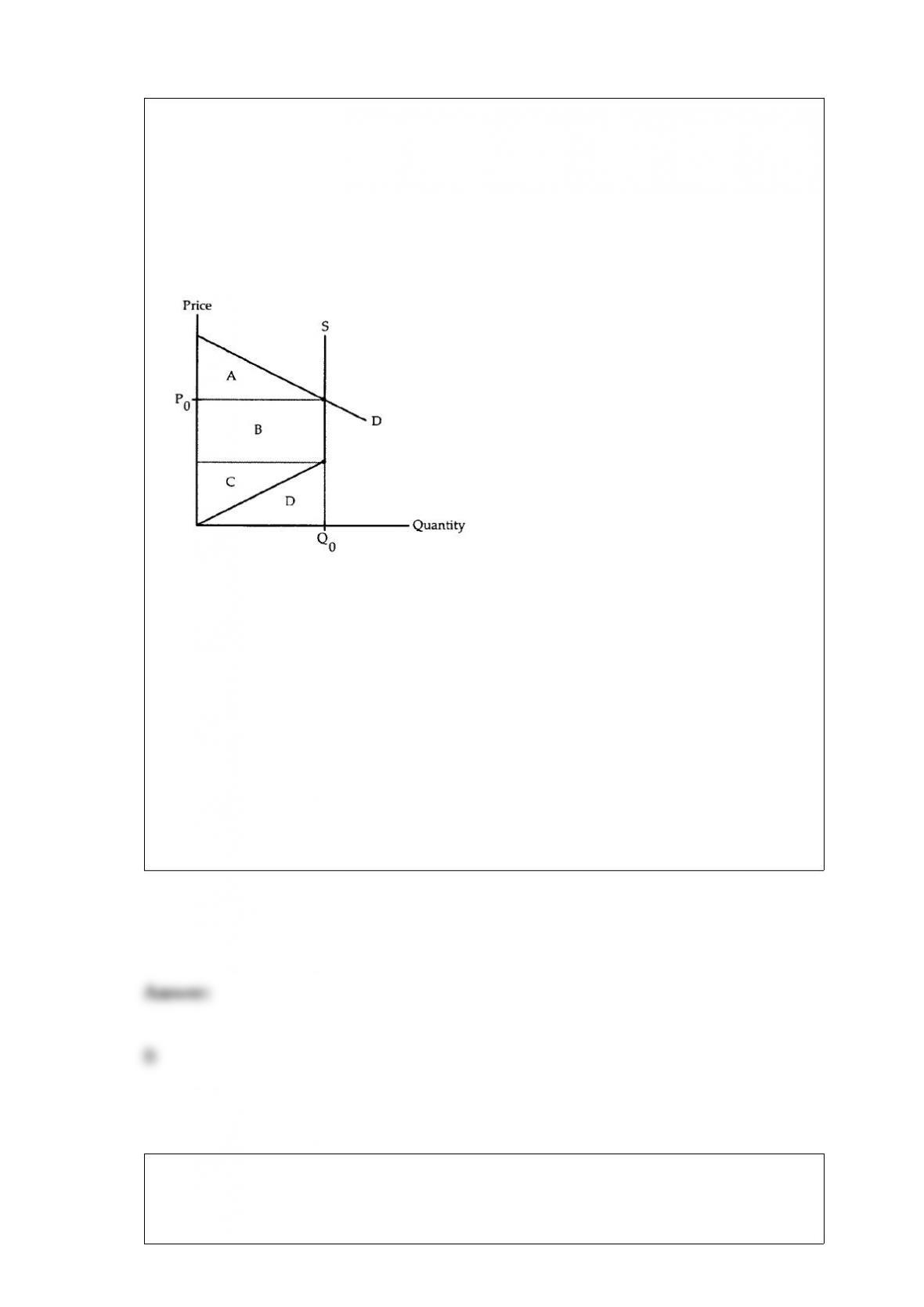
Resource Supply/Demand
The following questions refer to the accompanying graph, which shows the supply and
demand for a resource. The owner of the resource is receiving the price P0 and is
providing the quantity Q0.
If the government confiscates the rent and pays the owner area D to supply Q0 units of
the resource at a zero price, then
a. area B + C is transferred from the resource owner to the government with no loss in
social gain.
b. area A + B + C overestimates the social gain that will be created.
c. demanders will continue to receive area A + B + C + D in value from the resource.
d. a deadweight loss equal to area B + C will be created.
If an activity is worth pursuing at all, then it should be pursued up to the point where
a. the total benefit received is as large as possible.

b. the marginal benefit and the marginal cost both equal zero.
c. the average net benefit is at a maximum.
d. the net benefit received from the last unit of the activity is zero.
Suppose the consumer’s indifference curves are concave (i.e., bowed away from the
origin) instead of convex. In this situation,
a. along an indifference curve, the marginal value of X is falling as more X and less Y is
consumed.
b. all baskets on the budget line give the consumer the same level of satisfaction.
c. the marginal value of X must equalPX/PY at the consumer’s optimum.
d. the consumer’s optimum is always a corner solution.
All of the following are economic explanations for why shopping carts have gotten
bigger over the years.
a. more women in the marketplace have made spending time in the grocery store more
costly.
b. grocery stores now have a wider variety of items available.
c. store owners are “tricking” customers in into buying more groceries by making them
feel ashamed that their carts are not full.
d. shoppers have become wealthier over the years and are willing to pay for the luxury
of wide aisles and the big carts that go along with wider aisles.
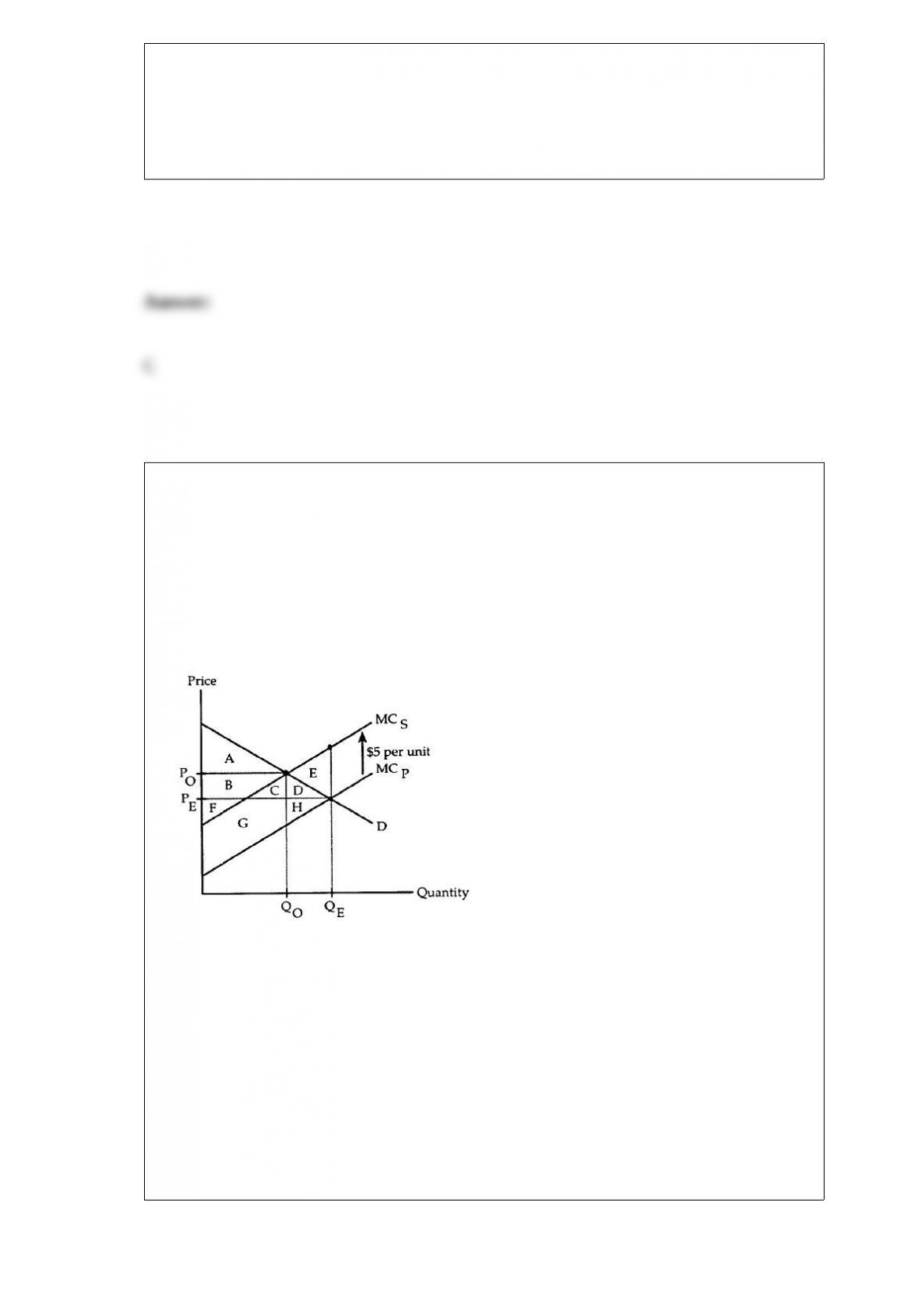
Negative Externality
The following questions refer to the accompanying diagram, which shows the effects of
a negative externality created by an industry’s production. The equilibrium quantity in
the absence of any attempt to internalize the externality is QE, and the optimal quantity
according to a Pigovian analysis is QO.
According to Pigou, the socially optimal quantity
a. is QO
b. is QE
c. eliminates area A+B+C+D.
d. creates area E.
According to Pigovian analysis, competitive behavior will result in overproduction of a
good when
a. firms’ activities create external costs.
b. people outside of market transactions benefit from those transactions.
c. property rights have been clearly and unambiguously assigned.
d. private and social marginal costs are identical.
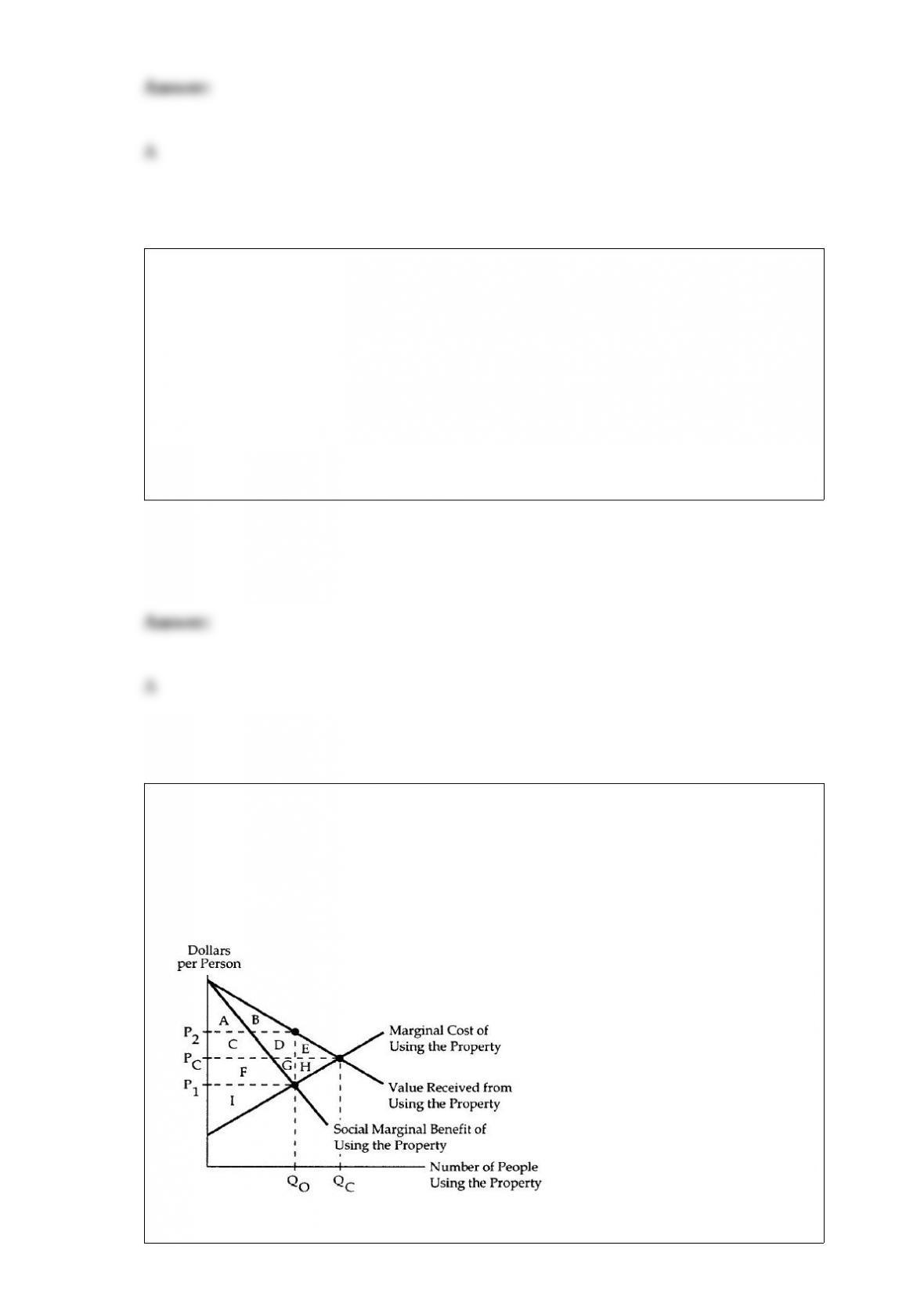
Common Property II
The following questions refer to the accompanying diagram, which shows the benefits
and costs associated with the use of a common property.

Suppose the common property becomes privately owned. If the owner behaves
competitively, what entrance fee would he charge for the right to use the property?
a. PC.
b. PC – P1.
c. P2 – PC.
d. P2 – P1.
A budget line is constructed to show
a. how consumers who budget their expenditures achieve more satisfaction than those
who do not.
b. the set of all baskets that the consumer can afford, given prices and his or her income.
c. the set of all baskets that the consumer would be willing to purchase given various
prices for the goods in the basket.
d. the set of all baskets that the consumer considers equally desirable.
The light bulbs currently made by a manufacturer currently last 1 year. People place a
value of $2.42 on one year’s worth of light from a light bulb, and the market rate of
interest is 10%. The manufacturer is considering a quality improvement that would

make its light bulbs last 3 years. Should the manufacturer make the quality
improvement?
a. No, because it will substantially reduce the number of light bulbs sold.
b. Yes, as long as it costs less than $2.42 per light bulb.
c. Yes, as long as it costs less than $4.20 per light bulb.
d. Yes, as long as it costs less than $4.84 per light bulb.
Consider an outcome in which it is impossible to make one player better off without
simultaneously making the other player worse off. We can conclude that this outcome
a. cannot be a Nash equilibrium.
b. must be Pareto optimal.
c. will not occur when the players use mixed strategies.
d. is a Stackelberg equilibrium.
The government authorized $10 million to build bridges on an interstate. After $8
million were spent, serious engineering flaws were discovered. At that point, experts
testified that the government must authorize another $10 million in funding to make the
bridges safe, bringing the project’s total cost to $20 million. The government should
authorize the additional funding as long as the benefits from the completed bridges

exceed
a. $10 million.
b. $12 million.
c. $18 million.
d. $20 million.
Game Matrix V
The following questions refer to the game matrix below. Each firm has a choice of
saying Yes or NO. The profits each gets depend upon which it chooses.
Which of the following values of X and Y result in the only Nash Equilibrium being
(No, No) and there not being a Prisoners’ Dilemma?
a. X = 21, Y = 9.
b. X = 19, Y = 11
c. X = 31, Y = 11.
d. It is not possible for (Yes, Yes) to be a Nash Equilibrium and for there not to be a
Prisoners’ Dilemma.

According to the equimarginal principle, if the marginal cost of an activity outweighs
the marginal benefit, then
a. the activity should not be pursued at all.
b. less of the activity should be undertaken.
c. the net total benefit received from the activity is negative.
d. people should expand their pursuit of the activity.
Pricing an option involves an application of all of the following except:
a. the Black-Scholes Model.
b. the law of one price.
c. the assumption that there are no unexploited profit opportunities.
d. the assumed probability that the stock price will go up.

An efficient market is one in which
a. no rents are created.
b. past prices can be used to predict the levels of future prices.
c. the principals can fully monitor the actions of their agents.
d. the price fully reflects all available information.
Facing choices between beer and pizza, the number of pizzas a consumer would be
willing to trade for just one beer is called
a. the marginal value of beer in terms of pizza.
b. the marginal value of pizza in terms of beer.
c. the demand for beer.
d. an undesirable trade.
In medieval Europe, small farmers held their land in several scattered plots, even
though this created obvious inefficiencies. Which of the following is an economic
explanation of such behavior?
a. Medieval farmers did not use rational decision making.

b. Medieval farmers were not as clever as their modern counterparts.
c. Medieval farmers were attempting to reduce their risk.
d. Medieval farmers put up with scattering as a natural consequence of marriage and
inheritance.
An economic rent can be created by a common property without any admission fee
a. only if people have identical tastes.
b. if people’s tastes differ, but the rent will still be sub-optimal.
c. if people’s tastes differ, in which case the rent will be optimal.
d. if people’s tastes differ, in which case the rent will be more than optimal.
Which of the following would be the most accurate means for the government to obtain
information about the value of irrigation water for farmers to be supplied by the
construction of a new dam?
a. Survey the farmers.
b. Hire experts to provide an estimate.
c. Use the current cost to farmers of withdrawing water from underground sources.

d. Conduct an economic study of how an increase in water supply would affect farmer
income.
When first-degree price discrimination is perfectly implemented
a. social gain is maximized, with all gains going to the monopoly.
b. consumers’ surplus and producer’s surplus are both larger than in the case of simple
monopoly.
c. the resulting deadweight loss is larger than if the monopoly did not price
discriminate.
d. the consumers’ and producer’s gains from trade are identical to those in a competitive
market.
A borrower sells bonds, and a lender buys bonds.

When people have identical tastes, an increase in the demand for a common property’s
use will increase the social gain it creates.
You are an economist for the City Subway Commission. Presently, the price of a
subway ride is 80¢, and 250,000 seats are filled weekly. The price elasticity of demand
for subway rides is -0.40, and the income elasticity of demand is -0.60.
(i) The Commission wants to ensure that the subway has enough excess capacity to
handle any extra demand that might occur during an economic decline. If a recession
lowered area incomes by 5%, how many additional seats per week would the subway
need?
(ii) The Commission has just approved a subway price increase of 10¢ per ride. The
Commission wants to know if it can use the opportunity to retire two aging subway cars
that each provide 5,000 seats weekly. When the price hike goes into effect, can neither,
one, or both cars be retired?
A game always has a winner and a loser.
The Law of demand can only be violated if a good is inferior.
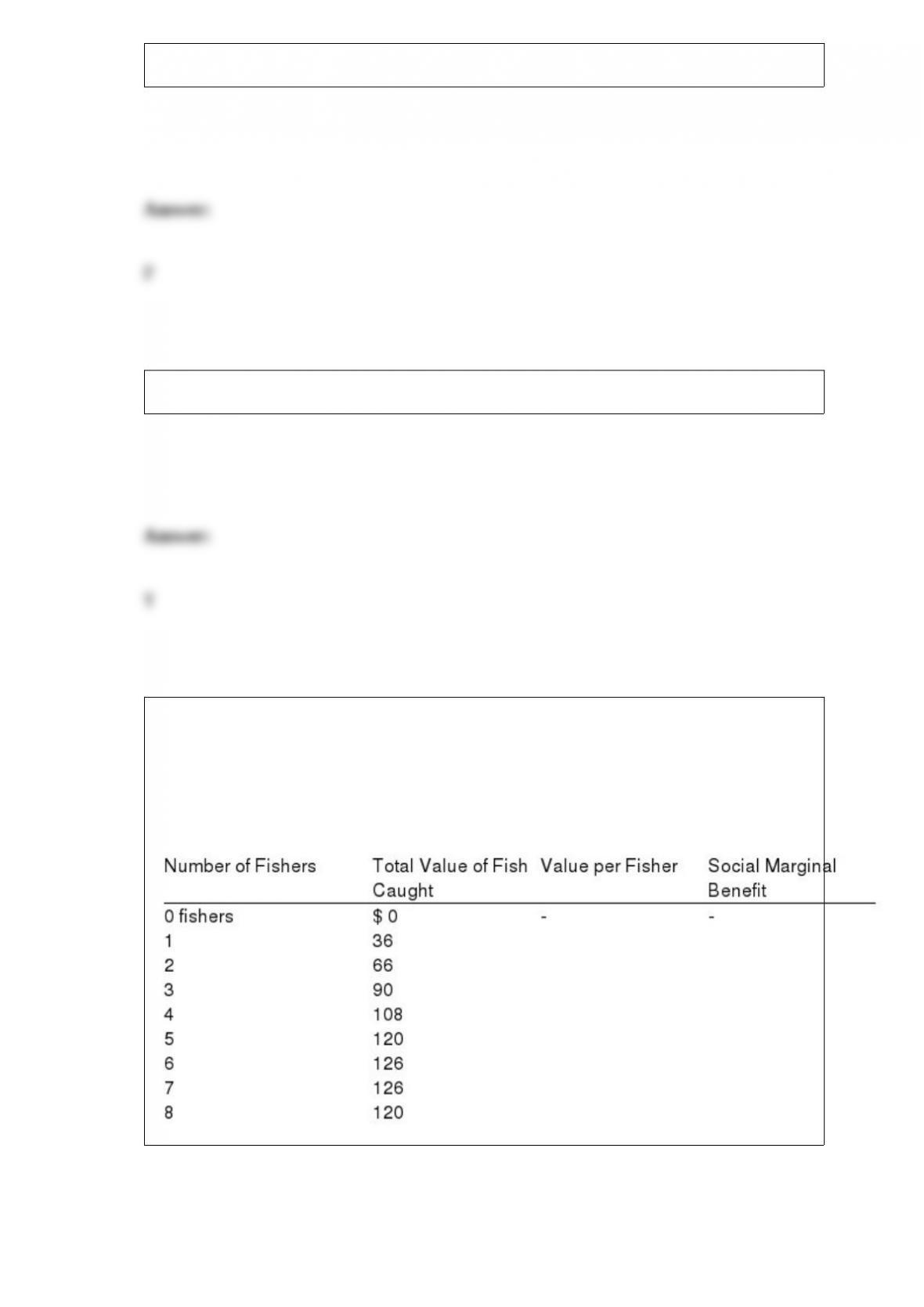
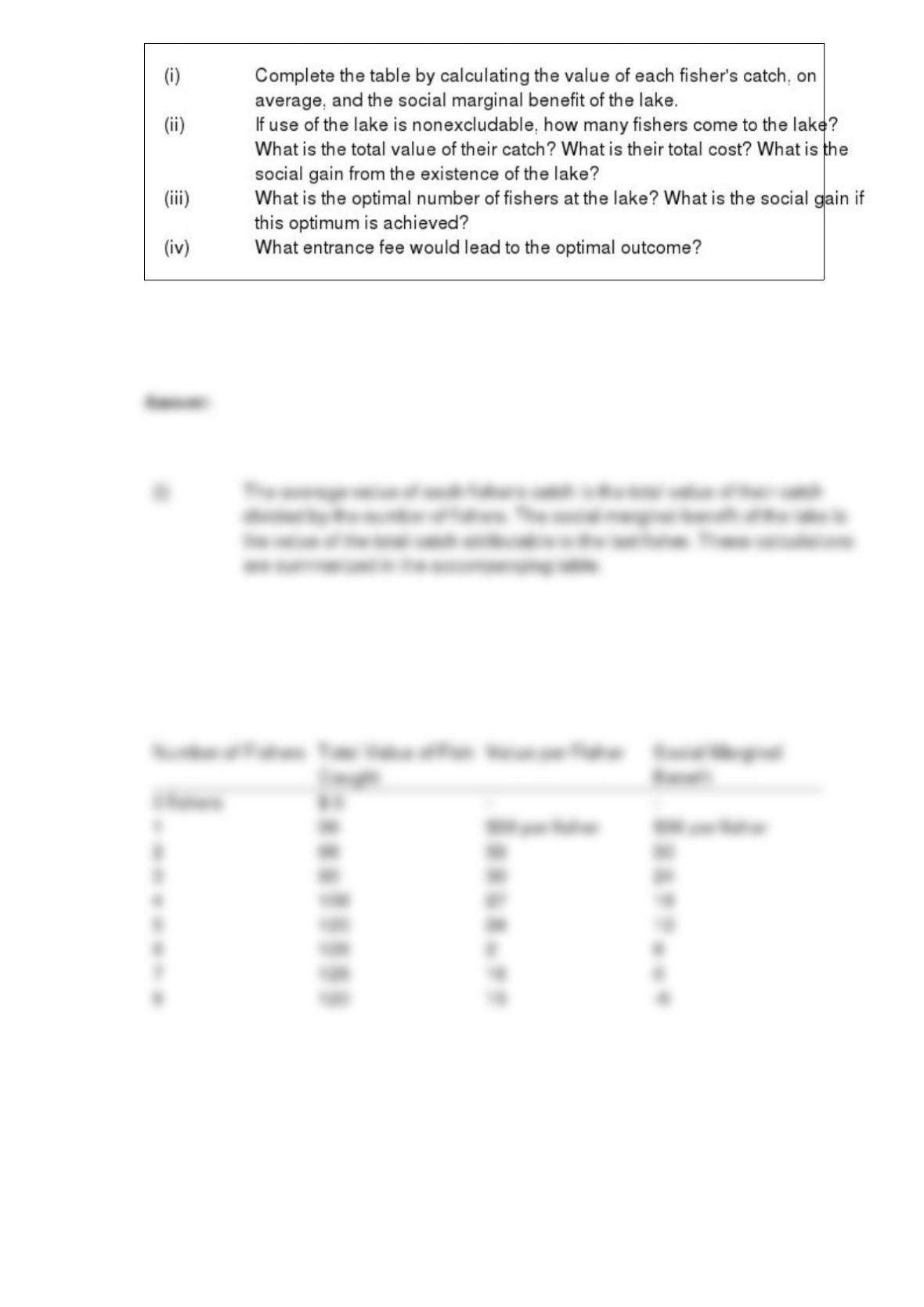
Consider a lake stocked with fish. The total value of fish caught at the lake depends on
the number of fishers, as shown in the accompanying table. As the table indicates, 1
fisher can catch $36 worth of fish in a day, 2 fishers can catch a total of $66 worth of
fish, 3 fishers can catch a total of $90 worth of fish, and so forth. The fishers are
identical, and the opportunity cost of a day at the lake is $18 for each fisher.

An unregulated, profit maximizing monopoly will never set a price where demand is
inelastic.
A firm’s long-run demand for labor is more elastic than its short-run demand for labor.
When a firm’s long-run demand curve for labor is derived, the amount of capital
employed is held constant.

Higher fuel costs would cause a delivery firm to raise the price it charges.
As long as profits remain positive, a firm will want to increase the quantity produced.
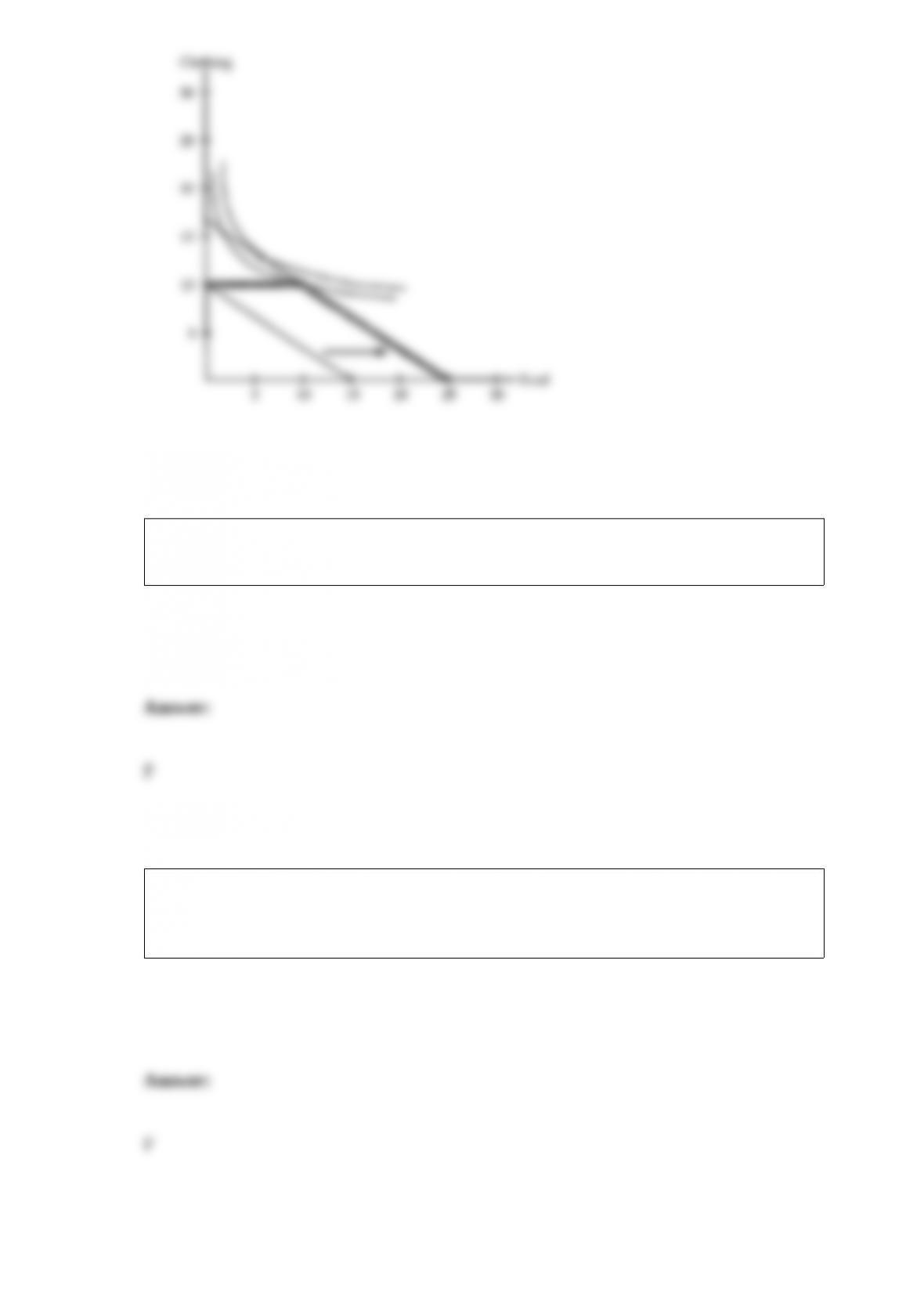
Consider the following:
A market price contains no more information about a good than a good social planner
would be able to obtain.
A utility maximizing person gets marginal utility of 20 from consuming their last piece
of bread and of 10 from consuming their last glass of milk. If a piece of bread costs 5
cents, then a glass of milk must cost 20 cents.

The spot market is the market for goods that are to be delivered at a particular location,
or “at that spot”.
If a tax and a price control have the same effect on the price paid by consumers, then
the two policies will create the same deadweight loss.
If a consumer demands the same (positive) amount of a good no matter what their
income, then the income elasticity is also positive.