
One reason why it is difficult to reform an existing welfare system is that
a. the people who provide these services currently are not willing to see their programs
eliminated.
b. any reform provides disincentives to both taxpayers and welfare recipients.
c. the system has been fine-tuned to the point where further reforms are not cost
effective.
d. most families receiving assistance are lazy and would not benefit from welfare
reforms.
e. welfare is a right provided for in the Constitution.
Usury laws stemmed from the idea that
a. interest represents labor surplus appropriated by business.
b. interest rates are not prices and therefore are not subject to the laws of supply and
demand.
c. money is a medium of exchange and not a store of value.
d. money is an asset that is fixed in supply.
e. charging someone for the use of money is sinful.

An element of economic welfare that is NOT effectively captured in growth
measurements of real per capita GDP is
a. the rate of inflation.
b. new products and improvements in the quality of goods and services.
c. population growth.
d. a change in the price level.
e. a change in the growth of output.
Joseph Schumpeter’s view of innovation and the diffusion process can be represented as
a. a continuous movement along the average product of capital curve.
b. a series of outward shifts of the marginal product curves of capital and labor.
c. a steady increase in the stock of human capital.
d. an increase over time in entrepreneurial ambitions.
e. the independent effects of workers and technology on production.
Even if a perfectly competitive firm produces at a loss in the short run, continued
production is preferable to shutting down as long as

a. price is below marginal cost.
b. total losses are less than total fixed cost.
c. average variable cost exceeds price.
d. total revenue exceeds total fixed cost.
e. total variable cost exceeds total revenue.
The bulk of goods and services consumed in the United States is produced by
a. foreign countries.
b. the U.S. government.
c. households.
d. business firms.
e. the stock market.
From the firm’s point of view, the greatest advantage in collusion is
a. access to shared technology.

b. cheaper production costs.
c. higher-quality products.
d. a bigger market.
e. security.
The purpose of right-to-work laws is to outlaw
a. yellow dog contracts.
b. open shops.
c. union shops.
d. closed shops.
e. lockouts.
Capitalization is
a. the process of accumulating capital.
b. a measure of the degree of roundabout production.
c. the process of computing the present value of the future income stream produced by

an asset.
d. a form of labor’s surplus value kept by business.
e. a way of measuring the value of capital worn out in a year.
The basic distinction between demand deposits and NOW accounts is that NOW
accounts
a. are fiat money; demand deposits are near money.
b. serve primarily as a store of value; demand deposits serve as a medium of exchange.
c. are a part of the money supply only when broadly defined; demand deposits are part
of the money supply when narrowly defined.
d. are essentially interest-bearing checking accounts; demand deposits earn no interest.
e. must be converted into currency before they can be used; demand deposits can be
used directly.
If a $1 price increase causes the quantity demanded to fall by 7 units, the demand is
a. price elastic.
b. price inelastic.

c. unit price elastic.
d. arc price elastic.
e. undetermined; not enough information is given.
There is a strong tendency for oligopolists to cheat on collusive agreements because
a. effective collusion rarely benefits any individual firm.
b. a cheater can benefit both when all the other parties abide by the agreement and when
other parties also cheat.
c. when all firms abide by the agreement, the aggregate profits are reduced.
d. collusion is a form of marginal cost pricing, whereas most firms benefit when price is
above marginal cost.
e. cheating is generally at the expense of the buyer and not the colluding sellers.
Which of the following is cited as a reason for the productivity swings in the United
States?
a. a value system that promotes a materialistic philosophy
b. changes in the rate of growth of the capital-labor ratio

c. a shift in national output away from services toward goods
d. the depletion of our natural resources
e. swings in the balance of trade
Some economists, such as John Kenneth Galbraith, assert that the public sector receives
too few resources relative to the private sector. This assertion
a. is one with which most conservative economists, such as Milton Friedman, would
agree.
b. is one that can be completely settled by economic theory.
c. is based on Galbraith’s idea that government programs tend to be inefficient.
d. reflects a value judgment about an economy’s composition of output.
e. is one that can be resolved by maintaining full employment.
For the firm mentioned in question 68, if the marginal product of B changes to 20, the
firm should
a. increase the amount of B relative to A.
b. decrease the amount of B relative to A.

c. leave the relative amounts of A and B unchanged.
d. increase both A and B but leave the relative proportions of each unchanged.
e. decrease both A and B but leave the relative proportions of each unchanged.
The basic principle behind fractional-reserve banking is that
a. on a daily basis new deposits tend to equal withdrawals.
b. loans and investments are made with funds advanced by bank owners.
c. banks hold reserves either in the form of cash or deposits with the Federal Reserve
banks.
d. a bank’s assets are equal to its liabilities plus net worth.
e. there is a legal limit on the amount of reserves banks must retain against their loans.
It is likely that involuntary unemployment would be reduced if wage rates were
a. rigid.
b. perfectly flexible.
c. indexed to upward movements in the price level but downwardly inflexible.

d. inversely related to labor productivity.
e. positively related to the unemployment rate.
The paper currency we use in the United States is
a. issued and controlled by the Treasury Department.
b. backed by gold certificates.
c. issued by commercial banks.
d. composed almost entirely of silver certificates.
e. a debt of the Federal Reserve System.
For purposes of public regulation, when computing a fair rate of return, a firm’s assets
are generally valued at ________ cost.
a. marginal
b. variable
c. either implicit or opportunity
d. declining
e. either historic or reproduction
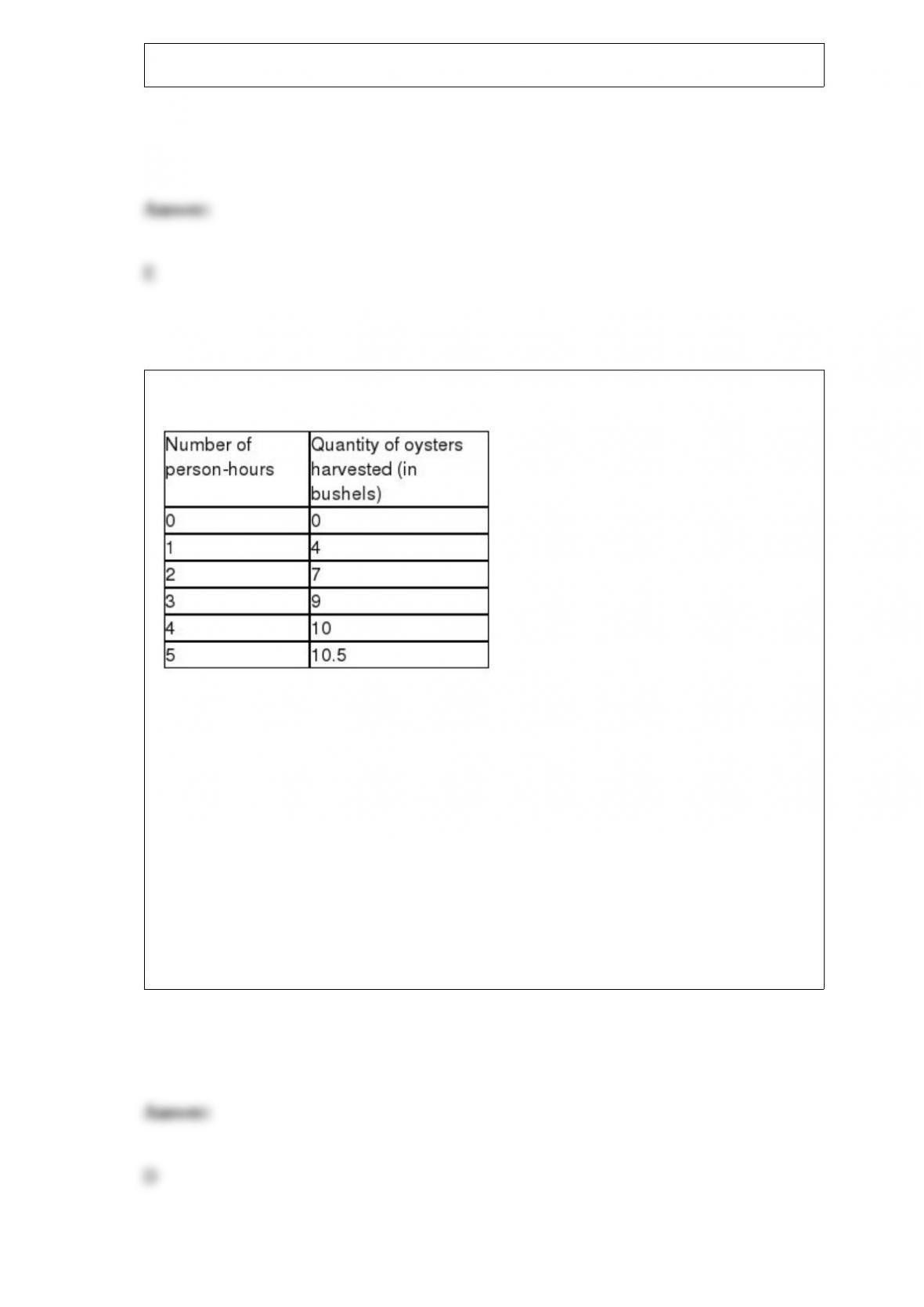
The following questions are based on the following production function:
In this production function
a. total, average, and marginal products are all declining.
b. total and average products are rising.
c. total, average, and marginal products are all rising.
d. total product is rising, while average and marginal products are declining.
e. total product is rising, but the behavior of the average and marginal products cannot
be determined.

A payment for resources purchased by a firm from outside suppliers is a(n)
a. fixed cost.
b. explicit cost.
c. joint cost.
d. derivative cost.
e. isocost.
The following questions are based on the following information. Country A can produce
either 10,000 barrels of petroleum or 12,000 bushels of wheat with one unit of its
resources. Country B can produce either 7,000 barrels of petroleum or 15,000 bushels
of wheat with one unit of its resources.From this information, country
a. A has an absolute advantage in petroleum.
b. A has an absolute advantage in wheat.
c. A has a comparative advantage in wheat.
d. B has an absolute advantage in petroleum.
e. B has a comparative advantage in petroleum.

Perhaps the biggest single criticism of price controls has been that they
a. encourage inefficient use of scarce resources.
b. tend to be harder on agriculture than on other segments of the economy.
c. invariably promote the very inflation they seek to quell.
d. are impossible to enforce in the short run.
e. have no effect on free markets.
In general, a firm should employ additional units of labor as long as
a. they are willing to work.
b. their wages exceed the value of their marginal product.
c. their wage rates do not change.
d. they add at least as much to revenues as they do to costs.
e. production is functioning.
One reason NOT to wait for wage rates and other input prices to fall and shift the
short-run aggregate supply curve to the right in an economy experiencing a
recessionary gap is that

a. such action will result in inflation.
b. unemployment would fall too fast for a complete adjustment.
c. a government budget deficit would be created.
d. it would take too long because wages and prices tend to be sticky.
e. falling prices would reduce exports.
To shift the supply of loanable funds to the right, a society must be willing to
a. eliminate risk.
b. cease saving.
c. postpone present consumption.
d. pursue tight money policies.
e. jail money lenders.
This table shows the labor supply as a function of wages and the values of marginal
product as a function of the number of laborers:
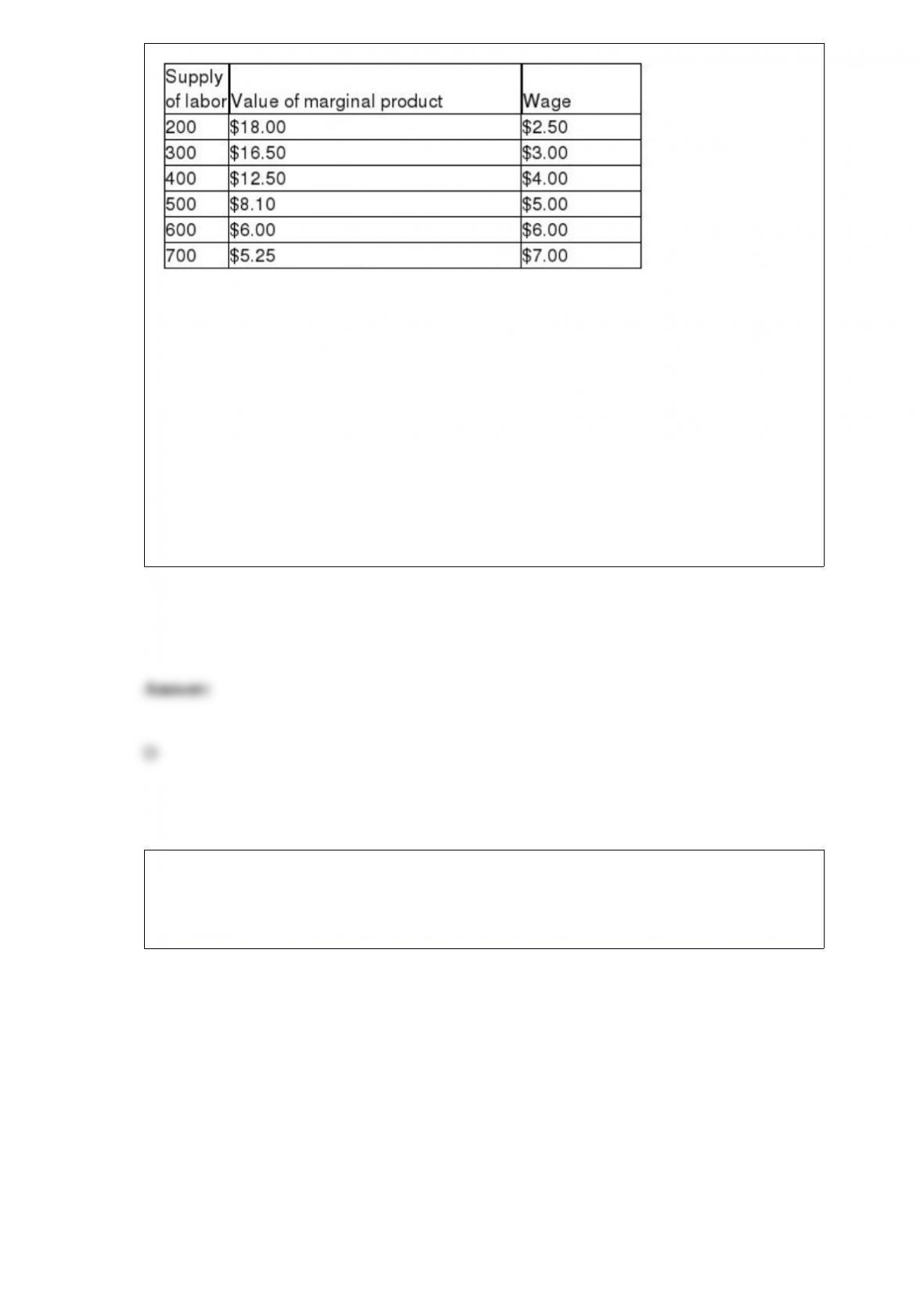
If the actual wage is $5, there will be
a. downward pressure on the wage because of the excess supply of labor.
b. no tendency toward change because $5 is the equilibrium wage.
c. upward pressure on the wage because the labor supply function is horizontal.
d. upward pressure on the wage because of the excess demand for labor.
e. a reduction in the supply of labor.
The following questions are based on the following diagrams in which D0and S0 refer
to the initial aggregate demand and short-run aggregate supply curves:
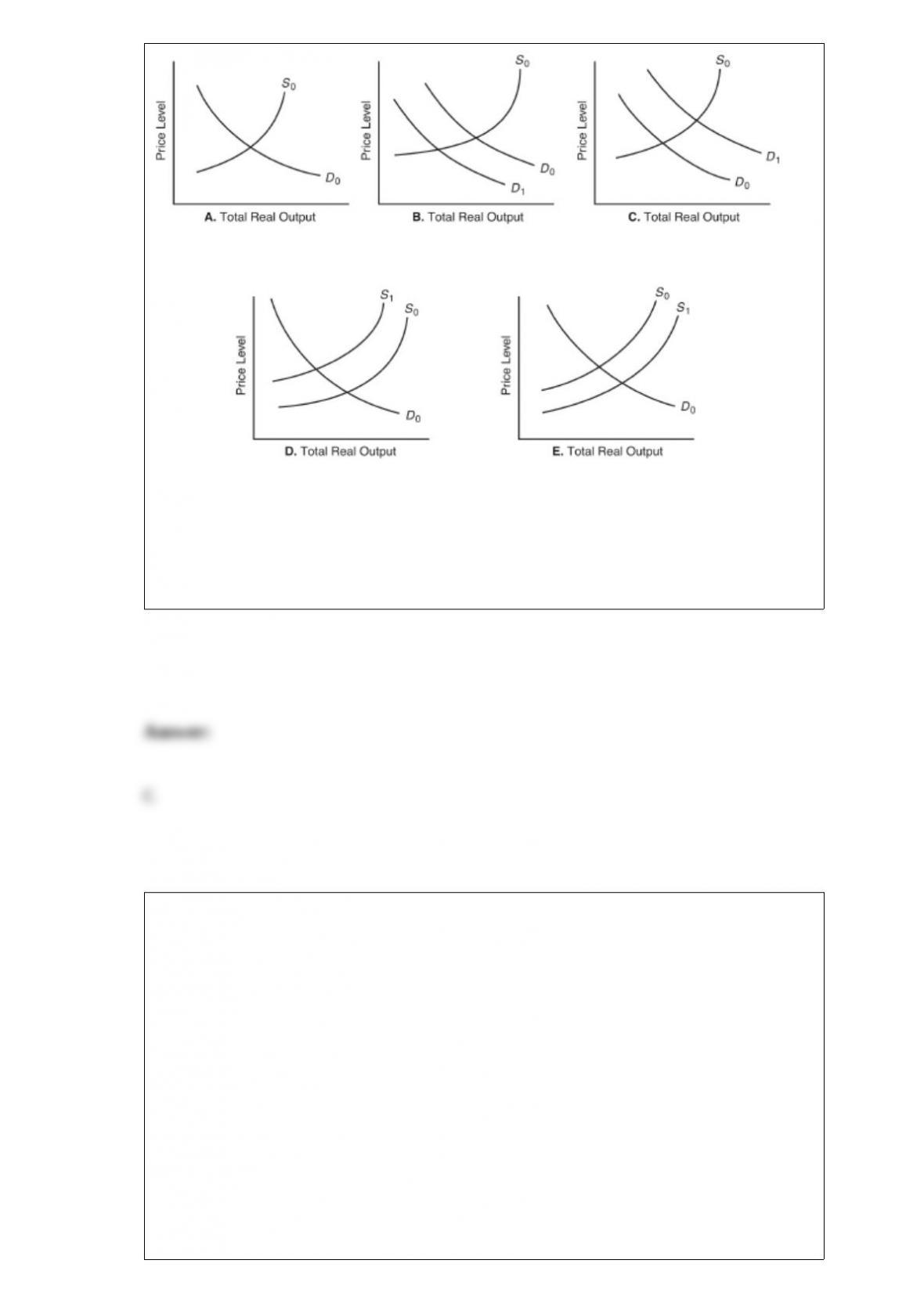
Economic conditions during World War II are best illustrated by diagram
a. A.
b. B.
c. C.
d. D.
e. E.
Which set of characteristics best identifies a pure monopoly?
a. many firms, homogeneous product, significant barriers to entry, significant nonprice
competition, and considerable power over price
b. few firms, differentiated product, no barriers to entry, the absence of nonprice
competition, and considerable advertising
c. one firm producing a product with no close substitutes, significant barriers to entry,
and considerable power over price
d. many firms, differentiated product, few barriers to entry, and nonprice competition
e. few firms, differentiated product, significant barriers to entry, and significant
amounts of nonprice competition

A recessionary gap
a. exists when actual spending is greater than its potential.
b. means that equilibrium total real output is below potential output.
c. measures the decrease in total real output needed to achieve price stability.
d. indicates the extent of the recession needed to raise the rate of inflation.
e. can be eliminated by fiscal policies designed to shift the C + I + G + (X ” MI) line
downward.
The marginal product of labor multiplied by the price of the product produced is called
the
a. value of the marginal product of labor.
b. firm’s supply curve of labor.
c. revenue possibilities curve of labor.
d. capitalization of labor curve.
e. labor productivity curve.