
When commercial banks extend loans, they are able to expand the supply of money in
the United States because the U.S. has
a. a fiat supply of money.
b. money that is backed by gold.
c. a fractional reserve banking system.
d. a system of federal deposit insurance.
Which of the following would most likely increase the supply of beef?
a. lower prices of grains used to feed cattle
b. lower prices for chicken, a substitute for beef
c. new medical research suggesting that beef causes more serious health problems than
was previously thought
d. an increase in the cost of transporting beef products to the consumer market
As the Fed increased the volume of loans to financial institutions in response to the
2008 financial crisis, this resulted in
a. a vast increase in the monetary base and the excess reserves of the commercial
banking system.
b. a substantial increase in short term interest rates.
c. a sharp decrease in the monetary base and a contraction in the excess reserves of the
commercial banking system.

d. an increase in the volume of loans extended by commercial banks and a sharp
increase in the inflation rate.
Which of the following are true?
a. Economists use the criterion of economic efficiency to judge the merit of alternative
outcomes.
b. Undertaking an economic action will be efficient if it produces more benefits than
costs for the individuals of the economy.
c. Undertaking an economic action will be inefficient if it produces more costs than
benefits to the individuals.
d. All of the above are true.
When there is reason to think that the existing structure of incentives will cause
individuals in the market to act in ways that are inconsistent with ideal economic
efficiency, economists say that
a. market failure is present.
b. democratic political decision-making will lead to the ideal efficient outcome.
c. government action, however well intended, cannot improve the situation.
d. government failure is present.

In order to achieve a high economic freedom rating, a country must
a. elect political officials democratically.
b. protect property rights, enforce contracts even-handedly, and rely extensively on
markets to allocate goods and services.
c. provide citizens with housing, health care, and other basic goods free of charge.
d. use the taxing power of the state to redistribute income from the rich to the poor and
thereby promote income equality.
The growth records of Japan and Hong Kong during the last fifty years indicate that an
economy can grow rapidly without
a. securely defined property rights.
b. abundant domestic natural resources.
c. significant capital formation.
d. adopting modern technology.

Under a pure flexible exchange rate system, the rate that equates demand and supply in
the exchange rate market will also lead to a balance of
a. merchandise exports and merchandise imports.
b. current account transactions.
c. capital account transactions.
d. current and capital account transactions.
Andrew buys yogurt, and he would be willing to pay more than he now pays. Suppose
that Andrew has a change in his tastes such that he values yogurt more than before. If
the market price is the same as before, then
a. Andrew’s consumer surplus would be unaffected.
b. Andrew’s consumer surplus would increase.
c. Andrew’s consumer surplus would decrease.
d. Andrew would be wise to buy less yogurt than before.
For an economy, aggregate demand equals
a. consumption plus investment plus government purchases plus exports.
b. consumption plus investment plus government purchases plus (exports minus
imports).

c. consumption plus investment plus (taxes minus transfers) plus (exports minus
imports).
d. consumption plus investment plus government purchases plus (imports minus
exports).
Shaniqua sells life insurance and is considering buying a $60,000 Lexus for business
purposes (thus, the expense reduces her taxable income). If Shaniqua is in the 40
percent marginal tax bracket, how much after-tax income will she have to give up in
order to enjoy the Lexus?
a. $24,000
b. $36,000
c. $30,000
d. $84,000
Which of the following contributed to the strong auto sales and soaring housing prices
during 2002-2004?
a. the Fed’s high-interest rate policy during the period
b. the tightening of loan standards by commercial lenders
c. the increasing popularity of fixed-rate, long-term loans to lock in low interest rates
d. the Fed’s low-interest rate policy during the period
The market pricing system corrects an excess supply by
a. raising the product price and increasing producer profits.
b. lowering the product price and decreasing producer profits.
c. raising the product price and decreasing producer profits.
d. lowering the product price and increasing producer profits.
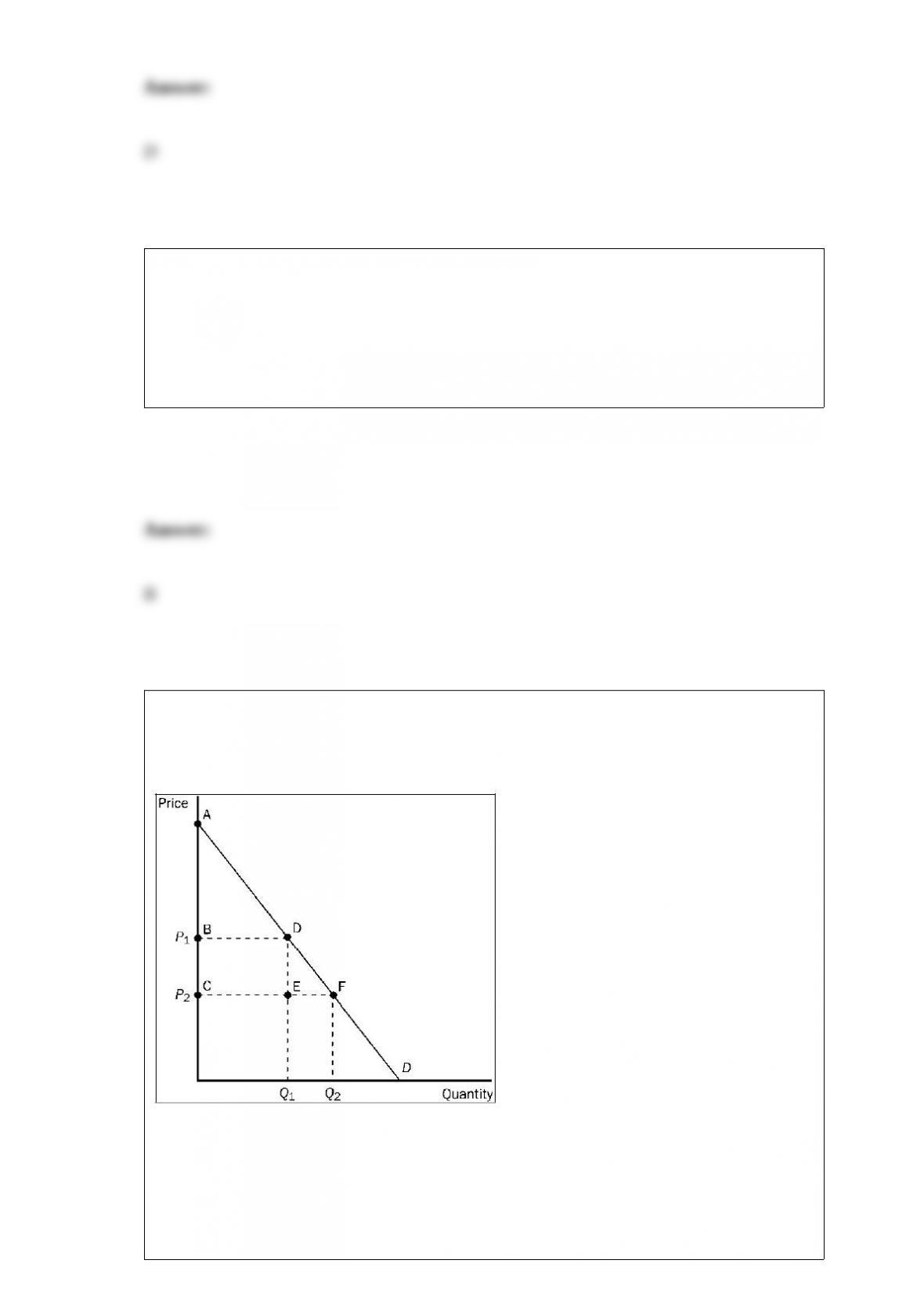
Figure 3-18
Refer to Figure 3-18. Which area represents consumer surplus at a price of P1?
a. ABD
b. ACF
c. BCDE
d. DEF
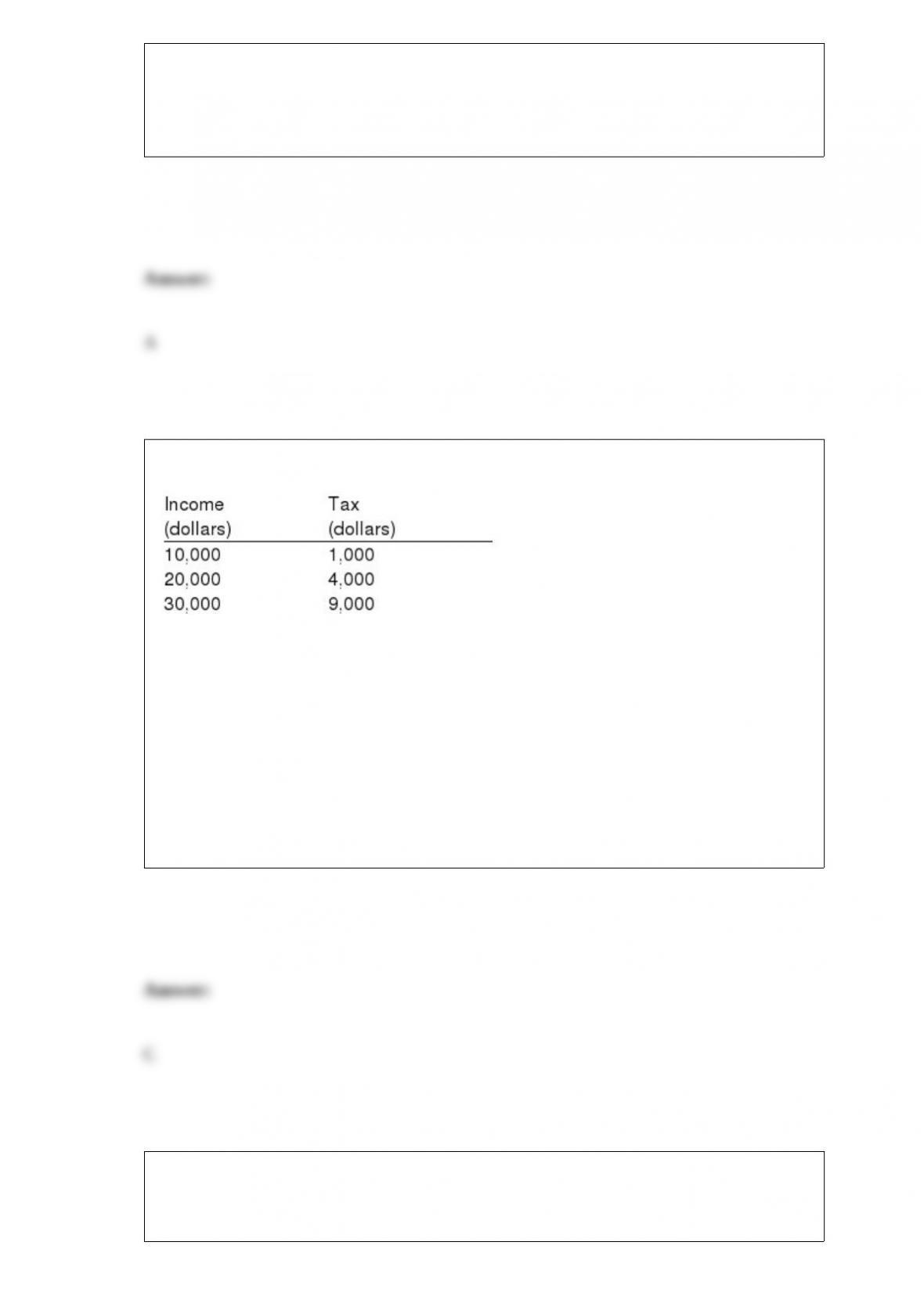
Use the table below to choose the correct answer.
For the income range illustrated, the tax shown here is
a. regressive.
b. proportional.
c. progressive.
d. regressive up to $20,000 but progressive beyond that.
Increases in government expenditures and large budget deficits are projected for
2014-2020. If strong growth is observed during this decade, this would be most
consistent with

a. the Keynesian view.
b. the supply-side view.
c. the crowding-out effect.
d. the new classical theory.
Investment in both physical and human capital tends to enhance economic growth
because it generally
a. increases consumption during the current period.
b. makes it possible for individuals to produce more goods and services per hour
worked.
c. encourages firms to expand output by employing more low productivity workers.
d. encourages workers to unionize and thereby fight for higher wages.
Demographic conditions
a. were much less favorable for the Social Security system in 1950 than is currently the
case.
b. are currently unfavorable because the number of retirees is growing rapidly as the

result of the high birth rate in the United States during 1930-1945.
c. will be less favorable for the Social Security system once the baby boom generation
begins to retire.
d. don’t affect the financial status of the Social Security system because it is based on
the same principles as private insurance programs.
Which of the following is a deficiency of the regular (or traditional) consumer price
index (CPI) as a measure of the cost of living?
a. The CPI fails to make any adjustment for changes in the price of housing.
b. The CPI only measures changes in the prices of food, clothing, and energy.
c. The CPI fails to maintain the quantities of the typical bundle of goods purchased by
consumers constant over a lengthy time frame.
d. The CPI does not adjust regularly for the fact that consumers will shift their spending
away from goods that become more expensive.
If the actual price level exceeds the expected price level reflected in long-term
contracts,
a. many firms will find production more profitable than they had expected and will
increase the quantity of output supplied.
b. many firms will find production less profitable than they had expected and will
decrease the quantity of output supplied.
c. many firms will find production more profitable than they had expected and will
decrease the quantity of output supplied.

d. many firms will find production less profitable than they had expected and will
increase the quantity of output supplied.
Farmers can choose to produce eggs or milk. If there is an increase in the price of milk
then what will be the effect in the egg market?
a. The quantity of eggs demanded will increase.
b. Egg demand will decrease.
c. Egg supply will increase.
d. Egg supply will decrease.
Suppose the demand for large (and therefore high-gasoline consumption) cars decreases
sharply during an energy crisis. The most likely market adjustment would be
a. a sharp rise in the price of large cars in the short run as people rush to purchase these
vehicles before producers cut back on manufacturing them.
b. a moderate increase in short-run prices, followed by a larger long-run price increase
as the supply of large cars is depleted.
c. lower short-run prices, which will lead to an expansion in the number of large cars
sold.
d. a decrease in the price of large cars in the short run, leading to a reduction in output,
which will moderate the price decline in the long run.

When price is the rationing criterion, individuals have a strong incentive to
a. ignore the wishes of others when making decisions about how to use their resources.
b. provide services to others in exchange for income.
c. avoid exchanges because in every exchange there will be one person who gains and
another who loses.
d. substitute promises for the consistent delivery of a quality product.
Budget projections for 2014-2020 indicate both higher levels of government spending
and large budget deficits. Non-Keynesian economists argue that this will lead to
a. lower taxes, which will reduce aggregate supply and retard long-term growth.
b. growth rates above the historic average for the decade.
c. an increase in aggregate demand and real output.
d. higher interest rates, higher taxes, and sluggish future growth.

The consumption function shows the relationship between
a. planned consumption expenditures and disposable income.
b. permanent income and savings.
c. business inventory and real GDP.
d. aggregate demand and aggregate consumption.
Which of the following items are counted in M2?
a. stock mutual funds
b. money-market mutual funds
c. bond mutual funds
d. all of the above
According to the economic way of thinking, personal benefits and costs influence the
actions of
a. consumers in the private sector but not voters in the public sector.
b. producers in the private sector but not politicians in the public sector.

c. taxpayers but not recipients of government-provided goods and services.
d. consumers, producers, voters, and politicians in both the private and the public
sectors.
Which of the following is correct?
a. Federal Reserve purchases of securities will increase the reserves available to
commercial banks.
b. Federal Reserve purchases of securities exert upward pressure on interest rates in the
short run.
c. The Federal Reserve System determines the ratio of currency held by the public to
the money supply (M1).
d. Federal Reserve purchases of securities will decrease the reserves available to
commercial banks.
Which of the following would shift a firm’s short-run cost curves downward?
a. an advance in technology
b. an increase in employees’ wages
c. an increase in the demand for the firm’s product
d. an increase in excise taxes levied on the firm’s product

In 2013, ____ percent of college degrees were earned by women.
a. 27
b. 37
c. 47
d. 57
Studies indicate that the demand for fresh tomatoes is much more elastic than the
demand for salt. These findings reflect that
a. tomatoes are a necessity while salt is a luxury.
b. it takes longer for consumers to adjust to a change in the price of salt than to a
change in the price of tomatoes.
c. salt will not spoil as easily as fresh tomatoes.
d. more good substitutes exist for fresh tomatoes than for salt.