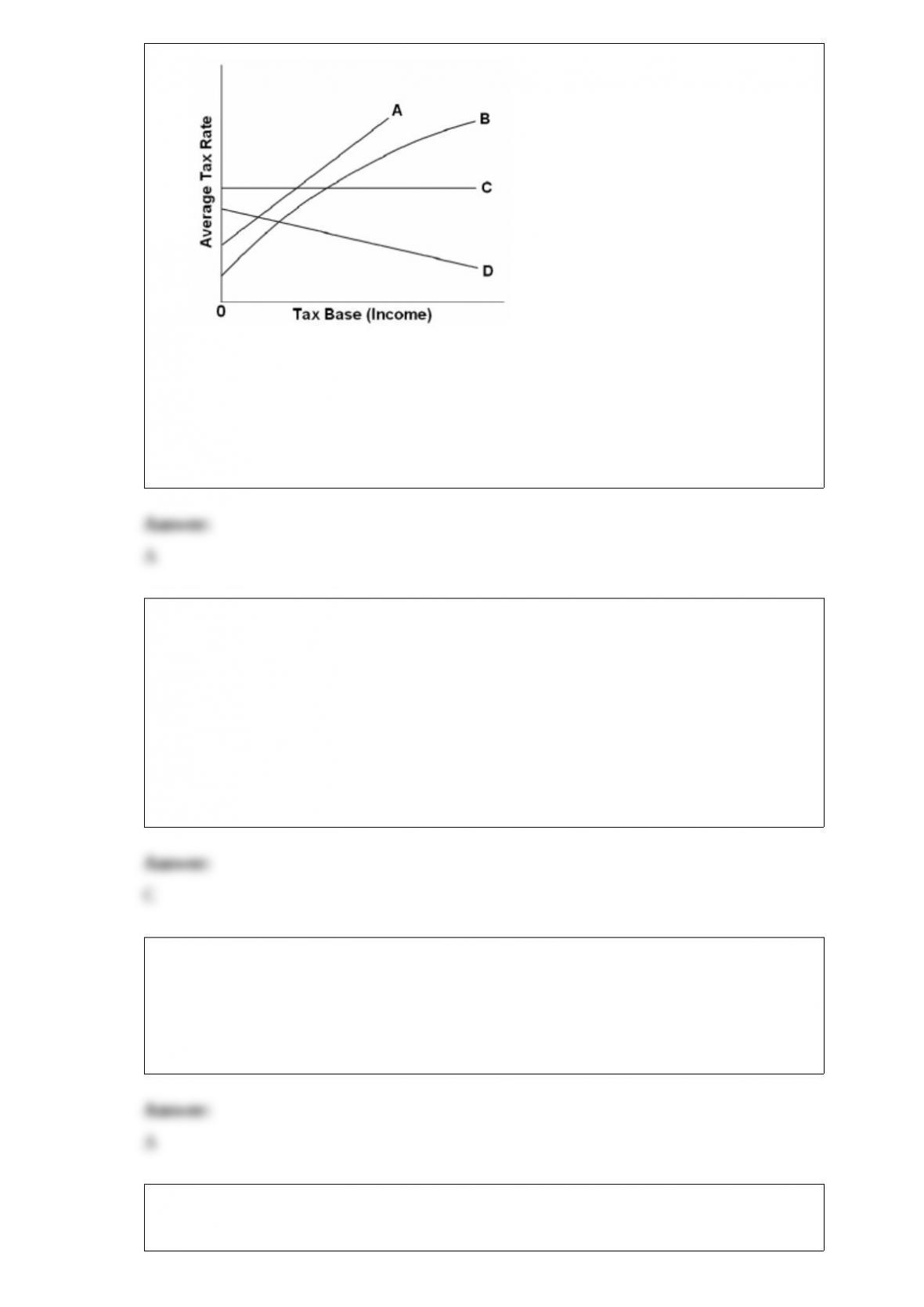
1)
Refer to the above graph. Which of the lines in the above diagram represent(s) a
progressive tax?
A.both A and B.
B.D only.
C.C only.
D.B only.
2) Gomez argues that we need to increase the nation’s output. Chang contends that our
top priority should be a more equal distribution of income and output. It can be
correctly stated that these two goals are:
A.essentially unrelated.
B.complementary because the realization of one will promote fulfillment of the other.
C.at least partially competing because the redistribution of income might impair
incentives to work and produce.
D.complementary because a more equal distribution of income always promotes
economic growth.
3) Productivity measures:
A.real output per unit of input.
B.per unit production costs.
C.the changes in real wealth caused by price level changes.
D.the amount of capital goods used per worker.
4) Which of the following describes the equilibrium condition in a purely competitive
labor market?
A.MRP = Wage Rate
B.MRP > Wage Rate
C.Wage Rate > MRC
D.Wage Rate < MRC
5) Money is destroyed when:
A.loans are made.
B.checks written on one bank are deposited in another bank.
C.loans are repaid.
D. the net worth of the banking system declines.
6) The following table for a commercial bank or thrift:
Refer to the above table. When the legal reserve ratio is 20 percent, the money creating
potential of the entire banking system is:
A.$4,000.
B.$6,000.
C.$8,000.
D.$10,000.
7) If net exports are positive:
A.the equilibrium GDP must be greater than the full-employment GDP.
B.imports must exceed exports.
C.aggregate expenditures are greater at each level of GDP than when net exports are
zero or negative.
D.some other component of aggregate expenditures must be negative.

8) In the United States, research and development spending as a percentage of GDP is:
A.1.5 to 2.0 percent, which is lower than that of most other industrial countries.
B.2.5 to 3.0 percent, which is higher than that of most other industrial countries.
C.4.5 to 5.0 percent, which is lower than that of most other industrial countries.
D.5.5 to 6.0 percent, which is higher than that of most other industrial countries.
9) the demand for commodity x is represented by the equation p = 10 – 0.2q and supply
by the equation p = 2 + 0.2q.
refer to the above information. if demand changed from p = 10 – .2q to p = 7 – .3q, we
can conclude that:
a.demand has increased.
b.demand has decreased.
c.supply will increase.
d.supply will decrease.
10) if production is occurring where marginal cost exceeds price, the purely competitive
firm will:
a.maximize profit, but resources will be underallocated to the product.
b.maximize profit, but resources will be overallocated to the product.
c.fail to maximize profit and resources will be overallocated to the product.
d.fail to maximize profit and resources will be underallocated to the product.
11) when compact disc (cd) players first came on the market, they sold for over $1,000.
now they cost only $100. these facts imply that:
a.the cd industry was once competitive, but is now monopolistic.
b.fewer firms produce cd players than was the case five or ten years ago.
c.the demand curve for cd players has shifted leftward.
d.the cd player industry is a decreasing-cost industry.
12) one can say with certainty that equilibrium quantity will increase when supply:
a.and demand both decrease.
b.increases and demand decreases.
c.decreases and demand increases.
d.and demand both increase.
13) Average per capita water consumption in the U.S. was approximately how many
gallons per day in 2000?
A.440
B.764
C.1,040
D.1,430
14) the following cost data for a firm that is selling in a purely competitive market:
refer to the above data. if the market price for the firm’s product is $32, the competitive
firm will produce:
a.8 units at an economic profit of $16.
b.5 units at a loss of $10.
c.8 units at a loss equal to the firm’s total fixed cost.
d.7 units at an economic profit of $41.50.
15) Name the type of unemployment occurring in each of the causes below and explain
your answer.
(a)Frank recently lost his job as the computer manufacturing company he works for
recently downsized after poor sales and poor performance of the economy during the
last year.
(b)Julie just recently graduated from college and is spending the summer traveling
before she begins a job with a consulting firm in the fall.
(c)Tom recently lost his job as the steel manufacturing firm he worked for moved their
plant overseas. The other steel plants in the nation have been also been following this
trend.
(d)Susan recently left her marketing job at a local bank because she found that finance
interests her more. She is currently looking for a job as a financial consultant.
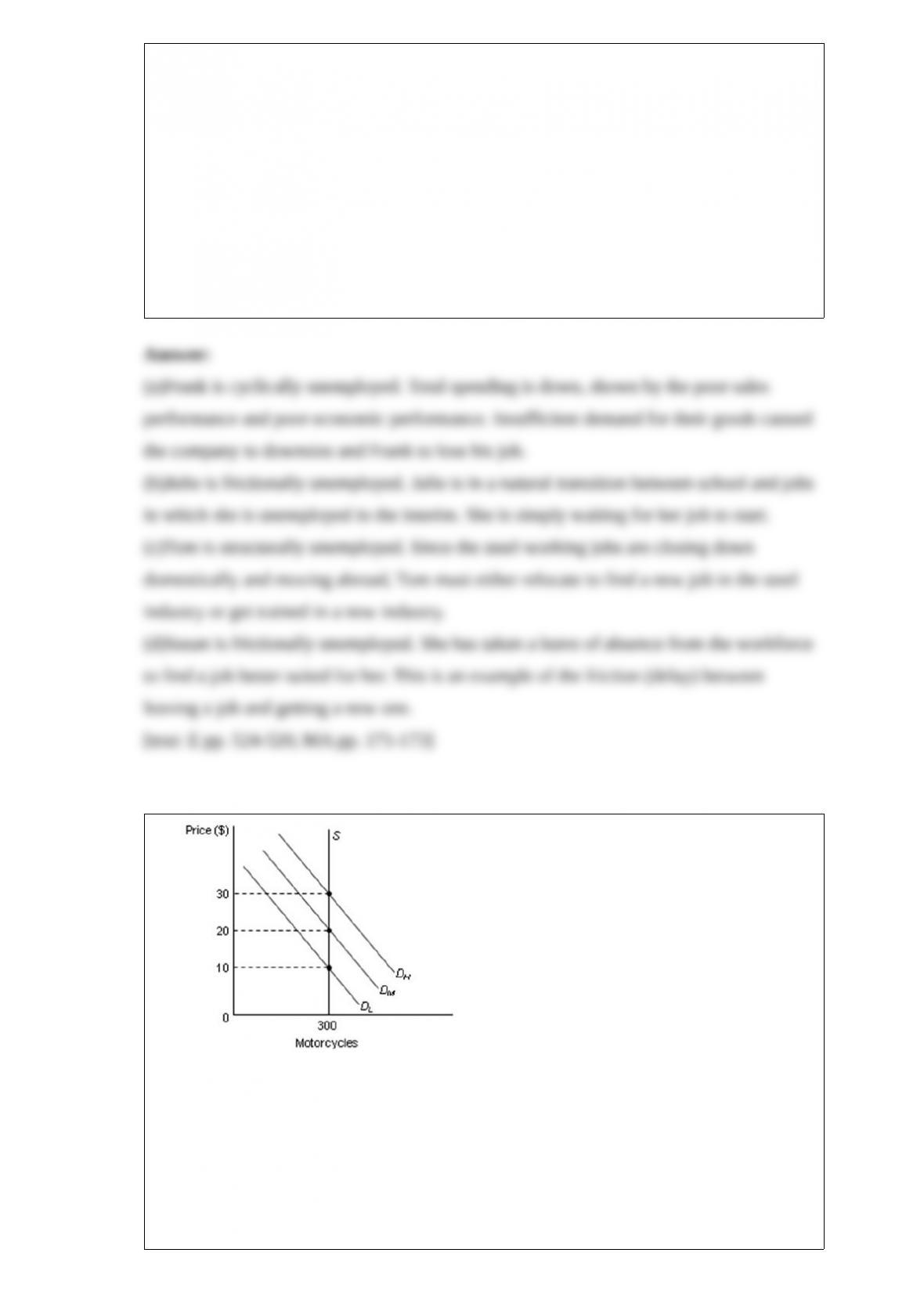
16) Answer the next four questions based on the
following demand and supply model for a business firm producing motorcycles.
Assume that 300 motorcycles is the optimal and most profitable level of production for
the firm. All dollars are in thousands.
(a)What are the equilibrium price and quantity at the medium level of demand (DM)?
(b)What will be the equilibrium price and quantity if there is a demand shock that
unexpectedly lowers demand (DL)?
(c)What will be the equilibrium price and quantity if there is a demand shock that
unexpectedly increases demand (DH)?

(d)What can you conclude will happen to prices and output when this model is shocked
by changes in demand?
17) an effective price floor will:
a.force some firms in this industry to go out of business.
b.result in a product surplus.
c.result in a product shortage.
d.clear the market.
18) Other things equal, if there is an increase in nominal GDP:
A.the demand for money will decrease.
B.the interest rate will rise.
C.bond prices will rise.
D.consumption spending will fall.