In 2009 Greece received emergency loans from other European countries and the
International Monetary Fund. These loans required the Greek government to cut
spending, which worsened the Greek recession.
A) True
B) False
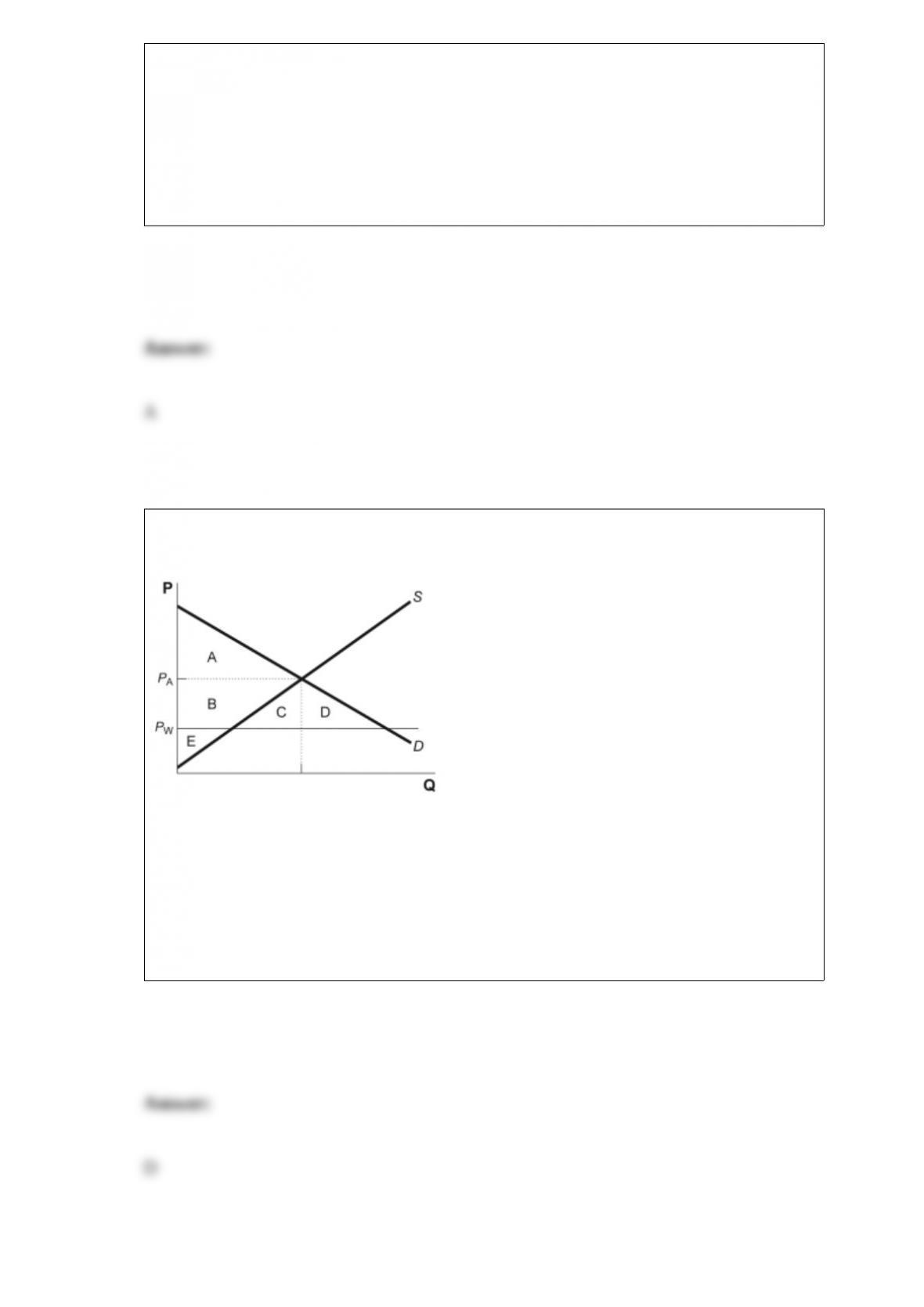
Figure: The Market for Thumb Drives
Look at the figure The Market for Thumb Drives. Assume that PAis the autarky price,
PWis the world price, and Dand Srepresent domestic demand and supply, respectively.
Producer surplus in free trade equals the area:
A) B + C.
B) B + C + D +E.
C) B + E.
D) E.

Which of the following financial asset(s) is (are) a share of ownership in a company?
I. bonds
II. loan-backed securities
III. stocks
A) I only
B) II only
C) III only
D) I, II, and III
If the production possibility frontier is a straight line:
A) opportunity costs are constant.
B) the firm faces increasing costs.
C) the firm faces decreasing costs.
D) there is no trade-off between the two goods represented.
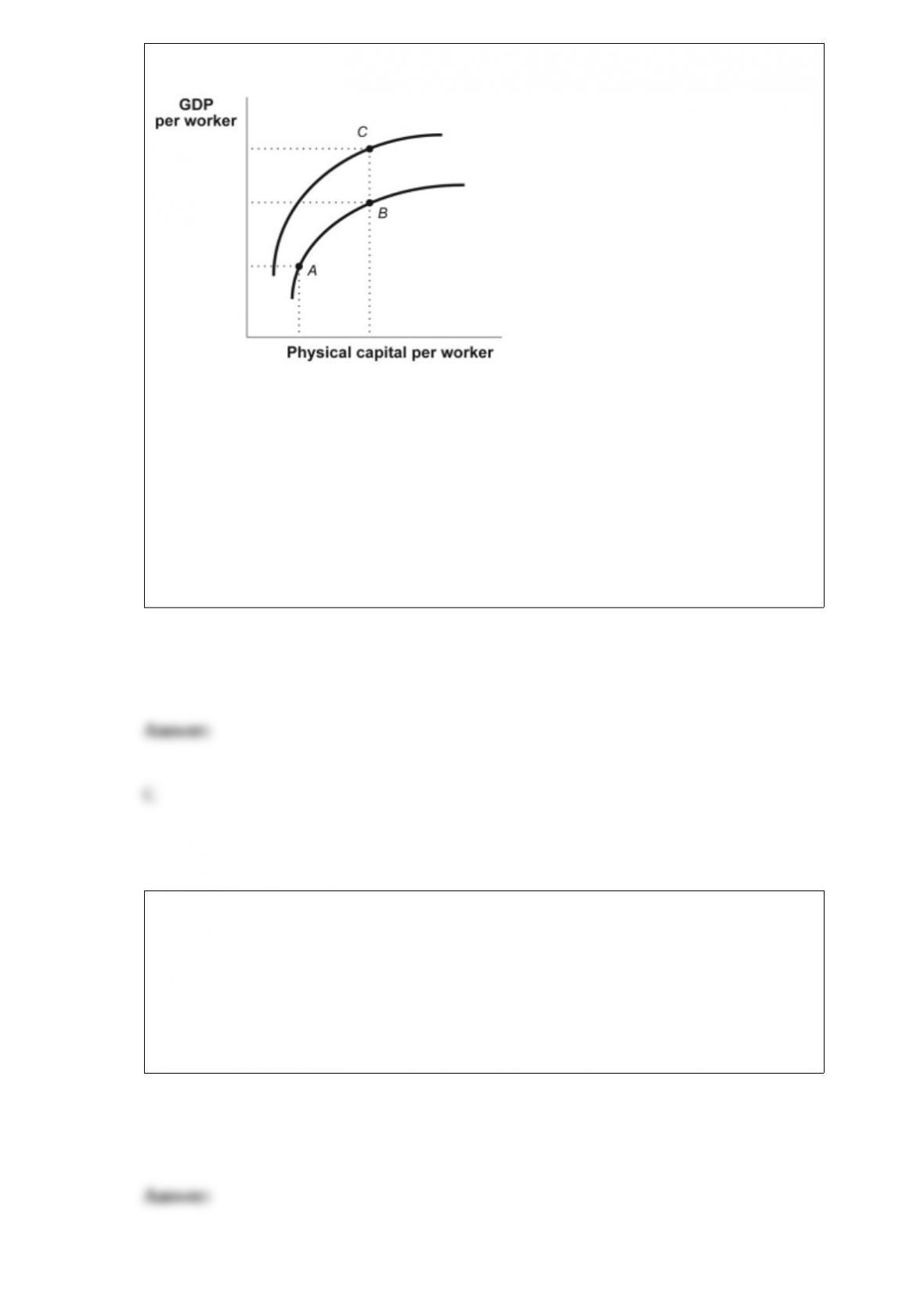
Figure: Productivity
Look at the figure Productivity. An
increase in physical capital per worker with everything else remaining unchanged is
shown on the diagram as a movement from:
A) B to C.
B) A to C.
C) A to B.
D) B to A.
A tariff or quota will _____ prices and _____ the consumption of the protected goods in
the importing country.
A) raise; increase
B) raise; decrease
C) lower; increase
D) lower; decrease

Before the twentieth century, the most important determinant of productivity was:
A) technology.
B) natural resources.
C) physical capital.
D) human capital.
The present value of a future payment will be smaller the:
A) sooner the payment is due.
B) lower the interest rate.
C) higher the interest rate.
D) higher the interest rate and the later the payment is due.
Table: The Economy of Albernia

Real GDP
(in billions) Disposable Income
(in billions) Consumption
(in billions) Planned Investment
(in billions)
$ 0 $ 0 $ 400 $600
500 500 700 600
1,000 1,000 1,000 600
1,500 1,500 1,300 600
2,000 2,000 1,600 600
2,500 2,500 1,900 600
3,000 3,000 2,200 600
Look at the table The Economy of Albernia. What is the consumption function for
Albernia?
A) C= 600 + 0.3 YD
B) C= 600 + 0.75 YD
C) C= 400 + 0.6 YD
D) C= 400 + 0.75 YD
When the output gap is negative, the actual unemployment rate is:
A) above the natural rate.
B) below the natural rate.
C) equal to the natural rate.
D) The actual and natural unemployment rates are not related to the output gap.

Suppose an economy uses a monetary system of checkable deposits only and it has a
required reserve ratio of 20%. If the central bank in this economy conducts an open
market purchase of $5 million of Treasury bills, this will potentially _____ the money
supply by _____.
A) increase; $25 million
B) decrease; $25 million
C) increase; $10 million
D) decrease; $10 million
A decrease in the price of eggs will result in an increase in the:
A) demand for eggs.
B) supply of eggs.
C) quantity of eggs supplied.
D) quantity of eggs demanded.
The Fed usually responds to a recession by:
A) buying short-term government debt from banks.

B) selling short-term government debt to banks.
C) raising interest rates.
D) increasing reserve requirements.
Nominal wages are sticky because:
A) wages are slow to rise when there are labor shortages and slow to fall even when the
level of unemployment is significant.
B) wages remain fixed in the long run, increasing the profitability of the firms.
C) wages are slow to fall when there are labor shortages and slow to rise even when the
level of unemployment is significant.
D) in the long run all wages are adjusted for inflation.
InSeptember 2007, reversing its course, the Federal Reserve began a series of:
A) interest rate increases, reversing its previous policy of lowering interest rates to fight
the financial crisis.
B) interest rate increases to combat inflation.
C) cuts in the reserve requirements, reversing its previous policy of increasing the
reserve requirement, to stop bank failures.
D) cuts in the federal funds target rate to lower the interest rate, reversing its previous
policy of raising interest rates, to fight the financial crisis.
Planned investment spending depends on:
A) the market interest rate.
B) wealth.
C) expected disposable income.
D) the life-cycle hypothesis.
In the long run, changes in the money supply _____ the aggregate price level and _____
aggregate output.
A) affect; affect
B) affect; do not affect
C) do not affect; affect
D) do not affect; do not affect
The savings and loan crisis began in the early 1970s, when interest rates increased
sharply and depositors at S&Ls withdrew their money from their low-interest savings
accounts and invested in money market accounts that paid higher interest rates.
A) True
B) False
Figure: Unemployment Rate over Time
Look at the figure Unemployment Rate over Time. In the time-series graph, as we move
from the beginning of 2001 to the beginning of 2003, we see that the unemployment
rate has _____ from approximately _____ to approximately _____.
A) decreased; 5%; 4%
B) increased; 5.3%; 7.3%
C) decreased; 7.7%; 5.5%
D) increased; 4%; 6%

A central bank is an institution that oversees and regulates the banking system and
controls the monetary base.
A) True
B) False
According to the classical model, prices are _____, making the aggregate supply curve
_____ in the short run.
A) sticky; upward sloping
B) flexible; vertical
C) flexible; downward sloping
D) sticky; vertical
The money demand curve is _____ because the opportunity cost of holding money is
_____ related to the interest rate.
A) downward-sloping; inversely
B) downward-sloping; directly
C) upward-sloping; inversely
D) upward-sloping; directly
The economy is self-correcting in the long run.
A) True
B) False
Savings and loans were very profitable in the 1970s because investors withdrew their
funds from low-interest-paying money market accounts and invested them in
high-interest-paying accounts at thrifts.
A) True
B) False
Goods that are produced in a particular period but NOT sold in that period:
A) go into inventory and are called consumption.
B) end up in inventory and are included in investment.
C) are finally included in depreciation when they are sold.
D) are classified as intermediate goods.
The Heckscher”Ohlin model cannot explain United States”Mexico trade, since the
United States has more labor and more land than Mexico.
A) True
B) False
If the supply and demand curves intersect at $14, then any price below that would result
in:
A) a shortage.
B) a surplus.
C) equilibrium.
D) an increase in demand.
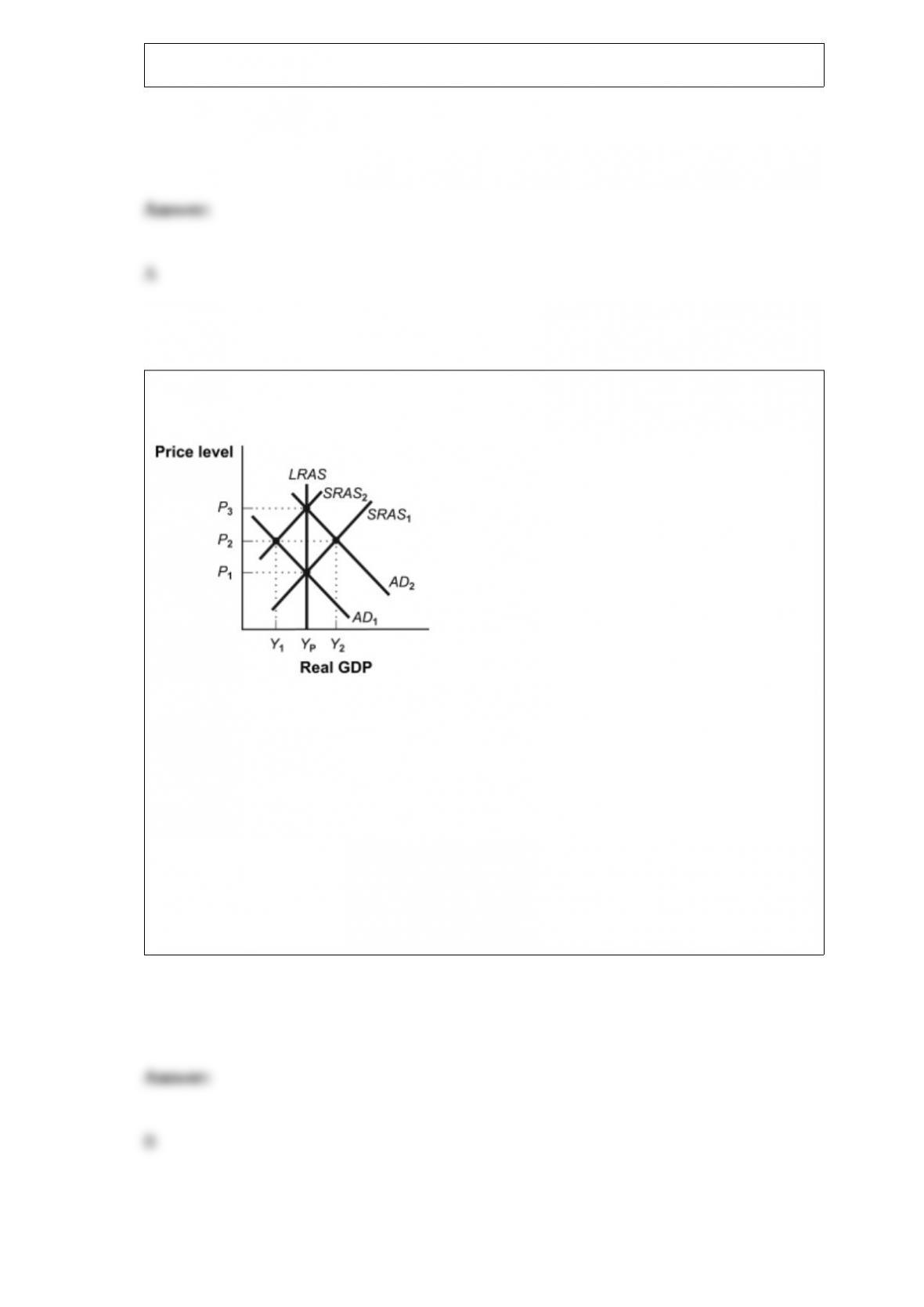
Figure: An Increase in Aggregate Demand
Look at the figure An Increase in Aggregate Demand. At the Y2 level of real GDP:
A) an inflationary gap equal to the sum of Y2 and YP occurs.
B) an inflationary gap equal to the difference between Y2 and YP occurs.
C) the solution at Y2 is a long-run equilibrium.
D) a recessionary gap equal to the difference between Y2 and YP occurs.

GDP is the value of consumption spending _____ investment spending _____
government purchases _____ the value of exports _____ spending on imports.
A) plus; plus; plus; plus
B) plus; plus; plus; minus
C) plus; minus; minus; plus
D) minus; minus; plus; plus
Cyclical unemployment:
A) rises during a recession.
B) falls during a recession.
C) rises during an expansion.
D) is a part of natural unemployment.
If the price index in year 1 is 110 and the price index in year 2 is 115, then the inflation
rate is exactly 5% from year 1 to year 2.
A) True
B) False
The behavior of the financial accounts is determined in the international _____ market.
A) goods and services
B) loanable funds
C) money
D) stock
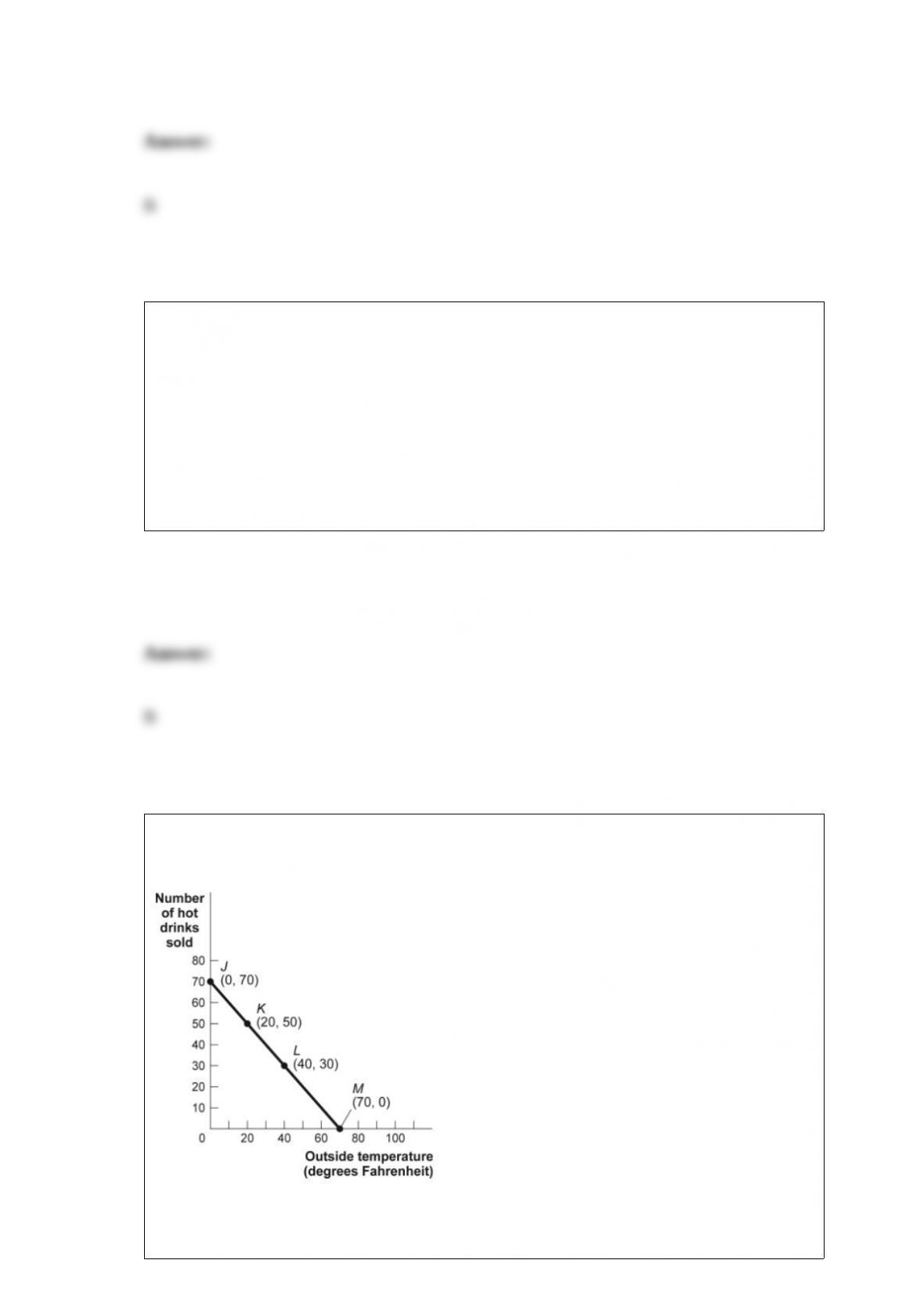
Figure: Hot Drinks Sold and Temperature
Look at the figure Hot Drinks Sold and Temperature. If we move from point K to point
L in the figure, the outside temperature has ______ degrees and the number of hot
drinks sold has ______.
A) decreased by 30; increased by 30
B) increased by 20; decreased by 20
C) increased by 30; decreased by 30
D) increased by 40; decreased by 40