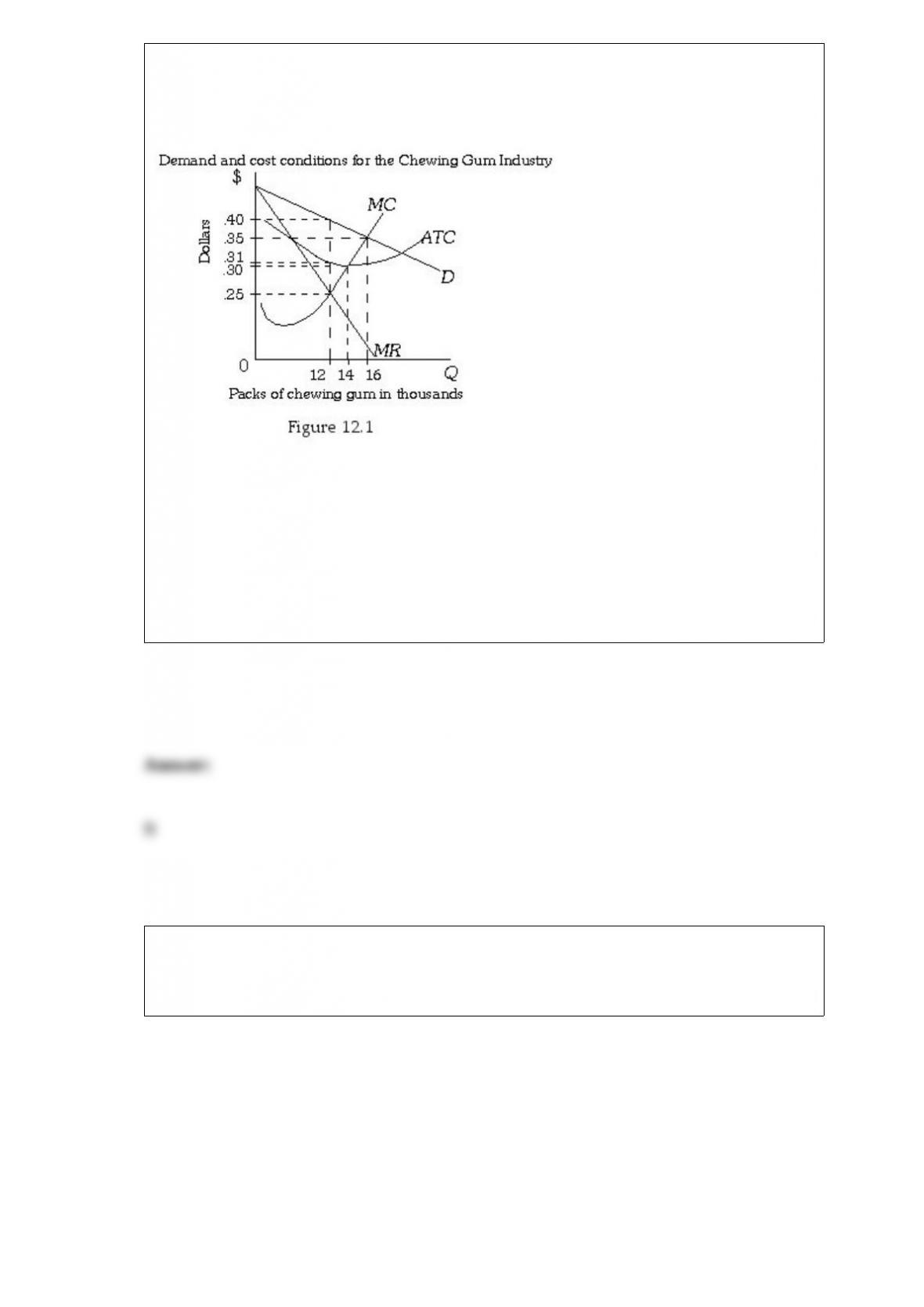
Refer to Figure 12.1. Six firms that produce chewing gum have formed a cartel. The
cartel faces the market demand curve given by D. To maximize profits, the cartel should
produce ________ packs of chewing gum and the price should be ________.
A) 12,000; $.25
B) 12,000; $.40
C) 14,000; $.30
D) $16,000; $.35
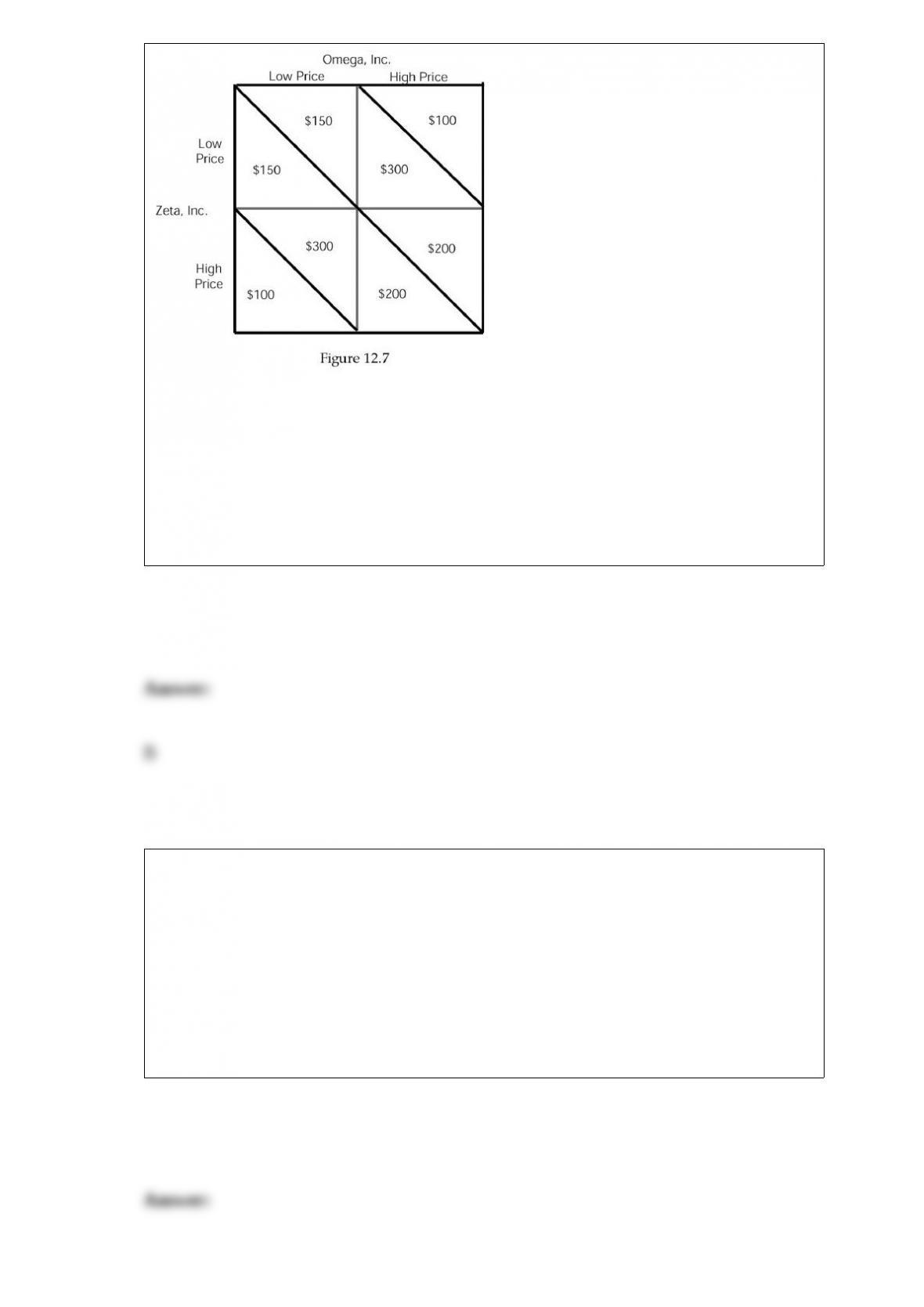
Refer to Figure 12.7. The numerical data show daily profits for each of the two firms
when they choose a specific pricing strategy. If Zeta commits to charging a high price
Omega can earn the largest profit by:
A) also charging a high price.
B) charging a low price.
C) convincing Zeta to charge a low price and then matching it.
D) doing none of the above.
If you watch a pay-per-view movie on a cable TV, the movie is:
A) a private good but nonrival in consumption.
B) a private good and rival in consumption.
C) a public good but nonexcludable.
D) a public good and excludable.

Recall the Application. A recent study concluded that following the merger between
Penzoil and Quaker State, the market share of Penzoil products ________ and the
market share of Quaker State products ________.
A) increased; increased
B) increased; decreased
C) increased; did not change
D) did not change; increased
According to the Application, the opportunity cost of your time should be ________ the
opportunity cost of your invested funds.
A) added to
B) subtracted from
C) multiplied with
D) divided by
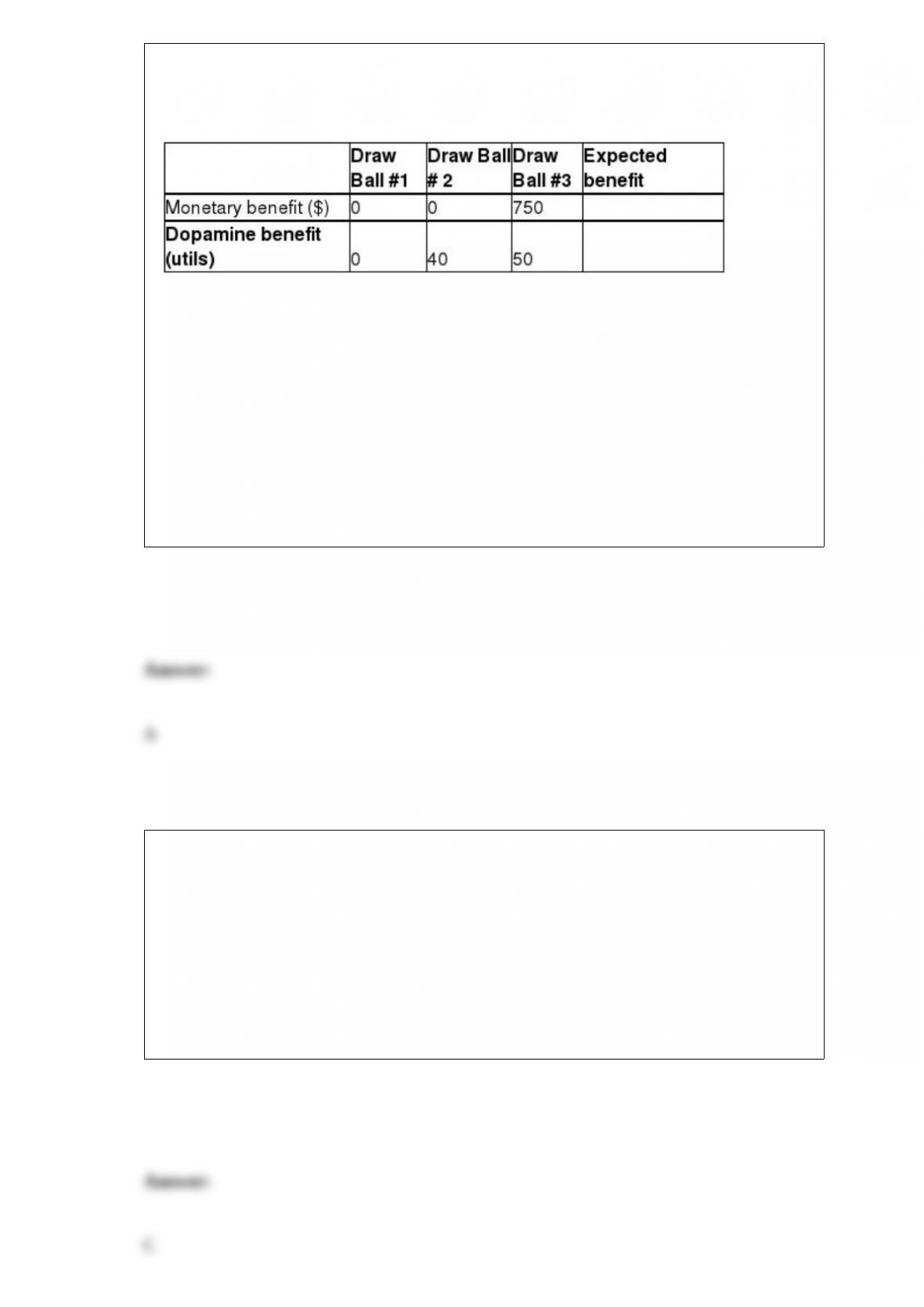
Refer to Table 7.1. For this game, the dopamine benefit will exceed the expected
benefit:
Table 7.1
The Table represents the payoffs for a gambling game. The player blindly draws
one of three balls, marked 1, 2, and 3, from an urn. The cost to play the game is
$375 per draw.
A) if ball number 2 or number 3 are drawn.
B) only if ball number 3 is drawn.
C) if ball number 1 or number 2 are drawn.
D) The actual dopamine benefit will never exceed the expected benefit.
The Law of Supply states that:
A) producers should only produce what they can sell.
B) producers should only sell the items when the price is right.
C) there is a positive relationship between price and quantity supplied, ceteris paribus.
D) producers are legally required to make necessary items available in the marketplace.
The existence of the Federal Deposit Insurance Corporation (FDIC):
A) increases the risk of moral hazard in the savings and loan industry.
B) reduces the risk of moral hazard in the savings and loan industry.
C) increases the risk that customers of savings and loans will engage in moral hazard,
but reduces the risk that the lenders will engage in moral hazard.
D) reduces the risk that customers of savings and loans will engage in moral hazard, but
increases the risk that the lenders will engage in moral hazard.
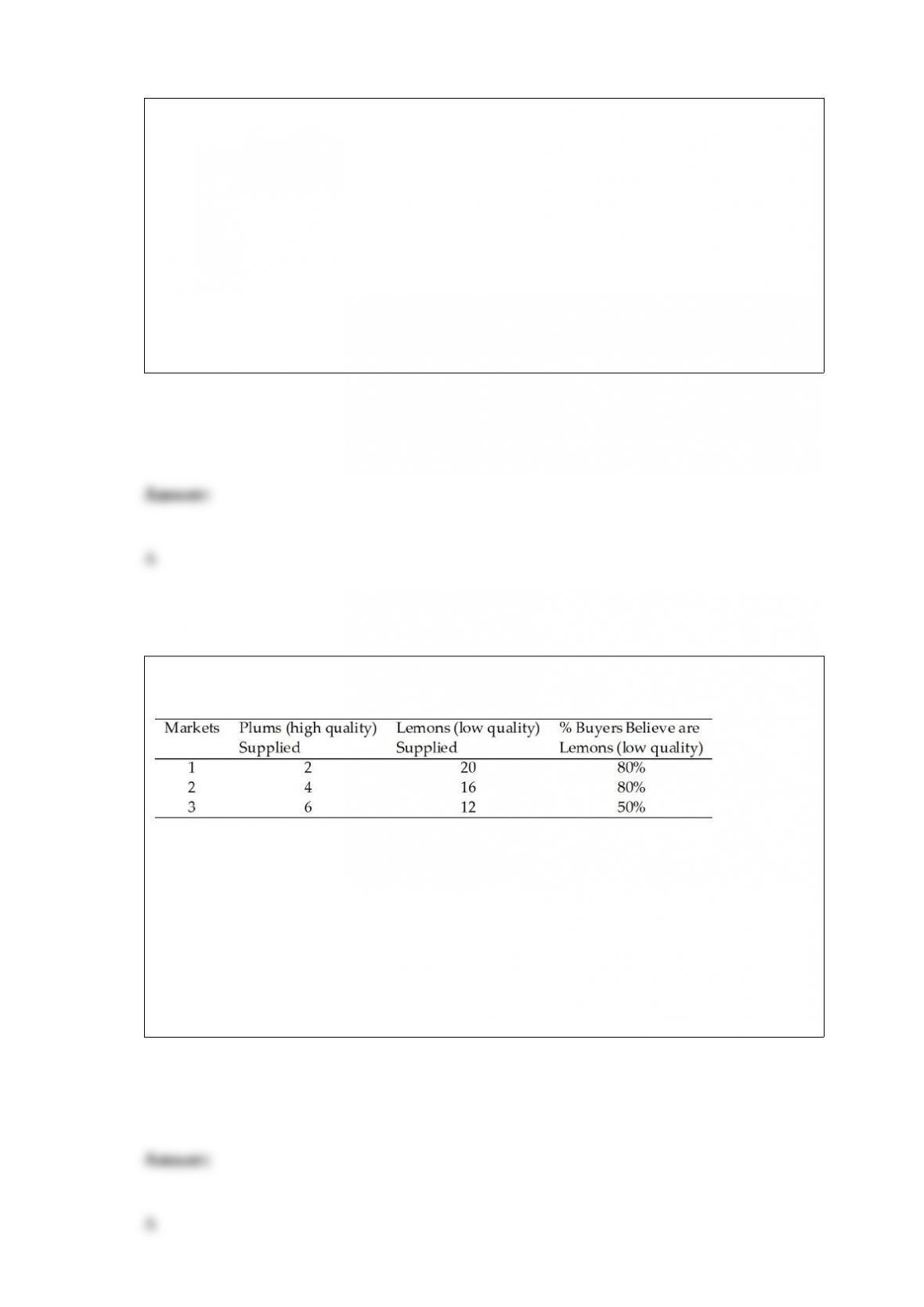
In Table 14.4, Market 1 would be in equilibrium if buyers believed lemons accounted
for:
Table 14.4
A) about 90.91% of the market.
B) about 74.5% of the market.
C) about 63.25% of the market.
D) about 57.65% of the market.

Import bans, import quotas, voluntary export restraints, and tariffs on goods all:
A) increase imports and raise prices for consumers.
B) reduce imports and prices for consumers.
C) reduce imports and raise prices for consumers.
D) increase imports and reduce prices for consumers.
Which of the following could lead to an increase in labor supply?
A) an increase in immigration
B) a decrease in the marginal product of workers
C) an increase in the wage rate
D) none of the above
Jane is a student at a university. She pays $10,000 per year in tuition, $4,000 per year in
living expenses, and $800 per year for books. Were she not in school, she could earn
$20,000 per year working as a bookkeeper and she would not live with her parents.
What is her economic cost of a year in college?
A) $10,000
B) $13,000
C) $30,800
D) $34,800
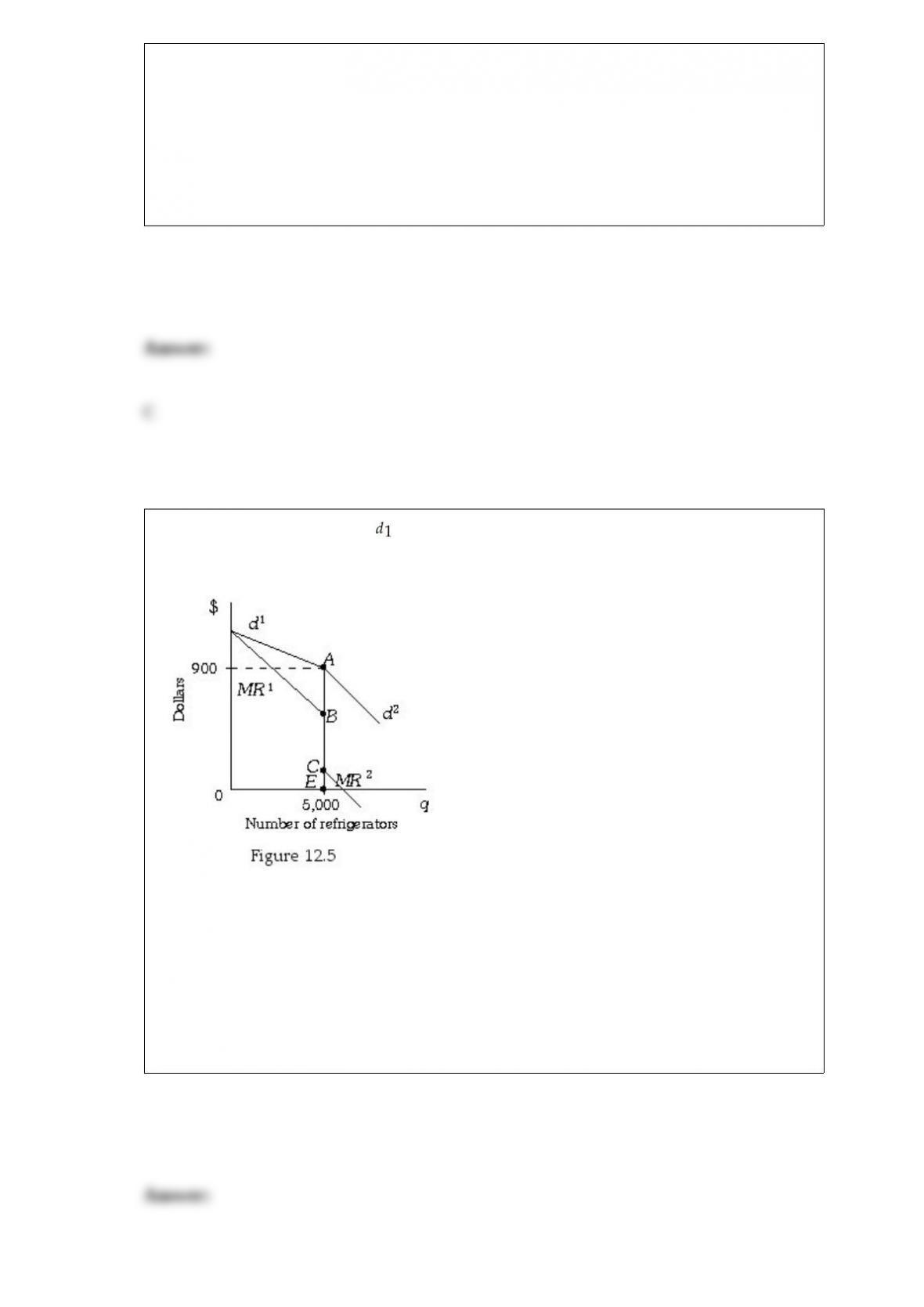
Refer to Figure 12.5. Section of the demand curve assumes that competing firms
will:
A) raise their price in response to this firm’s price increase.
B) decrease their price in response to this firm’s price increase.
C) not change their price in response to this firm’s price increase.
D) raise their price in response to this firm’s price decrease.
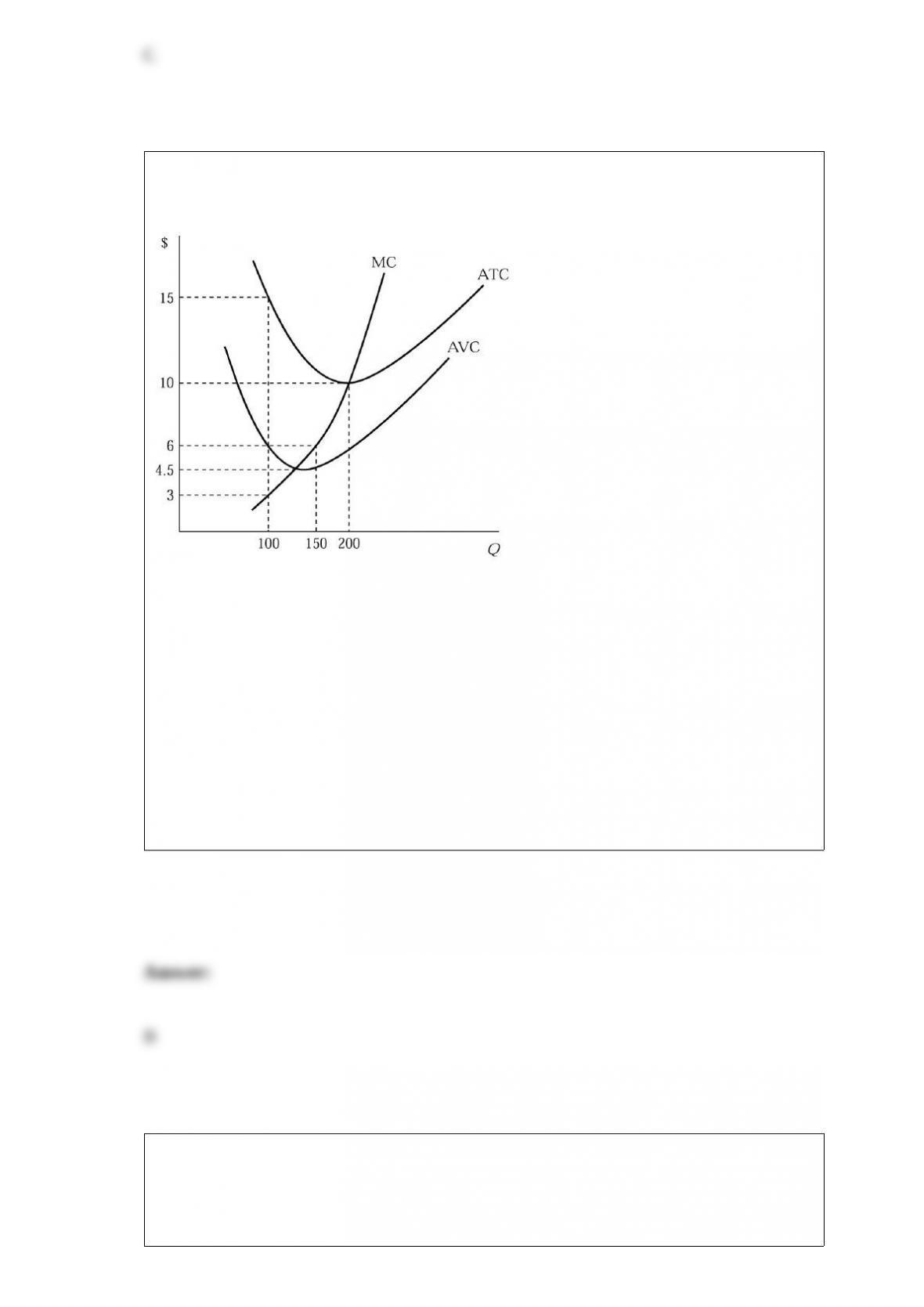
Figure 9.3 shows the cost structure of a firm in a perfectly competitive market. If the
market price is $6, then the firm will:
Figure 9.3
A) be better off producing 150 units than shutting down.
B) be better off exiting the market and using the resources for other production
activities.
C) be better off shutting down in the short run and waiting until the market price rises
above $10.
D) none of the above
In 2002, President Bush imposed a tariff on imported steel. Which of the following
caused President Bush to end the tariff in 2003?
A) the threat of retaliatory policies by European countries
B) the realization that the tariffs hurt the consumers
C) the request of domestic steel producers to end the tariff
D) the emotional and diplomatic appeal by leaders in Europe and Japan
If the demand for a product is perfectly inelastic, then which of the following is most
likely to be true?
A) The product is extremely important, or necessary, to those who buy it.
B) The product has many substitutes.
C) The demand curve for the good is horizontal.
D) The price elasticity of demand for that product is equal to one.
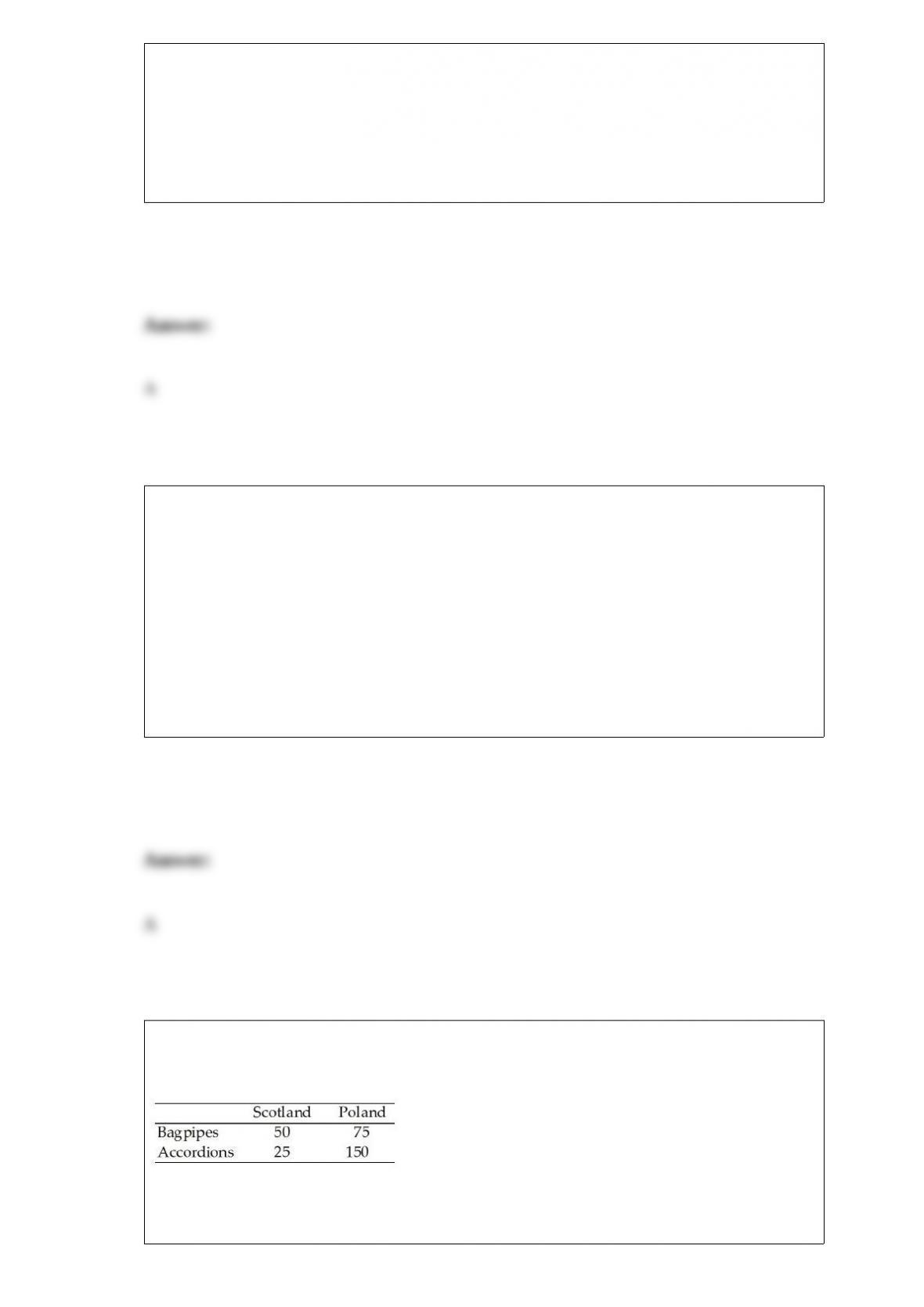
Daily Output of Scotland and Poland
Table 18.1
Refer to Table 18.1. If Poland produces 50 bagpipes, how many accordions can they
produce for the rest of the day?
A) 50
B) 125
C) 25
D) 75
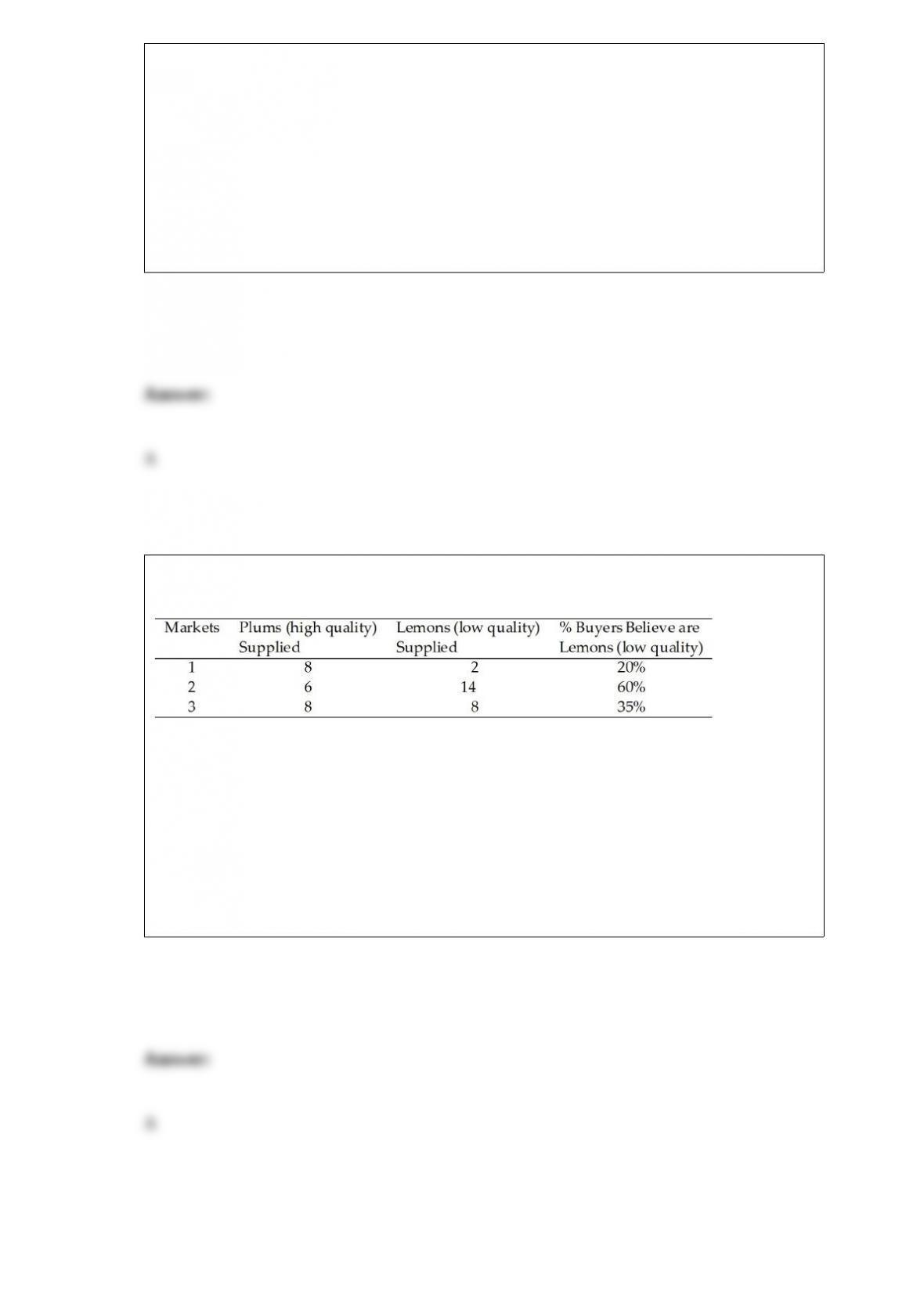
Table 14.2 represents 3 markets for used guitars. Which of the markets in Table 14.2 are
in equilibrium?
Table 14.2
A) 1 only
B) 2 only
C) 3 only
D) 2 and 3

Recall the Application. Which of the following is a reason for the state of Virginia to
increase its revenue while the price for vanity plates increases?
A) The demand for vanity plates in Virginia is inelastic.
B) The demand for vanity plates in Virginia is elastic.
C) The demand for vanity plates in Virginia is equal to 1.
D) There is insufficient information to draw a conclusion.
Jobs lost to outsourcing can be partially offset by jobs gained from:
A) higher production costs.
B) higher opportunity costs.
C) greater trade imbalances.
D) increased output from another industry.
Refer to Figure 9.4. This farmer’s profit-maximizing level of output is ________ units
of output.
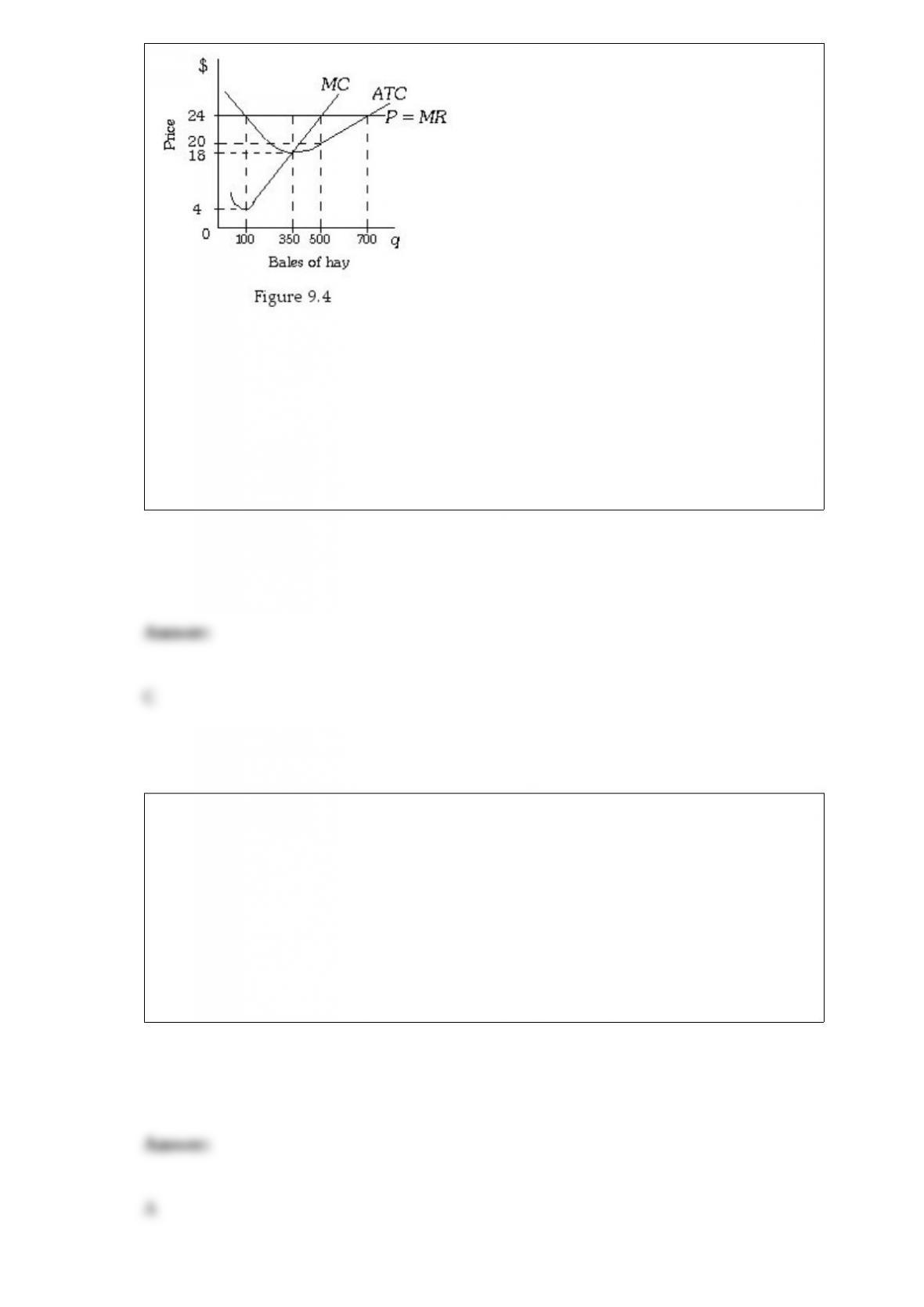
A) 100
B) 350
C) 500
D) 700
Who are the price takers in a perfectly competitive market?
A) both the buyers and the sellers
B) the buyers
C) neither the buyers nor the sellers
D) the sellers

When the government eliminates artificial barriers to entry:
A) firm profits will rise.
B) prices to consumers will likely decrease.
C) competition in the market will decrease.
D) All of the above will occur.
The slope of a straight line:
A) is constant.
B) is negative.
C) is zero.
D) changes along the curve.
Refer to Table 14.1, which shows the market for used motorcycles in a small
Midwestern town. As buyers adjust their expectations of lemons in this market:

Table 14.1
A) the price they will be willing to pay will rise.
B) the quantity of plums supplied will rise.
C) the proportion of lemons in the market will rise.
D) all of the above
If a union is successful in increasing wages, it may find that:
A) demand for workers falls.
B) demand for workers increases.
C) the price of union-made goods falls.
D) the demand for union-made goods rises.
Refer to Table 5.1. A change in the price of hamburgers caused the change in quantity
demanded shown in the table. The price elasticity of demand for hamburgers (calculated
using the initial value formula) is:
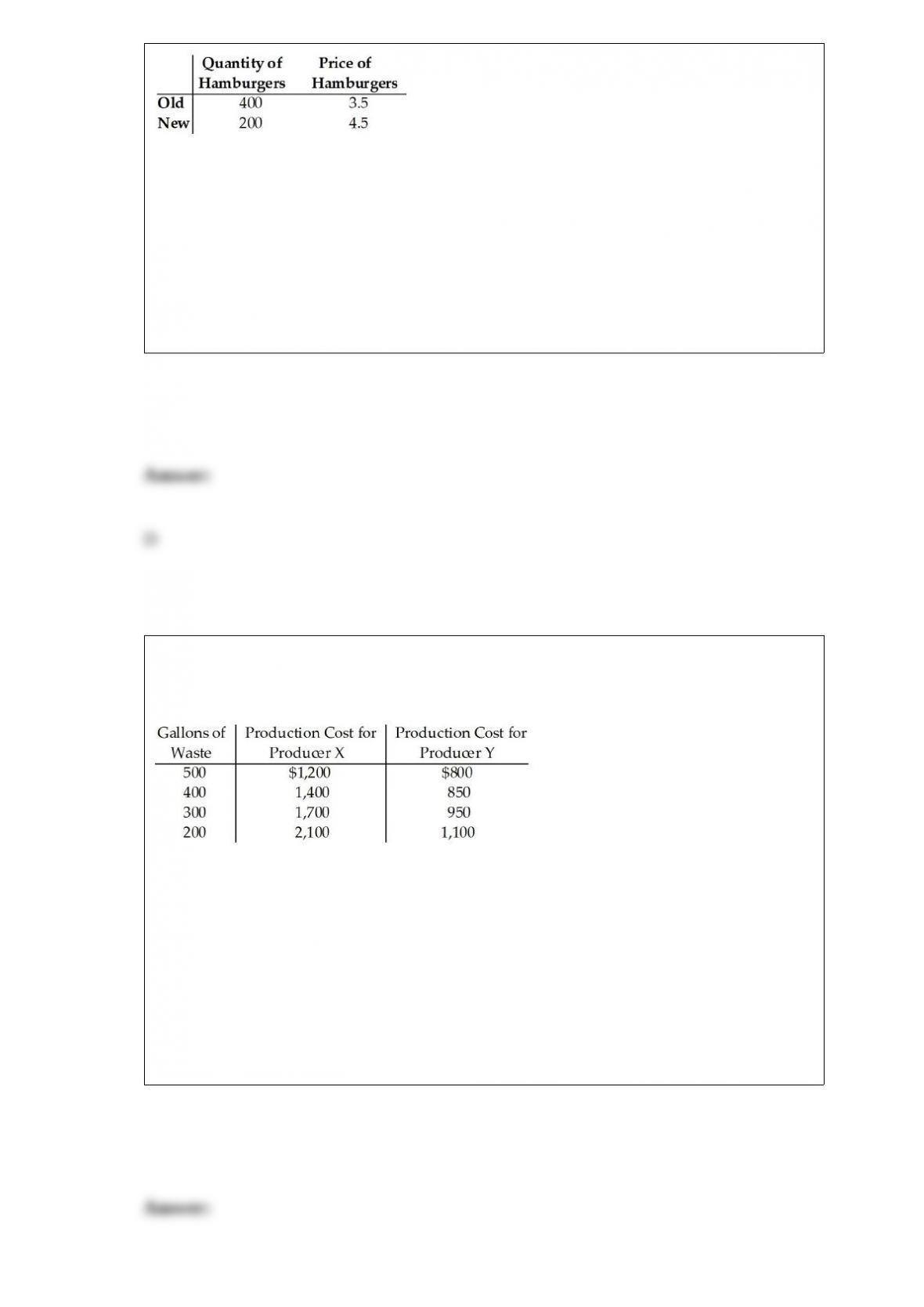
Table 5.1
A) 0.25.
B) 0.50.
C) 1.
D) 1.75.
Producers X and Y dump waste into a local river. Table 16.1 shows the production costs
each firm faces at different levels of waste. For Producer Y, the marginal cost of
reducing waste from 500 gallons to 400 gallons is:
Table 16.1
A) $800.
B) $50.
C) $100.
D) $850.

A price equal to the free market equilibrium price is efficient because the willingness to
pay by someone to consume an additional unit ________ the marginal cost to someone
for producing that unit.
A) exceeds
B) is less than
C) equals
D) None of the above; efficiency is defined in terms of natural resources, not market
equilibrium.
Recall the application about the beauty premium with respect to wages. Which of the
following is a factor in the beauty premium?
A) Some workers and customers like dealing with attractive people.
B) Beautiful people get more opportunities to learn through experience.
C) Attractive people demand higher wages because of their greater potential.
D) A and B are correct.

Suppose there are only 2 nations A and B, and only two goods, x and y. If nation A
produces only x, it can make 16x per day. If nation A produces only y, it can make 4y
per day. If nation B produces only x, it can make 20x per day. If nation B produces only
y, it can make 4y per day. After trade begins, nation ________ will specialize in the
production of x and nation ________ will specialize in the production of y.
A) A; A
B) A; B
C) B; B
D) B; A
In general, the quantity of output in an oligopoly market is:
A) lower than in perfect competition.
B) higher than in perfect competition.
C) the same as in perfect competition.
D) The answer depends on the shape of the average cost curve.
Additional Application

Prior to 2001 Canada annually exported billions of board feet of lumber to the U.S.
tariff-free. The two countries had followed an agreement in which there would be no
restrictions on the lumber from Canadian companies. In March 2001 the agreement
ended and in 2002 the U.S. imposed tariffs and duties on imported Canadian lumber.
What were the effects of these changes and who gained and who lost?
The forestry workers of Canada were hurt. About 15,000 workers lost their jobs in
British Columbia and many Canadian towns suffered from the loss of income from
lumber sales and related industries. Exports to the U.S. fell from 14.7 billion board feet
in 2000 to 20.9 million board feet in 2004. When the lumber prices rose in the U.S., the
costs of production for home building firms increased.
The U.S. government has realized $3.5 billion from the tariffs and that is sitting in the
Treasury awaiting resolution of legal disputes. Lumber companies in the U.S. have seen
their prices rise with less competition.
James Thayer, “Soft Wood, Hard Dispute,” The Weekly Standard, November 18, 2005.
Online
According to this application about the U.S. imposing tariffs on lumber from Canada,
after the tariffs were placed on Canadian lumber imports, we could expect the consumer
surplus in the U.S. to:
A) increase.
B) decrease.
C) remain unaffected.
D) none of these
Refer to Table 7.7. If the price of a soda is $2, the price of a hamburger is $6, and
George has $20 of income, George’s utility maximizing combination of sodas and
hamburgers per day is:
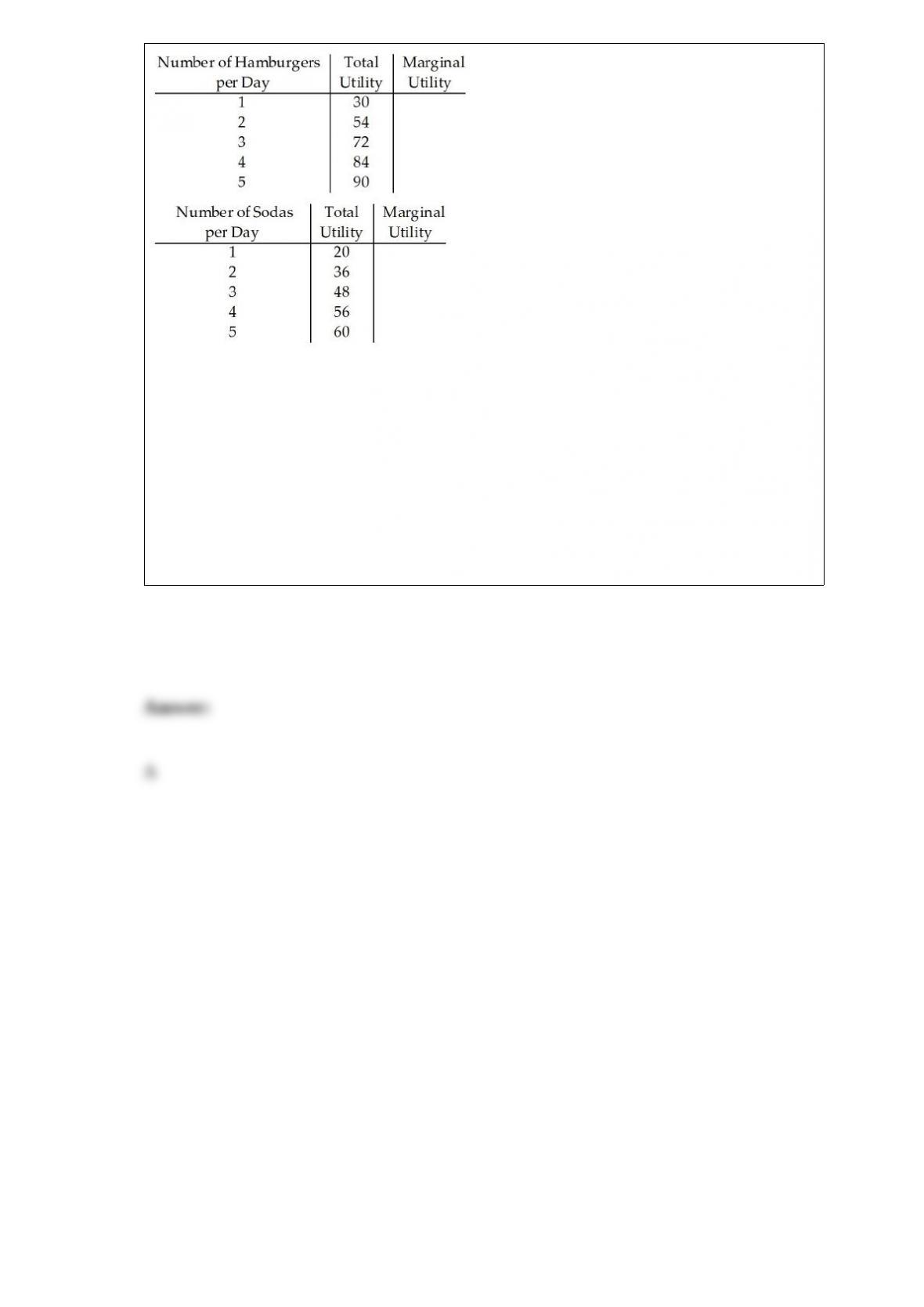
Table 7.7
A) 4 soda and 2 hamburgers.
B) 1 sodas and 3 hamburger.
C) 4 sodas and 1 hamburgers.
D) 3 sodas and 4 hamburgers.